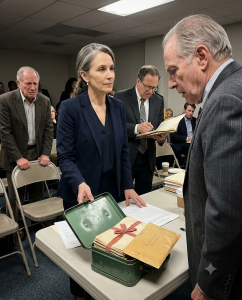
She walked into the auction room carrying a patent leather purse and a small, dented tin lunchbox.
At first, no one looked twice.
Why would they?
The room was full of attorneys, brokers, consultants, and the kind of businessmen who learned early to sort strangers by shoes, watches, and last names. The woman who took the back-row seat in a navy blazer and pearl earrings did not look like a threat. She looked composed, older, unremarkable in the way powerful people often fail to notice until it is too late.
The lunchbox on the chair beside her looked even less important.
Old tin. Dented left corner. Scrape across the lid. Faded handle.
A relic.
A prop.
Certainly not the thing that would split open the last protected secret of the Hargrove family.
Loretta Mae Combs had spent much of her life being underestimated by rooms exactly like this one. She had learned not to interrupt people while they were making that mistake.
Twenty years earlier, she had sat in another room in Pittsburgh filled with Hargrove men. That time, she was thirty-four and newly widowed. Her husband Roy had been buried two days before. She still smelled funeral flowers on her borrowed black dress.
Borrowed, because she had not owned a dress fit for a city funeral. Roy’s people had made sure she felt that from the moment she arrived.
The Hargroves were old steel-and-money Pittsburgh. Not East Coast famous, not newspaper dynasty rich, but prosperous in the way that turns into family mythology. Their hardware business had started with one storefront after the war and grown into a regional chain with warehouses, vendor networks, and the kind of local loyalty people confuse with immortality.
Roy Hargrove had been the son who walked away from all of it.
He met Loretta in West Virginia when he was doing supplier work near Fayette County. She was funny, direct, unimpressed by his last name, and poor enough to know the exact cost of every item in her grocery cart before she reached the register. He loved her before his family knew she existed and married her before they could stop him.
When the marriage didn’t collapse under pressure, they moved farther away.
Roy took a job at Emerald Mine. It paid less than family business management would have, but it was his own. He bought a modest house. He cut his own grass. He carried the same tin lunchbox underground every shift for sixteen years and came home covered in coal dust that Loretta swore she could still smell on his flannel shirts after three washes.
He told her once, while sitting at the kitchen table rubbing his sore hands, that peace was worth more than inheritance.
She believed him.
He died at fifty-six from injuries after a collapse deep in the mine. Not instantly. Long enough for the hospital to call. Long enough for Loretta to hear the words support failure and internal trauma and never hear the rest properly again.
The funeral was held in Pennsylvania because the Hargroves insisted. They paid for the church, the flowers, the polished casket, the luncheon afterward. Anyone watching might have mistaken it for generosity.
Loretta understood later that it was choreography.
They wanted Roy mourned their way, in their town, under their name.
The day after the burial, they asked her to come to a lawyer’s office to review “family matters.”
She went because grief had made everything sound official and because she still had not learned how cruel well-dressed people could be without raising their voices.
The conference room was cold. One long table. Leather chairs. A silver tray with coffee nobody offered her. Gerald Hargrove sat nearest the head. He was the oldest brother, broad-shouldered, pink-faced, and radiating the lazy arrogance of a man who had never once had to ask whether he belonged.
The lawyer cleared his throat and explained there would be no direct inheritance from family holdings. Roy’s ownership interests had long ago been restructured. There were trust complications. Business protections. Preexisting agreements.
Loretta barely understood half the language.
Then Gerald leaned forward and said, loud enough for the whole room to hear, “We’re not leaving anything to the hillbilly he dragged home.”
Three men laughed.
The lawyer looked at the ceiling as if a stain had become fascinating.
Loretta’s ears rang. She rememberd the exact feel of her purse strap cutting into her fingers. She remembered rising without asking permission, walking out of that office, and driving all the way back to West Virginia in a state so silent it felt like suffocation.
She didn’t cry in the city.
She didn’t cry on the highway.
She didn’t cry until she crossed the state line and pulled onto the shoulder where no one could see her.
For a long time, that was the version of the story she carried: Roy died, his family rejected her, and that was the end of it.
It would have stayed that way if not for the lunchbox.
Weeks after the funeral, Loretta finally found the strength to go through Roy’s things properly. She had been moving around them for days, touching his boots, folding shirts, reopening drawers she could not bear to empty. The lunchbox sat on the kitchen windowsill where she had placed it after washing out the thermos.
One evening, just before dark, she picked it up.
It felt heavier than it should have.
Inside was a false bottom.
Roy had fashioned it neatly from thin metal and black tape. Underneath were documents folded in oilcloth to keep out damp: copies of internal inventory logs from Hargrove Hardware, handwritten notes, shipping discrepancies, vendor correspondences, and a sealed envelope addressed to Gerald in Roy’s unmistakable hand.
Loretta sat at the table for three hours reading what she could understand and staring at what she couldn’t.
The pattern emerged slowly.
Roy had discovered something years earlier while helping one of the family locations on a temporary supply issue. Inventory was being rerouted through shell vendors. Tools and materials were billed twice, moved once, and recorded differently across systems. Money had been siphoned out in ways a miner’s widow would not know how to describe but absolutely knew how to recognize as wrong.
More importantly, Roy had tried to confront it.
His notes mentioned Gerald. Terrance. Two outside contractors. Missing audits. Pressure to “let it go.” One line, underlined so hard it nearly tore the page, read: If anything happens to me, this proves I was right.
There was no accusation tying Roy’s death to the discovery. No melodramatic confession. Nothing so neat.
Just enough to prove he had found serious financial wrongdoing inside the family business and enough to explain why the Hargroves had been eager to make her disappear before she learned what Roy left behind.
At first, Loretta did nothing.
She did not have the money to hire investigators. She did not understand the records well enough to go to the police. She was overwhelmed, isolated, and still drowning in bills. Grief made every decision feel impossible.
But something had shifted.
Before, she had been discarded.
Now she knew she had been dismissed.
There was a difference, and it lit a cold, durable fire in her.
The next year, she earned her GED at forty-one. She carried Roy’s lunchbox with her to the testing center and kept it in the car because she could not explain to anyone why she needed it nearby.
Then she enrolled in community college courses at night. Accounting first. Basic business law after that. She sat in classrooms with fluorescent lighting and children barely out of high school, taking notes with an intensity that startled even her.
She worked days. Studied evenings. Came home and read until her eyes crossed.
Some people reinvent themselves through inspiration.
Loretta did it through humiliation with a long memory.
Once she understood numbers, she saw the world differently. Buildings were no longer buildings; they were cash flow, deferred maintenance, tax advantages, leverage, tenant quality, and timing. She bought a neglected duplex with money saved from years of careful living and a small insurance settlement from Roy’s death. She scrubbed the floors herself. Patched walls herself. Learned quickly which contractors lied on instinct and which ones only lied when cornered.
The duplex became two rent checks.
Those rent checks became a down payment.
The down payment became another property, then a laundromat, then a self-storage lot on the edge of town no one thought would amount to much until the nearby highway project expanded traffic.
She kept going.
Loretta discovered that respectable people often sold valuable things cheap when they thought they were unloading problems. She became excellent at spotting the difference between broken and neglected. She trusted ledgers more than charm. She negotiated with the patience of someone who had once sat in a funeral dress while strangers laughed.
By forty-seven, she had signed for her first small commercial building.
By fifty-two, she had a portfolio.
By fifty-eight, she employed an accountant who initially mistook her for someone who had inherited everything. She let him keep thinking that for an entire year before casually mentioning she had started with almost nothing and enjoyed the expression on his face.
All those years, Roy’s lunchbox stayed with her.
Not daily. Not performatively.
But always on the days that mattered.
It sat beside her during closings. In the passenger seat during long drives. In hotel rooms before major negotiations. Once, during a difficult refinancing, she ran her thumb over the dented corner and remembered Roy laughing in their kitchen over a split biscuit and saying, “People with more money than sense always believe paper makes them smarter.”
He had been right more often than he knew.
The final confirmation came on an ordinary Tuesday morning when her accountant visited with quarterly reports. He was a conservative man whose face rarely moved more than necessary. He took off his glasses, glanced down again, and said carefully, “Loretta, your net worth has crossed eight figures.”
She looked at the statement. Looked at him. Then rested her hand on the closed lunchbox beside her chair.
Eight figures.
She thought of the lawyer’s office. Gerald’s voice. The laugh around the table.
She did not celebrate.
She only said, “All right,” and asked about tax positioning for the next year.
Three months later, while drinking coffee in her kitchen, she opened the Pittsburgh Post-Gazette and saw the headline.
Hargrove Hardware files for bankruptcy.
She read every paragraph.
Sixty-one years in business. Eleven stores. Vendor defaults. Debt acceleration. Operational failures. Unwise acquisitions. Leadership concerns. One unnamed family source blamed “rapid deterioration in executive judgment.”
Loretta read it twice, then a third time.
Gerald had inherited the power he once used to humiliate her, and he had wrecked it.
She called her attorney before the coffee went cold.
The process moved quickly once she decided. She already owned commercial real estate in multiple states through holding companies. She had liquidity, financing access, and something no casual bidder would have: a personal understanding of what the Hargrove name was worth in spite of Gerald, and what the physical assets might yield under competent management.
She spent weeks reviewing filings, title records, inventory summaries, staffing reports, and lease structures. She learned which stores still made money, which ones had loyal managers, which ones sat on better land than the market had recognized. She made one private visit to a former Hargrove location under another company’s name and watched the customers. The brand still meant something to people.
That mattered.
The auction was set for a Tuesday.
Loretta chose her clothes with care, though not vanity. The navy blazer fit perfectly. Her mother’s pearl earrings were small but visible. She wanted no costume of revenge, nothing theatrical. Dignity was the point. Calm was the point. To anyone else, she intended to look like exactly what she was: a serious buyer.
Only the lunchbox meant something beyond that room.
When she entered, no one noticed.
A regional chain from Ohio had the loudest representatives. A real estate investment group seemed chiefly interested in break-up value. Two smaller bidders stayed until the early rounds and then disappeared as the price moved beyond opportunistic territory.
Loretta sat in the back and watched.
The room smelled like stale coffee and panic. Lawyers whispered into sleeves. Pens clicked. Spreadsheet pages rustled. Gerald Hargrove sat near the side with Terrance and looked older than any newspaper photo had prepared her for. He was heavier, yes, but shrunken somehow, as if the collapse of the company had taken bone from him.
She felt no pity.
Only curiosity.
Had he ever thought of Roy while the business unraveled? Had he remembered the brother he mocked? Had he remembered the widow he wanted erased? Or had arrogance kept those memories buried until this room, this morning, this woman with a lunchbox in the back row?
Loretta waited through the first rounds. Let the loud bidders test each other. Let desperation reveal itself. She watched who overreached and who lost interest once it became clear the assets would stay assembled.
When the Ohio chain paused, consulting in urgent whispers, she entered.
One number.
Heads turned.
The real estate group countered.
She raised again.
The rhythm changed. The room now had to account for her.
The chain pushed once more, clearly irritated at being forced upward by a bidder they had dismissed. Loretta responded without haste. She never looked triumphant. She looked as though she were ordering exactly what she had come for.
The group folded first.
The chain fought two more rounds and then stopped.
Silence.
The auctioneer repeated the amount.
No one answered.
The gavel struck.
Sold.
All eleven properties. The inventory. Warehouses. Fixtures. The Hargrove name itself.
For a second, no one moved.
Then Loretta stood, picked up her purse and the lunchbox, and walked to the front table.
That was when Gerald looked up properly.
Recognition moved across his face in stages. Confusion. Search. Shock.
He knew her.
Not the older woman in pearls and a tailored blazer. He saw through that to the widow in the borrowed black dress, standing in a lawyer’s office trying not to break apart.
Loretta reached the table and placed Roy’s lunchbox beside the purchase documents.
She did not explain why.
She signed the papers with a steady hand: Loretta Mae Combs-Whitfield. The Whitfield came from a later marriage that had lasted five mostly peaceful years before ending without bitterness. She had kept the legal surname tied to business holdings because changing it back would have complicated contracts. Roy would not have minded. He had never confused loyalty with paperwork.
When she finished, the attorney passed her the copies.
The room had gone silent enough to hear fabric shift.
Terrance gripped the back of a folding chair. Gerald stared at the lunchbox as if memory itself had materialized in tin.
Then he spoke.
“Where did you get the money to—”
He did not finish, perhaps because he heard how the question sounded. Perhaps because he realized he had no right to ask. Or perhaps because the lunchbox latch clicked under Loretta’s thumb and every instinct in him answered before his mind did.
She opened it.
Inside were the folded papers tied with a faded red ribbon, Roy’s old miner ID, his watch chain, and the sealed envelope with Gerald’s name written in Roy’s hand.
Gerald went pale.
Terrance took a half-step forward and stopped.
The attorney, who had spent most of the day cultivating professional invisibility, lifted his eyes and lost it completely.
Loretta did not hand Gerald the envelope. She let him see it.
That was enough.
“Roy kept records,” she said.
Gerald’s lower lip twitched. It was the first vulnerable thing she had ever seen on his face.
“You don’t understand,” he muttered.
Her gaze did not move. “I understand your family was in a mighty hurry to send me away before I learned what he left.”
“It wasn’t like that.”
She almost laughed, not because anything was funny, but because men in trouble always reached first for the comfort of vagueness. It wasn’t like that. Things got complicated. You’ve got the wrong idea. There are details you don’t know.
Loretta had spent two decades learning that details were exactly where people buried the truth.
She untied the ribbon and opened the top page just enough for the attorney to see the letterhead. Internal account reports. Store transfer logs. Roy’s handwriting in the margins. Dates from years before. A pattern impossible to ignore once named.
The attorney straightened.
“What are those?” he asked.
“Copies,” Loretta said.
Gerald shut his eyes briefly, as though pain had become physical.
Terrance spoke next, voice tight. “Loretta, this is not the place.”
She turned toward him. “No. The place was twenty years ago. Before you all laughed.”
No one corrected her.
That told the attorney more than any document could have.
Loretta slid the sealed envelope out and held it over the table. Gerald stared at it with a look so nakedly fearful that even strangers in the room understood they were witnessing something far older than bankruptcy.
“Roy wrote this after he found the discrepancies,” she said. “He addressed it to you.”
Gerald swallowed. “He was angry.”
“Was he wrong?”
Gerald did not answer.
The attorney asked quietly, “Ms. Combs-Whitfield, may I review those materials?”
Loretta considered him. “You may in a moment.”
She looked back at Gerald. For twenty years she had replayed that lawyer’s office, wondering what she should have said. The answer had arrived late, but it arrived whole.
“You asked where I got the money,” she said. “I got it the same place you lost yours. By paying attention.”
Nobody in the room breathed.
Gerald’s shoulders sagged with a defeat so total it seemed to age him another decade. “What do you want?”
It was the wrong question, but at least it was honest.
Loretta glanced at the envelope, then the signed purchase documents, then the men who had once believed she was too small to matter.
Revenge had carried her farther than grief ever could, but standing there she realized revenge was not the whole truth of it. She had not spent twenty years building a life solely to humiliate Gerald Hargrove in public. She had built because building was the opposite of what they did to her. It was proof. It was refusal. It was survival shaped into something undeniable.
What she wanted now was cleaner than vengeance.
“I want the truth recorded correctly,” she said. “I want every false entry traced. I want to know what Roy found, who knew, and whether the pressure put on him after he found it reached farther than these pages show.”
Terrance flinched. Gerald looked away.
That, too, was an answer.
The attorney spoke more firmly. “I think we need a private room.”
“No,” Loretta said. “You can have the papers. The envelope stays with me until I hear something useful.”
Gerald finally met her eyes. “You’d destroy us.”
She held his stare. “You did that yourselves.”
The attorney escorted them to a smaller conference room down the hall. The sale documents went with an assistant. The old records went with the attorney, who handled them now like explosives.
The meeting lasted nearly three hours.
Some of it was legal language. Some of it was silence used as leverage. Some of it was Gerald attempting to recast years of fraud as desperate business maintenance that had spiraled out of control. He admitted enough to protect himself from being caught in a direct lie and withheld enough to remain contemptible.
Roy had discovered inventory diversion through favored vendors. Gerald had known. Terrance had known later. They had all counted on Roy choosing family loyalty over exposure. Instead, Roy documented everything and threatened to go outside the company if corrections were not made.
He had never gotten the chance.
There was no evidence anyone harmed him physically. The mine collapse had been exactly what the official reports said it was: a tragic industrial accident. But after Roy’s death, the Hargroves found traces of what he had copied and panicked. They searched his office at an old storage site. They worried about what he might have taken home. When Loretta arrived for the funeral, poor, grieving, and visibly out of place, Gerald made a decision.
Dismiss her.
Belittle her.
Push her out before she learned enough to become dangerous.
It had worked for twenty years.
Until it didn’t.
By late afternoon, the attorney had enough to recommend immediate preservation orders and outside forensic review. Civil exposure was certain. Criminal exposure was possible. Gerald no longer looked like a man pleading for family discretion. He looked like someone trying to measure how much prison could fit inside the time he had left.
When the meeting ended, Loretta stood, picked up the lunchbox, and tucked the sealed envelope back inside.
Gerald watched the motion as if it were the closing of a vault.
“You never read it?” he asked quietly.
She paused.
“I read the others,” she said. “Not that one.”
“Why?”
“Because Roy wrote it to the man he still hoped would do the right thing.”
Gerald’s face crumpled in a way she had not expected. Not enough to redeem him. Not enough to matter. But enough to remind her that shame often arrives too late to save anything.
She left the building just before dusk with signed acquisition papers in her bag and the lunchbox under her arm.
Outside, the air smelled faintly of rain and city heat. She stood on the sidewalk for a moment, looking at the traffic, feeling not triumph exactly but release.
The days that followed moved fast. The forensic review confirmed the fraud scheme had distorted vendor relationships and internal accounting for years. Some losses tied directly to Gerald’s decisions, some to his concealment of earlier misconduct. Terrance cooperated once it became clear silence would cost him everything. Settlements began. Investigations followed. The Hargrove name, already damaged by bankruptcy, became synonymous with something uglier.
Loretta kept the stores open where she could.
That surprised people most.
They expected liquidation. They expected vengeance in its crudest form.
Instead, she did what Gerald never learned how to do: she separated ego from stewardship.
She visited the locations one by one. Spoke to managers. Asked cashiers what customers complained about. Reworked purchasing. Closed the worst lease. Saved six stores outright and restructured the others. Retained long-time employees where possible. Paid late vendors in order of urgency. Changed signage slowly, respecting what still held public trust while scrubbing the rot from underneath.
Within two years, the company—under a revised name that still nodded to its history—was profitable again.
A reporter once asked Loretta in an interview whether buying Hargrove Hardware had been “the sweetest revenge imaginable.”
She looked at him for a long moment before answering.
“No,” she said. “Sweet would’ve been being treated decently the first time.”
That quote ran everywhere.
The sealed envelope stayed unopened for almost another year. On a Sunday afternoon, sitting at her kitchen table beside the same window where geraniums still bloomed, Loretta finally broke the seal.
Roy’s letter was not dramatic. It was tired. Clear. Loving in the spare way he had always loved.
He told Gerald he knew about the false records and had kept copies. He said he would not help hide theft disguised as management. He said that if the family wanted to save itself, Gerald needed to confess, repair the books, and stop mistaking inheritance for worth. Then, in the last paragraph, he wrote something that made Loretta cover her mouth with her hand and stare out the window until dark.
If you ignore this and something happens before I can make it right, Loretta will know what to do. You always thought she was too little for this world. That was your first mistake.
Loretta folded the letter carefully and put it back in the lunchbox.
She sat there a long time, thinking about Roy underground with his lamp and his lunch and his quiet certainty. Thinking about Gerald in that conference room twenty years ago. Thinking about the auction room and the exact instant power changed hands.
People later said her comeback was legendary. They said she had bought the family empire that rejected her and exposed the men who mocked her. They called it justice, revenge, karma, brilliance.
Maybe it was all of those.
But sitting by the window with dusk settling over the yard, Loretta knew the truest part was simpler.
A man had believed in her before anyone else did.
A family had mistaken grief for weakness.
And the biggest red flag had never been their money, or their arrogance, or even the fraud buried in their books.
It was the moment they looked at a widow in a borrowed black dress and decided she would never become the woman who came back holding the deed to everything they had left.