She bought the whole thing.
Every boat. Every dock. Every rusted cleat and salt-warped piling.
And not one of them knew it was her.
—
Carol Pruett was sixteen years old the first time she walked into a Pamlico Sound Fishermen’s Co-op meeting. Her daddy’s boots on her feet. His logbook under her arm. His seat at that table — his seat, the one with his name practically worn into the wood — was supposed to be hers now that he was gone.
She sat down.
The room went quiet in that particular way rooms go quiet when something is wrong.
The man at the head of the table — big guy, red face, name she will never forget as long as she lives — looked her over like she was a seagull that had wandered indoors.
“Honey,” he said. “Women don’t run boats.”
She was out the door before she cried.
But she was sixteen. And she was Carol Pruett. And she did not stay out.
—
What they didn’t notice, on the way out, was what she was wearing.
Her daddy’s belt buckle.
Brass. Octagonal. A compass rose pressed into the center, the points worn smooth from thirty years of his thumb running over it when he was thinking. He’d gotten it from somebody important — he always said that, somebody important — but he never said who.
Carol had worn it every day since the funeral.
She was wearing it the day they threw her out.
She was wearing it the day she bought her first boat.
She was wearing it this morning, when she stepped off a plane in Manteo, North Carolina, and a man in a rental car took her straight to the marina.
—
The centennial banquet was everything you’d expect.
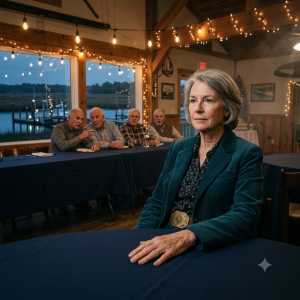
Twinkle lights on the dock. Folding tables with navy tablecloths. Bushels of steamed shrimp and hush puppies that weren’t quite as good as the ones Carol’s mother used to make. A slideshow of black-and-white photographs cycling on a screen near the stage — weathered men in chest waders, proud catches, boats christened with women’s names even though the women themselves weren’t invited in.
Carol sat in the back.
She’d asked them specifically to put her there.
She wore her good blazer — a deep teal that her assistant said made her look “like money,” which Carol had taken as a compliment — and her daddy’s buckle catching the light every time she shifted in her chair.
She watched the old-timers at the head table. Watched a few of them squint at her. Watched one lean over and say something to the man next to him, both of them glancing her way with that particular expression people get when they almost remember something.
One of them was looking at the buckle.
She didn’t look away.
—
The co-op had been dying for a decade. Bad seasons. Worse luck. Three hurricanes in five years and a lease on the processing facility that had gotten too heavy to carry. They’d done what struggling institutions always do — they’d thrown a party. Called it a celebration. Invited a mysterious anonymous donor who had, out of nowhere, written a check that saved every job on that dock.
The donor had one condition.
They’d show up to the banquet.
The rest they’d figure out together.
—
The emcee was a nervous young man in a rented tuxedo who kept clearing his throat. He’d been handed a notecard with the donor’s name on it thirty minutes ago and had been told to keep it close until the big reveal. He’d been told this person was important. He’d been told to make it a moment.
He tapped the microphone twice.
The room settled.
Carol set down her sweet tea.
She put her hand flat on the table, compass rose facing up, and waited.
The emcee squinted at the card. He looked up at the room. He opened his mouth, and he read the name out loud — the full name, the way it appeared on the deed of sale, the name that had been in this co-op’s records once before, on a membership application filed by a sixteen-year-old girl that had never been answered.
The twinkle lights kept blinking.
The slideshow kept cycling.
And every man at the head table went the color of old bait.
—
Nobody moved for a long moment.
Then Carol stood up.
She didn’t rush. She’d waited forty-one years. She could afford to take her time pushing back her chair, smoothing her blazer, picking up the sweet tea just to set it down again like she had all the patience in the world, because she did.
She walked from the back of the room to the front of it the same way she’d walked into every room that had ever tried to keep her out. Head level. Eyes open. Not smiling, not frowning. Just present. Just there.
The slideshow behind the emcee clicked to a new photograph, and she noticed, without breaking stride, that it was her father.
Rudy Pruett, circa 1971. Standing at the bow of his boat, the Miss Lenora, named for Carol’s mother. His left hand on the rail. His right thumb hooked in his belt, right there at the buckle.
She had not planned that. She didn’t think anyone had planned it. It was just the slideshow cycling through, the way things do.
But she felt it like a hand on her shoulder.
She stepped up to the microphone.
—
The emcee handed it to her like he wasn’t entirely sure she was real.
She thanked him by name. She’d done her research.
She looked out at the room. Hundred and some faces. Fishermen and their wives and their kids. Young guys she didn’t recognize at all. Old guys she recognized too well. Somewhere near the middle, a woman about her age who caught her eye and gave her the smallest, most deliberate nod Carol had ever received in her life.
She’d find out later that woman was the daughter of the man who had seconded her ejection from that first meeting. That she’d driven four hours because she’d heard rumors about the donor and had wanted to see for herself. That she’d been waiting a long time for this, too, for reasons of her own.
But that was later.
Right now, Carol had a microphone.
—
“My name,” she said, “is Carol Pruett. My father was Rudyard Pruett. He held a seat on this co-op for twenty-two years and he earned every inch of it. When he died, he left me his boots and his logbook and his buckle and his belief that this place was worth fighting for.”
She paused.
“I have been fighting for it from the outside for a long time.”
Another pause. She looked specifically at the head table. At the red-faced man, old now, much older, but still recognizable, sitting there with his hands wrapped around a glass of sweet tea as if he needed something to hold onto.
“I’m going to fight for it from the inside now,” she said. “That’s not a threat. It’s a correction.”
She reached into the breast pocket of her teal blazer and pulled out a folded piece of paper. She unfolded it and smoothed it on the podium.
“This is a photocopy of a membership application submitted to this co-op on September 9th, 1983. The original is in your files. I had someone check. It was never rejected, technically. It was just never answered.”
She looked up.
“I’m here for my answer.”
—
The room was very still.
Then, from the middle section, one of the young guys — couldn’t have been more than twenty-five, sunburned, with a co-op windbreaker on and the kind of calluses you only get from actual work — started clapping.
He was standing up before most people realized he’d moved.
Then the woman who had driven four hours.
Then a few more.
Then, gradually, imperfectly, the way things spread when they’re real rather than rehearsed, most of the room.
Not all of it.
But most.
—
The red-faced man did not clap.
He sat very still, and Carol looked at him, and he looked at her, and she watched him do the arithmetic. The buckle. The name on the deed. The application in the files. The check that had saved everything. The forty-one years of interest, paid in full.
His mouth opened. Something came out that was not quite words.
Carol leaned slightly into the microphone.
“Don’t,” she said. Not unkindly. Just clearly.
He closed his mouth.
—
After the applause settled and the emcee recovered enough to say something into the microphone that technically counted as wrapping up the moment, people started coming over.
The young guy in the windbreaker first. His name was Danny Styron, third generation, and he told her his grandmother had known her father and had spoken of him well. He had the kind of direct handshake Carol respected, and she told him so.
Then others. A lot of others.
She stood there for nearly an hour and shook hands and accepted introductions and ate three more hush puppies, which were better the second time, and she told that to the woman who had made them, who looked genuinely pleased.
The woman who had driven four hours introduced herself last. Her name was Terri. They talked for a long time, standing just at the edge of the dock, where you could hear the water under the pilings. Terri said she’d heard things over the years. About what had happened at that first meeting. About Carol’s father, and what he would have thought.
“He would have been proud,” Terri said.
“He would have been furious,” Carol said. “But then proud.”
Terri laughed, and it was the realest sound of the whole evening.
—
Around ten o’clock, after most people had gone, Carol walked to the end of the main dock alone.
The sound was black and wide out beyond the marina lights. Somewhere out there, just barely visible, the running lights of a shrimp boat heading in late. She watched it and thought about all the mornings she’d watched running lights with her father, not talking, just watching, two people who understood each other well enough not to need words before sunrise.
She put her thumb on the buckle, right in the center of the compass rose, right where the brass was worn smoothest.
She’d found out about the buckle eventually. Not until she was in her thirties, when her mother, finally ready to tell it, sat her down at the kitchen table and laid it out. The somebody important her daddy had mentioned. An old man who had fished this same sound forty years before him, who had pressed the buckle into Rudy Pruett’s hand at a co-op meeting in 1961 and said: hold onto this. It’ll remind you which way you’re pointed.
That old man’s name had also been on a membership application that was never answered.
Different reason. Different year. Same room.
Carol had thought about that a lot over the years. The line of it. The way exclusion passes itself forward like a bad inheritance, and the way you can choose, if you’re deliberate, to pass something different forward instead.
—
She had one more thing to do before she left the dock.
She went back inside to where the last of the cleanup crew was stacking chairs. She found the emcee still trying to fold a tablecloth into something smaller than it wanted to be. She asked him for a pen, and he handed her one.
She took out the photocopied application. She turned it over to the blank side.
She wrote, in her father’s logbook handwriting, which she had spent years practicing without realizing that’s what she was doing:
Membership approved. September 14th, 2024.
She signed it.
Then she set it on the head table, compass rose buckle holding it flat, and walked back out to her rental car.
—
The buckle she kept.
Some things you don’t put down.