She brought that envelope to Thanksgiving.
She brought it to the Easter potluck at First Methodist. To the county fair in July, tucked under her arm like a library book. To her nephew’s graduation party, where she set it on the folding table right next to the potato salad and never said a single word about it.
For eighteen months, my sister-in-law Carol carried that sealed manila envelope everywhere.
And none of us — not one person at any of those gatherings — ever figured out why.
I should back up.
Carol is the kind of woman people underestimate. Soft voice. Sensible shoes. Has worked the reference desk at the Harlan County Public Library for going on twenty-two years. The kind of woman who remembers every patron’s name and still sends handwritten birthday cards.
She is also the woman whose brother-in-law Gary — charming, backslapping, always-has-a-joke Gary — forged her late mother’s signature on a deed transfer and sold the family farmhouse to a development company before Carol had finished picking out flowers for the funeral.
Eighty-three acres. The porch where their mother shelled butter beans every August. The creek that ran behind the barn. Gone.
Carol found out four months after the burial, when a letter from a land title company arrived addressed to her mother.
She called Gary. He told her she’d misunderstood the situation. He said her mother had always planned to sell. He said Carol was grieving and not thinking clearly.
And then he laughed. Not loud. Just enough.
Carol went quiet after that.
Not sad-quiet. Not defeated-quiet.
Still-quiet. The way water goes still before it goes somewhere fast.
The next time I saw her was Christmas Eve. She walked into Gary’s mother’s house — yes, she still came to family dinners, every single one — and she was carrying that envelope.
Cream-colored. Sealed with the metal clasp pressed flat. Her name was written on the outside in her own careful handwriting.
My aunt asked what it was.
Carol just smiled and set it by the bread basket.
Gary glanced at it. Asked if she needed him to hold onto anything.
“No thank you,” Carol said. “I’ve got it.”
Over the following year, that envelope became the ghost at every gathering. People started whispering about it between themselves — did she ask you? did you ask her? — but no one could get a straight answer from Carol. She just kept bringing it. Setting it down. Letting it sit there while she passed the green beans and asked about your kids and recommended novels she thought you’d like.
Gary stopped making jokes about it somewhere around month six.
By month twelve, he’d stopped looking at it altogether.
Which, if you knew Gary, told you everything.
Now.
The Harlan County Centennial Gala.
One hundred years of the town’s founding. The Elks Lodge decorated with white lights and round tables and those little candles in glass jars. The mayor. The county commissioner. The editor of the Harlan Daily Enterprise. Half the town dressed in their best.
Carol was invited because the library had been asked to display the historical archives.
Gary was there because Gary is always somewhere he can shake hands.
I watched Carol walk in.
She was wearing her navy dress, the one with the white collar. Hair pinned back the way she wears it for church. And under her arm, as it had been for eighteen months through every holiday and potluck and fair and Sunday dinner —
The envelope.
She set it on the display table while she arranged the archive photographs. She spoke to people. She admired someone’s corsage. She ate exactly four bites of the chicken.
And then the program began.
The mayor spoke. The commissioner spoke. There was a slideshow about the town’s founding families.
Then there was an open microphone segment — anyone who wanted to share a memory of Harlan County was welcome to come up.
Carol stood.
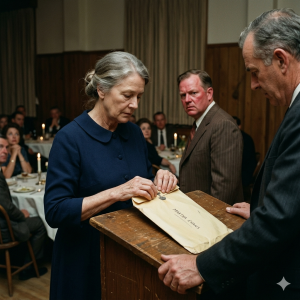
She smoothed her dress. She picked up the envelope.
She walked to the front of the room the way she walks to the reference desk — no hurry, no performance — and she set the envelope flat on the podium in front of her.
I watched Gary across the room. Watched the color change in his face.
The room was quiet in that particular way rooms get quiet when everyone suddenly understands something is happening.
Carol looked out at all of us. Then she looked directly at Gary. Her voice, when she spoke, was the same soft voice she uses to help you find exactly the book you didn’t know you needed.
“I’ve been waiting,” she said, “for the right audience.”
And then the mayor — who had been standing two feet away, who had watched her walk up, who had not stepped back to give her the podium alone —
leaned into the microphone right beside her.
Like he’d been expecting this too.
Carol’s fingers found the clasp on the envelope.
She opened it slowly. The way you open something you have handled so many times you no longer need to look at your own hands.
What she removed was not a document. Not a single sheet of paper.
It was a photograph. Eight by ten, printed on good stock. She held it up so the room could see it, then she laid it flat on the podium and smoothed it once with her palm.
Then she reached in again and removed a stack of papers, maybe an inch thick, held together with a binder clip. She set those down beside the photograph without showing them to anyone.
She looked at Gary one more time. He had gone the color of old putty. His wife, seated next to him, was looking at her own hands.
“My mother,” Carol said, “was born on that farm. She is buried three hundred yards from the back door of the house where she was born. The deed to that property has been in our family since 1941, when my grandfather paid off the last of the note and the bank mailed him the title. My mother kept that title in a cedar box on the second shelf of her bedroom closet her entire life. She showed it to me when I was seven years old and told me what it meant to own something free and clear.”
The room was so quiet I could hear the candles.
“She also kept a second box,” Carol continued. “A shoebox, on the floor of the same closet. Inside that box she kept every birthday card, every Christmas card, every letter anyone in the family had ever sent her. She kept them in the order she received them. She had done this since approximately 1967.”
Carol tapped the stack of papers.
“My mother had a stroke in the spring of the year before she died. After the stroke, her handwriting changed. It became larger. The letters separated from each other. Anyone who visited her in that last year would have noticed this. I noticed it. Her doctors documented it. It is in her medical records.”
She paused. She took a breath that was not a trembling breath. It was a deliberate breath. The breath of a woman who has been waiting eighteen months to take it in exactly this room.
“The signature on the deed transfer that conveyed my mother’s eighty-three acres to Consolidated Land Partners LLC is dated fourteen months before her death. Before the stroke. It is, on its face, in my mother’s pre-stroke handwriting.”
Another pause.
“But in my mother’s shoebox, there is a birthday card she sent to my cousin Renee in that same month. And a letter she wrote to her sister Dot two weeks after the deed was supposedly signed. In both of those, her handwriting had already changed. The stroke had already happened. The large, separated letters are there. Anyone can see it.”
She lifted the photograph and held it toward the room again. From where I sat I could see it was a close-up of two documents side by side. Two samples of handwriting.
“I have spent the better part of eighteen months working with a forensic document examiner out of Lexington. Her report is in this envelope. Her conclusion is that the signature on the deed transfer is not consistent with my mother’s post-stroke handwriting from the same period, and shows multiple characteristics of simulation — meaning someone studied my mother’s earlier handwriting and attempted to reproduce it.”
I heard someone behind me say oh my Lord in a whisper that was not really a whisper.
“I also have the original deed of trust from 1941. I have the complete chain of title. I have my mother’s medical records establishing the timeline of her stroke. I have sworn statements from two of her nurses. And I have a letter, written by my mother herself, roughly six weeks before she died, in her large, separated, post-stroke handwriting, addressed to me, in which she says, and I am quoting directly: Carol I would never sell the farm. You know that. It was always supposed to come to you and I want you to have it.”
Carol set the photograph down.
“I filed a civil suit in Harlan Circuit Court fourteen months ago. I did not tell anyone in this family because I did not want anyone in this family to have the opportunity to make things disappear.”
She looked at Gary. Gary was not looking back.
“The case was settled eleven days ago.”
The whole room seemed to shift.
“I cannot disclose the financial terms. But I can tell you that Consolidated Land Partners LLC has agreed to rescind the deed transfer. The property has been reconveyed. The eighty-three acres, the house, the porch, the creek, my mother’s grave — all of it is back in my name, free and clear, as of eleven days ago.”
She picked up the envelope. She tucked it back under her arm.
“I brought this to Thanksgiving,” she said. “I brought it to Easter and to the county fair and to every dinner I was invited to. Not because I wanted anyone to ask me about it. I brought it because I needed Gary to see it. Because I needed him to spend eighteen months understanding that I knew. That I had always known. And that I was patient enough to wait until I could say it somewhere it would mean something.”
She looked one final time at Gary.
“I thought a hundred-year celebration of this county, in front of the people who love it, felt about right.”
Then she thanked the mayor. She thanked the room. And she walked back to her seat the same way she had walked to the podium — no hurry, no performance — and she sat down, and she set the envelope in her lap, and she folded her hands on top of it.
The applause started somewhere in the back. I don’t know who started it. By the time it reached the front of the room it was every person standing.
Every person except Gary, who was already moving toward the door with his head down. His wife did not follow him immediately. She sat for a moment. Then she reached over, picked up Gary’s untouched dinner roll, wrapped it in a napkin, put it in her purse, and walked out behind him.
I have thought about that dinner roll many times since.
After it was over I went to Carol. I didn’t know what to say, so I just put my hand on her arm.
She patted my hand. She asked if I’d tried the peach cobbler because the woman who made it was a patron of hers and had been bringing peach preserves to the library staff every summer for fifteen years and the cobbler was exceptional.
I got the cobbler. She was right. It was exceptional.
The last thing she said to me that night, while we were putting on our coats by the door, was this:
“My mother worked that land for sixty years. The least I could do was be patient for eighteen months.”
Then she smiled. She picked up her envelope. She walked out into the Harlan County night.
I have heard that Gary is no longer welcome at family gatherings, though I don’t know that anyone had to formally say so. Some things arrange themselves.
I have heard that the farmhouse is being looked after by a local family who is renting it while Carol decides what she wants to do with the land. She has not rushed that decision. She is not a woman who rushes things.
And I have heard that the Harlan Daily Enterprise ran a small item about the gala a few days later. The item mentioned the historical archive display, the slideshow, and the open microphone segment.
It quoted Carol by name. It called her a twenty-two-year veteran of the Harlan County Public Library and a lifelong resident.
It said she had shared a personal memory that the audience found, and this is the paper’s word, memorable.
I thought that was just about right.