Clara Mitchell buried her father under a sky the color of old steel.
The ground in Copper Springs had frozen hard three nights earlier, and every shovelful felt like she was trying to split stone. By the time the coffin was lowered and the preacher muttered his final amen, the skin across Clara’s palms had torn open in two places. Blood mixed with dirt on the shovel handle. Her black mourning dress was streaked with mud to the knees. She looked less like a grieving daughter than a woman dragged through war.
She did not cry.
Not because Samuel Mitchell didn’t deserve tears. He deserved oceans. But her father had spent her whole life teaching her that grief and weakness were not the same thing, and there were men in Copper Springs who fed on weakness the way wolves fed on the slowest calf in winter.
So when Harlem Blackwood’s riders appeared before the dirt had fully settled over the coffin, Clara stood straight and waited.
Jonas Cran led them, sitting his horse with lazy confidence, his gloves clean, his eyes shining with the smug pleasure of a man carrying someone else’s cruelty. Behind him rode two others, both the kind of men who touched their holsters when they smiled.
“Mr. Blackwood sends his condolences,” Jonas said.
The lie was so polished it almost sounded practiced.
Clara’s fingers tightened around the fence rail. “That all?”
Jonas looked toward the grave. “Not quite. He says Samuel Mitchell’s debt still stands. With interest.”
The words were absurd enough to make her blink.
“My father paid that debt two years ago.”
Jonas clicked his tongue. “Paid debts require records.”
“There were records.”
“Then it’s a shame they can’t be found.”
The men behind him grinned.
Clara understood then that this was no misunderstanding. Blackwood was not claiming what he was owed. He was taking what he had failed to steal before Samuel died.
“You tell Blackwood,” she said, her voice low and steady, “that my father’s land does not change hands because he sends jackals to a funeral.”
Jonas leaned forward in the saddle. “You’ve got until tomorrow at sundown. Sign the ranch over peacefully, and maybe Blackwood lets you keep the house. Refuse…” He let the rest hang there between them. “Well. Winter is hard on women alone.”
Clara held his gaze until he was the first one to look away.
When they finally rode off, Esra Pulk emerged from the barn with the limp he’d carried home from the army twenty years earlier. He had worked for Samuel Mitchell since before Clara was born. Some people called him hired help. Samuel had always called him family.
“That one means it,” Esra said.
“I know.”
“He’s cut our north fence twice already. Lost two calves last week.”
Clara stared out at the pasture. Twenty cattle remained. Twenty. The number mocked her. A year ago they had more than fifty. Blackwood’s pressure had not begun with her father’s death. It had been tightening for months—missing supplies, broken fencing, whispers at the bank, delayed feed deliveries, a sudden rise in fees no one else seemed to pay.
Samuel had said only one thing every time she asked whether Blackwood was behind it.
“Men like that don’t come for your land all at once,” he’d said. “They come for your footing first.”
Now he was gone, and the shove had finally come.
The next morning Clara rode into town to beg time from Theodor Harrison, the banker who held the ranch note. Copper Springs looked as if it had folded in on itself overnight. Curtains twitched as she passed. Men outside the feed store lowered their voices. No one wanted to be seen standing too close to Samuel Mitchell’s daughter now that Harlem Blackwood had marked her.
Harrison received her in his office with a face damp from worry and a collar buttoned too tight.
“I can’t extend the note,” he said before she’d fully sat down.
“You haven’t even heard what I came to ask.”
He rubbed both hands down his face. “It wouldn’t matter.”
Clara leaned forward. “My father paid Blackwood. You know he did.”
Harrison flinched. “Please.”
“You know.”
He stood and moved toward the window, keeping his back to her. “I have a wife. I have children.”
Clara rose too, anger flashing hot through her grief. “And my father had a daughter. That didn’t stop any of this.”
The banker’s shoulders shook once, but he did not turn around. Clara understood the message clearly enough. He was afraid, and fear had already bought him.
She left before she said something she could not take back. Her hands were trembling by the time she stepped into Lawson’s general store, but the sight waiting for her burned every other thought away.
Maggie O’Brian was pinned between the counter and Jonas Cran. One of his men had her wrist twisted behind her apron ties while the other blocked the door to the stockroom. Maggie’s eyes were bright with panic. She had buried a husband three winters ago and still kept the café running on grit and cheap coffee. Samuel had eaten there almost every market day. Since his death, Maggie had quietly slipped extra bread into Clara’s sack without charging her.
“Let her go,” Clara said.
The store went still.
Jonas turned with theatrical slowness. “Miss Mitchell. You keep landing in unpleasant scenes.”
Maggie tried to speak. “Clara, don’t—”
Jonas cut in. “Maggie here is behind on rent. Blackwood owns the building. But he’s a generous man. If you sign today, perhaps he forgets what she owes.”
Clara stepped closer. “You want the ranch, come after me. Leave her out of it.”
Jonas smiled. “No. You still don’t understand. This is how men like Blackwood collect. Not from your land first. From your breath. From your sleep. From every person whose name can bend you.”
The bell over the front door exploded into noise as someone shoved inside against the wind.
He was tall, broad-shouldered, carrying cold with him like a second coat. Snow dusted the brim of his hat. A faint scar ran from the corner of his cheek toward his jaw. His eyes swept the room once and settled on Jonas’s hand near Maggie.
“The lady said let her go.”
No one moved.
Jonas’s expression changed first—from amusement to caution. “This doesn’t concern you.”
“It does now.”
“And who are you supposed to be?”
The newcomer removed one glove finger by finger, calm as prayer.
“Sam Hay.”
The name passed through the room like a voltage.
Even Clara had heard it. Everyone had. Sam Hay tracked fugitives for courts, marshals, and private men with enough money to buy skill where law failed. They said he once followed a killer for eleven days through a blizzard. They said he never threatened twice.
Jonas stepped back from Maggie.
“Blackwood won’t forget this,” he said.
Sam’s voice remained flat. “Then tell him to remember where he saw me.”
The men left. Maggie collapsed into tears the moment the door shut. Clara turned to the stranger.
“You just made yourself part of this.”
His gaze held on hers a second too long. “I already was.”
“What does that mean?”
“It means Blackwood will move tonight.”
Clara did not like how certain he sounded. “How would you know?”
But he only said, “Lock your doors.”
He was gone before she could stop him.
Back at the ranch, Esra listened grimly as she told him what happened in town.
“I know that name,” he muttered. “Sam Hay isn’t the sort that wanders into trouble by accident.”
Night dropped early and mean. The temperature fell so fast that even inside the house Clara could hear wood beams complaining in the cold. She cleaned her father’s shotgun at the kitchen table, every scrape of cloth against metal sounding too loud.
She must have drifted for a moment, because the pounding on the front door yanked her upright with the gun already in her hands.
“Who is it?”
“Sam Hay.”
She opened the door a crack. He stood there holding a bundle of oily rags and three burned matches.
“Found these by your barn.”
Clara’s stomach turned.
“They were going to burn us out?”
“They still might.”
As if the words summoned it, orange light flared on the north side of the property.
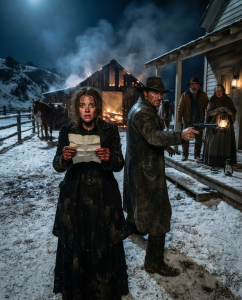
Clara ran before she realized she’d moved. Esra came tearing from the bunkhouse. The small feed shed behind the main barn was already burning, flames racing along the outer wall in bright liquid lines where kerosene had been thrown. The horses thundered and kicked inside the stable, maddened by smoke.
What followed became a blur of heat, mud, shouting, and pain. Sam split a water barrel with an axe and threw soaked blankets. Esra opened the horse stalls and slapped terrified animals into the snow. Clara beat flames with bleeding hands until the skin on her palms tore wider and her sleeves smoked at the cuffs.
At last the fire collapsed inward with a wet hiss.
They had saved the barn. They had saved the horses. But half the feed was gone, and one corner of the shed lay black and splintered under the snow.
Clara stood in the smoke, chest heaving.
“They want me desperate,” she said.
Sam crouched at the edge of the yard, studying hoofprints in the slush. “Three riders.”
Esra limped closer. “Can you tell who?”
“One horse throws more weight on the right rear leg. Another has a broken edge on the left hind shoe. One man drags his left boot.”
Esra swore softly. “Jonas.”
Clara looked at Sam. “You knew.”
He straightened. “I knew Blackwood doesn’t bluff when fear might do what law can’t.”
That answer wasn’t enough. “Why are you here?”
For the first time, something like hesitation moved across his face. He reached inside his coat, then stopped, as if he’d decided the moment wasn’t right.
Before he could speak, hoofbeats tore up the drive.
Maggie O’Brian nearly fell from her horse trying to dismount. Her hair had come loose, her cheeks were white with cold and panic.
“They took Harrison,” she gasped.
“The banker?” Clara said.
Maggie nodded frantically. “Three men. Dragged him out of his own house. My cousin saw it from the alley.”
“Why would Blackwood grab his own banker?” Esra asked.
Maggie swallowed hard. “Because Harrison got drunk tonight. And he talked.”
The yard went silent.
“He said Samuel Mitchell showed him proof before he died,” Maggie whispered. “He said there never was a real debt. He said there were papers Blackwood would kill to get back.”
Clara felt her pulse hammer against her throat.
Samuel had known.
He had known Blackwood would come after the ranch. He had known Harrison was too weak to stand up once the pressure started. And he had hidden something—documents strong enough to destroy Blackwood’s claim and dangerous enough to get a man dragged out of bed in the middle of the night.
Sam finally drew a weathered envelope from inside his coat. “I found this under a loose board in the barn loft.”
Clara took it with shaking fingers.
Samuel Mitchell’s name was on the front. On the back, in the same familiar hand that had once labeled seed sacks and birthday gifts and every tool in the workshop, was her own name.
Inside was a folded note.
Don’t trust the grave marker. Trust—
The gunshot came before she reached the end.
The letter jerked in her hand as the bullet tore through the paper. Sam hit her from the side, knocking her behind the trough as a second shot shattered the porch lantern. Maggie screamed. Esra flattened himself in the mud and reached for the rifle by the steps.
“Riders on the ridge!” he shouted.
Sam fired once. The return shot never came. Instead, Jonas Cran’s voice drifted down from the dark.
“Last chance, Miss Mitchell! Sunrise!”
Then hoofbeats retreated into the trees.
Clara looked at the letter. The bottom edge had been ripped nearly in half by the bullet. Only two final words remained visible under her father’s warning.
…the church.
Sam took the page, read it once, and looked toward town.
“Your father didn’t hide those papers in the graveyard,” he said. “He hid them where Blackwood wouldn’t dare look openly.”
“The old church,” Maggie breathed.
Copper Springs Chapel had been closed since the winter fever five years earlier. People avoided it after dusk out of habit, superstition, or both. Its windows were boarded. Its bell rope had rotted through. Children told stories about hearing coughing from inside when the wind changed.
Clara didn’t care if the dead walked there. If her father had left proof, she was going.
They rode before dawn.
The road into town was slick with old snow, and the church stood on a slight rise beyond the last row of houses, dark and hunched like something waiting. Sam dismounted first and checked the perimeter. Clara followed with the shotgun. Maggie stayed back with the horses while Esra covered the rear entrance.
Inside, the air smelled of dust, wax, and old rot. Moonlight slid through cracks in the boards. The pews sat under sheets of gray frost. The altar cloth had long since been taken, leaving only bare wood and a warped cross on the wall.
“Where would he hide them?” Clara whispered.
Sam’s gaze moved across the room with methodical precision. “A man like your father wouldn’t trust obvious places.”
She walked slowly toward the front, forcing herself to think like Samuel Mitchell. Practical. Quiet. Careful. He never believed in fancy tricks. He believed in places a decent person might overlook but a greedy man never would.
Then she saw it.
Not the altar. Not the pulpit.
The offering box.
Blackwood would search graves, barns, banks, safes. But a thief who mocked decency would never think a man hid truth in a place meant for giving.
Clara lifted the warped lid.
Inside lay a packet wrapped in oilcloth.
Her hands trembled as she opened it. Land receipts. Payment records. Harrison’s sealed acknowledgment of debt satisfaction. And beneath them all, a signed agreement bearing Harlem Blackwood’s own name and Samuel Mitchell’s witness note detailing an illegal scheme to force foreclosures across three ranches using fabricated interest.
Maggie let out a broken laugh behind her. “He’s finished.”
“No,” Sam said sharply.
Too late.
The church doors burst inward.
Jonas Cran entered with two gunmen and Blackwood himself behind them, dressed in a dark coat with silver buttons, looking more like a politician than a cattle baron. That was always the danger with men like him. Their violence came pressed and polished.
“Hand me the packet,” Blackwood said calmly. “And I may let the old man and the café widow walk out.”
Clara stepped in front of the papers. “You sent men to a funeral.”
“I sent men to collect my property.”
“You forged debt. You bribed Harrison. You burned my feed shed.”
Blackwood’s smile was small and bloodless. “In this country, Miss Mitchell, property belongs to whoever can keep it.”
Sam Hay moved slightly to Clara’s left. “Then you should’ve brought better men.”
The shootout, when it came, lasted seconds and felt endless.
Jonas fired first. Sam’s shot dropped him before the second trigger pull. Esra hit one gunman from the rear aisle. Maggie kicked the church door shut on the third man’s retreating leg and Clara drove the butt of the shotgun into his face when he stumbled. Blackwood lunged for the papers instead of a weapon, and that was his mistake. Clara jammed the barrel under his chin hard enough to stop him cold.
For the first time, she saw fear in his eyes.
Not fear of dying. Fear of losing.
Sheriff Nolan arrived only because Sam Hay had sent word the previous night to a deputy in the next county, expecting something dirty before dawn. Two more lawmen came with him. They found Blackwood on his knees in the church aisle, hands bound with his own belt, while Jonas Cran bled across the frosted boards and Clara Mitchell stood over the evidence Blackwood had murdered to bury.
The arrests did not happen cleanly. Men like Blackwood always had friends. But papers spoke louder than favors when enough names were attached, and Samuel Mitchell had been more careful than anyone knew. His notes implicated not just Blackwood, but Harrison, two speculators from Dry Creek, and one county recorder whose signature appeared where it should never have been.
Harrison, brought in alive after a night of terror, broke completely once shown the packet. He confessed to altering records under pressure and admitted Blackwood had threatened his family. The confession did not erase what he had done, but it finished what Samuel’s papers had started.
Within a week, Blackwood’s claim to the ranch was dead.
Within two weeks, warrants spread beyond Copper Springs.
Within a month, people in town who had crossed the street to avoid Clara were suddenly remembering Samuel Mitchell as an honest man and speaking his name with admiration they had been too frightened to show while he lived.
Clara accepted none of it politely.
She buried her father properly in the spring, when the ground softened and wild grass began pushing through the thaw. She replaced the crude winter marker with carved stone. No lie, no forged ledger, no hired threat would ever stand over him again.
Sam Hay stayed longer than anyone expected.
At first it was practical. There were statements to give, fences to mend, horses to calm, and one burned shed to rebuild. Then it became harder to explain. He worked silently beside Esra. He never offered comfort in the soft ways other men did, but he was there each morning before sunrise and each night after dark. Clara learned he had once ridden with Samuel years earlier on a cattle drive through Wyoming. Learned Samuel had trusted him after seeing him refuse payment to hunt a runaway boy whose only crime was stealing food. Learned the letter in the barn loft had been written weeks before Samuel died.
If anything happens to me, Samuel had written, my daughter won’t ask for help. Help her anyway.
When Clara read that part, she folded the letter and sat with it a long time.
She saved the ranch. That was the simple truth. But she had not done it alone, and admitting that felt stranger than winning.
One evening, standing by the repaired fence line, she asked Sam the question that had lived in her since the store.
“Why did my father trust you?”
Sam looked out over the pasture where the surviving cattle moved through evening light. “Because I once had the chance to become a man like Blackwood,” he said. “And chose not to.”
It was the most he ever said about himself.
Sometimes that is enough.
Copper Springs went on, because towns always do. Snow melted. Mud came. Calves were born. Maggie’s café filled up again. Esra grumbled about his shoulder and worked anyway. And Blackwood, stripped of his swagger, learned what it felt like to have his future decided by papers instead of threats.
Still, the story did not settle neatly.
Some people said Harrison deserved mercy because fear made him weak. Others said a weak man with a ledger could destroy lives as thoroughly as any outlaw with a gun. Some said Samuel should have gone to the law sooner. Others knew the law had been eating from Blackwood’s table for years.
Clara never argued about it.
She only knew this: the biggest red flag had not been the threats shouted in public. It had been the quiet moment when good people looked away because they were afraid trouble might notice them too. That was how men like Blackwood built kingdoms. Not just on greed, but on borrowed silence.
And in the end, what ruined him was not force.
It was one dead rancher’s stubborn honesty, one daughter who refused to sign, and a handful of papers no fire could burn before the truth finally reached daylight.