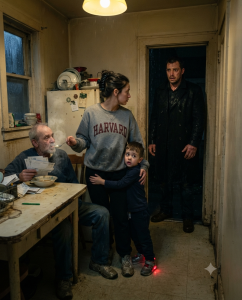
Darío Beltrán felt the blood leave his face when he found a stranger feeding his father in the kitchen of the house he had avoided for eight months.
He stood in the doorway with rainwater still clinging to his coat, one hand near the pistol hidden under the fabric, and watched the young woman lift a spoon to Samuel Beltrán’s mouth as if she belonged there. The kitchen light was weak and yellow. Steam floated from a chipped bowl of vegetable soup. Across the table, his mother was studying unpaid utility bills with the exhausted focus of someone choosing which problem would hurt less if ignored for one more week.
Nothing about the scene made sense.
The old house on the narrow street in Colonia Obrera had always smelled of cumin, dust, and old furniture polish. That night it smelled like garlic, boiled tomatoes, damp walls, and the stubborn effort of someone trying to keep decay from winning. Rain hit the roof and rolled through the gutter with a metallic rattle. Out at the curb, Darío’s driver waited in a black SUV with the engine running.
When Darío stepped on a loose floorboard, the crack startled the room into stillness.
The little boy at the table dropped his green crayon. The woman moved at once, placing herself between the child and Darío in one quick instinctive motion that told him more about her than an hour of introductions could have.
“You’re the son,” she said.
She wasn’t impressed by his coat, his expression, or the danger that usually followed him into rooms. She looked tired, soaked from the weather, and too young to be carrying that level of caution in her eyes. Her black hair was clipped up carelessly. Her gray sweatshirt was worn at the cuffs. Her sneakers were wet. But her voice was steady.
“Put the spoon down,” Darío said.
“He hasn’t finished the vegetables,” she replied.
Before he could answer, his father rasped, “Shut up, Darío. You disappear for eight months, then come back scaring the only person who kept your mother from breaking her hip.”
That was how he met Teresa.
In the next twenty minutes he learned more than he wanted to. The expensive private care company he had been paying each month had stopped sending aides to the neighborhood in September, claiming the route was unsafe. No one had told him. Or rather, someone had kept taking his money and counting on the fact that he would never come often enough to notice. Teresa had entered the house on a rainy day because she smelled gas. Samuel had left a burner on for hours without a flame. Consuelo had been trying to carry toilet paper inside while using a walker. Teresa had stayed because one emergency became another, then another, and eventually leaving began to feel crueler than helping.
When Darío opened the refrigerator and found eggs, milk, broth, spinach, and discount ground beef, he demanded to know who had paid.
“The jar had eleven pesos,” Teresa said. “So I did.”
He tried to hand her more money than she had spent. She refused to take it.
He had seen people lie while crying, smile while betraying him, swear loyalty with murder still warm on their hands. But he had never seen anybody turn down easy money with that kind of plain, irritated honesty.
After she left, Samuel told him the rest. Teresa worked nights at a packaging plant. She cleaned part-time at a public school in the mornings when she could. She had a six-year-old son, Santi, and an ex-husband who drifted in and out of their lives mostly to create new problems. She brought groceries when there was nothing in the house. She made sure Samuel took his medication with food so he wouldn’t vomit. She helped Consuelo up after a fall in the bathroom. She got Samuel to the clinic once when he started coughing blood.
“She never asked for anything,” Consuelo said.
That line followed Darío all the way home.
The next morning he ordered a real nurse to be sent over. By noon the nurse was calling him, offended.
“That young woman was right,” she said stiffly. “Your father gets confused if approached too quickly, and he favors his right side when swallowing. Your mother doesn’t trust anyone with the medication drawer. They barely let me in.”
Darío hung up and went himself the day after.
He found Teresa sitting on the floor wrapping electrical tape around the worn rubber tip of Samuel’s walker. Santi was asleep on the couch with his shoes still on, one arm flung over his schoolbag. Consuelo was shelling peas. The television muttered low in the background.
“I told you I’d send proper care,” Darío said.
Teresa looked up once. “And I told your nurse not to wave perfume over an old man who can’t catch his breath.”
His mother had to hide a smile.
That irritated him. So did the fact that he kept coming back. At first he told himself it was about the fraud. He had already set people on the care company’s owner and the supervisor forging service logs. That part was easy. Men stole. Men lied. Men skimmed from the weak because they assumed no one dangerous was paying attention.
But Teresa complicated things.
He had her checked too. He needed to know whether kindness was genuine or just a slower weapon.
The report came back boring in the most disarming way possible. Twenty-six years old. Separated. One child. Night shift job. Past-due rent twice in six months. No criminal history. No suspicious boyfriend. No hidden family connections. No evidence she was trying to trap anyone.
Just debt, fatigue, and an unusual willingness to spend both money and energy on people who had nothing to offer her in return.
Over the next two weeks Darío kept visiting the house under increasingly weak excuses. He brought fresh groceries once and left them on the counter as if they had appeared there by accident. He paid for a repairman to fix the heater, then claimed the man had owed him a favor. He replaced the loose porch light, though he had no memory of ever doing anything as ordinary as standing on a stool with a screwdriver in his hand while his mother scolded him for wobbling.
Teresa noticed everything and thanked him for almost nothing.
“Your father needs softer fruit,” she said one afternoon, sorting pills into a plastic box.
“You could just say thank you.”
“You could just buy peaches instead of acting offended.”
Another day he found Santi doing homework at the kitchen table while Teresa stitched a tear in one of the boy’s school pants with blue thread because it was all she had. Darío stood in the doorway longer than necessary, watching the concentration on her face, the way she pinched the fabric tight and made ugly but durable stitches.
“You sew?” he asked.
“I repair,” she said. “There’s a difference.”
That night he sat alone in his penthouse apartment and realized he had started to measure wealth differently.
Not by what he could purchase.
By what he couldn’t command.
Then Verónica resurfaced.
His ex-wife had not contacted him directly at first. She reached out through his accountant with polished messages about “unresolved marital interests” and “financial transparency.” Verónica only spoke like that when she wanted to turn greed into something that sounded dignified.
Their marriage had burned out two years earlier in expensive restaurants, calculated silences, and betrayals so elegant they almost looked civilized. She left with jewelry, cash, and a man who owned half a chain of luxury watch stores. Darío hadn’t tried to stop her. Some endings deserved help.
So when she suddenly started asking questions about his parents’ household expenses, it caught his attention.
Toño intercepted the next message before it reached the accountant. That was when the real reason surfaced. Verónica had learned Darío still funded his parents through a web of shell accounts and proxies. She assumed the old house hid either cash, documents, or access codes. Since Darío rarely visited, she believed it would be easy to pressure two frail old people into handing over whatever they knew.
The moment Darío understood that, he felt cold all over.
He drove to Obrera that evening through hard rain and traffic that moved like a wound being stitched badly. He found the kitchen almost peaceful when he arrived. Samuel was sipping tea. Consuelo was teaching Santi how to stack coins into piles of five. Teresa stood at the stove, frowning into a pot.
Then the knocking started.
Three hard blows. Not desperate. Deliberate.
Everyone froze.
Another slam followed, rattling the warped front door in its frame.
Teresa pulled Santi behind her so fast it was almost invisible. Samuel tried to push himself up and nearly tipped his chair. Darío reached under his coat, but Teresa’s eyes cut toward him at once.
“No,” she said quietly. “Not in front of the child.”
Then Verónica’s voice came through the wood.
“Darío. Open up. I only want what’s mine.”
The room seemed to shrink.
Samuel’s breathing turned rough. He looked at the top of the refrigerator, where an old metal cash box sat beside a bag of dry beans. Then he looked at Teresa, not his wife, not his son. Teresa.
“Tell him about the paper,” he whispered. “Before she gets in.”
Darío pulled down a faded blue folder from above the fridge. Inside were clinic receipts, photocopies of IDs, prescriptions, and one folded stamped document. He opened it while the pounding continued.
At first he read with irritation, expecting confusion, maybe some old debt notice his father hadn’t understood. Then his gaze locked on the signatures.
Samuel’s.
A notary’s.
Verónica’s.
And an amount large enough to still him completely.
“What is this?” Darío asked.
Consuelo covered her mouth, her eyes wide with humiliation. Teresa answered.
“It’s the hospital debt she left in your father’s name after the accident.”
Darío looked up sharply. “What accident?”
Teresa blinked. “You don’t know?”
He didn’t. Whatever else he had been paying for, whatever systems and men he controlled, none of it had brought him this truth.
Months earlier, while Darío had been out of the country handling a business problem that ended with two burned trucks and a bribed customs officer, Verónica had crashed a luxury SUV she had been driving after a night of drinking. She escaped with minor injuries. The passenger—a man she was seeing on and off during the final weeks of her marriage—was not so lucky. In the panic that followed, and because she still knew exactly how to exploit the Beltrán family’s weak points, she had brought paperwork to Samuel while claiming she only needed a temporary guarantor to release insurance complications and avoid scandal.
Samuel, already medicated, frightened, and eager to keep Darío from hearing another public disgrace tied to Verónica’s name, signed.
“She promised she’d fix it in a week,” Consuelo whispered. “Then she stopped answering.”
The debt ballooned under penalties and legal fees. Collectors came. Samuel collapsed during one visit. Teresa had been there for one of the later confrontations. She was the one who had read the papers carefully enough to understand what had happened.
Darío lowered the document and looked at his father.
“Why didn’t you tell me?”
Samuel held his gaze. “Because for once I was ashamed of being fooled.”
From outside, Verónica called through the door, sharper now. “I know there’s money in that house.”
That made Samuel laugh, a bitter, failing sound.
“No,” he said. “There was.”
Under pressure from the debt and terrified the collectors would come after Consuelo physically, Samuel had done something he never imagined doing. Years before, Darío had hidden a reserve fund linked to one of his construction fronts using bearer instruments and paper certificates—old-fashioned, untraceable, meant to sit unnoticed until needed. Samuel knew only that a packet in the cash box was valuable and secret. During one collector visit, after Teresa had forced the man off the property by threatening to scream the street awake, Samuel admitted what he had. Teresa helped him locate a lawyer through a clinic volunteer, and they liquidated the instruments quietly to settle the hospital claim before it turned into a criminal fraud case tied to family signatures.
“You sold it?” Darío said, stunned.
Samuel nodded once. “To clean up what she dumped on this family.”
Every criminal instinct in Darío screamed at the loss. The hidden reserve had been meant for emergencies, leverage, escape, maybe war. But as the anger rose, another realization struck harder.
His father had burned through one of Darío’s secret safety nets to pay a debt Verónica had created—and Teresa had helped do it without stealing a cent.
“Why are you here tonight?” Darío said loudly, turning toward the door though Verónica couldn’t see him. “There’s nothing left.”
“Oh, there’s always something left,” she sang back. “Old men hide more than you think.”
Darío moved to open the door, but Teresa stopped him with one hand on his sleeve.
“Not angry,” she said.
“Impossible.”
“Then at least be smart.”
He looked at her, and for a second the whole house narrowed down to that contact: her fingers on his coat, steady despite everything. She trusted him just enough to stop him. That was more than he deserved.
He opened the door.
Verónica stood under a black umbrella held by a man Darío recognized from her new circle—expensive shoes, soft hands, false confidence. Her makeup was intact despite the rain. Her smile was not.
She looked past Darío into the dim hall as if searching for safes in the wallpaper.
“You took your time.”
“You should leave,” Darío said.
“I’m here for documents.”
“There are none.”
She tilted her head. “Don’t insult me. You’ve always parked money where sentiment can protect it.”
Behind him, Teresa had drawn Santi and Consuelo farther back. Samuel sat in his chair, pale but upright, refusing to be hidden.
Verónica saw him and changed tactics instantly, softening her voice. “Samuel, you remember what we discussed. There’s still the matter of—”
“The debt?” Samuel cut in. “The one you left in my name?”
Her expression flickered.
Darío watched that flicker and knew. She had come expecting fear, confusion, and easy manipulation. She had not expected records. She had not expected witnesses. She had not expected the poor woman she would have dismissed at a glance to know every date, every visit, every collector’s threat.
Teresa stepped forward then, not dramatically, just firmly.
“I kept copies,” she said.
Verónica’s eyes narrowed. “Who are you?”
“The reason your lies lasted six months instead of forever.”
The man with the umbrella shifted uneasily.
Darío took the blue folder from the hallway table and held up the stamped document. “Forgery by misrepresentation. Fraudulent transfer of medical liability. Coercive collection attempts on elderly debtors. We can start there.”
Verónica recovered enough to sneer. “Please. You think you can prove coercion?”
Teresa spoke before Darío could. “The clinic volunteer can testify. So can the collector who came back after realizing the debt had been settled and tried to scare them into paying twice. I recorded that visit.”
Now Verónica truly went still.
Darío turned his head slightly toward Teresa. “You recorded it?”
“I record lots of things when strange men yell at old people.”
Something almost like admiration cut through his anger.
Verónica’s companion took one step backward. “You told me this was just family money,” he muttered.
“It is,” she snapped.
“No,” Samuel said from the kitchen. “It was family damage.”
Rain hissed in the silence that followed.
Darío could have ended it his usual way. One call. One car. One disappearance no one would investigate too closely. For several hard heartbeats, the old instinct stood ready, elegant and brutal.
Then he looked back and saw Santi peeking around Teresa’s leg, eyes wide and frightened.
Not in front of the child.
Her earlier words returned like a hand closing over a blade.
Darío lowered the folder.
“You’re leaving,” he said. “And tomorrow my lawyer files everything. If you come near this house again, I won’t need threats. I’ll need dates, signatures, and your own voice from the messages asking my accountant how to pressure my parents.”
Verónica stared at him, perhaps trying to decide whether this was bluff or fury. With Darío, it had often been both.
She looked past him one last time, searching the house for weakness.
Instead she found Teresa standing straight in a faded gray sweatshirt, one hand on Santi’s shoulder, the other resting near the folder copies she had apparently kept for months. She found Consuelo no longer shrinking. She found Samuel looking at her with the exhausted clarity of a man who had finally buried his shame.
And she found no one willing to protect her from the truth.
Her smile vanished first. Then her poise.
“Fine,” she said. “Keep your ruined little house.”
She turned. Her companion followed immediately, eager to escape. The umbrella tilted in the wind as they hurried down the walk.
Darío closed the door and locked it.
No one spoke for several seconds.
Then Consuelo sat down and began to cry the way only relieved people cry—messily, helplessly, with all the strength gone at once. Samuel leaned back and shut his eyes. Santi asked in a tiny voice whether the bad lady was gone. Teresa knelt to answer him before anyone else could.
“Yes,” she said. “She’s gone.”
Later, after tea had been reheated and Santi had fallen asleep on the couch, Darío stood alone in the kitchen with Teresa. The rain had softened outside. The house creaked around them like something old trying to settle after surviving one more storm.
“You should have told me,” he said at last.
She was rinsing cups. “I tried.”
He frowned. “What?”
She turned off the tap and faced him. “I called the numbers in your mother’s phone after the first collector came. No answer. I sent a message once from the clinic desk. No response. After that, I stopped assuming you were the kind of son who showed up.”
He had no defense for that.
He looked at the sink, the cups, the stack of bills, the medicine chart written in Teresa’s neat block letters.
“I thought I was taking care of them,” he said.
“You were sending money,” she replied. “That’s not always the same thing.”
Again, no defense.
He let the silence sit where pride usually lived.
Finally he said, “How much do you owe in rent?”
She blinked, annoyed on reflex. “Don’t.”
“I’m not buying silence.”
“No. You’re trying to pay down guilt.”
He almost smiled despite himself. “Maybe.”
Teresa studied him for a long moment, then leaned back against the counter. “Santi and I are fine.”
“That wasn’t my question.”
She hesitated. “Two months.”
Darío nodded once. “Tomorrow it’s covered.”
Her jaw tightened. “As a loan.”
“As a debt I owe.”
That seemed to strike her harder than money would have.
Over the next months, things changed in ways that would have sounded impossible before that rainy night. Darío dismantled the fraudulent care company with paperwork and pressure instead of guns. He put certified in-home support in place but kept Teresa at the center because Samuel trusted her and Consuelo loved her like a daughter long before anyone said it aloud. He enrolled Santi in a better school nearby and paid the fees through a trust Teresa could monitor herself. He never handed her cash in thick envelopes again. He learned.
Slowly, Teresa learned something too: that Darío’s danger was real, but so was his effort. He began arriving unarmed when he could. He fixed things around the house badly and accepted correction. He took Samuel to appointments himself. He listened when Consuelo repeated stories he had ignored for years. He sat at the kitchen table and ate whatever Teresa made, even when she mocked his expensive shoes for slipping on wet tile.
One evening, months later, Samuel watched the four of them from his armchair—Consuelo knitting, Santi building a cardboard fortress, Teresa laughing for once without restraint, and Darío kneeling on the floor trying to attach a crooked paper flag to the fortress roof—and said, “Funny. I thought debt ruined this family.”
Darío looked up. “It almost did.”
Samuel smiled faintly. “Turns out it just showed us who was still willing to pay.”
After Samuel died the following spring, peacefully, with Consuelo on one side and Teresa on the other, Darío found the blue folder again. He kept it, not as evidence anymore, but as a reminder. Some debts were written by greed, signed in fear, and collected in pain. Others were older and more humiliating. The debt of absence. The debt of believing money could stand in for love. The debt owed to the person who stepped in when family failed.
He paid the legal ones with lawyers.
He spent the rest of his life trying to pay the other kind with presence.
People on the block still talked for months about the night the elegant ex-wife came back hunting for money and walked away empty-handed. But the story that lasted longer was quieter. It was about the single mother in the faded sweatshirt who smelled gas, opened a stranger’s door, and refused to let two forgotten old people disappear. It was about the hardened son who arrived too late and discovered that the poorest person in the room had done the richest thing.
And depending on who told it, the real question at the end was never whether Verónica deserved forgiveness.
It was whether Darío did.