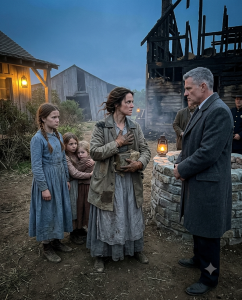
The same day Marin Holloway arrived in Blackstone Ridge to marry a dead man, the town council tried to divide three orphaned sisters as neatly as unpaid debts.
She had traveled for days with a dented trunk, forty-three cents sewn into the hem of her skirt, and the last of Marcus Deal’s letters folded in her reticule until the edges had gone soft. Marcus had been kind on paper. Careful. Never extravagant, never foolish. He had written of a small house, honest work, and a town rough around the edges but manageable if a person kept to themselves. He had never promised romance in the grand sense. That was not what Marin needed. After Cincinnati, after the fever, after the tiny grave with Thomas’s name on it, she no longer believed in grand things.
What Marcus offered instead was steadiness.
Then, three days before she arrived, he died of pneumonia.
The letter informing her had been brief, unsigned, and practical in the way bad news often was. A decent woman, it implied, would simply not come.
But Marin had already sold what little she owned to buy the train ticket west. She had nowhere to return to, and no one waiting if she did. So she stepped off the train into Blackstone Ridge with her chin up and grief sealed tight behind her ribs.
Alderman Puit met her at the station. His sympathy felt sanded down by inconvenience.
“Miss Holloway,” he said, touching the brim of his hat, “I’m sorry about Marcus Deal.”
“So am I,” Marin replied.
He looked at her trunk, her worn gloves, her patched travel dress, and his mouth thinned. “The council will need to determine your situation.”
“Then I’ll be there when they do.”
That was how she found herself seated at the back of the council hall while a roomful of men decided which hardships mattered and which could be sorted into piles.
The town hall smelled of damp timber and old paper. Men spoke quietly around Magistrate Corwin Hail, a silver-haired figure at the center of the front table whose calm manner only made his power more obvious. He did not raise his voice. He did not need to. The room had long since trained itself to lean toward his will.
Marin stayed still and listened.
Bridge repairs. Fence disputes. Delinquent taxes. Then Alderman Puit cleared his throat and announced, “The matter of the Mercer girls.”
The three sisters sat on a side bench as if already removed from their own lives.
Evelyn Mercer, twelve, stared straight ahead with the rigid expression of someone who had run out of childhood faster than anyone noticed. Clara, nine, looked sharper, watchful, like a child who had learned to hear insult before it was spoken. The youngest, Josephine, had curls gone wild from neglect and soot-stained shoes too big for her feet.
Puit began reading the arrangements.
Their parents, Jacob and Helen Mercer, dead in a house fire. Temporary care by the Abernathys no longer sustainable. Evelyn to Henry Cotter, where she would be “useful.” Clara to the Haskells. Josephine to be placed elsewhere pending availability.
“My name is Josie,” the child said.
No one acknowledged her.
That was when something inside Marin snapped awake.
She saw Thomas in fever again. His small hand clutching at her sleeve. The desperate instinct of the powerless to reach for what love remained. She looked at the girls and saw what the room chose not to see: their parents were gone, their home was ash, and now the town meant to take the last thing they had left.
She stood. “I’ll take them.”
The silence hit so fast it seemed to strike the walls.
Hail turned toward her. “You arrived today.”
“Yes.”
“You have no house, no employment, and no established means of support.”
“I’m aware.”
Whitmore snorted. “This is absurd.”
Marin faced the front table. “Separating sisters the week they bury their parents seems more absurd to me.”
No one rushed to agree.
Hail folded his hands. “The Mercer land is ruined. The home burned. The barn is collapsing. There is debt against the property, an unfinished well, and no practical value in the claim.”
“No practical value,” Reed repeated, not quite meeting Hail’s eyes.
Marin glanced at the girls. Evelyn looked as though hope itself would be a dangerous mistake.
“Then give me the burden,” Marin said. “I’ve carried worse.”
It took nearly an hour of legal muttering and open disapproval, but in the end Reed pushed the matter through. Perhaps conscience finally found him. Perhaps he simply disliked Hail enough to do one thing against him. Whatever the reason, the papers were signed before anyone could think better of it.
Marin walked out with guardianship of Evelyn, Clara, and Josie Mercer.
Outside the hall, Evelyn caught her.
“You don’t know what you just did.”
“Probably not.”
“We’ve got nothing,” Evelyn said flatly. “House burned. Barn half gone. People won’t help us. And everybody blames us because of Hail.”
That made Marin turn. Across the street, Corwin Hail stood beside Puit, speaking softly as if all the world’s outcomes belonged to him.
“Why Hail?” Marin asked.
Evelyn’s jaw worked before the words came. “Because Pa found something on our land. And after that, everything started burning.”
The Mercer place lay at the edge of town where the road thinned into scrub and stone. The house was a black skeleton, its chimney still standing over a foundation laced with ash. The barn leaned hard to one side. The well was a ring of rough stone behind the ruins, abandoned before it was finished.
That first night they slept in the barn under a canvas sheet full of holes. Marin heated beans salvaged from the root cellar while the girls ate in silence. Josie fell asleep against Clara before the cup was empty. Evelyn sat near the lantern with her back to the wall, every line of her body saying she intended to stay awake until daylight if that was what safety required.
Marin watched her and felt a sorrow so old she barely recognized it anymore.
The next morning she went into town for flour and coffee and was refused credit at every stop. Garrett Sloan looked past her as if she were already one more ruined thing on Mercer land. A man outside the feed store muttered that she ought to leave before “the curse” settled on her too.
Only Mrs. Daw, who ran the boarding kitchen, offered anything at all. She hired Marin for an afternoon of splitting wood behind the cookhouse and slipped her stale bread and dripping in a cloth at the end.
“Hail doesn’t want that place for the ashes,” Mrs. Daw said while no one else was near enough to hear. “He wants what’s under it.”
“What is under it?”
“If I knew that, I’d be gone before sunset.”
On the sixth day, while clearing debris near the unfinished well, Evelyn noticed a narrow ledge hidden behind loose stones. Marin tied a rope around her waist and lowered herself carefully into the shaft. It was cooler below, the air close and damp. Halfway down, tucked inside a recess where a casual glance would miss it, sat a tin box wrapped in waxed cloth.
She brought it up with hands that trembled harder the moment she opened it.
Inside were survey maps, deed copies, tax records, letters, and a notebook with Jacob Mercer’s cramped writing. On the first page he had scrawled a single line:
If anything happens to me, it was not an accident.
There were notes about a boundary survey redone without witnesses. Tax demands issued on parcels that had already been paid. Families leaning on land one season and gone from it the next. Again and again one name sat in the margins like a stain.
Hail.
Then Clara, who had been sorting the letters by date, stopped breathing for a second and held one up.
“It’s addressed to Marcus Deal.”
Marin took it so fast she nearly tore the seal.
Jacob’s letter to Marcus was written a month before the fire.
Marcus, you were right to warn me about Hail. I dug where the old survey marked stone and found the seam below the ridge. More than silver, there is water under pressure enough to feed half this town. Hail has been buying land cheap on false liens and burned titles because once the rail company confirms the spring and ore, these claims will be worth fortunes. I copied the true records. If anything happens, don’t trust the council. Find someone from outside. Someone Hail does not own.
Marin stared at the page until the lantern flame blurred.
Marcus had known.
Perhaps that was why he had written to her so steadily, so urgently, urging her to come as soon as she could. Perhaps he had intended to marry her, yes, but also to place the truth in the hands of someone beyond Hail’s reach. Instead he died before she arrived.
For the first time since stepping off the train, Marin felt something larger than grief take shape inside her. Not hope exactly. Something harder.
Purpose.
The next morning Corwin Hail came to the Mercer property himself.
He stood near the well in a fine dark coat too clean for the place, boots missing the mud by some private arrangement with the world. His gaze passed from the girls to Marin and then to the shovel leaning against the stones.
“Mrs. Holloway,” he said pleasantly, though she was no man’s widow. “You continue making unusual choices.”
“I’ve noticed men here dislike that.”
His mouth curved, not quite to a smile. “I hear you found papers. It would be sensible to bring them to the council and let proper authorities determine whether they amount to anything.”
Evelyn, standing stiff beside Clara, spoke before Marin could stop her. “You came the night our house burned.”
Hail looked at her with almost paternal patience. “Grief makes children imagine all sorts of things.”
Marin stepped between them. “And power makes men careless.”
For the first time, his eyes sharpened. He dipped his head and left without another word.
That evening Reed arrived in secret.
He looked worse up close than he had in the council chamber—yellowed around the eyes, hands restless, a man carrying shame like a hidden fever. He asked to see the papers. Marin refused until he said, very quietly, “Marcus showed me copies before he died.”
That bought him five minutes.
By lantern light he confessed the part he had played. Hail had ruled Blackstone Ridge for years by controlling deeds, taxes, and fear. Properties fell behind on suspicious debts; titles vanished; fires erased records. Reed had signed documents he knew were wrong because opposing Hail meant ruin. Marcus, a clerk in the magistrate’s office, had begun copying records after discovering survey numbers altered to hide the Mercer claim. Jacob Mercer found the ore seam and pressurized spring beneath his land, realized why neighboring farms were being pushed out, and threatened to go to the state land office.
A week later, his house burned.
“You think Hail set it?” Marin asked.
“I think Hail never dirties his own hands,” Reed said. “But things happen for him.”
“Why come now?”
Reed looked at Evelyn, Clara, and Josie huddled together on the blanket. “Because he intends to take the papers and put the blame for everything on Jacob’s debts and your hysteria. And because Marcus asked me, if anything happened to him, to help the woman who came on the train.”
Marin’s throat closed for a second.
“Marcus knew I was coming?”
“He was counting on it.”
Together they formed the only plan available: they would not hand anything to the town council in private. Reed would request an open hearing after Sunday service when most of Blackstone Ridge was already gathered. Mrs. Daw would spread word quietly that testimony concerning the Mercer fire and the land claims would be heard. Reed would also send a rider at dawn to the county recorder with copies of the documents, so that even if Hail seized the originals the evidence would no longer live in one place.
It was a thin plan. The sort desperate people make because there are no thicker ones.
Sunday came hard and bright.
The church hall overflowed. Miners, wives, shopkeepers, farmers from the ridge road, even Garrett Sloan at the back pretending not to care. Hail sat near the front with the composure of a man expecting a nuisance, not a threat.
Reed opened the hearing with a voice that shook only once. Then Marin stood and laid the Mercer box on the table.
At first the room resisted her. Outsider. Widow-that-wasn’t. Mail-order bride with no husband. But she had learned something in grief: people ignore you until you stop speaking the language they expect. So she did not plead. She read.
Jacob’s warning.
The altered tax dates.
The duplicate surveys.
Marcus’s memorandum comparing original deed books to Hail’s revised copies.
Then the letter Jacob had written Marcus naming the silver seam and the underground spring beneath Mercer land.
The room stirred like something waking.
Hail rose at last. “These are scraps and accusations from dead men. Mrs. Holloway is a stranger repeating rumors she does not understand.”
Marin looked straight at him. “Then perhaps the living should speak.”
She nodded to the side door.
Mrs. Daw came first and testified that she had seen Hail’s hired man, Benton Crowe, riding toward the Mercer place the night of the fire carrying kerosene cans from the livery. Garrett Sloan followed, pale and sweating, and admitted Hail had ordered merchants not to extend credit to the girls after Jacob accused him publicly. Then, to nearly everyone’s shock, Benton Crowe himself was dragged in drunk by two miners who had found him trying to leave town at dawn.
Crowe denied everything until Reed placed before him the payment ledger Marcus had copied from Hail’s office. A line marked “special labor” appeared two days before the fire beside Crowe’s name and an amount far beyond his wages.
Crowe broke in the ugliest possible way: half-angry, half-afraid.
“I was only meant to scare him,” he shouted. “Hail said the fool kept records hidden and wouldn’t sell. He said smoke would drive them out. I didn’t know the wife was still inside—”
The room exploded.
Hail tried to leave. Two miners blocked the door.
For the first time since Marin had seen him, the magistrate lost command of his face. Not much. Just enough. A tightening around the mouth. A flash of pure contempt when he realized fear had moved off the townspeople and onto him.
The county sheriff, who had arrived midway through the hearing after Reed’s messenger reached him faster than anyone expected, stepped forward and asked for the box.
Hail refused to surrender authority. The sheriff informed him, in a tone colder than law and almost as final, that he had no authority left.
By evening, Corwin Hail was in a cell at the county seat awaiting charges for fraud, conspiracy, arson leading to death, extortion, and falsifying land records. Benton Crowe went with him. Puit resigned before anyone asked. Whitmore swore he had known nothing, and no one cared enough to answer him.
The harder part came after.
Truth did not rebuild a house. It did not put parents back into beds or remove fear from children’s bones. But it did alter the shape of the future.
The state confirmed the Mercer claim. The land truly sat over a valuable silver seam and, even more important in a thirsty country, a pressurized spring large enough to supply Blackstone Ridge for generations. The council could not simply take it now. Reed, chastened and sober in a way that looked painful, helped arrange a trust in the names of Evelyn, Clara, and Josephine Mercer until Evelyn came of age. A modest lease to a mining company brought income. The spring rights brought more. For the first time since the fire, the girls’ future belonged to them.
Mrs. Daw organized women from town to help raise a new house. Some came from guilt. Some from anger at how long they had bent to Hail. Some because once the truth was spoken aloud, they could not bear to keep pretending they had heard nothing before. Marin accepted their help without excusing their silence.
It took all summer to make the place livable.
Evelyn stopped sleeping in her boots.
Clara began asking questions instead of hiding them.
Josie laughed with her whole body once the nights no longer smelled like smoke.
As for Marin, she stayed.
There was no dramatic decision, no speech to mark the moment. One evening she stood on the new porch with a cup of coffee in her hand and watched the girls argue over where to plant beans the next spring. The light was falling red over the ridge. The barn had been righted. The well had a proper cover now. The sound of water from the spring carried faintly across the yard.
Evelyn came to stand beside her. At thirteen now, she still held herself too straight, but some of the old bracing had left her face.
“You could leave,” she said.
Marin looked at her. “Is that what you want?”
Evelyn’s eyes filled before she could stop them. “No.”
“Then I suppose I live here.”
The girl nodded once, sharply, as if any bigger movement might break something loose. Then she reached for Marin’s hand with the same fierce need Marin remembered from a small fevered hand in Cincinnati years before.
This time, she held on.
Months later, when the first proper snow settled around the new house, Reed brought her a packet tied with cord. Inside were Marcus Deal’s remaining letters, ones he had never mailed because illness took him before he could finish them. In the last full page he wrote that he did not know whether affection could survive the awkwardness of strangers becoming family, but he believed some people were sent into one another’s lives not for romance alone, but to keep something good from being destroyed by smaller souls.
Marin read that line twice.
Then she folded the letter and placed it in the kitchen drawer where important things were kept.
Blackstone Ridge said for years afterward that a dead man had brought Marin Holloway to town. That was true, in part. But it was not the whole truth.
She came for a husband and found three daughters instead.
And if people argued over who had been right, who had failed, and whether forgiveness was deserved, the argument usually circled the same hard fact: the clearest warning had never been the silver under the land or the water under the stone. It had been how easily decent people let one powerful man decide which children could be split apart and which lives could be burned away for profit.
That was the part Marin never forgot.
Neither did the girls.