She drove nine hours to give a piece of herself to a stranger.
She did not know the stranger was the man who had taken everything from her.
By the time Delia Mae Arceneaux realized whose name was on the file, it was too late to pretend she could simply stand up, walk out, and go back to the life she had built in careful silence. Some roads only let you travel one way. The road back to Terrebonne Parish had always been like that.
At sixty-seven, Delia Mae still carried herself with the quiet steadiness that had once made laboring women trust her on sight. Age had silvered her hair and softened the sharpest edges of her face, but her eyes remained the same: observant, patient, hard to fool. She had one functioning kidney, a modest house outside Baton Rouge, a garden that gave more tomatoes than one woman could eat, and a life so orderly it sometimes felt stitched together from discipline alone.
People looking from the outside might have called it peaceful.
They would not have known that peace and distance are not the same thing.
For forty years she had stayed away from Terrebonne Parish. Not a holiday visit. Not a funeral. Not even the kind of drive-by curiosity people allow themselves in weak moments. She stayed away because she knew what memory could do when fed too much fresh air. She stayed away because of what had happened the last time she trusted that parish to remember who she really was.
At twenty-six, Delia Mae had been one of the best midwives in three parishes.
That was not vanity. It was simply the truth. She had a gift for reading mothers before they even spoke. She could tell from the set of a jaw, the tension in a shoulder, the rhythm of breathing whether labor would be easy or long or dangerous. She knew when to soothe, when to wait, and when to fight for urgency. Women called for her in the middle of rainstorms and on roads half-drowned in mud. Grandmothers vouched for her. Husbands listened when she gave instructions. Babies arrived into her hands in farmhouses, fishing camps, shotgun homes, and neat little bedrooms where windows rattled in winter winds.
But skill is not always enough to protect the person who has it.
One winter night, a delivery turned catastrophic.
The mother had already been laboring too long by the time Delia Mae was called. The baby was in distress. The bleeding started fast. There were not enough supplies, not enough help, and not enough time. Delia Mae did everything she knew how to do. She worked until her arms trembled. She prayed without words. She tried.
The mother died anyway.
So did the baby.
The house became a place grief could not stand to remain inside without breaking something. Men demanded answers. Women sobbed into aprons. Somebody shouted that a doctor should have been there. Somebody else snapped back that no doctor would have gotten there in time. And then, as happens too often in rooms full of pain, the search for truth gave way to the search for blame.
Gerald Fontenot provided it.
He was not the grieving husband, and he was not a physician. He was a parish official with enough authority to make his words count and enough ambition to use tragedy as leverage. Delia Mae had crossed him before without realizing it was dangerous. She had corrected him once in public when he spoke carelessly about childbirth. She had refused to flatter him. She had become known, in that quiet steady way, as someone harder to control than he liked.
He signed a report stating that Delia Mae had acted recklessly.
He described negligence where there had been none. He suggested arrogance where there had been urgency. He wrapped lies in official language until they looked respectable enough for others to repeat.
She lost her license within weeks.
Then the whispers began.
People who had trusted her stopped meeting her eyes. Shopkeepers shortened conversations. A landlord suddenly decided he needed the house back. Neighbors who had once borrowed sugar or called across fences turned cautious, then cold. Some were afraid to stand beside her. Some preferred the comfort of believing a neat lie over the discomfort of a complicated truth.
By the time Delia Mae packed what she could into a borrowed car, the message was clear: leave, or spend the rest of your life being crushed more slowly.
She left with her three-year-old daughter asleep on her shoulder.
It was so cold that night the porch wood had a brittle shine to it. Her green wool coat caught on a splintered railing as she turned, and one brass button popped loose and landed by her shoe. Delia Mae bent, picked it up, and held it a second longer than sense required.
Later she would think that perhaps part of her already knew she was picking up the last small proof that she had once belonged to that place.
In Baton Rouge, survival took all the room that grief left over.
She found work first as a cleaner, then as an aide in a clinic where no one asked too many questions about why a woman with her knowledge wasn’t licensed to do more. She learned to stretch meals. She learned what landlords hear when a woman says, “I’ll have the rest next Friday.” She learned how to smile for a daughter who did not understand why everything familiar had disappeared.
And she wrote letters.
To her mother. To her younger sister Ruth. To old neighbors. To church women. To anyone who might remember her before the lies. She explained what had happened. Sometimes calmly, sometimes angrily, sometimes with the kind of heartbreak that makes handwriting look older than the hand that forms it.
After the first few went unanswered, she began placing a small brass button in each envelope.
It started with the original from her coat. Then she had copies made at a hardware store because she couldn’t bear to send away the one she had picked up that last night. The button became her mark, her private signal. No one else would think to include such a thing. If one of them opened the letter and found that dark gold piece inside, they would know the message truly came from Delia Mae.
At least that was what she told herself.
No one replied.
Months became years. Years became decades.
Her mother died, according to a single clipped notice she heard about through someone else. Ruth married. Then Ruth vanished into the kind of silence families use when they have decided it is easier to let one person remain missing than to reopen whatever hurt first separated them. Delia Mae kept writing longer than pride should have allowed. She kept waiting longer than hope deserved.
Eventually she began telling herself another story.
That the letters never arrived.
That someone intercepted them.
That no decent mother would ignore her daughter if she knew where she was. That no sister who had loved her as a girl would stay silent for forty years unless there had been some interference.
It was a merciful lie. Not fully convincing, but merciful.
Her daughter Celestine grew up carrying fractures Delia Mae did not know how to mend. The child had questions Delia Mae could not answer without reopening wounds she was barely surviving herself. Then adolescence came. Then anger. Then a man Delia Mae did not approve of. Then one departure after another until mother and daughter, too, were living inside silence.
By the time Celestine was grown, the gap between them had developed its own weather.
They had not spoken in forty years.
That should have been the sharpest grief Delia Mae carried. Some days it was. Other days something even stranger hurt more: the possibility that she had been erased so thoroughly from the parish that not even her own letters had mattered.
Then came the phone call from her doctor.
A transplant team was looking for a donor match. Her testing history had flagged something rare. A man in Houma was critically ill. Without a transplant, he did not have much time.
“Are you willing to be evaluated?” the doctor asked.
Delia Mae asked practical questions first. Risks. Recovery. Travel. Probability of success. Then she said yes.
The doctor paused. “You don’t want the recipient’s identity before deciding?”
“No,” she said. “If he needs it, he needs it.”
That answer surprised everyone except the people who had known her when she was young. The world had humiliated her for being a healer, but it had never managed to teach her how to withhold help once suffering stood plainly in front of her.
So she drove south.
The closer she got to Houma, the more the land awakened beneath old memory. Water flashed beside the road. Cypress leaned over black channels. The air thickened with that living green smell particular to bayou country, rich and damp and impossible to mistake. It reached into her chest with such force she nearly missed a turn. Memory arrived not as images first but as sensation: the sound of frogs at dusk, the drag of wet hems, the sweet rot of marsh grass, the rough warmth of hands passing a newborn from one woman to another.
She had been gone forty years.
Her body remembered in forty seconds.
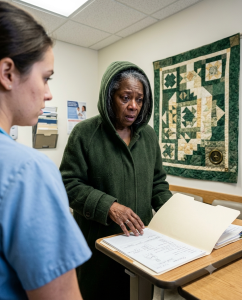
At the hospital, a transplant coordinator named Amber guided her through intake with polished kindness. She looked to be in her late twenties, maybe younger, with an efficient smile and tired eyes that suggested she had helped many frightened people through hard decisions. She brought Delia Mae to a consultation room and set a thick packet of consent forms on the table.
“The surgeon will be with you soon,” Amber said. “Take your time reading. I’ll come back in a few minutes.”
Delia Mae thanked her.
Then she looked up and saw the quilt.
It hung on the wall opposite the table, large and handmade, a field of green and cream with gold pieces worked through in graceful patterns. It was the kind of quilt that told you, immediately, someone had made it out of love or longing or both. Delia Mae stood without thinking and walked toward it.
At the bottom right corner, sewn into the border, was a brass button.
Dark gold. Nearly brown. Worn smooth.
Her breath vanished.
She leaned in closer. The button had a small nick near one edge, the exact imperfection made by the porch rail on the night she fled. This was not merely similar. It was the button. The original. The one she had never mailed. The one she had kept.
No, she realized a second later. Not the original. One of the copies.
But an early one. Handled often enough to darken. Kept long enough to age.
The stitching that held it was old. Decades old. Careful. Deliberate.
Someone had received one of her letters.
Someone had believed enough in what it carried to preserve the button inside a quilt meant to endure.
Amber returned and found Delia Mae standing inches from the wall, one hand half-raised but not touching.
“Ma’am?” Amber said gently. “Are you all right?”
Delia Mae turned, face pale. “Where did that quilt come from?”
Amber glanced up. “It was donated years ago. I can check the plaque if you’d like, but I think it came from a local family.”
Delia Mae said nothing. She simply stared until Amber shifted awkwardly and reminded her there were forms to sign.
Back in the chair, Delia Mae began turning pages.
Release of liability. Acknowledgment of risk. Consent for anesthesia. Blood products. Follow-up care. She forced herself to read each one even as her mind remained pinned to the button on the quilt. Her hands shook. Twice she had to stop and lay them flat on the table until the tremor passed.
Then she reached the recipient information.
Patient name: Gerald Fontenot.
She went still.
The room narrowed to a single point.
She read it again.
Gerald Fontenot.
There are names the body stores separately from ordinary memory. Names tied to the moment life splits into before and after. Gerald’s was one of those. She saw again the false solemnity with which he had signed the report. The way he had kept his tone professional while ending her future. The way the room had treated his word as cleaner than hers.
She was here to save him.
Without ever knowing.
Her pulse became so loud she could hear it.
Then her eyes moved lower to the emergency contact section.
Name: Celestine Arceneaux-Broussard.
Her daughter.
Not a similar name. Not a coincidence. Celestine’s full name. Celestine’s address. Listed as the person the hospital should call if Gerald died on the operating table.
The packet slid from Delia Mae’s hands and struck the floor.
Amber, standing just outside the door, looked up sharply and stepped in. “Ms. Arceneaux?”
Delia Mae opened her mouth. No sound came. She had the terrible sensation that language itself had abandoned her.
Amber bent to gather papers, then noticed the page Delia Mae was staring at.
“What is it?” she asked.
Delia Mae pointed first at the name Gerald Fontenot, then at the emergency contact. Her finger shook violently.
Amber’s expression changed. It did not go blank, which would have been easier. It changed in the particular way of someone who knows more than she expected the other person to know.
That frightened Delia Mae more than anything.
“Where did that quilt come from?” she asked again, this time in a voice rough as torn cloth.
Amber closed the door before answering.
That single act said too much.
“It was donated by Ruth Broussard,” Amber said softly.
Ruth.
Her sister Ruth.
The room lurched.
“Your sister?” Amber asked after one look at Delia Mae’s face.
Delia Mae could only nod.
Amber looked from the quilt to the emergency contact page and back again. “She said the quilt was made from family things. She wanted it displayed where it might comfort people waiting.”
“They got my letters,” Delia Mae whispered.
Amber did not answer.
She did not need to. The button answered for her.
All those years. All those envelopes. All that silence. The letters had arrived.
Her mother or sister—maybe both—had opened them. Touched the brass buttons. Read the words. Chosen not to answer.
The realization did not feel like anger at first. It felt like temperature leaving the room.
“Why is my daughter listed for him?” Delia Mae asked.
Amber hesitated. “I’m not supposed to discuss the patient’s private history.”
The words were careful, but behind them Delia Mae heard confirmation: there was a history.
She rose too quickly and had to catch herself on the table. “That man destroyed my life. My daughter disappeared from me. My sister kept my letters. And somehow all their names are tied together in this building.”
Amber swallowed. “Mr. Fontenot asked for you by name before he was sedated.”
Delia Mae stared.
“No,” she said.
“He knew you were the donor.”
The room seemed to lean. “How?”
Amber looked miserable now. “He said if you came, someone needed to tell you the truth before surgery.”
Delia Mae pressed a hand against her chest, not from pain but because everything inside her felt as if it had begun moving too fast.
This had not been random.
Gerald knew.
He had agreed to accept her kidney knowing exactly who she was.
Worse, he had wanted her here.
“Where is my daughter?” she asked.
Amber did not answer immediately. She opened the file, checked something, then lifted her eyes. “She’s in the family waiting area.”
Delia Mae stood very still.
Forty years collapsed into a single doorway.
Amber led her down a corridor too bright for the weight it carried. Nurses moved past. A cart squeaked somewhere nearby. Overhead speakers called names and room numbers. Ordinary hospital sounds. Life continuing. Delia Mae felt removed from all of it, as though she were the only one walking inside a memory while everyone else moved through a normal morning.
At the waiting area door, Amber paused.
“There’s more,” she said quietly. “I think you need to hear it from her.”
Delia Mae’s hand closed around the door handle.
Inside, near the far window, sat a woman in her forties with silver at her temples and Delia Mae’s exact mouth. She was holding a paper cup she did not seem to realize had gone cold. When the door opened, she looked up.
The cup slipped from her hand and rolled.
For one stretched second, neither of them moved.
Celestine stood first. She had her mother’s eyes, too, only harder around the edges. Lived-in. Guarded. But beneath the caution, Delia Mae saw something else she was not prepared for: recognition without surprise.
“You knew I was coming,” Delia Mae said.
Celestine’s chin trembled once before she steadied it. “He told me you matched.”
“He knew it was me.”
“Yes.”
“And you said nothing?”
Celestine shut her eyes briefly, then opened them. “Would you have come if you knew?”
The cruelty of the question was not in the words but in how impossible it was to answer. Delia Mae did not know whether she would have come. That uncertainty enraged her.
“What is he to you?” she asked.
Celestine looked toward the floor, then back at her. “My father.”
The world stopped.
Not metaphorically. Not poetically. It stopped in the brute, awful way a body stops recognizing where it is.
Delia Mae stared at her daughter and felt forty years rearrange themselves into a shape far uglier than the one she had survived.
“No,” she said.
Tears filled Celestine’s eyes. “Mama—”
“No.”
“I didn’t know for sure until Ruth was dying.”
Delia Mae caught the back of a chair to stay upright. “Say that again.”
Celestine was crying now, but she did not look away. “Aunt Ruth told me before she passed. She said Gerald had been seeing you before you were run out. Said he made promises. Said when you got pregnant, he panicked. Said after the delivery tragedy, he used it to bury everything at once. You. The baby. The scandal. All of it.”
Delia Mae felt something inside herself tear cleanly.
Fragments returned with vicious clarity. Gerald appearing too often on roads that were not his. Gerald bringing papers that did not need his signature. Gerald standing too close one evening after church and saying he could change her life if she let him. Delia Mae refusing him. Delia Mae later, months after, making one catastrophic choice in loneliness and confusion after he arrived at her door full of apologies and soft promises. Then pregnancy. Then fear. Then the disaster at the delivery. Then Gerald’s report, swift and merciless.
“You knew,” Delia Mae whispered. “All this time?”
Celestine shook her head. “Not all this time. I knew he helped Aunt Ruth after Grandma got sick. I knew she stayed in contact with him. I thought he was just… somebody important. Somebody who made things happen in the parish. When I was older and went back looking for family, Ruth let me in, but not fully. She showed me your letters.”
Delia Mae flinched.
“They kept them,” Celestine said, voice breaking. “All of them. Aunt Ruth said Grandma couldn’t bear the shame and Gerald convinced them it was better if they let the past stay buried. Ruth said she was weak. Said every year she meant to write you back and every year she failed.”
The brass button in the quilt flashed through Delia Mae’s mind.
“They made a keepsake out of my begging,” she said.
Celestine sobbed once, quietly. “I’m sorry.”
“Why him?” Delia Mae asked. “After knowing?”
Celestine pressed both palms to her face, then lowered them. “Because by the time I knew, he was already dying. And because he finally told the truth in writing. Not for goodness. Because he was scared to die with it hidden. He wrote everything down. What he did to you. How he kept Ruth and Grandma silent. How he knew I was his. How he watched from a distance and still never claimed me.”
Delia Mae could not speak.
Celestine stepped toward her but stopped short of touching. “He said he wanted to confess to you himself.”
“And then take my kidney?”
Celestine’s face folded with shame. “He said he didn’t expect you to say yes. He said when he found out you were the match, he cried.”
That almost made Delia Mae laugh. Not with humor. With disbelief so sharp it bordered on madness.
A nurse appeared briefly at the door to say the surgical team needed a decision soon. Gerald’s condition was unstable. The timing mattered.
Then they were alone again.
Forty years of abandonment stood between mother and daughter. At the center of it lay a dying man whose lies had poisoned every bond that should have protected them.
“Do you want me to save him?” Delia Mae asked.
Celestine looked shattered by the question. “I don’t know what I have the right to ask.”
At last, Delia Mae sat down because her legs no longer trusted her. She studied her daughter’s face, the face of the child she had carried out of that parish in the dark. So much had been stolen. Not all of it by Gerald alone. Cowardice had helpers. Silence had helpers. Families had a way of becoming accomplices when shame was offered to them as a shelter.
“What happened to Ruth?” Delia Mae asked.
“Cancer,” Celestine said. “At the end, she made the quilt. She stitched one of your buttons into it and told me she needed to put at least one truth where people could see it, even if they didn’t understand what they were looking at. She told me if you ever came back, the button would prove the letters were real.”
That hurt in a different way. Too late. Everything too late.
“And you?” Delia Mae asked. “Why didn’t you come for me?”
Celestine sank into the chair opposite her. “Because I thought you left us. That’s what I grew up hearing in pieces. That you chose your pride over your family. Then when I finally found Ruth and saw the letters, I was furious. At them. At myself. At you. I didn’t know what was true anymore. And every year I waited, it felt harder to explain why I had waited.”
Honest. Ugly. Human. Delia Mae hated how much she understood it.
The nurse returned. The surgeon needed an answer.
Delia Mae stood again.
She thought about the mothers she had once helped through impossible pain. She thought about the women who had screamed at her, cursed her, begged her not to let them die, then clutched her hand in gratitude when the child was finally placed on their chest. She thought about Gerald’s signature. Gerald’s cowardice. Gerald’s blood in Celestine’s veins. She thought about how evil often arrives not with a knife but with a pen, a silence, a room full of people willing to let a lie harden into history.
Then she thought about herself.
Not the woman Gerald had described on paper.
The real one.
She turned to her daughter. “Bring me what he wrote.”
Celestine retrieved an envelope from her bag. Inside was a handwritten confession, pages long, signed shakily at the bottom. Gerald admitted the false report. Admitted pressuring Delia Mae’s family into silence. Admitted knowing Celestine was his child. Admitted doing nothing because preserving his reputation mattered more than any of them.
When Delia Mae finished reading, she folded the pages with extraordinary care.
Then she walked to the nurse’s station and asked for a witness.
Before surgery, she signed a condition of her own: Gerald’s confession was to be copied, notarized, and entered into legal record with designated recipients, including the medical board that had revoked her license, the parish records office, and the surviving family members named by Celestine. The hospital attorney, startled but efficient, arranged it. Gerald, barely conscious but lucid enough to understand, was brought the document confirming his statement would not die with him.
For the first time in forty years, Delia Mae saw fear in him that had nothing to do with illness.
Only then did she sign her final consent.
The transplant surgery lasted hours.
When Delia Mae woke, pain sat deep and blunt in her side. The room was dim. Her mouth was dry. For a moment she knew only relief that she was alive.
Then she saw Celestine asleep in a chair beside the bed, one hand still resting near the blanket as if she had been afraid her mother might disappear again if she let go entirely.
Delia Mae watched her daughter for a long time before speaking her name.
Celestine woke instantly, then began crying before she could even form a sentence.
This time Delia Mae let her come close.
They talked in pieces over the next two days, because forty years cannot be crossed in one conversation. They spoke about lies and anger, about Ruth’s regret, about the grandmother who had chosen silence, about the years each of them had spent building stories that made survival possible. None of it was neat. Forgiveness did not arrive whole. But truth, once opened, kept making space where lies had lived.
Gerald survived the surgery.
On the third day, he asked to see Delia Mae.
She agreed.
He looked smaller than she remembered, diminished not only by sickness but by the collapse of whatever story he had told himself about being justified. His voice shook when he apologized. He cried. He said he had loved her once, which only made Delia Mae’s face go still.
“No,” she told him. “A man who loves does not erase.”
He had no answer for that.
He asked why she saved him.
Delia Mae considered him quietly, then said, “I did not do it for you. I did it because I will not let what you made of your life decide what kind of woman I am.”
After that, she left the room.
Months later, the medical board issued a formal posthumous correction to the record of her case after Gerald’s confession and corroborating documents were reviewed. Delia Mae’s license, though meaningless in a practical sense after so many years, was restored in honor. The parish paper ran a notice so small it was almost insulting, but people read it. Some remembered. Some denied remembering. Some called with apologies she had no use for.
Gerald died the following winter from complications unrelated to the transplant.
Delia Mae attended neither the funeral nor the burial.
What she did do was return to Terrebonne Parish one spring morning after the roads had dried. She stood outside the old church. Walked past the house where she had once rented rooms. Sat with Celestine by the water and said things mothers and daughters should not have to wait forty years to say.
Their closeness did not become effortless overnight. There were too many lost birthdays, too many empty holidays, too many habits of distance. But they kept choosing conversation over silence. Sometimes that is the only miracle available to ordinary people, and sometimes it is enough.
Later, Delia Mae visited the hospital and stood before the quilt again.
The brass button remained stitched into the border.
She touched it this time.
Not with grief alone. Not even with anger.
With recognition.
It had once been evidence of exile. Then evidence of betrayal. Now it was also evidence that truth survives strange journeys. It gets buried. Hidden. Sewn into borders. Passed through guilty hands. Misunderstood by daughters. Guarded by sisters too weak to speak when it mattered. But it survives.
As Delia Mae turned to leave, she thought about how close the world had come to letting Gerald’s version remain the final one. A report had almost outlived a life. Silence had almost become history. A child had almost gone on believing the wrong parent had abandoned her.
Who was most to blame in the end—the man who lied, the family who stayed quiet, or the fear that made everybody choose the path that hurt the weakest woman first?
Delia Mae never answered that question aloud.
But every time she looked at her daughter, and every time she remembered the weight of that brass button against her fingertips, she knew exactly where the first red flag had been:
not the night she was forced to leave,
but the moment a man decided his reputation mattered more than the truth.