Colin knew his son’s grief had become its own kind of schedule long before anyone else admitted it.
Every Thursday at 6:14 p.m., Owen climbed onto the arm of the living room couch and stood with one hand against the apartment window, staring toward the elevated tracks that cut across the far side of town. The train was too distant to see clearly from there, but that had never mattered. Owen didn’t need to see it. He only needed to know that Thursdays at 6:14 used to mean something.
They had meant Daniel.
Before the funeral. Before the hospital corridors and forms and sympathy cards and casseroles stacked so high in the fridge Colin stopped opening containers because he couldn’t bear seeing another untouched lasagna. Before the apartment got quiet in a way that felt permanent. Before every well-meaning friend began saying things like, “Children are resilient,” and, “He’ll adjust.”
Colin had nodded through all of it because grieving in front of other people required a kind of politeness he no longer had the energy to resist.
But alone, he watched his son climb to that same spot every week, and he understood something everyone else missed.
Children did not forget.
They repeated.
They turned memory into ritual because ritual was the closest thing grief had to structure.
Daniel had taken the commuter line home every Thursday in time for dinner. He’d come through the door smelling like cold air and wool and the faint metallic scent of train stations. He would loosen his tie, kiss Owen on the crown of the head, and steal fries off the boy’s plate while pretending he hadn’t. Now Owen stood at the window as if enough fidelity to the routine might force the world to correct itself.
So when Colin saw the train museum’s flyer posted in the grocery store—Family Rail Day, open cars, restored engines, whistle demonstrations—he bought tickets that same afternoon.
He told himself he was doing something kind. Something smart, even. Give Owen a train that didn’t carry absence. Let him touch brass handles, hear whistles, climb old steps, and maybe walk away with a different memory attached to tracks.
The museum sat in a decommissioned depot at the edge of town, the kind of place built from equal parts devotion and decay. Old lanterns hung from hooks blackened by age. Route maps faded to cream lined the walls. Model trains ran through painted mountains behind glass. Volunteers in pressed uniforms explained couplings and switchboards with the seriousness of people preserving scripture.
Owen loved it immediately.
That alone made the trip worthwhile.
He darted from one exhibit to the next, not wildly, but with the alert curiosity Colin had missed for months. He touched polished rail spikes, peered through a conductor’s pocket watch, and asked a volunteer if old trains had bedrooms. Colin laughed for the first time in longer than he wanted to calculate.
Then they climbed into a restored passenger car, and everything changed.
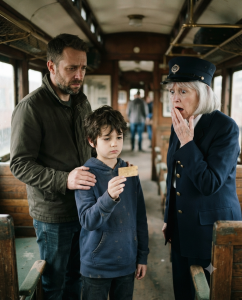
One of the volunteer conductors was mid-tour when she noticed the crumpled ticket stub in Owen’s hand.
Her name tag read ELEANOR.
She looked to be in her fifties, with silver hair tucked under a navy cap and the kind of face that seemed naturally composed, even stern. But the second she saw that scrap of paper, the composure vanished. She stopped speaking in the middle of a sentence and stared at Owen like he had walked in carrying a piece of her private life.
“Where did you get that?” she asked.
Colin answered before Owen could. “He found it in a coat pocket.”
That was true, though incomplete. Three days earlier Colin had bought a vintage wool coat from a church thrift sale. Owen, digging through the torn inside lining, had discovered the stub wedged deep in the fabric and declared it “train money.” Colin had nearly thrown it out, but the boy had stuffed it into his jacket and kept carrying it around.
Now, under the bright museum lights, it looked old enough to matter. The edges were yellowing. The print was faded. One side had been torn cleanly from its match, leaving rough perforation along the center.
Owen held it up to Eleanor. “It’s for the train girl.”
Eleanor turned pale.
“My sister had a ticket exactly like that,” she said. “The day of the Blackstone derailment.”
Colin frowned. The name struck somewhere dimly familiar. Blackstone. Mill Creek. A bridge.
Then he remembered: years earlier, he’d bought a secondhand picture frame and discovered a newspaper clipping tucked behind the backing board. He had kept it for no good reason beyond the oddness of it. A small local article about the Blackstone derailment in 1989. Three commuter cars off the bridge north of Mill Creek. Victims named. Families quoted.
He looked back at the ticket stub, and his stomach tightened.
Owen spoke again. “The girl said hers got ripped when she was mad.”
Eleanor gripped the nearest seatback.
“My sister tore her ticket in half before she boarded,” she whispered. “She was angry she had to travel that night.”
The chill that ran through Colin had nothing to do with ghosts and everything to do with precision. Children said strange things. But they did not land on private family details with surgical accuracy unless someone had fed them the information first.
No one had.
“What was your sister’s name?” Colin asked.
“Julia.”
Owen nodded. “She still doesn’t like bridges.”
Eleanor shut her eyes like someone taking a blow.
That might have still been survivable as coincidence if Owen had stopped there. He didn’t.
“She said you still have the glove.”
“What glove?” Colin asked.
Eleanor swallowed hard. “My sister’s left winter glove. We only found one after the derailment. My mother kept it in a bread bag in the chest freezer for years. Said it still smelled like Julia’s coat.”
“She said freezer box,” Owen replied helpfully.
The woman sat down.
Around them, other museum visitors drifted past display cases and plaques, unaware that the atmosphere inside that restored car had changed entirely. Colin felt as though some invisible door had opened beside his son and none of the adults in the room had any idea whether they should close it or step through.
Then Owen lifted the stub again.
“She wants the other half.”
Eleanor looked at the torn edge, and something new entered her expression—recognition sharpened by dread.
“My sister hid something before she boarded,” she said. “A key. We knew that much later, but we never found it. She had a station locker. After the crash, we opened the locker with bolt cutters, but it was empty.”
Owen tilted his head. “No. She dropped it in the whistle.”
Eleanor turned toward the end of the railcar so suddenly that Colin followed her gaze.
Inside a glass display case sat a brass conductor’s whistle tied to a faded blue ribbon. A small plaque identified it as part of the Hart family donation.
“It was hers,” Eleanor said hoarsely. “Julia borrowed it from our father. Said it made her look official.”
Museum staff noticed the commotion and came over. Eleanor, to Colin’s surprise, did not try to explain. She simply asked for the case to be opened.
When the whistle was placed in her palm, the entire railcar seemed to hold its breath.
She turned it over once. Twice. Then she pressed a fingernail into the narrow mouthpiece.
A tiny roll of brittle paper slid free.
Even Colin, who had spent the past ten minutes trying to keep both feet planted in the world as he understood it, felt his chest tighten.
Eleanor carefully unwrapped the paper. A small brass key fell into her hand. Wrapped around it was a note in slanted handwriting.
She read the first lines and began to cry.
Colin caught only fragments.
If Dad finds this first…
don’t let him…
not after what he did…
Then Owen spoke, staring at nothing visible to anyone else.
“He didn’t mean to make the bridge happen,” he said softly. “He just knew before everyone else.”
Eleanor looked up as if she had been struck.
In that instant, the story changed.
This was not a message from the dead about a keepsake, or a family secret born from sentiment. This was about warning. About guilt. About something Julia had known before she boarded the train that killed her.
Eleanor refused to read more in public. She asked the museum director for access to the archive room, and because this was now partly museum property and partly a family matter, they led her into a staff corridor lined with shelves of ledgers, donation records, and route documents.
Colin followed with Owen.
In the archive room, Eleanor sat at a steel table beneath a yellow lamp and unfolded the note the rest of the way. Her face changed line by line.
“It’s not a goodbye,” she said finally. “It’s a warning.”
Julia had written that she went to surprise their father at signal control before boarding. There, she overheard him arguing with a supervisor about a fault report near the Mill Creek bridge. According to the note, a delay order should have been issued until the line was cleared. It wasn’t. Their father had begged for ten minutes. He said it might be nothing. He said another report would ruin him after a string of previous mistakes.
Then came the line that froze the room.
If anything happens, check locker 214. I took the ledger page. He’ll say I misunderstood. Don’t let him.
Eleanor lowered the note slowly. “We opened locker 114 after the crash,” she whispered. “Not 214.”
For thirty-five years, her family had believed Julia’s locker was empty. They had assumed she’d been confused, or frightened, or simply wrong. Yet if the note was accurate, they had searched the wrong place from the beginning.
Owen, who had been quiet in the corridor, looked toward the museum map pinned to the wall. “She said he switched the tag after.”
Museum records showed that during restoration in the early nineties, several employee lockers had indeed been renumbered. One old maintenance alcove had been sealed behind a bolted panel and reclassified as storage. What had once been 214 was no longer part of the public exhibit at all.
The museum director fetched tools. An older maintenance worker removed the panel while Eleanor stood rigid, clutching the brass key so tightly her knuckles blanched.
Behind the panel sat a row of forgotten metal lockers, gray with dust.
One still bore the faint outline of numbers beneath layers of paint.
The brass key fit.
The locker door opened with a sound so small it seemed impossible that it had taken three and a half decades to hear it.
Inside was a canvas station satchel, mold-specked but intact, and wrapped in wax paper beneath it, a torn ledger page sealed in an old plastic sleeve.
Eleanor stared without touching either item.
The museum director carefully lifted the page and set it on the table under better light.
It was a photocopy of a signal maintenance ledger, but one line had been circled in red pen.
Mill Creek bridge signal relay—repeated fault flagged 5:42 p.m. Await delay authorization.
Beneath that, where a supervisor’s signature should have authorized the delay, the space was blank.
Below the blank line was another notation added later in different ink:
Cleared verbally by R. Hart.
Eleanor made a sound Colin would never forget—not a sob, exactly, but the cracking noise a person makes when grief and betrayal collide.
R. Hart.
Robert Hart.
Her father.
The room stayed silent for several long seconds. Even the museum director, clearly aware of the legal implications, said nothing at first.
Colin looked at Owen, wanting suddenly, fiercely, to take him far away from this and yet unable to dismiss what had brought them here.
“There’s more,” Eleanor said.
She opened the satchel and found a cassette tape in a cracked plastic case, a small notepad, and the missing half of Julia’s train ticket.
The torn edge matched Owen’s stub perfectly.
Eleanor pressed her fingers to her mouth. “She left proof.”
The museum still had an old cassette player in the archive office because some oral histories had never been digitized. The director found it after a frantic search through a cabinet. The tape hissed, clicked, and then a young female voice filled the room.
“Okay, if this is working, I’m recording because Dad will say I imagined it.”
Julia sounded seventeen in the most painful way possible—young enough to still believe truth would matter if she preserved it correctly.
Her voice shook as she described overhearing the argument in signal control. A relay fault. A recommendation to hold traffic. Her father insisting the warning was probably a false trigger. Mention of prior mistakes. Mention of one supervisor about to leave early and another refusing to put anything in writing until the line was checked. Julia said she took the ledger copy when no one was looking because she panicked. She said she was going to keep it in her locker and come back after her trip because she didn’t know what else to do.
Then, near the end of the tape, her voice changed.
“If he lets the train go, and if nothing happens, then maybe I’m a terrible daughter for doing this,” she said. “But if something does happen and he tells everyone it was just fate, don’t believe him.”
The recording clicked off.
No one moved.
For thirty-five years, Eleanor had mourned her sister as a victim of a terrible accident. Now she was standing in a museum archive room listening to evidence that suggested their father had ignored a warning and then buried the proof after the derailment killed his own daughter.
“What happened to him?” Colin asked quietly.
Eleanor kept staring at the table. “He died ten years ago. Heart attack.” She laughed once, bitterly. “And all this time I thought his silence was grief.”
The museum director finally spoke, voice careful. “We have to contact the authorities. Historical records division, maybe transportation investigators. The statute issues may be complicated, but this is evidence.”
Eleanor nodded without looking up.
Colin should have been thinking about police, museums, records, legal chains of custody. Instead he found himself looking at the two halves of Julia’s ticket now lying side by side on the table, perfectly matched after thirty-five years in separate hiding places.
He turned to Owen. “Buddy… do you understand what’s happening?”
Owen’s gaze rested on the ticket halves. “The train girl wanted her sister to know she was telling the truth.”
That answer should have unsettled him more than it did. Instead Colin felt a strange, exhausted calm settle over him.
Because beneath the impossible details, beneath the fear and coincidence and grief and history, there was a simpler shape to all of it. A dead girl had not wanted to disappear inside the story told about her. Whether Owen had somehow sensed it, imagined it, carried it, or something stranger had happened, the result was the same.
The truth had survived.
The police came. Statements were taken. The museum turned over the note, the tape, the ledger page, and the ticket halves. Follow-up inquiries reopened old records no one expected to examine again. Newspaper archives filled in gaps. Former rail employees, now old men and women, were contacted. One remembered the fault report. Another remembered Robert Hart’s insistence that the line remain open. A retired supervisor, facing his own mortality and no longer interested in protecting a dead colleague’s reputation, admitted there had been pressure to avoid delays during a politically sensitive contract week.
The final official statement months later was cautious in the way institutions are cautious when confronting their own past. It did not say Robert Hart caused the derailment by himself. It said documented warning protocols had not been followed. It said evidence had likely been concealed after the fact. It said the original investigation had been incomplete.
For Eleanor, the wording hardly mattered.
She had her sister’s voice.
She had the note.
She had the truth Julia feared would vanish.
A local paper ran the story under a restrained headline about newly surfaced evidence in the Blackstone derailment. Another outlet made it uglier and more sensational. Friends called. Strangers wrote letters. Families of other victims reached out, some grateful, some furious, some simply relieved that what had always felt unresolved now had shape.
Eleanor visited Colin and Owen three weeks after the tape was authenticated.
She brought coffee for Colin, a model train for Owen, and a small archival sleeve containing photocopies of Julia’s note and the matched ticket halves. Not the originals—the authorities still had those—but enough to hold.
“I wanted you to see them together,” she said.
Owen studied the ticket pieces solemnly. “She’s not mad now.”
Eleanor’s mouth trembled. “No,” she said. “I don’t think she is.”
Colin invited her in. They sat at the same window where Owen had spent so many Thursdays waiting.
For a while no one spoke.
Then Eleanor asked the question Colin had known was coming. “Do you think she was really talking to him?”
He looked at his son, who was pushing the model train slowly along the windowsill.
“I don’t know,” Colin said honestly. “I know he couldn’t have known those things. I know something found a way through.”
Eleanor nodded. It seemed enough.
After she left, Thursday evening came the way it always came. At 6:14, Colin glanced toward the couch and felt his body prepare for the familiar ache of seeing Owen climb into place.
But Owen didn’t.
He stayed on the rug, lining up the little train cars Eleanor had brought.
Colin waited, barely breathing. “Aren’t you going to the window?”
Owen looked up. “No.”
The answer was so simple it hurt.
“Why not?” Colin asked.
Owen considered this with the grave seriousness only children could give ordinary miracles. “Because Daddy knows the way home now.”
Colin sat down before his knees could betray him.
Maybe Owen meant Daniel. Maybe he meant Julia. Maybe he meant both. Maybe grief had finally shifted just enough to let routine loosen its grip. Colin did not interrogate it. He had learned by then that not every truth arrives in language adults can file neatly.
That night, after Owen was asleep, Colin stood alone by the window at 6:14 and watched the distant lights move across the tracks.
He thought about Robert Hart, who had hidden from the consequences of one decision until death made silence permanent. He thought about Julia, seventeen and frightened, trying to save the truth even when she could not save herself. He thought about Eleanor carrying grief for decades only to discover that memory had been poisoned by loyalty to the wrong person. And he thought about the terrible, beautiful possibility that love—parent to child, sister to sister, husband to husband—sometimes found paths around time when ordinary speech failed.
The hardest part was deciding which wound cut deepest.
That a father might choose his reputation over safety.
That a sister had to die before being believed.
Or that it took a grieving little boy, still waiting for one dead parent, to return another lost daughter to the family that had failed to hear her the first time.
Colin never did settle the question.
He only knew that some ghosts were less about haunting than insistence.
And some of the worst derailments do not happen on bridges at all.
They happen inside families, the moment truth is delayed just long enough to become tragedy.