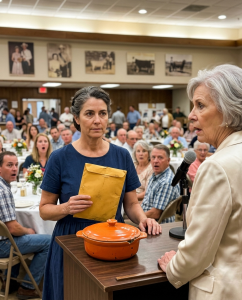
When Luanne Pickett was escorted out of the Sweetwater County Fair Pageant committee meeting for “lacking the refinement” to chair the event, she still had her late mother’s casserole dish in her hands.
It happened on a Tuesday night in March, under the kind of fluorescent lights that made everyone look slightly tired and slightly cruel. The committee room behind the livestock pavilion always smelled faintly of burnt coffee and old paper, and that night it smelled like lemon cleaner too, as if someone had prepared for company. Luanne had arrived ten minutes early carrying a persimmon-orange Fiestaware casserole dish with a dishtowel wrapped around the handles. The lid rattled softly when she walked.
Her mother had carried that dish into fair meetings for twenty-three years.
Chicken casserole, green chili bake, funeral potatoes, cobbler, scalloped corn—her mother believed no important county decision should be made on an empty stomach. People used to joke that the dish had more voting rights than half the committee. It was chipped on one side and darkened on the bottom from a thousand oven racks. Every woman in that room recognized it instantly.
That was part of why what happened next felt so pointed.
The chairmanship had opened after Dorothy Bell stepped down for health reasons. For two weeks, everybody had assumed Luanne would take it. She knew the pageant schedule backward and forward. She had grown up backstage pinning hems and carrying bobby pins and calming girls who cried when a heel broke. Her mother had served on the committee long before Renata Goode ever learned how to pronounce “heritage” into a microphone. Luanne had the trust of volunteers, the patience of someone raised on farm work, and a memory for details that made other women call her when things went missing.
But Renata had something else.
Presence.
That was the word people used when they wanted to flatter her without admitting they were intimidated. Renata wore tailored jackets to livestock breakfasts and spoke in complete polished paragraphs even when asking where someone had left the tape dispenser. She knew donors by name and sent handwritten thank-you notes on thick cream stationery. She could make ordinary county business sound like a gala.
That night, once the coffee had been poured and the papers laid out, a few women mentioned Luanne’s name for chair. Not loudly. Sweetwater women rarely did anything loudly when there was still time to cut someone down politely first.
Renata waited until the room had settled before speaking.
“The pageant,” she said, folding her hands over her legal pad, “is the public face of the fair. It requires a certain level of polish.”
No one answered.
She glanced at Luanne’s jeans, still dusted with flour from the dessert table prep. Then at the casserole dish.
“We need someone who understands refinement.”
That was the moment the air changed. Several women looked down immediately. One reached for her coffee even though the cup was already in her hand. Another smiled in that helpless, embarrassed way people do when they’re relieved the cruelty isn’t aimed at them.
Luanne stood there holding the dish and felt her ears burn.
She was not a dramatic woman by nature. She didn’t fight to win rooms. She built fences, balanced invoices, hauled feed, and made herself useful. But she had loved that pageant once. Loved the bustle of it, the safety pins in her mouth, the smell of hairspray and curling irons, the breathless chaos five minutes before curtain. Her mother had taught her that invisible work mattered. That smooth events were built by women no one thanked enough.
So when Renata stood, came around the table, and lightly motioned toward the door, it was not simply a rejection.
It was humiliation made ceremonial.
Luanne walked out with the casserole dish against her chest, climbed into her truck, and drove home through sleet without turning on the radio.
She did not attend another pageant meeting for eleven years.
In a small county, absence becomes folklore fast.
Some said she’d quit in a rage. Some said she never really wanted responsibility. Others repeated Renata’s version: that Luanne was hardworking, dependable, invaluable behind the scenes—but not suited to leadership. That phrase, “not suited,” spread because it felt civil. Sweetwater had always preferred clean phrases over dirty truths.
Luanne never corrected anyone.
She worked.
She helped her father keep the family hay business alive after his knees worsened. She ran produce from the farm stand in summer and plowed driveways in winter when storms boxed in older neighbors. She took meals to grieving families, fixed busted latches, sat through hospital waits, and became the person people called when pride had failed and practical help mattered more than dignity.
And always, the casserole dish came with her.
At first, people assumed she was delivering food. Often she was. Sometimes the dish was full of enchiladas or cheesy potatoes or peach cobbler. Other times it was empty. Still she carried it into feed stores, church basements, emergency rooms, school board meetings, and funeral receptions with equal care. She set it beside her like it belonged there. She never joked about it. Never apologized for it. Never explained.
The chip on the rim remained visible all those years, a small white crescent against the orange glaze.
Children noticed it. Adults pretended not to.
The first person who openly asked about the dish was old Marvin Lott at the co-op after a spring auction.
“You keep gold in there?” he said with a grin.
Luanne answered, “Something heavier.”
He laughed, assuming he’d been answered.
But the odd thing was that she treated the dish less like a container and more like a promise. She never left it in the truck if she was going inside somewhere important. She never handed it off. When she sat, it sat within reach. Once, at the county clinic while waiting with a neighbor whose husband had collapsed in the field, a nurse tried to move it off an extra chair. Luanne’s hand snapped out so fast the nurse blinked.
“I’ll keep it,” Luanne said.
That was the end of that.
Years passed. Renata Goode rose.
She became chairman of the pageant committee, then chair of the fair centennial planning committee, then the sort of woman whose name wound up on every sponsorship banner and printed thank-you. She was good at what she did, at least publicly. The pageant gained better staging, nicer programs, more outside sponsors, and local press attention that made Sweetwater feel larger than it was. Renata called it modernization.
Some praised her. Some didn’t trust the shine.
By the ninth year of Luanne’s absence, low murmurs started circling about fair finances. Not embezzlement in the movie sense. Nothing dramatic enough for deputies. Just irregularities that accumulated the way dust does under furniture if the same person keeps deciding where no one else needs to look. Vendor renewals without proper votes. Donor perks promised but not documented. Historic fund allocations moved “temporarily” and slow to return. When questions rose, Renata had an answer prepared before they were fully asked.
That, more than anything, began to unsettle people.
Then the fair board announced a centennial gala honoring “the women who built this fair.”
The phrase appeared on flyers all over town. Photographs, heirloom aprons, recipe cards, cookware, handwritten notes—families were encouraged to bring items that represented generations of unpaid labor and love. The exhibit hall would host a ceremony, and Chairman Renata Goode would deliver the keynote tribute.
Luanne saw one of the flyers hanging at the feed store beside a sale notice for mineral blocks and a lost-dog poster.
She stared at it long enough for the owner, Wes Trammell, to notice.
“You going?” he asked.
“No,” Luanne said.
But her voice landed too flat to be believed.
That night she took the flyer home and laid it on her kitchen table beside the casserole dish.
For an hour she just sat there with both hands wrapped around a mug gone cold. On the wall behind her hung a faded photo of her mother in an apron, laughing with one hip cocked against a counter. Her mother had been practical in the way some women are so practical that others forget how sharp they can be. She never wasted words. Never forgot numbers. Never let people flatter her into silence.
Luanne heard her mother’s voice often at night, not as a ghostly thing, but as memory sharpened by solitude.
If they smile while they do it, she had once said, that doesn’t make it kind.
The next morning, Luanne drove to Riverton with the casserole dish on the seat beside her. She parked outside a ceramic restoration shop and carried the dish inside.
The shop owner, a careful woman with silver glasses and steady fingers, turned the lid over, examined the chip, and said, “This can be repaired nearly invisibly.”
Luanne shook her head. “I don’t want the chip fixed.”
The woman looked confused. “Then what would you like done?”
Luanne hesitated. It felt strange even now, speaking the truth aloud.
“The rim catches sometimes,” she said. “And the base isn’t safe anymore.”
The woman inspected the underside and found where years had worn the glaze rough. She nodded. “I can smooth and seal it. It’ll sit safely.”
“Good,” Luanne said.
The woman smiled. “Planning to use it again?”
Luanne answered without smiling back. “I’m planning to set it down.”
In the weeks leading up to the gala, rumors moved ahead of facts the way they always did in Sweetwater. Somebody saw Luanne buying a dress in Casper. Somebody else heard she’d requested records from the clerk’s office. One woman swore she’d seen Luanne speaking to Dorothy Bell on Dorothy’s porch for nearly two hours. Another said that was impossible because Dorothy no longer heard well enough for porch conversations.
The truth was simpler and more dangerous.
Luanne had gone through everything her mother left behind the summer after the funeral—recipe cards, utility bills, church bulletins, seed catalogs, old fair programs. Tucked into one stack she had found a pageant committee note on official letterhead and a receipt for a reimbursement her mother never collected. The note was unsigned but written in a hand Luanne recognized from dozens of agenda margins: Renata’s. The message had been curt and dismissive, telling Luanne’s mother that certain expense questions were “not appropriate for further discussion” and reminding her that public controversy would damage the pageant.
At the time, grief had numbed Luanne’s understanding. She knew it was ugly. She knew her mother had been upset. But she hadn’t yet grasped the shape of what her mother had done next.
That came later, by accident.
One evening during a thunderstorm, Luanne had reached for the dish to carry it away from a leak in the roof. Her fingers brushed something strange beneath the base. A slight raised edge. Not original. Not ceramic. She turned it over and saw an old, neatly applied layer of protective tape, browned with time and nearly invisible against the worn underside.
She stopped breathing.
Under the tape, sealed flat against the bottom, was a packet.
Luanne did not open it right away. She sat on the kitchen floor with rain hammering the roof and the dish in her lap, suddenly afraid—not of what she would find, but of what it would require from her once found. Her mother had hidden something inside the very object that went everywhere with her. Not in a drawer. Not in a Bible. Not in a lockbox. In plain sight, disguised by usefulness.
When she finally opened it, she found copies of payment records, handwritten notes, and a page in her mother’s careful script summarizing discrepancies between donor-designated funds and actual pageant expenses over two seasons. Names were listed. Dates. Amounts. One donor gift marked for contestant scholarships had been partially redirected. A vendor tied to Renata’s brother-in-law had been paid above approved cost. Nothing vast enough to shake the state. Plenty enough to poison trust.
At the bottom of the page, her mother had written: If anything happens to me before this is addressed, don’t hand it over quietly. Quiet is where they win.
Luanne refolded everything and slid it back.
For years she carried that knowledge without acting on it.
Partly because grief had left her tired. Partly because her father needed her. Partly because exposing something in Sweetwater meant burning not just one reputation but the whole web of women and men who protected each other through silence. And partly because she knew if she brought it forward too soon, Renata would frame her as bitter.
But the centennial gala changed the balance.
Because once Renata announced a tribute to “the women who built this fair,” once she invited every family to bring proof of labor and sacrifice, once she prepared to stand under spotlights and speak about legacy as if she owned the word—Luanne understood something her mother would have appreciated.
A public lie deserves a public correction.
On the evening of the gala, the exhibit hall glowed with rented chandeliers and white linen. Tables displayed old aprons, black-and-white photographs, typed recipes stained with butter fingerprints. Women moved through the room in dresses chosen carefully enough to suggest effort but not vanity. Men clustered near the back in sports coats, already looking trapped.
Renata floated from table to table in cream silk, smiling at donors, touching elbows, pausing for photos.
Then the front doors opened and Luanne walked in carrying the casserole dish.
The reaction rippled before it became visible. Heads turned, then froze. Conversations stalled mid-sentence. One woman near the desserts whispered, “Oh my God,” without meaning to.
Luanne wore a dark blue dress and low heels she clearly found impractical. Her hair was pinned back neatly. Nothing about her looked flashy. Everything about her looked resolved.
Renata saw her from across the room. For one brief second, her expression emptied. Then the smile returned, polished but thin.
“Luanne,” she called as though they had lunch every Thursday. “How lovely that you came.”
Luanne nodded once and kept walking.
She signed the guest book. Chose a seat near the front. Set the casserole dish on the table beside her plate with both hands. Then she folded those same hands in her lap and waited.
The ceremony began with old photographs projected on a screen: women frying hamburgers in 1972, ironing sashes in 1989, hanging bunting in the rain sometime in the late fifties. People softened at the images. Nostalgia always lowers defenses.
Renata took the podium to applause.
She was excellent, Luanne would later admit that much. Renata could braid sentiment into authority so smoothly people mistook performance for sincerity. She spoke of labor, grace, devotion, standards. She named women long gone and praised women still living. She even included Luanne’s mother, calling her “a steadfast volunteer whose warmth nourished generations.”
Luanne sat still with one hand resting lightly on the lid of the dish.
The speech moved toward its close. Renata lifted her voice, speaking now about duty to the next generation and the importance of protecting the fair’s legacy “with dignity, transparency, and care.” The irony sailed over some heads and struck others like a thrown stone.
When she finished, the applause rose. A young volunteer stepped forward carrying the ceremonial gavel on a velvet cushion.
Renata turned to accept it.
And found Luanne Pickett already standing at the podium, the casserole dish sitting on the table in front of her like she’d saved a seat.
For a second, no one understood how Luanne had moved so quickly. One moment she had been seated. The next she was there, one hand beside the orange dish, the other holding a yellowed envelope.
The room went silent.
Renata laughed lightly into the microphone. “I’m sure this isn’t the time for personal grievances.”
Luanne met her gaze. “That’s what you told my mother, too.”
The words hit like dropped glass.
An older woman in the second row made a strangled sound and covered her mouth. Dorothy Bell, nearly deaf and usually stooped, straightened with startling force. Wes Trammell leaned forward so hard his chair creaked.
Luanne took the papers from the envelope one by one: the reimbursement receipt, the committee note on letterhead, her mother’s index cards covered front and back with neat handwriting.
“These belonged to my mother,” she said. “She kept asking questions about scholarship funds and vendor payments. She was told she was causing trouble. She was told she was emotional. She was told not to damage the pageant.”
Renata stepped closer, smile gone now. “You have no context for those notes.”
Luanne didn’t look away. “I have dates. I have amounts. I have donor designations. And I have something else.”
She placed both hands on the casserole dish.
“For eleven years,” she said, voice carrying farther than anyone expected, “I kept this with me because I didn’t trust myself to set it down before I was ready. Not because of the chip everybody could see. Because of what was hidden underneath.”
A murmur broke across the room.
Luanne lifted the dish and turned it just enough for the front rows to glimpse the sealed packet taped beneath the base. Gasps moved outward in widening circles.
“She hid it there after that meeting,” Luanne said. “After she realized no one in that room intended to hear her unless the whole county was watching.”
With careful fingers, Luanne peeled away the protective tape. She removed the packet and unfolded its contents under the lights: copied ledger pages, donor notes, signatures, contract numbers. Not rumors. Not stories. Documents.
Renata’s face altered in stages—first irritation, then calculation, then something closer to fear.
“This is absurd,” she said. “Old paperwork can be misunderstood.”
“Then explain it,” Luanne replied.
She held up one sheet showing scholarship donations and a lower payout than allocated. Another showed a vendor invoice approved without board vote. A third listed reimbursements denied or delayed after questions were raised. Two board members in the audience began whispering fiercely over the numbers. One donor stood up and demanded to see the page marked with his family name.
The ceremony dissolved.
People crowded the front. Cell phones came out. A local reporter from the county paper, invited only for a social photo, suddenly looked electrified. Dorothy Bell asked for the documents in a voice that shook with anger. “I knew,” she kept saying. “I knew something was off, but I let her talk over me.”
Renata tried to regain control. She reached for the microphone and called for order. She said audits existed. She said context mattered. She said no conclusions should be drawn from “partial records.”
Then Dorothy Bell, of all people, took the microphone from her.
“Sit down, Renata.”
The room obeyed the authority in Dorothy’s voice before it processed the words.
Dorothy turned to the crowd. “I remember this note,” she said, tapping the page on letterhead with one bent finger. “I remember Clara Pickett bringing concerns to us. I remember this committee deciding that preserving appearances was easier than investigating. That’s on more than one person.”
The confession landed like a second blow.
It was not just Renata, then. It was a culture. A habit. A roomful of women who had let polish outrank honesty because confronting the truth was messier than protecting tradition.
The fair board president, who had been seated at the donor table trying unsuccessfully to vanish, came forward and announced an immediate independent review. The scholarships account would be examined. Vendor contracts frozen. Committee authority suspended pending investigation. The room erupted in overlapping voices—anger, defense, relief, accusation.
Renata stood very still, as though stillness might preserve status.
Luanne gathered the papers methodically. She did not grandstand. She did not cry. She did not tell the room how long she had waited or how much it had cost her to stand there. She simply laid the documents in front of the board president and slid the casserole dish a few inches away from herself.
For the first time in eleven years, she let it rest on a table and took both hands off it.
That small movement quieted the people nearest her more effectively than any shout.
Later, the review found enough to force resignations. Not criminal charges, but clear breaches of process, improper allocations, concealed conflicts, and years of governance shaped more by image than accountability. Renata stepped down before she could be formally removed. The local paper ran the story for three straight weeks. Donors demanded reforms. Former volunteers came forward with their own memories of being dismissed when they asked practical questions in rooms that preferred flattering silence.
The hardest conversations were not about money.
They were about the way communities decide who looks believable.
About how quickly “refinement” gets used as a weapon against women who work with their hands.
About how often the women who truly build things are invited to serve only until they ask where the numbers go.
A month later, when the board voted on interim leadership for the pageant restructuring committee, Dorothy Bell nominated Luanne from her seat near the back.
This time, no one mentioned polish.
No one said refinement.
The vote was unanimous.
Luanne accepted with less ceremony than people expected. She wore clean jeans and a chambray shirt and brought no speech. She did, however, bring the persimmon-orange casserole dish. She set it on the side table near the coffee urn, empty and visible, chip and all.
After the meeting, a younger volunteer lingered behind and asked the question half the county had been wondering.
“Why did you keep carrying it everywhere?”
Luanne considered the dish before answering.
“Because every time I thought about letting it go,” she said, “I remembered how easy it is for people to rewrite a woman after she’s gone.”
The volunteer looked at the chip on the rim. “And now?”
Luanne touched the lid once, gently.
“Now it can just be a casserole dish again.”
That autumn, at the fair, scholarship winners were announced from a newly audited fund. The donor report was posted publicly. Vendor bids were recorded properly. The pageant itself felt a little less glossy and a little more honest. Some people missed Renata’s shine. Others said the air backstage felt easier to breathe.
Luanne’s mother’s dish appeared at the volunteer supper on the final night, full of scalloped corn.
People smiled when they saw it. Not because it was symbolic anymore, though it still was. Because it meant someone had shown up to feed everybody and tell the truth about what that kind of work is worth.
Even then, not everyone agreed on who the villain had been.
Some blamed Renata entirely. Some blamed the committee that let her thrive. Some quietly admitted they had enjoyed the order and prestige until the cost became visible. A few said Luanne should have spoken sooner. Others asked whether they would have been brave enough to do what she did standing alone at that podium.
Maybe that was the real aftershock left behind in Sweetwater.
Not just the money. Not just the records.
But the uncomfortable realization that the biggest red flag had never been hidden in a ledger at all.
It had been the moment a room full of people watched a woman get escorted out while carrying her dead mother’s casserole dish—and decided the one who looked refined must be right.