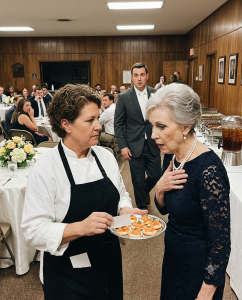
When Dorothy Crane stepped into the fellowship hall carrying a silver tray of smoked salmon canapés, nobody looked at her twice.
That was the first miracle.
The second was that she kept her hands steady.
On the outside, she looked exactly like what she was supposed to look like that day: the owner of a respected event company overseeing a wedding reception with practiced calm. Her chef coat was crisp. Her dark hair was pinned smoothly under a white cap. Her shoulders were set, her instructions to staff were brief and quiet, and every detail in the room seemed to settle the second she glanced at it.
But inside the pocket of her apron, her fingers kept turning over a plain white business card.
Front to back. Back to front.
A private rhythm. A reminder. A promise to herself.
Across the room, pale yellow roses spilled from rented urns beside the cake table. Satin ribbon curled around the backs of folding chairs. The church ladies who’d volunteered to help with setup stood near the punch bowl whispering their approval of the food. A string quartet recording floated through the hall speakers, softened by conversation and laughter.
It was Roger Whitfield’s wedding day.
And Dorothy Crane was catering it.
Fourteen years earlier, that sentence would have sounded absurd. Back then, Dottie—everyone had called her Dottie long before she learned to hold herself like Dorothy—was a young woman with a sewing kit, a hopeful heart, and more skill than anyone had bothered to value properly.
She married Roger at First Methodist in Clover Hill, Tennessee, in a ceremony small enough that every face in the room mattered. She had sewn her own wedding dress because the one she wanted in the bridal shop window was too expensive, and she knew exactly how much money Roger had in savings and how much rent was due at the end of the month. She told herself she didn’t mind. She told herself the dress meant less than the marriage.
Roger had looked at her with such softness that morning she almost believed that was enough.
His mother ruined it before the reception cake was cut.
Not publicly. Patricia Whitfield was too polished for open cruelty. She practiced something far sharper: social humiliation disguised as harmless observation. By the end of the afternoon, at least six people had heard Patricia mention that Dottie “made the dress herself.” By the next week, that fact had grown thorns. Dottie heard the rest through town gossip.
Sweet enough, Patricia had apparently said.
But Roger could have done so much better.
She grew up out on Route 9, in one of those trailer parks.
Dottie never confronted her. She was too young then, too eager to be loved, too determined to prove she could fit into a family that had decided not to make room for her. Instead, she did what she always did: she worked harder.
She learned every Whitfield favorite dish. Patricia liked orange-glazed carrots cut on a bias. Roger’s father preferred deviled eggs with extra paprika and a touch of mustard. Roger wanted coconut cake for his birthday every year and insisted nobody made it like Dottie. At Christmas, she roasted hams, baked rolls, and pulled pies from the oven with cheeks flushed and arms aching while guests praised the meal as if it had appeared by magic.
The Fourth of July spreads became local legend. Dottie’s ribs, brisket, skillet cornbread, blackberry cobbler. People who had never once asked her where she came from or who her mother was or whether she had enough gas money to get to work still spoke her name when food was involved.
That should have told her something.
It did, eventually.
But not before nine years of marriage passed. Not before all the little humiliations hardened into a climate. Not before Roger learned the lazy habit of receiving devotion as if it were a household utility: always available, noticed only when absent.
He left on a Tuesday in March.
No affair confession. No explosion. No weeping apology.
He stood in the kitchen while rain tapped against the window over the sink and told her he had “outgrown the marriage.”
Dottie remembered the exact shirt he wore because cruelty becomes strangely precise in memory. Blue stripes. Sleeves rolled halfway. Wedding band still on his hand when he said it, as if even then some part of him wanted credit for decency.
She stared at him, certain there was more. A reason. A name. Something she could hold in her hand and hate.
But Roger only sighed, looked around the kitchen she had built for them meal by meal, and said he wanted something different now. He was sorry. He just wasn’t the same person anymore.
By dinner, he was gone.
For weeks after that, Dottie moved through the house like a woman listening for a sound that never came. His truck in the driveway. His key in the lock. An apology she would never have accepted but still somehow expected.
Then the pity began.
In Clover Hill, pity arrived with casseroles and lowered voices. Women from church stopped by with foil-covered dishes and eyes that slipped toward the empty side of the room. Men at the hardware store got gentler when they spoke to her. And under all of it, beneath the concern, there was something else: the old assumption that this kind of woman would not recover publicly.
Roger remarried eighteen months later.
Her name was Courtney. Younger, pretty, bright smile. Dottie heard she worked in medical sales. Heard the wedding was tasteful. Heard Roger looked happy.
That was the day Dottie stopped crying.
Not because she was healed. Because she was done giving grief the best parts of her day.
A week later, she accepted a church member’s request to cater a retirement lunch for thirty people. She undercharged. Overdelivered. Went home exhausted and strangely alive. Two more small jobs came from that one. Then a birthday dinner. Then a fundraiser. A county commissioner’s wife asked if Dottie could handle two hundred guests for a donor event.
Dottie almost said no.
Instead, she went to the library, borrowed books on event logistics and small business accounting, and taught herself everything nobody had ever bothered to explain to her. Pricing. Staffing. Contracts. Margins. Presentation. She sold the last piece of jewelry Roger had given her and used the money to buy warming trays and better linens.
At first, people still treated her work like a charming hobby.
Then they tasted it.
What made Dottie dangerous was not just that she could cook. It was that she understood hospitality as structure. She remembered allergies without writing them down. Knew when to send out servers and when to hold them back. Could walk into a room, see ten tiny problems at once, and solve them before anyone important noticed. She made wealthy people feel expertly cared for, and she did it without flattery.
Word spread.
Within five years, Crane & Co. Fine Events was handling weddings, political dinners, museum galas, and corporate launches in three counties. Within eight, she had a commercial kitchen, a small office, four full-time employees, and a waiting list through autumn.
The social shift happened slowly enough that some people barely noticed. Invitations started arriving with her name printed properly. Women who once spoke to her like a helper now leaned in to ask where she got her china rentals. Men who would have forgotten her at the grocery store now shook her hand twice.
What nobody in the Whitfield family seemed to know was that Dottie had also become indispensable to the Clover Hill Heritage Foundation.
The foundation was old-town power disguised as philanthropy. It preserved historic buildings, funded school scholarships, hosted the biggest annual gala in the county, and quietly decided whose names belonged in the local papers under headlines about culture, giving, and leadership. Patricia Whitfield had spent decades circling it. Donating where she could. Volunteering on minor committees. Hosting teas for women who sat one rung higher on its ladder.
But Patricia never made it into the circle that mattered.
Dottie did, first through catering. Then through logistics. Then through fundraising strategy when she casually rescued a failing donor dinner by reorganizing the guest flow, changing the timing of the live appeal, and doubling the night’s expected contributions. The board noticed. They invited her to join an advisory committee. After that, things moved quickly. She had the rare mix of competence, discretion, and backbone old institutions eventually recognize as leadership.
Three weeks before Roger’s wedding, the board voted her in as incoming chair.
Dottie hadn’t announced it broadly. She disliked the performance of status. But she had ordered new business cards.
And on the afternoon of Roger Whitfield’s reception, one of them sat in her apron pocket.
When the contract first crossed her coordinator’s desk, Dottie considered declining. Not because she was afraid of seeing Roger. She had passed the point of fear years ago. She hesitated because she did not want her staff caught in someone else’s unfinished story.
Then she reviewed the numbers, the menu requests, the date, and the venue. First Methodist fellowship hall. The same place she had once cut sheet cake in a handmade dress.
Something in her grew very still.
“We’ll take it,” she said.
She gave her team only the information they needed. The bride’s preferences. The service schedule. The floor plan. Nobody had reason to connect Dorothy Crane of Crane & Co. with the woman Roger Whitfield left nearly a decade earlier. Dottie had changed in all the visible ways and a few deeper ones. She wore her confidence plainly now. She looked people in the eye. She no longer apologized before stating prices or boundaries or facts.
On the wedding day, she arrived before dawn.
She checked the refrigeration truck, walked the kitchen, positioned the platters, adjusted the line flow, and reviewed staff assignments. Smoked salmon canapés at cocktail hour. Brisket and herb chicken at buffet service. Creamed potatoes, charred green beans, yeast rolls, three sauces, lemon wedding cake with raspberry filling.
By noon, everything was in motion.
At two-thirty, Roger saw her.
He was near the entrance greeting Courtney’s relatives when his gaze landed on her across the room. She watched the recognition hit in pieces. He didn’t move at first. The smile stayed on his face a moment too long, then slipped.
Dottie met his eyes.
She gave him a courteous nod reserved for clients, then turned to instruct a server to rotate the tea urns.
“Dottie?” he said behind her.
She kept walking.
That single choice unsettled him more than any scene would have. In his mind, perhaps, their history still waited where he had left it. Preserved. Available. But Dottie had become a person whose day did not stop because Roger Whitfield was uncomfortable.
Courtney, meanwhile, looked lovely and nervous and entirely innocent of the old damage in the room. When Dottie saw her laughing with a bridesmaid near the cake table, she felt an unexpected tenderness. Courtney wasn’t the villain in Dottie’s story. She was just the woman standing where Dottie once stood, still unaware of the small weather systems that moved around Roger and Patricia.
The reception began smoothly. Guests praised the food. The pastor complimented the carving station. Someone asked one of the servers for the brisket recipe and was gently refused. Dottie moved through the hall with efficient grace, solving problems before they happened.
Then Patricia Whitfield approached the buffet.
She was older now, but the architecture of her remained the same: pearls, pressed posture, smile sharpened by judgment. She sampled the brisket, visibly impressed, then stopped a server.
“Who owns this company?” Patricia asked. “This is extraordinary.”
The young server, proud of her employer, pointed across the room. “Miss Dottie, ma’am. Right there.”
Patricia turned.
Time slowed.
Dottie saw the moment the past caught up. Patricia’s eyes narrowed, widened, then fixed. She crossed the room with careful steps.
“Dorothy?”
Dottie set down the garnish tray. “Mrs. Whitfield. Lovely event. The florals are beautiful.”
Patricia looked her up and down, unable to disguise her shock. “You own this company?”
“I do.”
There were a dozen things Patricia might have said then. Congratulations. I had no idea. You’ve done well for yourself. But people rarely become generous under surprise. Instead, her attention shifted to the white corner peeking from Dottie’s apron pocket.
“What is that?”
Dottie hesitated just long enough to understand what she was choosing. Then she removed the card and offered it over.
Patricia read it once.
Then again.
Clover Hill Heritage Foundation
Incoming Board Chair
Dorothy Crane
The color drained from Patricia’s face so quickly it looked painful.
Dottie could almost hear the calculations breaking apart in her head. The foundation. The gala. The committees. The women she had courted for years. All that effort—and Dorothy Crane, the girl from Route 9, the woman Patricia had considered fit for kitchens but not drawing rooms, now stood above her in the one social structure Patricia had never managed to conquer.
Patricia’s hand trembled.
Dottie took the card back gently.
“I’ll have my coordinator send the invoice Monday,” she said.
Then she turned toward the kitchen.
But Patricia followed.
“Dorothy.”
Dottie stopped just before the swinging doors.
For a moment they stood half-separated from the party, close enough to hear laughter, far enough to speak honestly.
“How long?” Patricia asked.
Dottie understood. How long had she been building this life? How long had the Whitfields been wrong?
“A while,” she said.
Patricia’s voice tightened. “Why didn’t anyone tell us?”
Dottie looked at her, really looked at her, and saw something she had once wanted badly: not approval, but recognition. The difference mattered now.
“You never asked,” Dottie said.
Behind Patricia, Roger had edged close enough to hear. His expression had changed from shock to something rawer. Not anger. Not even regret exactly. Regret still contains self-importance. This was humiliation stripped bare—the realization that he had mistaken familiarity for full knowledge, and in doing so had walked away from a woman he had never properly seen.
Patricia lowered her voice. “You could have said something.”
Dottie almost laughed. Instead, she spoke softly.
“When? Back when I was good enough to feed your family, but not good enough to belong to it?”
Patricia flinched.
Roger said, “Dottie—”
She turned to him, and he stopped.
That was another new thing. Once, Roger’s half-finished sentences had directed the emotional weather of her entire day. Now they died the moment she looked at him.
From across the room, Courtney had begun to notice the triangle forming. She stood with her champagne glass in hand, eyes moving from Roger to Patricia to Dottie, taking in the tension no one had explained.
Dottie should have left then.
Instead, she made one final merciful choice.
She spared Courtney the public spectacle.
Without raising her voice, Dottie said, “I think this is a family conversation.”
Then she pushed through the kitchen doors.
She stayed there only long enough to check the dessert release and steady her breathing. Through the small glass window, she could see the room shifting. Courtney approached Roger. Patricia was speaking too quickly. Roger looked trapped. Courtney’s expression sharpened with each answer.
One of Dottie’s senior servers stepped beside her. “You want me to finish floor supervision?”
Dottie looked back through the glass and, for the first time in years, felt not pain but distance.
“No,” she said. “We finish what we came to do.”
So they did.
The cake was cut. Coffee was served. The final trays were cleared.
At some point, Courtney found a quiet corner near the coat rack and cried in angry, contained silence while one bridesmaid rubbed her back. Roger hovered, not touching her. Patricia had disappeared entirely.
An hour later, as Dottie reviewed the signed service forms, Courtney approached her alone.
“I didn’t know,” Courtney said.
Dottie believed her instantly.
“You didn’t owe me anything,” Courtney added, voice shaking. “But I wish someone had told me what kind of man I was marrying.”
Dottie studied her. Young, embarrassed, trying to stand upright inside a dress that had begun the day full of promise.
“Sometimes,” Dottie said carefully, “people don’t lie with words. They lie by letting you believe they’ve told you everything.”
Courtney blinked hard. “Did he do that to you?”
Dottie thought of the Tuesday in March. Of every dinner served without thanks. Of every time she made herself smaller to keep peace in a house built around other people’s appetites.
“Yes,” she said. “But that doesn’t mean you have to stay where I stayed.”
Courtney nodded once, like someone receiving directions while still lost.
Before she left, she glanced toward the hall where Roger stood alone and asked, “Does it ever stop hurting?”
Dottie slid the fresh business card from her pocket and turned it over one last time before placing it back.
“Yes,” she said. “But not because they change. Because you do.”
By the following week, Clover Hill had its version of the story. None of them got it completely right. Some said Roger had tried to talk Dottie into returning. He hadn’t. Some said Patricia fainted. She didn’t. Some said Dottie took revenge.
That was the least accurate part of all.
Revenge would have required performance. Dottie hadn’t gone there to humiliate anyone. She had gone to do her job flawlessly. The humiliation came from contrast, from reality arriving in a room where false assumptions had lived too comfortably for too long.
A month later, Courtney filed for an annulment.
Six months after that, Patricia attended the Clover Hill Heritage Foundation fall gala as a regular donor. Dorothy Crane presided over the evening from the stage, calm and gracious, thanking sponsors by name. When Patricia’s table was acknowledged, Dottie nodded politely in her direction and continued with her remarks.
Nothing more.
That was enough.
Roger moved away the next year. Nashville, someone said. New job. New apartment. Quieter life. Dottie never asked.
As for Dottie, Crane & Co. expanded into a second kitchen. The foundation scholarship fund had its best year on record under her chairmanship. The local paper ran a profile about women reshaping leadership in small-town Tennessee, and for once the article told the truth plainly: Dorothy Crane was one of the most respected business owners in the county.
Not because she had suffered beautifully.
Not because she had been underestimated.
Because she had built something durable out of everything meant to diminish her.
People still bring up the wedding sometimes. Usually with a gleam in their eye, hoping for a sharper ending than life actually gave. They want Patricia publicly crushed, Roger begging, a scene dramatic enough to satisfy old wounds.
But the real ending was better.
Dottie did not need to destroy them to prove they were wrong about her.
She simply became undeniable.
And maybe that is the part that lingers longest after the story is over: not the business card, not the wedding, not even the look on Patricia Whitfield’s face.
It’s the thought of Dottie standing in that fellowship hall, carrying a tray with perfectly steady hands, while the people who once measured her worth too cheaply finally faced the full cost of their mistake.
Some wounds close into scars. Others become foundations.
The only hard question left was whether Roger and Patricia ever truly understood what they had lost—or whether the biggest red flag had always been that they never learned how to recognize value until it no longer belonged to them.