For three years, Valeria scrubbed the floors of a mansion she never felt allowed to look at directly.
She arrived before dawn and left after dark, always through the back entrance, always carrying the same cloth bag with her lunch, her bus fare, and whatever medicine she could manage to buy for her mother. The mansion sat on the hill above the city like it belonged to another country—white stone, black gates, trimmed gardens, fountains that never stopped running even when poorer neighborhoods below went days with low water pressure.
Inside, everything gleamed. Chandeliers. Marble. Silver frames. Imported rugs. Fresh flowers in rooms no one used.
And somewhere in that massive house moved Don Arturo, the man who owned all of it and made sure everyone around him felt the weight of that fact.
To outsiders, he was a celebrated businessman. Newspapers praised his generosity. Local politicians smiled beside him at charity events. He funded school drives, donated winter blankets, and spoke about family values with a soft, polished voice that made strangers trust him instantly.
But the staff knew a different man.
They knew the one who criticized the cook until her hands shook. The one who dismissed gardeners over dead leaves after storms. The one who docked pay over imagined mistakes. The one who liked to summon people just to remind them that their lives depended on his mood.
And for reasons Valeria did not understand, he saved his sharpest cruelty for her.
Maybe it was because she never answered back. Maybe it was because poverty made her an easy target. Or maybe, though she could not yet prove it, some part of him had always recognized her face.
Whatever the reason, he humiliated her every chance he got.
One afternoon, while guests sipped coffee in the sunroom, he held up a trash bag she had forgotten to replace in an upstairs wastebasket and called her in front of everyone.
“Come here,” he said.
Valeria obeyed.
He shook the bag once in disgust, as though even touching something she had handled offended him. “Do you know why people like you stay poor?”
The guests lowered their eyes. One woman took a nervous sip of tea.
Valeria kept her hands clasped. “I’m sorry, sir.”
“Eres una muerta de hambre,” he said coldly. “You are a starving wretch. You are only good for cleaning my trash and nothing else.”
She felt heat flood her face. But she swallowed it, the same way she swallowed everything else.
Because later that night, when she reached the pharmacy near her neighborhood, the pharmacist didn’t care that she had been insulted. He only cared whether she could pay.
Her mother, Elena, had not walked properly since the accident twenty years earlier. Officially, it had been a car crash caused by brake failure on a mountain road. Unofficially, the details had never made sense. Elena remembered flashes—rain on glass, a black vehicle too close behind, a truck that appeared at the wrong moment—but pain medication, surgeries, and trauma had blurred the edges of that memory until even she doubted herself.
Now she lived in a small rented room behind a mechanic’s shop, moving slowly with a cane and sometimes not getting out of bed at all. There were days when she apologized for still being alive, and those were the days Valeria smiled hardest and lied best.
“We’re going to be okay,” she would say while crushing pills into applesauce or massaging her mother’s hands when the pain turned them stiff.
Valeria believed almost nothing in her life could get better. But she believed she had to keep trying.
Then came Tuesday.
The sky was gray from morning, the kind of dull weather that made the mansion feel even colder. Don Arturo announced at breakfast that he was leaving on a business trip and would be gone for two days. Before stepping out, he handed instructions to the house manager.
“My study,” he said. “I want it cleaned properly. Top to bottom. No mistakes.”
The house manager glanced toward Valeria with visible unease. “Yes, sir.”
That room was practically forbidden territory. The staff dusted around the doorframe, polished the brass handle, and moved on. No one entered unless Arturo ordered it directly.
When the key was finally placed in Valeria’s hand, it felt heavier than metal should.
“Be careful,” the house manager murmured. “Don’t open drawers. Don’t ask questions. Just clean.”
Valeria nodded and went upstairs.
The study looked less like an office and more like a private kingdom. Dark wood paneling covered the walls. Shelves climbed to the ceiling. A massive desk sat in front of tall curtained windows, every surface arranged with impossible precision. Leather-bound books stood in rows. Glass cabinets held old watches, medals, and sealed boxes. The air carried the smell of dust, tobacco, and old paper.
She started carefully, wiping every surface exactly as instructed. The silence in that room unsettled her. It was the kind of silence that made small noises sound guilty.
She cleaned the desk, then the side tables, then the lower shelves. When she reached the tallest bookcase, she dragged over a narrow stool and stepped up with a cloth in one hand.
The upper ledge was thicker with dust. She stretched to reach behind a row of books shoved too tightly together.
Then the stool slipped.
The world jerked sideways.
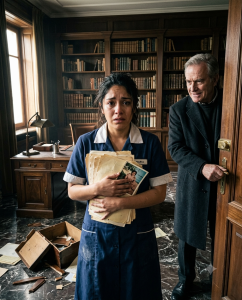
She gasped, grabbed at empty air, and came crashing down. Her shoulder clipped something hidden on the top shelf—a large old wooden box shoved deep in shadow. It tipped, wobbled once, then plunged to the floor with her.
The crash exploded through the room.
Valeria hit the rug hard. The box struck the marble and burst apart, splintering at the corners. Papers flew loose in every direction. Several photographs spun across the floor and landed face-up.
For two full seconds she did not move.
Then panic seized her.
She scrambled onto her knees, listening for footsteps. None came. She started gathering everything as fast as she could, stacking pages blindly, trying to ignore the pain in her hip and shoulder.
That was when one photograph made her stop.
A child stared up at her from the floor.
Dark eyes. Familiar mouth. Hair tied with a ribbon she suddenly remembered hating because it always slipped loose.
It was her.
Valeria stared so long her vision blurred. Her hand shook as she turned the photograph over. There was a date. Her name. A note in faded ink.
Beneath it lay an original birth certificate.
She unfolded it.
Her mother’s name was there.
So was her father’s. A man Elena had always said died before Valeria could remember him.
And another name appeared in the family notation—Arturo.
Her chest tightened.
She reached for the thicker document beside it, yellowed but intact, stamped and notarized. It was a will. Her grandfather’s last testament.
At first the legal language made no sense. Then the names aligned. The estate. The succession order. The clauses regarding incapacity and descendants. Her mother was the principal heir. If Elena was unable to take control, the inheritance transferred to her daughter—Valeria.
Not to Arturo.
Never to Arturo.
Valeria read faster, pulse hammering. More documents lay underneath: letters between attorneys, a private statement from a family accountant, insurance reports, and a witness declaration that referred to “the arranged accident” and “pressure to suppress the surviving branch’s claim.”
The room seemed to shrink around her.
Her mother’s crash had not been chance.
It had been arranged.
And while Elena spent two decades in pain and poverty, Arturo had taken the estate, the mansion, the fortune, and the family name. He had buried evidence in a wooden box and then hired the rightful heir as a servant in her own home.
“Dios mío,” Valeria whispered. “He’s not my boss. He’s my uncle.”
She remembered every insult at once, each one now transformed into something fouler. He had known. Or suspected enough. That was why he kept her close, degraded, invisible. It was safer for him if she believed she belonged on the floor.
A wave of rage rose so powerfully it made her dizzy.
She thought of her mother selling jewelry piece by piece. Of empty refrigerators. Of delayed treatments. Of nights when Elena cried quietly, thinking Valeria was asleep. She thought of herself kneeling on marble, polishing furniture bought with the life stolen from her family.
Valeria grabbed the documents and stood.
She would go straight to the police. No, first she would photograph everything. No, first she had to get out of the room. Her mind raced in jagged fragments.
Then came the metallic click.
She turned.
The study door was shut.
Don Arturo stood with one hand on the key.
He should have been on a plane. Instead, he leaned against the door as if he had never left at all. His expression was calm, but his eyes had gone flat.
He looked at the papers in her arms, then at the shattered box.
For a moment neither of them spoke.
Then he smiled.
“I told you to clean the dust, you wretch,” he said softly. “You are not leaving this room alive.”
Fear hit her with such force it almost emptied her body. But beneath it, something harder was already rising. He had spent years training her to be quiet. He expected panic. He expected obedience. He expected her to beg.
Instead, Valeria looked around the room.
Desk. Lamp. Intercom panel. Broken wood. Heavy curtains. One locked door. One man between her and it.
Arturo moved first, stepping toward her with a hand extended for the papers.
Valeria reacted on instinct.
She hurled herself sideways and smashed the broken lid of the wooden box into the brass base of an antique lamp. The lamp toppled off the desk and shattered across the floor with a deafening blast of glass and metal.
Arturo flinched.
That fraction of a second was enough.
Valeria slammed her palm onto the black intercom button embedded near the desk edge—the one she had seen him use countless times to summon staff.
A tone sounded, and the study’s speakers snapped live.
“Give me those papers!” Arturo roared, lunging after her.
His voice boomed into the hallway.
Valeria screamed.
Not a startled yelp. Not a cry for help softened by shame. She screamed from the bottom of her lungs, a sound so raw it seemed to tear the room open.
Arturo grabbed her wrist. She twisted, and the birth certificate slipped from her hand on purpose. A second later the will slid across the polished floor and stopped under the door, its official seal clearly visible in the gap beneath.
“You killed my mother for this inheritance!” Valeria shouted.
Silence answered from the hall.
Then pounding footsteps.
Arturo’s face changed.
She would remember that expression for the rest of her life. Not rage. Not superiority. Fear.
Someone outside was trying the handle. Someone else was shouting. The house manager’s voice. Then the driver’s. Then another voice Valeria knew but had not heard in weeks.
Her mother’s.
Earlier that morning, Elena’s clinic appointment had been canceled at the last minute, and the neighbor who sometimes drove her had brought her to the mansion to ask Valeria for the pharmacy card. The guard, recognizing her as the maid’s mother, had let her wait inside because of the rain. She had made it upstairs just in time to hear the shouting through the door.
“Elena?” Arturo breathed, stepping back as if he had seen a ghost.
The sound of keys rattled outside. The house manager was crying now, saying the spare didn’t fit. The driver cursed and threw his shoulder against the door. Once. Twice.
Arturo turned toward the fireplace, perhaps calculating another exit, but Valeria saw something in the papers she still held—a signed confession draft from the old family accountant, naming Arturo directly and stating where duplicate ledgers had been hidden. The man had apparently written it years earlier and kept a copy. Arturo must have recovered one version and hidden it away, but not before the signature was witnessed.
Valeria raised the page high.
“It’s over,” she said, though her voice shook.
Arturo came at her again.
The door burst open at that exact second.
The driver hit Arturo first. The house manager rushed to Valeria. Elena stood in the doorway gripping her cane so tightly her knuckles were white, her face drained of color as she looked from her daughter to the papers to the man she had feared and doubted for twenty years.
“You,” Elena whispered.
Arturo tried to recover his polished mask. “This is a misunderstanding.”
But the intercom was still live.
His threats had been heard downstairs by two kitchen workers, the groundskeeper, and a security guard. The will lay in plain sight. The smashed box spilled old photos and letters across the floor. And Valeria, shaking but upright, placed the signed statement into her mother’s hands.
The police arrived within twenty minutes.
Once officers began sorting the documents, the case expanded with terrifying speed. Search warrants uncovered hidden financial records in a safe behind the study wall. Bank trails linked Arturo to the transfer of estate assets after Elena’s crash. Retired employees came forward. So did an attorney’s former assistant who admitted she had been ordered to file altered documents years earlier. The mechanic who once inspected Elena’s wrecked vehicle testified that he had been pressured to change his report.
The country that had admired Don Arturo watched his face on television that night for completely different reasons.
No longer the smiling philanthropist, he was led down courthouse steps in handcuffs while reporters shouted questions about fraud, attempted murder, inheritance theft, and unlawful imprisonment. Every network ran the story. Every newspaper printed the same unbelievable line: the millionaire had forced the true heir to work as a maid in the mansion he stole from her family.
The legal battle lasted months, but the evidence was overwhelming.
The court restored the estate to Elena and Valeria as lawful heirs. Much of the fortune had been moved and concealed, but enough was recovered to change their lives completely. The mansion, the accounts, the properties—piece by piece, the stolen legacy returned.
Valeria’s first act as owner was not to throw a celebration.
It was to convert one wing of the estate into a rehabilitation center for women recovering from trauma and financial abuse. Her second was to ensure every worker in the house received contracts, benefits, and wages no one had to beg for.
As for Elena, she finally had access to specialists, treatment, and comfort she should have had all along. Recovery was slow. Some injuries never fully disappeared. But for the first time in decades, her pain was no longer sharpened by helplessness.
One evening, months later, Valeria stood in the same study where everything had changed. The room looked different now. Lighter. The curtains open. The air clean. The broken box had been removed, but she kept one photograph from it—her childhood picture, the one that had stopped her heart on the floor that day.
Elena entered quietly and stood beside her.
“You know,” her mother said, looking around the room, “I used to think the worst thing he took from us was money.”
Valeria turned to her.
Elena shook her head. “It was time.”
Valeria understood immediately. The stolen years. The fear. The humiliation. The life they might have lived.
And yet, standing there together, neither of them felt only grief.
There was anger, yes. There was sorrow. There was the permanent ache of what had been done. But there was also something steadier now—truth, finally spoken aloud. Justice, imperfect but real. A future built not on silence, but on what had survived it.
People in the city still argued about the case long after the trial ended. Some said Arturo’s downfall was inevitable because evil always leaves cracks. Others said the bigger scandal was how many people had looked away while he performed goodness in public and practiced cruelty in private. Many asked the same question when they heard Valeria’s story: what was the first red flag?
Maybe it was the way he enjoyed humiliating someone who could not fight back.
Maybe it was how carefully he controlled every room, every paper, every version of the past.
Or maybe the biggest warning sign was this: truly decent people do not need witnesses to behave like human beings.
Valeria had entered that mansion as a maid who believed survival was the best she could hope for.
She left that room as the woman he had feared all along—the rightful heir, the living proof he had failed to erase, and the reason the empire he built on stolen blood finally collapsed.