She didn’t go there for revenge.
She went because she was invited.
That’s the part nobody in that VFW hall understood — not Dale, not his golf buddies in their polo shirts, and certainly not Carol, who had spent the better part of fifteen years making sure everyone in Tupelo knew exactly what kind of woman Loretta Burch was.
Broke. Bitter. Behind.
Loretta had heard all three words so many times they’d stopped stinging somewhere around 2012.
She stood in the parking lot of the VFW hall on a warm Tuesday evening in her old navy blazer — the one with the gold buttons she’d bought the year her mother passed — and she turned a small brass key over and over in her palm. Just a habit. Something to do with her hands when her heart was beating a little faster than she liked.
She dropped the key into her blazer pocket and walked through the door.
—
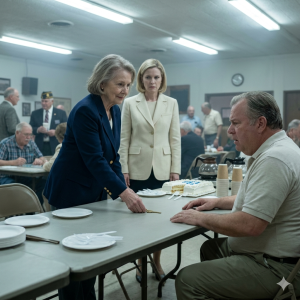
The hall smelled like every VFW hall in Mississippi. Folding tables. Sheet cake. Coffee that had been sitting since three o’clock.
There was a banner: CONGRATULATIONS DALE — 30 YEARS IN BUSINESS.
Loretta got herself a cup of punch and found a spot near the window.
Nobody came to greet her. She didn’t expect them to.
She watched Dale work the room — bigger than she remembered, laughing that big Dale Burch laugh, shaking hands with the men who’d bought lumber and PVC pipe from him for thirty years. He looked happy. She was glad for that, genuinely. Whatever had broken between them had broken a long time ago, and she’d made her peace with the pieces.
What she had not made her peace with was Carol’s voice cutting across the room like a cake knife.
“Oh, Loretta.”
The whole table went quiet.
Carol walked toward her in a cream-colored blazer that probably cost more than Loretta’s truck payment, smiling the kind of smile that isn’t a smile at all.
“I didn’t think you’d actually come.” She said it loud enough for eight people to hear. “Bless your heart. Is that the same blazer from the Rotary dinner back in — what was it, 2010?”
A few nervous laughs.
Carol wasn’t done.
“I always told Dale — I said, Dale, Loretta didn’t drag out those divorce papers because she was heartbroken.” She paused for effect. “She dragged them out because she was too broke, and too proud, to let go.”
The room held its breath.
Loretta took a slow sip of punch.
She reached into her pocket and turned that little brass key over in her palm — once, twice — the way she’d been doing all evening. A few people glanced at it. Her car key, they probably figured. Old Loretta, always got one foot out the door.
She set her cup down.
“Carol,” she said pleasantly, “you might be right about the proud part.”
—
Here is what Carol did not know.
Here is what almost nobody in that room knew.
For fifteen years, while Dale’s hardware store grew and expanded and won Small Business of the Year two times running, Loretta had been doing something quiet.
Something patient.
She’d taken the money from her mother’s estate — not much, but enough — and she’d bought a little piece of property on Commerce Street. Then another. Then the empty lot beside it when the florist retired. Then the building on the corner when the old insurance agency closed.
One by one. Year by year.
Every piece of commercial property on the street where Dale’s hardware store stood.
She hadn’t told a soul.
Not because she was hiding it. But because nobody had asked. And Loretta Burch had learned a long time ago that a woman who waits quietly and works quietly tends to end up somewhere the loud ones never expected.
She turned the key over one more time.
—
Carol cornered her by the punch bowl twenty minutes later, voice dropped low now, the party-smile finally gone.
“I think it’s time for you to go,” she said. “This is our night. You know that.”
Loretta looked at her for a long moment.
Then she looked at Dale, who had drifted over, sensing something, the way men drift when they know trouble is forming but can’t yet name it.
She picked up that little brass key — not a car key, it turned out, was never a car key — and she set it on the folding table. Gently. No drama. The way you’d set down something you’d been carrying for a long, long time and finally didn’t need to carry anymore.
And she slid it across the table toward Dale.
He looked down at it.
His face changed.
And that’s when the door to the VFW hall swung open, and Dale’s business partner Gary walked in — white as communion bread, phone pressed to his ear, eyes finding Dale across the whole length of that room.
He said, “Dale.”
He said, “We need to talk.”
He said, “Right now.”
The sheet cake sat untouched.
Nobody was laughing anymore.
—
Dale picked up the key.
He held it the way a man holds something he recognizes but can’t immediately place — the way you’d hold a coin from a country you visited once, twenty years back. Turning it. Reading it with his fingers before his brain caught up.
It was a small brass key, worn smooth on one side, with a number stamped into the bow. The number was 114. And underneath the number, in letters so small you had to squint: Commerce St. Properties LLC.
Loretta watched his face do the math.
She’d seen Dale do math her whole married life. He was good at it when it was lumber and pipe fittings and quarterly invoices. He was slower when it was things that mattered.
“Loretta,” he said. Just her name. Just that.
“It’s the master,” she said. “For the building. I had the locks rekeyed last month, so that one’s no good anymore, technically. But I thought you’d want to hold it.”
Gary had made it across the room by then, still holding his phone, still the color of old chalk. He looked at the key in Dale’s hand. He looked at Loretta. Something moved across his face that wasn’t quite surprise, because Gary, unlike most people in that room, had done enough business in Tupelo to know that names on deeds don’t always match the names you expect.
He’d known for about six weeks, Loretta figured. Long enough to lose some sleep over it, but not long enough to say anything to Dale. She didn’t blame him. It was a hard thing to bring up.
“Your lease,” Gary said to Dale, and his voice came out rough, like he’d been talking too much or not enough. “The building lease. It came up for renewal next month.”
“I know when my lease comes up,” Dale said.
“The owner reached out,” Gary said. “Through a property management company down in Jackson. I’ve been trying to figure out who we were actually dealing with.” He looked at Loretta again. “It’s her.”
The room had gone very still. Not politely-conversation-paused still. Genuinely still, the way a room gets when something real is happening and everyone present understands they are witnessing it.
Carol had not moved from her spot near the punch bowl. Her cream blazer suddenly looked like a costume.
Dale set the key down on the table. He didn’t slide it back. He just set it down, and he looked at Loretta, and he said, “How long?”
“I bought the first parcel in 2009,” she said. “About eight months after the divorce was final. Your building came available in 2014 when Don Attaway retired and moved to Destin. I almost didn’t buy it.” She paused. “I’m glad I did.”
“You’ve been my landlord,” Dale said slowly, “for ten years.”
“Eleven, come October.”
Gary made a sound that wasn’t quite a laugh.
Dale looked at the key on the table. Then he looked at his partner. Then he looked back at Loretta, and something shifted in his expression — the bluster gone, the party-host warmth gone, something older underneath, something that recognized her.
“Why didn’t you tell me?”
It was a fair question. She’d thought about it enough.
“Because it wasn’t your business,” she said, “until it was.”
—
What happened next was not dramatic in the way Carol had probably hoped some part of the evening would be dramatic.
There was no shouting. No tears. No moment where Loretta produced papers and said she was taking the building and Dale’s thirty years of work along with it.
That was never what the key was.
The key was a conversation she’d been waiting fifteen years to have — not to win something, but to finish something. To stand in front of the man she’d been married to and the woman who had made a sport of her poverty and say, without saying it in so many words: I was always going to be fine. I was always working. You just weren’t watching.
She’d reached out to Gary three weeks earlier through the property management company in Jackson. She’d offered Dale a long-term lease — twenty years, fixed rate, below market, the kind of rate that let a hardware store stay a hardware store and not become a smoothie franchise. The only condition was that she wanted to deliver the paperwork herself. In person.
Gary had thought that was unusual.
Gary had agreed.
The paperwork was in Loretta’s car. A manila envelope on the passenger seat, held shut with a binder clip. She’d go get it in a minute.
But first she let Dale sit with it.
She owed him that, she figured. The sitting with it. The understanding that the woman he’d watched go quiet and go away had been out there in the world the whole time, doing something patient and real.
After a moment, Dale Burch did something she didn’t expect.
He laughed.
Not the big room-working laugh she’d heard all evening. Something smaller. Private. The laugh of a man who has just understood a joke that took fifteen years to reach its punchline.
“Your mother’s land money,” he said.
“Mostly.”
“I always wondered what you did with that.”
“I know,” she said. “You never asked.”
He nodded at that. Took it the way it was meant. Not as an accusation. As a fact.
—
Carol left before the cake was cut.
Loretta noticed. She didn’t say anything about it. Some exits don’t need commentary.
She went out to her car and got the manila envelope and brought it back in and handed it to Gary, who looked like a man who had aged four years in forty minutes but was beginning to feel that he might survive the evening. He shook her hand. Dale shook her hand too, and held it for a moment, and said, “I’m glad you came, Loretta. I mean that.”
She believed him.
She stayed for cake. It was good cake — white with white frosting, the kind that’s never as fancy as it looks and always tastes exactly like a birthday is supposed to taste.
One of Dale’s golf buddies, a man named Phil she’d never liked much, sidled up and said, “So you own the whole block?”
“Most of it,” she said.
He nodded with the slow, recalibrating nod of a man updating his files. “Well,” he said.
“Well,” she agreed.
—
She left around nine, while the crowd was still thinning and someone had put George Strait on the speaker system and a few of the older couples were finding reasons to stay.
She walked through the parking lot in her old navy blazer — the one with the gold buttons, the one Carol had tried to make her ashamed of — and she got in her truck. The same truck she’d been driving for six years, with the cracked dashboard and the radio that only got three stations reliably, because when you are building something patient and real you do not spend money on things that don’t compound.
She sat for a moment in the dark.
She didn’t feel triumphant. She wanted to be honest with herself about that. She felt something quieter. The particular relief of a woman who had carried a thing for a long time and finally set it down — not on the table in front of her ex-husband and his new wife and all those people in their polo shirts, but here, in the parking lot, alone, in the dark, where it was just her.
She’d built something.
Not out of anger. Not out of spite. Out of her mother’s hard-saved money and fifteen years of Tuesday mornings reading property listings and talking to agents who didn’t take her very seriously at first and then did, and then very much did.
Broke, Carol had said.
Loretta started her truck.
The three stations were all playing commercials. She drove home in the quiet.
She had an early meeting in the morning — a developer from Memphis who wanted to talk about the corner lot. She was not in a hurry to sell it. But she was always willing to listen.
That was the thing about patience.
Once you learned it, it stopped feeling like waiting.
It just felt like knowing you had time.