She didn’t say a word when they read her name.
Not one single word.
Just smoothed a small brass button on the lapel of her blazer — the same button, people would later notice, that she’d been touching all morning — and waited.
—
Thirty years ago, Marvette Cousins drove four hours from Statesboro to Savannah in a dress she’d saved up three paychecks to buy.
She was twenty-six. In love. Convinced that love was enough.
The Whitmore garden party was everything she’d ever seen in magazines and never believed was real — white linen, silver trays, gardenias floating in crystal bowls. Marvette stood at the edge of the lawn holding a glass of sweet tea she was afraid to drink, watching for the man who had promised to introduce her to his family that afternoon.
He never came to find her.
His mother did.
Margaret Whitmore didn’t raise her voice. She didn’t have to. She simply appeared at Marvette’s elbow with two of her husband’s associates flanking her like parentheses, smiled the kind of smile that has no warmth in it anywhere, and said, “I think there’s been a misunderstanding about the invitation.”
They walked her out through the side gate.
Not the front. The side.
Marvette sat in her car for eleven minutes before she could make her hands work well enough to start the engine. She drove home. She did not cry until she reached the county line.
The next morning she found a small brass button on her passenger seat. She had no idea where it had come from — it didn’t match anything she owned. She almost threw it away.
She didn’t.
—
Here is what the Whitmores did not know about Marvette Cousins.
They didn’t know she had enrolled in night school that same fall.
They didn’t know she had a mind for numbers that her professors called, in carefully measured academic language, *exceptional.*
They didn’t know she would spend the next decade building a quiet, careful, almost invisible career in real estate investment — buying distressed properties in small markets, holding them, selling at exactly the right moment, reinvesting every dollar.
They didn’t know any of this because people like the Whitmores, once they’ve escorted someone out the side gate, stop thinking about them entirely.
That is almost always their biggest mistake.
—
Marvette was fifty-six years old when she read about Whitmore Hall going to auction.
The estate had been in the family for four generations. The main house — fourteen rooms, original heart pine floors, a wisteria arbor that the *Savannah Morning News* had photographed for their Sunday section three separate times — sat on four and a half acres bordering the marsh.
The family was selling because they had to. Medical debt. A bad business decision by the youngest son. The kind of quiet financial unraveling that happens behind closed doors and good curtains until suddenly it doesn’t.
Marvette read the listing on a Tuesday evening.
She touched the brass button she’d had re-sewn onto the cuff of her cardigan — she moved it from garment to garment, had for years, though she’d never once explained this habit to anyone — and she sat very still for a long time.
Then she called her attorney.
—
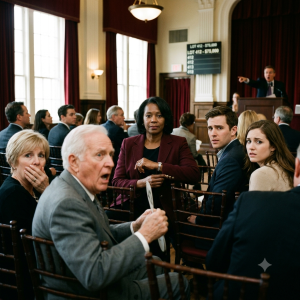
The auction was held on a Thursday morning in late October.
The Whitmore family arrived in two cars and sat in the front row in a cluster — Margaret, now eighty-one, still upright, still composed, her reading glasses on a pearl chain. Her daughter Cecelia. The youngest son, the one responsible for most of the trouble, staring at the floor.
Marvette arrived alone.
She wore a deep burgundy blazer, structured and clean, and if you looked closely — a few people did, later — you could see a plain brass button at the left cuff that was ever so slightly different from the others. Older. More worn.
She sat four rows back.
Margaret Whitmore glanced over her shoulder once, the way you do when you sense something in a room without knowing what it is. Her eyes moved across Marvette’s face without a flicker of recognition.
Thirty years is a long time.
Or it isn’t. Depending on which side of the side gate you were on.
The auctioneer called the room to order. He explained the terms. He noted that there had been significant prior interest in the property and that he had some preliminary paperwork to address before opening the floor.
He cleared his throat.
He unfolded the transfer deed.
He looked up — directly at the Whitmore family seated in the front row, all of them leaning slightly forward, Margaret’s hands folded in her lap — and he read Marvette’s name aloud as the sole bidder who had already paid in full, in cash, three weeks ago.
The room went absolutely still.
And Marvette reached up, smoothed that small brass button at her cuff, and said absolutely nothing.
—
Margaret Whitmore turned around slowly, the way very old women move when they are being careful not to show that anything has surprised them.
She found Marvette’s face. Held it for a long moment.
And something happened in those pale eyes that Marvette had not expected. It was not fury. It was not the cold dismissal from thirty years ago. It was something smaller and more honest than either of those things.
It was recognition. And behind the recognition, something that looked almost like understanding — the particular understanding of a woman who has lived long enough to know exactly what she is looking at when she sees it.
Cecelia grabbed her mother’s arm. The youngest son made a sound that was not quite a word. Two of the family’s associates were already pulling out phones, already calling attorneys who would later confirm what the auctioneer’s paperwork already made plain: the sale was legal, the price had been fair, the process had been entirely correct.
Marvette had made sure of that. She had been meticulous. She had not wanted a wound she could be sued out of. She had wanted a door.
The auctioneer finished his remarks. People began to stand and gather their things. The room filled with the low, particular murmur of people who have just witnessed something they will be describing at dinner tables for years.
Marvette did not move.
She waited until the Whitmore family had filed out — Cecelia steering Margaret by the elbow, the youngest son still not looking up — and then she gathered her folder, capped her pen, and walked to the front of the room to sign the final documents.
Her attorney, a compact woman named Diane who had been watching all of this from the side wall with practiced neutrality, fell into step beside her.
“You want to tell me now?” Diane said quietly. “About the button?”
“Walk with me,” Marvette said.
—
They stepped outside into the October air, which was cool and smelled of the marsh. The oak trees along the drive were full of Spanish moss, and the light was coming through at a low angle the way it does in coastal Georgia in the fall, turning everything gold and slightly unreal.
Marvette stopped at the edge of the parking lot.
She held her wrist up and looked at the button for a moment before she spoke.
“You remember I told you I drove to Savannah thirty years ago. For that party.”
Diane nodded.
“When they walked me out — through the side gate, around the back of the property — I went past the kitchen garden. There was a man out there. Old man, Black, clipping something back. He looked up at me and he could see I was holding myself together by about a thread.” She paused. “He didn’t say anything stupid. He didn’t say it was going to be all right. He just nodded at me, like he knew exactly what had just happened and he was bearing witness to it. Like I deserved that much.”
The moss moved in the faint breeze off the water.
“I got to my car and I sat there falling apart, and when I finally looked up, there was a button on the passenger seat. I think it must have caught on my dress when I walked past him and pulled loose. It looked like it was off a work coat. Old. Brass. Completely ordinary.”
She smoothed it one more time with her thumb.
“I didn’t throw it away because it felt like the only thing that had been given to me that whole day. The only thing that was just — freely given. No conditions on it.”
Diane was quiet for a moment. “Did you ever find out who he was?”
“I tried, a few years ago. I called the estate, before any of this. Said I was researching the property’s history for a potential investment.” A small, dry smile. “Which was true. The woman I spoke to said the only longtime groundskeeper she knew of had been a man named Clarence Odom. Said he’d worked there for thirty-one years and passed away in 2009.”
She looked at the button a moment longer, then lowered her wrist.
“I don’t know if it was him. I’ll never know. But I kept it anyway. Because whoever it was, he saw me. On the worst afternoon of my life, one person saw me and did not look away.”
—
The keys to Whitmore Hall were handed over on a Friday afternoon in November.
Marvette walked through the front gate. The front gate, wide open, the iron latch cold under her hand.
She walked through every room. She took her time. She stood in the kitchen and looked out at the garden, which was overgrown now, the hedges gone ragged and the kitchen beds gone to seed. She stood in the main hallway under the chandelier that needed cleaning and on the heart pine floors that needed refinishing and looked up at the plaster ceiling roses and thought about what things cost and what things are worth, which are very rarely the same number.
She walked out to the side gate.
It was a small wooden gate, weathered gray, half-hidden by an untended camellia that had gotten enormous over the decades. She stood there for a while, her hand on the latch, looking out at the spot where thirty-year-old Marvette had walked through it trying not to shake.
Then she unlatched it, swung it fully open, and left it that way.
—
What Marvette did with Whitmore Hall is not a secret, though it sometimes gets reported wrong.
She did not tear it down. She did not flip it. She did not turn it into something ironic or punishing.
She spent fourteen months and a sum of money she declines to specify on a full restoration. The heart pine floors. The plaster ceilings. The wisteria arbor, coaxed back to life by a horticulturist she flew in from Charleston.
And then she donated it.
The property is now a residential program for first-generation college students from rural Georgia counties — the kinds of places, Marvette said at the dedication, where the talent has always been there and the opportunity has not always followed it. Students spend summers on the property doing research, building professional networks, learning the things that are never in any curriculum: how to walk into a room and stay. How to make your hands work when everything in you wants to fall apart. How to hold something ordinary and unimpressive and understand that it might be the most important thing you own.
There is a small garden in the back that the students maintain. A plaque near the kitchen entrance names it the Clarence Odom Garden, in memory of, though Marvette has always been careful to say that she cannot be certain of the name. She wanted to name it after someone, she told the local reporter who covered the dedication. She wanted there to be a name, because there should always be a name for the person who sees you.
—
Margaret Whitmore died the following spring. Marvette read the obituary. She sat with it for a few minutes, the way you do.
She did not feel what she had expected to feel, which had always been, if she was honest, a complicated thing with a lot of edges on it.
What she felt instead was something quieter. Closer to finished.
The youngest son reached out through an intermediary, about six months later. A letter, formal and somewhat stiff, that managed after three careful paragraphs to arrive at something resembling an apology. Marvette read it twice, put it in a drawer, and did not respond.
She wasn’t cruel about it. She just had nothing to say.
Some doors don’t need to open in both directions. It’s enough that you can walk through them yourself.
—
The brass button is still on her blazer.
She was asked about it at the dedication ceremony by a young woman from Baxley, Georgia, a first-year student named Imani who had noticed it the way attentive people notice things that don’t quite match.
“That button looks different from the others,” Imani said.
“It is,” Marvette said.
“Why do you keep it?”
Marvette looked at her for a moment — this young woman who had driven however many hours to be here, wearing her good clothes, standing at the edge of something she didn’t yet know the shape of, hopeful and careful and working hard not to let it show.
“Because someone gave it to me on a day when I needed to remember that I was worth something,” she said. “And I decided a long time ago that I was going to carry it until I’d made that true enough for other people to see.”
Imani nodded. The way you nod when something lands.
Marvette smiled at her — a real one, all the way up — and said, “Come on. Let me show you the garden.”