She didn’t stand up. She didn’t raise her hand. She just slid a manila envelope onto the empty chair beside her — and the mayor stopped mid-sentence.
But let me back up.
—
Wren Stubbs spent twenty-two years in that library.
Not at the front desk, smiling for photos. Not at ribbon cuttings or grant luncheons or the county commissioners’ banquet where someone always ended up on the front page of the Gazette.
Wren was in the back.
Cataloging. Filing. Writing the curriculum guides nobody asked for but everybody used. Driving to Title I schools in her own Buick on Saturday mornings when the reading scores came back and she just couldn’t sit still about it.
She built the Millhaven County Literacy Initiative from a single cardboard box of donated paperbacks and a folding table in the community room.
Twenty-two years.
And then Patricia Holt — Head Librarian, pearl earrings, firm handshake, the kind of woman who knew how to work a room — called Wren into her office on a Tuesday and explained, very kindly, that the county was “restructuring.” That Wren’s position was being “reimagined.” That Wren, at sixty-one, might want to consider whether this was her moment to “embrace a well-earned rest.”
Wren drove home. Fed her cat, Dewey. Made a pot of coffee.
And she started organizing her files.
—
The memoir came out eight months later.
*Turning the Page: How I Transformed a Community One Book at a Time.*
Patricia Holt’s name on the cover. Patricia Holt’s face on the author photo. Patricia Holt’s story — complete with the Title I schools, the Saturday mornings, the cardboard box of paperbacks — told as if Wren Stubbs had never drawn a single breath in that building.
Wren’s neighbor Ruth called her the morning it hit the library’s display window.
Wren said, “I know.”
Ruth said, “Honey, you need to DO something.”
Wren said, “I am.”
She didn’t explain what.
—
The book launch was a sellout.
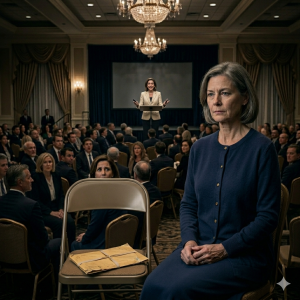
Every folding chair in the Millhaven Public Library community room was filled. The mayor was there. The county commissioners. The woman from Channel 4 who did the human interest segments. Patricia stood at the podium in a cream blazer, signing copies with a Mont Blanc pen, laughing that practiced laugh that carried across a room like a bell.
Nobody noticed the woman who came in late and took the last seat in the back row.
Wren wore her good cardigan — the navy one with the small brass buttons she’d bought for her daughter’s college graduation. She carried a purse, a program she’d picked up at the door, and a manila envelope held shut with a thick rubber band.
She set the envelope on her lap and folded her hands over it.
That was all.
The woman beside her glanced at it once, the way you do when you’re curious but too polite to ask. Wren’s hands stayed right where they were.
Patricia began to speak.
She talked about her vision. Her passion. Her late nights and early mornings. She talked about the children — oh, she talked about the children — and several people in the audience pressed their hands to their hearts.
Wren watched.
Twice during the applause, the woman beside her looked at the envelope again.
Twice, Wren’s hands didn’t move.
At the refreshment break, Wren shifted in her chair. The rubber band had left a faint mark across her palm. She smoothed it with her thumb and tucked the envelope a little closer.
Someone behind her said, “Patricia really is something, isn’t she?”
Wren said, “She really is.”
—
The mayor took the podium for the dedication.
A new plaque, he explained. For the community room wall. Honoring the program that had put Millhaven County on the map — three state awards, two national recognitions, four thousand children served.
Patricia stood to the side, hands clasped, eyes shining.
The applause was warm and long.
Wren’s phone buzzed once against her hip.
She looked down at the screen.
Read the message.
Closed her eyes for just a moment — the way you do when something you waited a long time for finally arrives, and you need one quiet second to let it be real.
Then she reached down.
And she slid the manila envelope — the rubber-banded stack of dated inter-office memos she had been holding in her lap for the last ninety minutes, that she had never once opened, never once explained — onto the empty chair beside her.
She folded her hands in her lap.
She looked at the mayor.
And the mayor cleared his throat, looked down at something someone had just handed him at the edge of the stage, and said:
“Before I unveil this plaque — I’ve just been handed something I think everyone in this room needs to hear.”
The room went very still.
Patricia Holt’s smile did not move.
But her eyes — her eyes went straight to the back row.
—
What the mayor had been handed was a single sheet of paper.
A printed statement, two paragraphs, on Millhaven County Public Library letterhead.
It had been prepared by the county’s own archivist — a quiet man named Gerald Foss who had worked in the basement records room for sixteen years and who, three weeks earlier, had received a very polite, very specific records request from a woman named Wren Stubbs asking for certified copies of every inter-office communication, grant application, program proposal, curriculum document, and budget justification filed under the Millhaven County Literacy Initiative from its founding to the present day.
Gerald had pulled the files.
Gerald had made the copies.
And Gerald, who had his own feelings about the way things sometimes went in that building, had read every page before he sealed them in a manila envelope and called Wren to tell her they were ready.
That was the phone call. That was the message on her phone. Gerald, texting from the lobby: *I’m here. Back row, three seats to your left. I brought a second set.*
The mayor read from the statement slowly, the way people read when the words are landing on them as they go.
He read that the Millhaven County Literacy Initiative had been proposed, designed, funded through grant writing, and operationally directed for its entire twenty-two-year history by a single staff member.
He read her name.
Wren Stubbs.
He read the documentation dates. The original program proposal, filed March 14th, 2001, under Wren Stubbs’s employee ID. The first Title I school partnership agreement, signed by Wren Stubbs. The grant applications — twelve of them, totaling over $340,000 in awarded funding — every one of them researched, written, and submitted by Wren Stubbs.
He read that the certified archivist of record had found no documentation, in twenty-two years of program files, of any originating or directorial contribution by the Head Librarian.
The mayor stopped reading.
He looked up.
The room had that particular quality of silence you almost never hear in a public space — not the silence of people waiting, but the silence of people absorbing.
Patricia Holt had not moved. She was still standing to the side of the podium in her cream blazer with her hands clasped in front of her, and she had the expression of a person who has rehearsed for many outcomes but not, quite, for this one.
The woman from Channel 4 had stopped writing in her notepad and was now holding her phone up.
One of the county commissioners leaned over and said something quietly to the one beside him.
And then a woman in the third row — a young teacher from Eastside Elementary named Ms. Danielle Portis, who had been one of Wren’s Saturday morning volunteers six years ago and who had brought three colleagues with her tonight — stood up.
She didn’t have a microphone. She didn’t need one.
She said, “I know Wren Stubbs. She came to my school in February in a snowstorm because two of my kids were reading below second-grade level and she had a box of decodable readers she thought might help. She stayed four hours.”
She sat down.
A man near the middle stood up next. Retired, in a Millhaven High School booster jacket. He said his granddaughter had learned to read in this building on a Saturday morning and the woman who taught her was not anybody he recognized on that podium.
He sat down.
A third person rose. Then a fourth.
The mayor set down his paper. He looked at Patricia Holt with the careful expression of an elected official who has just felt the ground shift under him and is deciding, in real time, which way to step.
Patricia opened her mouth.
She said, “I want to be very clear that this program was a collaborative—”
And from the back row, for the first time all evening, Wren Stubbs spoke.
She didn’t stand up. She didn’t raise her voice. She just spoke in the same tone she used when she was explaining the Dewey Decimal System to a ten-year-old — patient and exact and entirely without malice.
She said, “Patricia. The inter-office memo dated September 8th, 2003, is the one where you asked me to stop putting my name on the grant submissions and use the department header instead, because it would look more institutional. I still have the original. Gerald has a certified copy.”
She said it the way you state a documented fact.
Because that’s what it was.
—
The plaque was not unveiled that night.
The mayor thanked everyone for coming and said the dedication ceremony would be rescheduled pending a county review. He said it in his public voice, which is the voice that means something has gone badly sideways and he is going to be on the phone with the county attorney before his car reaches the parking lot exit.
The woman from Channel 4 did not leave. She stationed herself near the door and waited, very patiently, for Wren.
Two of the county commissioners stopped to shake Wren’s hand on their way out. One of them, a woman named Carol Sievert who had been on the board long enough to have signed three of Wren’s original grant approvals, held Wren’s hand in both of hers and didn’t say anything for a moment.
Then she said, “I’m sorry it took this long.”
Wren said, “It took exactly as long as it needed to.”
Patricia left through a side door.
She did not stop to sign any more copies of her book. She left behind a half-full tray of petit fours and her Mont Blanc pen on the signing table, and someone later found it and turned it in to the lost and found, and it sat there in a little basket by the front desk for weeks, which some people thought was fitting.
—
The Channel 4 segment ran four days later.
Eleven minutes, which is long for local news. The anchor introduced it as a story about credit and community and the records that tell the truth when people won’t. They showed the original program proposal with Wren’s typed name on it. They showed the grant letters. They interviewed Ms. Portis and the man in the booster jacket and three other people who had come to those Saturday mornings over the years.
They interviewed Wren in her living room, with Dewey asleep on the back of the couch behind her, which Wren had not planned but which looked, as Ruth later said, absolutely perfect.
The reporter asked her what had been in the manila envelope.
Wren looked a little surprised, like she’d almost forgotten about it.
She said, “Nothing.”
The reporter waited.
Wren said, “The envelope was empty. I emptied it three days ago when I realized Gerald was going to bring the certified copies himself. I just — I’d been carrying it for so long, I didn’t quite know what to do with my hands without it.”
She paused.
“I suppose I brought it as a reminder. For myself. That I’d done the work. That the work existed and was documented and was real. I didn’t need to open it. I just needed to know it was there.”
—
The county completed its review in six weeks.
The Millhaven County Literacy Initiative was formally re-credited to its founder. The program’s official records were corrected. The plaque was redesigned.
Patricia Holt resigned her position as Head Librarian the same week the review findings were released. Her publisher, after a quiet conversation, pulled *Turning the Page* from distribution and issued a statement about inaccuracies in the manuscript. The statement did not use words like “plagiarism” or “fraud,” but it didn’t need to.
Wren was offered her old position back.
She thought about it for a week. Fed Dewey. Made a pot of coffee. Talked to Ruth over the back fence on a Sunday afternoon while the neighbor’s dog ran circles in the yard.
She said yes — but not to the old position. She negotiated something new. Director of Community Literacy Programs, with a real budget line, a real title, and a real office that was not in the back.
She started on a Monday.
On her first day, Ms. Portis brought her third-grade class for a tour. Twelve eight-year-olds in a crooked line, some of them holding hands, all of them wide-eyed at the shelves.
One small girl in purple sneakers looked up at Wren and asked, “Do you work here?”
Wren said, “I do.”
The girl looked around at all the books with the expression children get when a place feels like it was made for them.
She said, “You’re lucky.”
Wren looked around too. At the shelves and the light coming through the tall windows and the little girl in the purple sneakers and all the books that had been waiting all this time for hands to open them.
She said, “I really am.”
—
The plaque went up on a Thursday afternoon in early April.
No ceremony. No podium. No Channel 4.
Just Gerald from the records room, who had driven the new plaque up from the county building himself and stood holding it while a maintenance worker got the anchor bolts right. And Ruth, who had insisted on coming and brought a small bunch of grocery store flowers that she held in front of her with both hands like it was a wedding. And Wren, in her good navy cardigan, watching them hang it on the wall of the community room where she had spent twenty-two years building something worth hanging a plaque for.
*The Millhaven County Literacy Initiative. Founded 2001. Four thousand children served. In recognition of Wren Stubbs, whose work made this possible.*
Gerald stepped back and looked at it.
He said, “Looks right.”
Wren looked at it for a long time.
Then she straightened it — just slightly, just a quarter inch to the left — the way she always did with everything in that building that needed to be exactly where it belonged.
She said, “There.”
And that was enough.