She didn’t walk into that ballroom to get revenge.
She walked in because they asked her to.
That’s the part nobody in Santa Fe saw coming.
—
My name is Marlene Seciwa, and for most of my life I have been easy to overlook.
Soft voice. Sensible shoes. A Zuni woman from Gallup who learned silversmithing from her grandmother in a kitchen that smelled like green chile and soldering flux. I never learned how to walk into a room like I owned it.
I never needed to.
What I knew — really knew, down in my hands and my chest — was silver. The weight of it. The way a stone either belongs in a setting or it doesn’t. The difference between a piece made with ceremony and a piece made for a catalog. You can feel it if you know how to feel.
Diane Hartwell did not know how to feel it.
But she knew how to talk about it, and in Santa Fe, that turned out to be worth more.
—
The first time I saw her, she was standing at my vendor table at the New Mexico Indian Market. Twelve years ago. July. The kind of heat that makes the air above the pavement look like it’s dreaming.
She picked up my inlay cuff — the one I’d worked on for four months, the one my daughter called *the good one* — and she turned it over once.
Set it down.
Looked at me like I was a student who had spelled something wrong on the board.
*”Charming,”* she said. *”But the collectors we work with expect a more elevated aesthetic.”*
I smiled. I didn’t know what else to do.
Three days later, the Market committee — the same committee where Diane’s new husband, my ex-husband, now held a board seat — informed me that my table assignment had been rescinded. Indefinitely. Concerns about *quality and presentation.*
I drove home to Gallup.
I kept working.
—
In my jacket pocket, I have carried the same thing for twelve years.
A silver cuff bracelet. Unfinished. Heavy gauge, hand-stamped with a water pattern my grandmother taught me, set with four turquoise stones in hand-cut bezels.
And one empty setting.
Just one. Right in the center. A little silver cup waiting for a stone that isn’t there yet.
People ask me why I don’t finish it.
I tell them I haven’t found the right stone.
That’s true. But it’s not the whole truth.
The whole truth is that I pick it up and I remember the table in the July heat, and the way she set my work down, and I think: *not yet.*
—
I didn’t plan for what happened next. I want to be clear about that.
I just kept working, kept learning, kept writing. Started studying provenance — how to date a piece, how to read the hallmarks, how to tell a 1940s pawn piece from a 1990s reproduction made to look like one. Got certified. Got published. Got called, slowly and then all at once, by museums and auction houses who needed someone who actually knew.
The call from the network came in February.
A nationally televised Native art auction, live from Santa Fe. Hosted by —
Well.
They didn’t tell me who was hosting until I arrived.
—
The ballroom at La Fonda was everything you’d expect. Camera rigs. Lighting that cost more than my first truck. Two hundred people in their finest, and somewhere in New York, two million more watching at home.
I walked in through a side door, the way authenticators do. No one looked up.
I reached into my jacket pocket and felt the weight of the cuff.
Four stones and one empty setting.
*Not yet,* I thought.
And then someone touched my arm — one of the young production assistants, a Diné girl with a clipboard — and she looked down at my hand and went very still.
*”Is that —”* she started.
*”Yes,”* I said.
She looked up at me. Something moved across her face that I recognized. The same thing that had moved across the face of the museum curator in Albuquerque, and the appraiser in Phoenix, and the professor in Flagstaff, when they saw it.
Recognition. Then something quieter than recognition.
She stepped back. She let me walk.
—
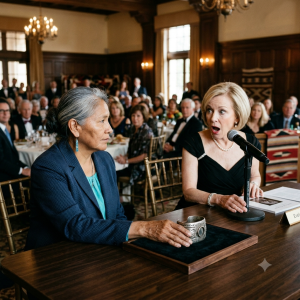
I was already seated at the authentication table when they brought Diane Hartwell to the microphone.
She looked extraordinary. She always did. Red blazer. Silver at her throat — someone else’s work, I noticed. She had the room. She knew how to do that.
She began her introduction. Her voice was warm and practiced, the voice of someone who had built a career on sounding like the most knowledgeable person in every room she entered.
*”And tonight’s authentication expert comes to us with the highest credentials in the field — someone the network flew in specifically because of their unparalleled expertise in historic and contemporary Native American silversmithing—”*
She looked up.
The smile stopped.
Not slowly. All at once. Like a clock someone had yanked the battery from.
I set the cuff bracelet on the table between us — four stones, one empty setting, the water pattern my grandmother taught me — and I said, very quietly:
*”Hello, Diane. I believe you still have the receipt.”*
Two million people were watching.
And Diane Hartwell had forgotten every single word she had ever learned.
—
Let me tell you about the receipt.
Four years after she had my table assignment pulled, Diane opened a gallery on Canyon Road. Hartwell Fine Native Arts. She had a gift for curation, I’ll give her that. The space was beautiful. The lighting was right. She had the kind of clientele who flew in from Connecticut and paid without flinching.
She also had, it turned out, a gift for a different kind of creativity.
I didn’t know this at first. I was in Gallup. I was working. My daughter Rosalie was in middle school and needed new shoes every three months because she was growing like a weed, and I was more focused on that than on anything happening on Canyon Road.
But I had a friend — have a friend, Gloria Tso, Navajo, one of the best beadworkers in the state — and Gloria knew a silversmith named Patrick Chino who had sold three pieces to Hartwell Fine Native Arts in 2016. Consignment. Standard arrangement. He signed the paperwork, left the pieces, and waited for his cut.
The pieces sold. He never got the call.
When he followed up, Diane explained that the pieces had been attributed to a different maker — a deceased Hopi artist with an established auction record — and that the pricing adjustment had consumed the consignment fee. She was sorry. The market was complicated. He was welcome to bring her more work.
Patrick didn’t bring her more work. But he also didn’t know what to do. He was twenty-four years old. She was on the board of two foundations. You do the math.
He told Gloria. Gloria told me.
I started paying attention.
—
Over the next three years, I found seven cases. Seven Native artists — Zuni, Navajo, Hopi, Santo Domingo — whose work had passed through Diane Hartwell’s hands and emerged on the other side with different names attached to it. Sometimes a deceased maker. Sometimes simply *”artist unknown, traditional style, mid-century.”* Always more valuable that way. Always sold to buyers too far removed to ask questions.
The pieces themselves were the evidence. That’s the thing about silver. It remembers. The tool marks, the gauge choices, the bezel geometry — these are as individual as handwriting once you know how to read them. I had published two academic papers by then on exactly this kind of forensic identification. I had testified in a federal case in Arizona.
I knew what I was looking at.
I documented everything. Photographs. Auction records. Provenance paperwork obtained through gallery sales receipts that the buyers, when I contacted them gently and carefully, were willing to share.
And then there was the cuff.
—
The unfinished cuff in my pocket was not the one Diane had picked up at Indian Market. That one I sold, years later, to a woman from Taos who wore it every day and sent me a photograph at Christmas. I still have that photograph.
The cuff in my pocket was made specifically. Made as a document.
When you are building a provenance case, sometimes you need a control piece. A known original, made by a known hand, with known materials, at a known date. Something you can hold next to a disputed piece and say: look. Look at the spacing of these stamps. Look at the depth of this bezel wall. Look at how the solder ran.
Same hands. Same tools. Twelve years apart, but the same.
The fifth piece I had documented — a concho belt sold by Hartwell Fine Native Arts in 2018 as the work of a Zuni master who died in 1987 — was not made by a Zuni master who died in 1987.
I knew this because I knew who had made it.
My cousin Raymond had made it, in 2015, and sold it to Diane Hartwell on consignment for what she told him was a fair price for emerging work, and it had reappeared eighteen months later in a Connecticut estate auction with a provenance certificate bearing a dead man’s name and a price twelve times what Raymond had been paid.
Raymond still had his workbench notes. His stone receipts. A photograph of the belt before it left his hands.
And when you laid the belt next to my control cuff — my unfinished piece — under magnification, the family resemblance was undeniable. Because Raymond learned from the same grandmother I did. In the same kitchen. With the same tools.
That was what the receipt was.
Not a paper receipt. A record in silver. In the hand of my grandmother’s hands, carried forward in both of us.
—
I hadn’t planned to say what I said at the microphone. I had planned to sit at the authentication table, do my job, and let the federal case that had been quietly building for eight months proceed on its own timeline.
I had been contacted by investigators in November. I had been cooperating since December. The timing of the broadcast was not my doing. The network had booked Diane months earlier, before anyone knew what was coming, and by the time the investigators had enough to move, the air date was three weeks out, and everyone decided that the most dignified thing was to let it proceed.
I was asked if I was comfortable.
I said yes.
I did not tell them about the cuff in my pocket. That part was mine.
—
The silence in the ballroom lasted, I think, about four seconds.
It felt much longer.
Diane’s mouth moved once. Then she looked at the cuff on the table, and I watched her understand it — watched her trace the watermark pattern and arrive at the same place I had, the same kitchen, the same hands — and the color left her face in a way that had nothing to do with the lighting.
The producer came out from behind the camera bank. He said something into his headset. Someone in the second row of the audience stood up, and then two more people stood up, and I recognized one of them from a meeting I had attended in December in a building in Albuquerque that did not have its name on the outside.
Diane stepped back from the microphone.
She did not fall. I want to be clear about that. She kept her composure in the way that she had always kept her composure, even now, even here. She was, whatever else she was, not a person who fell apart in public.
But she didn’t speak again that night.
—
The auction proceeded. I authenticated eleven pieces, called two questionable, and flagged one outright — a 1930s Navajo piece that I was ninety percent certain had been re-soldered at some point in the last decade, which changes the insurance category. The buyers were informed. The lot was withdrawn. This is normal work. This is what I do.
Diane was escorted out through the same side door I had come in through.
The two million people watching at home saw the camera cut away and then cut back, and the host who replaced her at the microphone explained smoothly that the show would continue, and it did.
—
The federal charges were filed eleven days later. Wire fraud, interstate transport of misattributed goods, violations of the Indian Arts and Crafts Act. Seven counts. The case named six victims by name.
Raymond was one of them.
I’m not going to tell you that I felt triumphant. That’s not what I felt.
What I felt was tired, and then grateful, and then something I don’t have a clean English word for — something more like the feeling after a long piece of work is finished and you set your tools down and the piece is right. Not perfect. Right.
Raymond called me from his shop in Gallup. He didn’t say much. He said he was glad someone had known how to look.
I told him our grandmother would have known how to look too.
He laughed and said she would have found it faster.
I think that’s probably true.
—
After the broadcast, the Diné production assistant with the clipboard — her name is Shandiin, I found out, she’s twenty-three, she’s from Shiprock — sent me a message through the network’s contact form. She said she had grown up hearing about Indian Market, about what the table meant, about what it cost to lose it. She said she had recognized the cuff because her aunt had shown her photographs of my work years ago.
She said her aunt had a piece of mine. Had it still.
I wrote back and said I remembered making it. That I was glad it had found the right home.
She wrote back and said: *”When you finish the cuff, will you let me know?”*
I looked at the bracelet on my workbench for a long time after that.
—
It took me another three months to find the right stone.
I wasn’t looking in any special place. I was at a show in Tucson, the kind of show where you walk for two hours through rows of dealers and by the end your feet are gone and you’ve seen enough turquoise to fill a swimming pool. Most of it is beautiful. Most of it is wrong.
And then there it was.
A Royston turquoise cabochon, Nevada, blue-green with a matrix that moved through it like water over stone. Oval. Slightly asymmetrical in the way that means it was cut by hand. The dealer was a retired geologist from Reno who had been collecting rough for thirty years, and when I asked him the history he told me more than I’d asked for, in the best possible way.
I held it against the empty setting.
I knew.
—
I finished the cuff on a Tuesday evening in April. Rosalie was home from college for the week, and she sat at the kitchen table doing her reading while I worked, the same way I used to do my homework at my grandmother’s table while she worked, and the smell of the kitchen was soldering flux and green chile because I had made posole and it was still warm on the stove.
When I set the stone and pressed the bezel down, Rosalie looked up.
She looked at the cuff for a long time.
*”That’s the one,”* she said.
I told her it was.
She went back to her book.
—
The cuff is finished now.
It sits on my workbench most days. I don’t carry it in my pocket anymore. There’s nothing left to wait for.
People have asked me if I’ll sell it. A few collectors have offered numbers that would have seemed impossible to me twelve years ago, standing at a folding table in the July heat watching a woman set down my work like it was a lesson she’d already learned.
I tell them it’s not for sale.
That’s true. And it’s the whole truth this time.
Some things you make for the market. Some things you make to know what you know. And some things you make because your grandmother’s hands are in your hands and the stone was always going to be that stone and the only question was whether you had the patience to wait for it.
I did.
I do.
—
I still have sensible shoes.
I still have a soft voice, mostly.
But I have learned, in the last few years, how to walk into a room like I know what I brought with me.
That turns out to be enough.