She walked into the ballroom carrying the same blueprint that had been in her hands the night they destroyed her.
By the time the valet pulled her gray Buick toward the hotel entrance, Beverly Kowalczyk had already gone over the evening in her head so many times it no longer felt like imagination. It felt like choreography. Hand over the keys. Thank the valet. Refuse the champagne. Keep her shoulders straight. Don’t rush. Don’t open the tote bag until she’s standing still.
The Marriott ballroom glowed gold and navy when she stepped inside. Chandeliers glittered overhead. White-jacketed servers crossed the room with silver trays. Framed magazine covers lined the walls, celebrating forty years of Hargrove & Associates: award-winning communities, design features, glowing profiles, smiling executives.
Beverly’s work was on three of those covers.
That part almost made her laugh.
Not because it was funny. Because it was obscene.
No one near the entrance recognized her. A few people nodded politely, the way conference attendees nodded at keynote guests whose names they knew better than their faces. That was fine. She didn’t need recognition yet. She only needed timing.
She smoothed the front of her black dress and slipped one hand into the tote bag at her side.
The blueprint was still there, rolled tight.
So was the envelope.
For a second, just a second, she thought about turning around and leaving. Not because she was afraid of Gary Hargrove. That fear had been burned out of her years ago. What frightened her was something stranger: the possibility that after carrying this proof for seventeen years, the moment might not feel as satisfying as she imagined. That justice, when it finally came, might be too late to matter.
Then she saw one of the magazine covers mounted along the wall.
Caldwell Commons, 2008.
A new standard in community-centered suburban design.
Vision by Gary Hargrove.
Beverly looked at her own rooflines, her own street curves, her own window placements printed under his name.
The doubt disappeared.
She moved farther into the room.
Seventeen years earlier, she had believed in work the way some people believed in prayer. Quietly. Totally. Without irony. She was thirty-six then, six years into her career, eager enough to volunteer for impossible deadlines and humble enough to think eventually that eagerness would be rewarded.
The Caldwell project had consumed her that winter.
The firm wanted a flagship residential development outside Cincinnati, something profitable enough to impress investors but warm enough to charm design magazines. Gary Hargrove wanted it fast. Beverly wanted it right.
She worked late through icy February evenings while the office emptied around her. She stayed long after the cleaning crew began vacuuming conference rooms. She missed family dinners. Missed a cousin’s wedding. Ate dinners from vending machines and cheap takeout cartons. The receptionist once found her asleep at her desk with a scale ruler still in her hand.
But the design came alive beneath her pencils.
She studied how light moved across the site at different hours. She shifted lots to preserve old trees. She widened sidewalks where strollers would pass. She fought for shared green space between clusters of homes so neighbors would actually see each other instead of retreating into isolated boxes. Every detail had a human reason behind it.
She knew it was good.
Not in an arrogant way. In the steady, private way a craftsperson knows when a thing has finally become what it was supposed to be.
Gary praised the project in meetings without once using her name. At first she told herself that was temporary. She was junior. He was the partner. That was how firms worked. Credit flowed upward before it flowed anywhere else.
Then came the client dinner.
The steakhouse on Fourth Street had white tablecloths and amber wall sconces and waiters who spoke in hushed voices. Beverly wore a blue blazer she had bought on sale because she wanted to look competent and serious and worth remembering. She brought the original blueprint in a tube. She thought perhaps Gary would introduce her formally, maybe mention that she had led the residential planning. Maybe let her answer questions.
Instead, before appetizers were served, he stood and thanked the clients for trusting the firm with what he called “my vision.”
Beverly felt cold.
Not angry first. Cold.
He described street arrangements she had sketched. Spoke about sunlight and family use patterns in language she had used in internal memos. The clients nodded, impressed. One of them asked an intelligent question about long-term livability, and Gary answered using a phrase Beverly herself had written in a margin two weeks before.
Then he turned to her.
There were no witnesses later who could ever claim he had looked cruel. That was part of what made it unforgettable. Gary’s expression was smooth. Controlled. Almost fatherly.
He slid an envelope across the table.
“You’re a sweet girl, Beverly,” he said, “but you’ll never design anything anyone would actually live in.”
Inside the envelope was her resignation letter.
Already written. Already dated. Already signed by HR.
The room went very quiet in that specific corporate way where silence is really cowardice in formalwear. Nobody defended her. Nobody challenged him. The clients looked uncomfortable. Her colleagues stared at bread plates and water glasses, waiting for the scene to end with the least possible damage to themselves.
Beverly picked up the envelope. Then the blueprint. Her own original blueprint.
She stood. Walked out. Made it to the parking lot before she started shaking.
She never returned.
What followed was not a triumphant montage. It was years.
Years of humiliation, exhaustion, rent checks, daycare pickups, and strategic silence. Years of hearing that Hargrove & Associates had concerns about her professionalism. Years of realizing rumors travel faster when they flatter power. The firm suggested she had taken proprietary concepts with her when she left. Some people believed it because powerful men often sound most persuasive when accusing others of the crimes they committed themselves.
Then her marriage broke.
Or perhaps it had already been broken and simply chose that moment to stop pretending. Her husband said he was tired of living inside her bitterness. She wanted to ask what he thought she had earned instead. Gratitude? Grace? But by then there was a daughter to feed and no energy left for philosophical debates about betrayal.
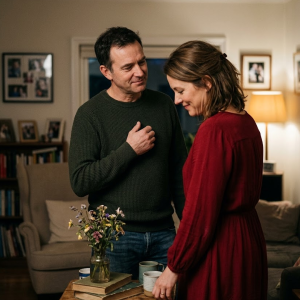
So Beverly downsized to a two-bedroom apartment in Dayton and started over the humiliating way adults start over: one invoice, one interview, one favor, one compromise at a time.
She took small jobs. Home additions. Renovations. Kitchens. Porch conversions. Duplex rehabs. The kind of work firms like Hargrove described with a smile and then forgot to finish respecting. Beverly did not forget to respect it. Families trusted her with real lives, not magazine spreads. They brought her coffee in chipped mugs and apologized for budgets she already understood. They told her how they actually lived—where shoes piled up, where kids did homework, where an aging mother needed light and quiet in the afternoon.
Beverly designed for the truth of people’s lives.
Some nights she came home too tired to speak. Some nights she opened the hall closet, took out the blueprint tube, and held it without unrolling it. Not because she enjoyed pain. Because she refused to let history be rewritten inside her own mind. She knew what she had done. She knew what had been taken. The paper became less like evidence and more like a promise she made to herself: one day there would be a room where this mattered again.
Her daughter Anna grew up watching all of it.
She saw the bills stacked under magnets on the fridge. Heard her mother on the phone negotiating calmly with men who always seemed surprised by competence in a woman’s voice. Watched Beverly come home from site visits muddy, tired, and still somehow dignified. Anna learned early that defeat and disappearance were not the same thing.
In 2011, Beverly opened her own firm.
She named it Ellery Studio, using Anna’s middle name because she wanted the company tethered to something no man could ever strip from her and claim he made. The office was small. The cash flow was terrifying. The first months felt like standing on one leg during an earthquake. But the work was good. Then better than good. Clients referred other clients. Contractors who had once doubted her began requesting her on projects. A local paper featured one of her community restoration plans. A regional housing award followed in 2014.
Recognition arrived slowly, then all at once.
By 2019, Architectural Digest called her “the quiet giant of residential design.”
Quiet, she thought when she read it. That was one word for a woman who had survived by learning exactly when not to waste breath.
She clipped the article and tucked it into a drawer beside older things she could not yet throw away.
Then, six weeks before the gala, the invitation arrived.
Embossed heavy cardstock. Formal script. Hargrove & Associates 40th Anniversary Gala. They wanted Beverly Ellery as keynote guest.
At first she assumed it was a clerical mistake. Then she realized what had happened. The firm knew the famous name. The public one. The award-winning founder of Ellery Studio. They did not know—or had not bothered to learn—that Beverly Ellery, their elegant keynote choice, was Beverly Kowalczyk, the employee they had erased.
She sat at her kitchen table and stared at the invitation for a long time.
Anna came in halfway through and read her face before she read the card.
“No,” Anna said immediately. “Absolutely not.”
Beverly looked up. “No?”
“No as in, they do not get to use your success to decorate themselves.”
Beverly considered that. Then she smiled, small and dangerous.
“What if I use their microphone instead?”
Anna took a breath, looked again at the invitation, and the corner of her mouth lifted.
“Then wear the black dress,” she said.
So Beverly RSVP’d yes.
On the night of the gala, she sat through the dinner and watched former colleagues age under flattering lighting. Some she remembered clearly. Some only by posture or laugh. Gary Hargrove, at the center table, had the softened face of a man who had spent years being toasted in public. He had silver at his temples and a gold anniversary pin on his lapel. He looked healthy. Celebrated. Secure.
He had no idea what was in the tote bag at Beverly’s feet.
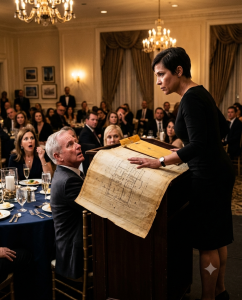
When the emcee finally introduced her as “a visionary voice in American residential architecture,” the applause was warm and automatic. Beverly walked to the podium with measured steps. She placed her notes down, then moved them aside.
Her hand went into the bag.
At first almost no one noticed the rolled blueprint she laid on the podium. But Gary noticed. Beverly saw it happen with exquisite clarity. Recognition moved across his face not like lightning, but like poison entering water. Slow at first. Then everywhere.
She let him sit in that.
“Seventeen years ago,” she said, “someone in this room told me I would never design anything anyone would actually live in.”
A ripple of polite laughter passed through the crowd. Gary gave the faintest dismissive smile, as though ready to endure a harmless anecdote.
Then Beverly removed the rubber band.
The room fell still.
She unrolled the blueprint carefully, flattening the corners with both hands. The paper crackled under the ballroom microphones. A few guests leaned forward. Several older employees recognized the Caldwell layout instantly. You could see it in their faces before they understood why it mattered.
Beverly rotated the paper toward the audience.
At the bottom right sat the original title block, preserved because she had taken the drawing with her the night she was fired.
BEVERLY KOWALCZYK
Lead Residential Designer
The reaction began as pockets of disbelief.
A client in the second row blinked hard and stood halfway from his chair. An older architect at the side table whispered, “No.” Someone dropped a fork. A woman near the back covered her mouth.
Gary Hargrove did not stand. He stared at the title block as if staring could undo graphite.
Then Beverly reached into the tote bag again and placed a second artifact beside the blueprint: the envelope.
“I kept this too,” she said. “The resignation letter I was handed at the same dinner where this design was presented as someone else’s vision.”
Now the room changed. People were no longer politely confused. They were alert. Hungry. Afraid.
A woman with pearl earrings at the front table had gone noticeably pale. Marianne Ellis from HR. Seventeen years earlier, she had been younger, colder, and very efficient. Beverly remembered her signature at the bottom of the resignation letter.
Beverly unfolded the document and raised it.
“Many of you were told I resigned over disagreements about fit,” she said. “About temperament. About whether I understood the market. But this letter was printed three hours before that dinner began.”
Gasps moved through the ballroom.
Gary pushed back his chair. “This is absurd.”
Beverly didn’t look at him. She looked at Marianne.
“Would you like to explain the timestamp?” Beverly asked.
Marianne’s mouth opened. Closed. No words came.
Beverly continued before either of them could regain control. She withdrew one final sheet from the tube, thinner than the blueprint, folded into careful quarters.
“A tracing overlay,” she said. “The one used to alter the submission title block before the final client presentation.”
She laid the translucent sheet over the blueprint. Under the stage lights, everyone could see it: the name placement, the erased original lines, the substitution of Gary’s title block over hers. Even from the back tables, the alignment was obvious.
The room erupted—not in shouting, not yet, but in frantic whispers, chairs scraping, phones lifted halfway. People looked from Gary to Marianne to the paper and back again. Former employees wore the stricken expressions of people reconsidering old memories under a much harsher light.
Gary found his voice first.
“You stole firm property,” he snapped. “You took confidential documents and built a career turning yourself into a victim.”
Beverly finally turned toward him.
“No,” she said, steady as stone. “I took the only proof you hadn’t managed to erase yet.”
He tried to laugh. It landed badly.
“Even if your name was on an early draft—”
“Lead designer,” Beverly said into the microphone. “Original drafting mark. Revision notes in my hand. Time stamps. Overlay removal. Preprinted resignation. HR approval. Should I keep going?”
The room stilled again.
Then a man near the side aisle stood up slowly. One of the original Caldwell clients. Older now, heavier, but unmistakable.
“I remember her,” he said.
Every head turned.
He pointed at Beverly, not Gary. “She was at the dinner. She brought a tube. Gary said she was transitioning out.” He looked at the blueprint, then back at Gary. “We asked a question about the green corridors. She answered before you did.”
That memory did what paper alone could not. It put flesh around the evidence. It restored Beverly to the scene as a person, not just a name in graphite.
Another voice rose from the back—an architect who had once interned at Hargrove.
“There were rumors,” he said quietly. “Back then. That Caldwell didn’t look like Gary’s usual work.”
The quiet cracked wide open after that.
Questions flew from table to table. Who knew? When did they know? How many projects? Was Caldwell the only one? Reporters and guests began filming openly now. Someone from the local business journal was already typing on a phone with both thumbs.
Gary’s confidence started to peel away in visible strips. Anger sharpened his face. Then desperation did. He accused Beverly of staging an ambush. He called the documents misleading, incomplete, unethical to present publicly. Every word made him sound guiltier.
Marianne broke first.
“It wasn’t supposed to go like that,” she said, too loudly, not realizing the microphone had caught enough of it.
The room froze.
Gary turned to her with pure warning in his eyes, but it was too late. Marianne had spent years helping powerful men package cruelty as process. Tonight, under hundreds of staring faces, she looked suddenly old and tired.
“He told me she’d agreed to leave,” Marianne said, voice shaking. “He said title changes were temporary until the client signed. He said…” She stopped, swallowing hard.
Beverly waited.
Marianne looked at the blueprint. “He said the clients would never trust a woman that young to lead the project. He said we couldn’t risk the contract.”
There it was.
No elegance. No strategic euphemism. Just the ugly, ordinary core of it.
Gary lunged toward the nearest microphone, but the emcee had already stepped back from him. People who had spent years laughing at his stories now studied him as though they had discovered rot beneath polished wood.
“You ruined your own career,” Gary barked at Beverly, the last brittle refuge of men who cannot survive truth. “You were emotional. Difficult. You never knew how to play the game.”
Beverly looked at him a long moment.
“That’s true,” she said. “I didn’t.”
She placed one hand on the blueprint.
“I knew how to design neighborhoods people actually wanted to live in.”
The applause started with a single table.
Then another.
Then half the room was on its feet, not because redemption is tidy, but because exposure is sometimes irresistible when people realize which side history is about to take. Gary stood trapped in the middle of his own anniversary gala while the story he had controlled for seventeen years collapsed around him in real time.
By the end of the night, the board had requested an emergency meeting. The reporters had names and photos and timeline confirmations. Three former employees approached Beverly quietly to say there had been other projects, other women, other credits that never quite landed where they should have. A client asked whether she would consider consulting on a redevelopment project. The irony was almost too clean to bear.
Gary left through a side exit before dessert was cleared.
Marianne cried in the hallway.
Beverly stayed long enough to collect her blueprint, the overlay, and the resignation letter. She rolled the paper carefully, as she had done so many times before, but this time her hands did not shake.
Outside, the night air felt cool and astonishingly ordinary. The valet brought her Buick around. She thanked him, slid into the driver’s seat, and set the tube on the passenger side.
For a while she didn’t start the engine.
She just sat there in the dark parking lane with the hotel lights glowing in her rearview mirror and thought about the thirty-six-year-old woman in the blue blazer walking out of a steakhouse carrying a future she had been told was already over.
Anna called before Beverly pulled onto the road.
“Well?” her daughter asked.
Beverly looked once at the rolled blueprint.
“It’s done,” she said.
Anna was quiet for a second. “How do you feel?”
Beverly considered the question honestly.
Not healed. Not triumphant in the movie-ending sense. Seventeen years does not evaporate because a ballroom finally sees what happened. The lost opportunities were still lost. The insult still happened. The younger version of herself still sat forever at that white tablecloth dinner hearing a man tell her nobody would live in what she created.
But the lie no longer belonged to him.
“Lighter,” Beverly said at last.
On the other end of the call, Anna exhaled.
As Beverly drove home through the dark, she thought about all the things people confuse with victory. Public apology. Career consequences. Headlines. Those things mattered, maybe. They would come or they wouldn’t. The board might save itself and throw Gary away. The press might tell the story cleanly or badly. Marianne might finally admit everything or retreat into technical denials. None of that could return the years.
But one thing had changed forever.
In the room where he had erased her, Beverly had placed the truth back under the lights and made everyone look at it.
And maybe that was the hardest lesson of all: the biggest red flags rarely arrive as rage. Sometimes they arrive smiling, prepared, and absolutely certain no one will question the version they have already printed on glossy paper. The real shock wasn’t that Gary stole her work. It was how many people found it easier to believe him until proof became impossible to ignore.
Whether he deserved forgiveness no longer interested Beverly.
What mattered was simpler.
At last, the design had gone home to the right name.