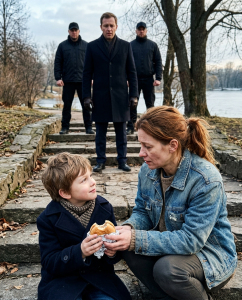
A single mother shared her burger with a sad little boy without the slightest idea who he was.
If she had known, she might have walked away. She might have lowered her eyes, apologized, and hurried back to the bus stop with the kind of caution people in dangerous cities learn too young. She might have told herself it was none of her business that a child in expensive clothes sat alone on cold stone steps staring at the lake like he had nowhere else in the world to be.
But Rosa Hartley didn’t know.
And that ignorance changed everything.
By the time Donovan Crane realized his son was gone, Harbor View Park had become too large to breathe in.
Families drifted between the fountain and the carousel. Teenagers laughed near the food carts. A balloon vendor shouted over the noise. Somewhere a child was crying, somewhere else a dog was barking, and yet all Donovan could hear was the roar of blood in his ears.
He stood very still.
People who knew Donovan feared that stillness more than his anger.
He lifted one hand, and the two bodyguards behind him straightened at once.
“Find him,” Donovan said.
That was all.
Bridge moved immediately, his face drained of color. He had seen Donovan in negotiations with men who later disappeared. He had seen him remain calm during raids, betrayals, and gunfire. He had watched him build a hidden empire out of the shipping lanes and warehouses of Ironport, turning the city’s rotting docks into a private kingdom of favors, silence, and debt.
But a missing child was something else.
A missing child was the one thing that could turn Donovan Crane from feared to reckless.
Toby was seven years old, sharp-eyed, quiet, and too observant for his age. He had learned early how to read the moods of adults, especially his father’s. Since his mother Eleanor died two years before, Toby had grown even quieter, as if grief had taught him not to expect too much from anyone.
Donovan had given him everything he knew how to give.
A mansion with a glass-ceiling playroom. Tutors. Security. Structured routines. The best doctors. The best schools. The best grief counselor in the state.
None of it had brought back the look Toby used to have when Eleanor was alive.
That look—open, trusting, bright—had vanished with her.
The nanny was in tears within minutes, insisting she had only turned away for a moment. One guard checked the bathrooms. Another searched the parking lot. Bridge called men posted at the park entrances. Donovan walked fast but never ran, his coat moving sharply behind him, his jaw tight enough to hurt.
He checked the fountain.
Nothing.
The carousel.
Nothing.
The duck pond.
Nothing.
Every second stretched into something violent.
Then, on the quieter side of the park, partially hidden by a line of leafless trees and an old stone retaining wall, Donovan saw him.
Toby was sitting on a broad set of stone steps beside a woman Donovan didn’t recognize.
For one terrible beat, Donovan thought kidnapping.
Then he saw the child’s body language.
Toby’s shoulders weren’t tense. He wasn’t pulling away. He wasn’t crying or frightened.
He was eating.
Half a hamburger rested in his hands, wrapped in foil.
The woman next to him held the other half. She looked tired in the way poor people often do—deeply tired, not lazily tired. Her denim jacket had been washed too many times. Her sneakers were clean but worn thin. Her reddish hair was tied back in a loose knot that had clearly been done in a hurry. Nothing about her suggested threat.
But something about her stopped Donovan anyway.
It was the softness in her posture.
The ease.
The way she sat beside Toby without crowding him, without performing concern, without trying to charm him.
She had simply made room for him.
“Here, sweetheart,” she said. “You look hungry.”
Her voice carried only because Donovan had gone so quiet inside himself.
He stayed where he was, partly shielded by the trees.
He didn’t know why.
Maybe because he wanted to understand what he was seeing before he shattered it by stepping in. Maybe because Toby’s face looked different. Less guarded. Less old.
The woman smiled lightly. “What’s your name?”
“Toby.”
“I’m Rosa.”
Toby held out his hand as if meeting someone important.
She shook it with a seriousness that made him straighten a little.
“Did you run away?” she asked.
Toby stared at his polished shoes. “They follow me everywhere.”
“Who?”
He shrugged. “Everyone.”
Rosa leaned back on her hands, looking at the lake instead of at him. It was the sort of thing that lets a child keep talking.
“To school. To the garden. When I want to look at ducks. When I don’t want to talk. It’s always someone.”
“And today?”
“I wanted quiet.”
Rosa nodded as if that made perfect sense.
“When I was little,” she said, “I used to sit on staircases because nobody bothered you there. It’s hard to force a smile out of somebody on a staircase.”
That got Toby’s attention. “You were lonely too?”
Rosa let out a breath that sounded almost like a laugh, though there wasn’t much humor in it.
“Yes,” she said. “Sometimes loneliness weighs more than hunger.”
Toby looked down at the burger, then back at her.
“Does it go away?”
“Sometimes not all at once.” She tore a corner off the napkin and rolled it between her fingers. “Sometimes it just gets lighter because someone sits next to you without asking you to be different.”
That was when Toby said the thing that would haunt Donovan long after the moment passed.
“I have a huge playroom,” he said. “Planes. Robots. Electric cars. But I play alone. My dad works all the time. Sometimes I wake up and he’s gone. Sometimes I fall asleep and he’s still not home.”
Donovan felt the words hit him in the chest with such force that for a second he forgot to breathe.
He had always told himself he was doing it for Toby.
Every late-night meeting. Every risk. Every violent compromise. Every expansion of power. Every fortress wall built around the boy’s life.
What good was safety, he suddenly thought, if the child inside it felt abandoned?
Rosa didn’t rush to defend him, and she didn’t criticize a man she had never met.
“Maybe your dad loves you very much,” she said quietly. “Adults get trapped. They start chasing things they think matter and forget the thing they love most is waiting at home.”
Toby smiled then.
It was a tiny smile, quick and uncertain.
But Donovan had not seen it appear naturally in months.
That was the moment he stepped forward.
“Dad!” Toby said, startled and relieved all at once.
Rosa stood quickly. Her eyes flicked from Toby to Donovan, then to the men behind him, taking in the expensive coat, the polished shoes, the unnatural stillness of the bodyguards. Something cautious entered her expression, but she didn’t retreat.
“Oh,” she said. “You’re his father.”
Her hand hovered near Toby’s shoulder, instinctively protective until she sensed the boy wasn’t afraid.
“He’s a good kid,” she added. “We were just sharing a snack.”
For reasons Donovan couldn’t explain, that sentence landed harder than any accusation could have.
Just sharing a snack.
She said it like it was nothing.
He tried to answer with his usual composure, but his voice came out lower and rougher than intended.
“Thank you,” he said. “For staying with him.”
Then, because money had solved nearly every social problem he had encountered for years, Donovan reached into his coat and produced a thick roll of cash.
“Please.”
Bridge looked away. The gesture itself was shocking only because it was so unnecessary. Donovan didn’t thank strangers. He compensated them. He settled them.
Rosa’s eyes dropped to the money. Then she looked back at him.
“Keep it.”
Donovan thought perhaps she hadn’t understood the amount.
“It isn’t charity.”
“I know.”
Her answer was calm, not offended.
“But I gave him food because I wanted to. If I take that, then it becomes something else.” She touched her own chest lightly. “I’m poor, sir. But this part of me isn’t for sale.”
The air changed.
Nobody spoke to Donovan Crane like that.
Nobody refused him without fear, greed, or calculation.
But this woman seemed to possess a kind of dignity that had survived too much damage to be impressed by wealth.
Donovan put the money away.
For the first time in years, he felt faintly embarrassed by the limits of his own language.
Rosa checked a cheap watch on her wrist, said goodbye to Toby, and started toward the bus stop. She didn’t ask Donovan’s name. She didn’t seem curious. She didn’t linger for more money or attention.
She was simply leaving.
Toby watched her go until she disappeared behind a row of parked cars.
At dinner that night, the boy barely touched his food.
“Rosa says the ducks come closer if you stay quiet,” he said.
A minute later: “Rosa has a daughter.”
Then: “Rosa said staircases are good when you don’t want to smile.”
Donovan listened in silence, each mention of her feeling somehow more dangerous than the last. Not because she threatened him. Because she had done in ten minutes what no one in his controlled, protected, expensive world had managed in two years.
She had reached his son.
After Toby was asleep, Donovan sat in his study with the door open to the hallway. From his desk he could see the edge of his son’s bedroom door. It had become a habit after Eleanor died. Sometimes he worked there late just to hear Toby breathing if the house was quiet enough.
Bridge stepped in without speaking.
“There’s a woman,” Donovan said. “Rosa Hartley. Find out who she is.”
Bridge hesitated. “You want contact?”
“No.” Donovan’s answer came too fast. “No one approaches her. No one scares her. I just want information.”
Bridge nodded and left.
He returned just after midnight with a file too thin to contain a whole life.
Rosa Hartley, age thirty-two. Recently arrived in Ironport. One daughter, Madison Hartley, known as Maddie, age six. No active spouse. No family nearby. Temporary work history. Morning office cleaning. Evening waitressing at Bell Street Diner near the station. Previous address in another state. Scattered records. Late rent. No criminal flags. No known local connections.
Donovan turned the pages slowly.
There were printed surveillance photos. Rosa leaving a grocery store carrying discount bread and canned soup. Rosa crouched outside a pharmacy, zipping up Maddie’s coat. Rosa laughing at something her daughter had said, one hand full of laundry, the other holding the little girl’s wrist so she wouldn’t trip stepping off the curb.
It was absurd, but those photographs made him feel like he was looking at a world more precious than his own.
Bridge remained standing. “There’s more.”
Donovan looked up.
“Her landlord served notice. She’s behind on rent. One more missed payment and she and the girl are out.”
Something hard flickered in Donovan’s expression.
“Does she know who I am?”
“No sign of it.”
“And Toby?”
Bridge paused. “He asked whether you were going back to the park tomorrow.”
Donovan lowered his gaze to the photographs again. Rosa’s coat was too light for the cold. Maddie’s shoes were scuffed badly at the toes. The apartment listed in the file was above a laundromat on Mercer Street, in a building Donovan knew should have been condemned years earlier.
He should have closed the file and forgotten her.
Instead he asked, “Anything else?”
Bridge slid the last page across the desk.
“Her ex-husband may have found her.”
Donovan’s eyes sharpened.
“Explain.”
“He called Bell Street Diner tonight asking if she worked there. Asked what shift she was on. The manager denied everything, but Rosa looked shaken after the call. One of our men nearby heard enough to confirm the name matched her file.”
“Is he dangerous?”
Bridge gave a small, careful shrug. “History of drinking. Disorderly conduct. One assault charge dropped when the witness refused to testify. No major convictions.”
In Donovan’s world, that did not mean harmless.
“Does he know where she lives?”
“We don’t know yet.”
Donovan closed the file. A quiet anger moved across his face—not the explosive kind, but the colder version that made seasoned men choose every next word carefully.
The emotion surprised even him.
This was not business. Rosa Hartley was not an asset, ally, or threat.
She was a stranger.
A stranger who had sat beside his son and given away half her dinner because she saw sadness and answered it with kindness.
He looked once more toward Toby’s room.
Then he stood.
The next morning, before dawn had fully broken over Ironport’s rooftops, a black sedan sat parked across the street from the building on Mercer. Inside it, one of Donovan’s men watched the entrance while pretending to read a newspaper.
Rosa emerged just after six-thirty, bundled against the cold, carrying a lunch bag and holding Maddie’s hand. The little girl wore a knitted hat that was slightly too large and kept slipping over one eye. Rosa knelt to fix it, kissed her forehead, and said something that made Maddie grin.
Simple.
Ordinary.
More dangerous to Donovan than violence, because it reminded him of everything he had lost and everything money had failed to rebuild.
By afternoon, Toby was asking about the park again.
Donovan told the nanny to take him.
Then, after a long silence, he said, “I’ll come too.”
The nanny blinked in surprise.
So did Toby.
That afternoon the park looked different to Donovan, or perhaps he was the one who had changed. He noticed the damp smell of leaves near the lake. The rust on the railing by the steps. The cheap paper cups in the bins. The way parents bent down to zip coats, wipe noses, settle arguments over snacks.
Rosa arrived twenty minutes later with Maddie.
Toby spotted her first and lit up so quickly Donovan almost looked away.
“Rosa!”
The woman turned, startled, then smiled despite herself. Maddie hid briefly behind her coat before peeking around it at Toby.
Rosa’s gaze lifted to Donovan. This time she recognized him, not by name, but as the imposing father from the day before. Something cautious returned to her face.
“You came back,” Toby said, breathless.
“I said I might,” Rosa answered.
Maddie studied him with open suspicion. “Are you the lonely boy?”
Rosa nearly choked. Donovan, unexpectedly, felt the corner of his mouth move.
Toby nodded with solemn dignity. “Sometimes.”
The children drifted toward the ducks while the adults stood in an awkward silence broken only by wind over the water.
Donovan spoke first. “I hope this isn’t unwelcome.”
Rosa folded her arms for warmth. “That depends.”
“On what?”
“On whether you came because your son wanted to see a friend,” she said, “or because you had me investigated.”
Most people would never have asked him that directly.
Donovan held her gaze.
“Both.”
To his surprise, Rosa gave a short humorless laugh.
“At least that’s honest.”
“You’re angry.”
“No,” she said. “I’m careful.”
The distinction hit him harder than anger would have.
He looked toward the children. Toby was explaining something intently while Maddie pretended not to be impressed. The sight was almost absurdly gentle against everything else Donovan knew.
“My son doesn’t talk much,” he said.
“I noticed.”
“He talked about you all night.”
Rosa looked away, perhaps to hide whatever that stirred. “He seemed like a child who had a lot to say and nowhere safe to say it.”
Donovan had negotiated with judges, smugglers, union bosses, and killers. Somehow those words were harder to answer than threats.
Before he could respond, Rosa’s phone rang.
She glanced at the screen and went visibly still.
Every line in her body changed.
Donovan saw it immediately.
Fear.
Not ordinary annoyance. Not debt. Not inconvenience.
Fear with history inside it.
She declined the call. It rang again. And again.
Maddie looked over. “Mom?”
Rosa forced a smile that fooled no one.
“It’s nothing, baby.”
Donovan stepped closer, his voice quiet. “Who is it?”
Rosa’s eyes flashed. “That’s not your business.”
Then the phone buzzed with a text. She looked at it, and the color drained from her face so fast Donovan’s chest tightened.
What he saw next was enough.
A message preview.
I know where you are now.
Rosa locked the screen instantly, but too late.
Donovan’s expression changed into something cold enough to freeze the afternoon.
“Who sent that?”
Rosa opened her mouth, hesitated, then looked toward her daughter.
“Nobody I can’t handle,” she said.
But Donovan had already learned one important thing about Rosa Hartley.
She did not lie for herself.
She lied to keep her child from being afraid.
And as he watched Maddie run toward the stone steps while Toby chased after her, Donovan realized with perfect clarity that whoever had just sent that message had made a mistake that would ripple far beyond one frightened woman’s phone.
Because Rosa still didn’t know exactly who he was.
And if the man hunting her forced Donovan Crane to choose between staying out of her life or stepping into it, Ironport was about to find out just how far a father would go to protect the one woman who had reminded his son how to smile.
By the end of that week, Rosa would learn Donovan’s name.
By the end of the next, she would learn what that name could do.
And when the truth finally came crashing down around both of them, the question would no longer be whether Donovan Crane was dangerous.
It would be whether a dangerous man could still become the shelter someone else had been praying for.