My sister made a life-and-death decision about our mother using my name.
I found the folded paper in the pocket of Rosa’s apron while I was looking for the car keys, and for a few seconds I honestly thought I was reading somebody else’s life. The page was creased into fourths, warm from being carried close to the body, stamped by the nursing home, and dated three weeks earlier. At the bottom were two lines for signatures. On one line was Rosa’s name. On the other was mine.
Only it was not my handwriting.
I read it again because sometimes your eyes protect you by refusing the truth the first time. But the truth stayed there in black ink: a do-not-resuscitate order for our mother. Signed. Filed. Approved.
And my sister had forged my name.
I stood there in the garage with the keys in one hand and that paper in the other, staring at the neat, rounded letters. Rosa had always written beautifully, the kind of handwriting teachers complimented. Mine slanted hard and impatient to the right. This one was calm. Careful. Hers.
I should have stormed inside. I should have confronted her right then. Instead I folded the paper back exactly the way I found it and slid it into her apron pocket.
I think some part of me needed one more hour to keep living in the version of the world where my sister was still the good one and I had not just discovered she was capable of choosing death in secret.
Rosa is my older sister. She stayed; I left. That sentence sounds simple, but it carries almost everything important between us.
Fourteen years earlier, I had moved to Tijuana, gotten married, crossed into a life that had distance built into it. I visited when I could. I called more than some daughters do and less than I should have. I sent money every two weeks without fail and let the regularity of it soothe my conscience.
Rosa never got that escape.
When our mother had her first stroke, Rosa was thirty-two and engaged. There was already a ring, already wedding talk, already a future in motion. Then our mother came home from the hospital unable to stand without help, unable to form complete sentences, unable to be left alone for more than an hour at a time.
Rosa left her fiancé.
Just like that.
She moved into our mother’s house “temporarily,” and temporary stretched into eight years. Eight years of lifting, cleaning, turning, feeding, soothing, medicating. Eight years of learning the rhythms of a body that was slowly losing itself. Eight years of half-sleep and interrupted meals and doctor visits and paperwork and the kind of loneliness people praise from a distance because they never have to live inside it.
Meanwhile, I became the daughter who paid.
I wired money every two weeks, covered medications, nursing supplies, specialist visits, anything Rosa asked for and much that she did not. People said I was helping. And I was. But I was also buying something harder to admit: permission not to be there.
Rosa never humiliated me for it. That almost made it worse.
Every Sunday she used to send me a photo of Mom brushed and dressed, cardigan buttoned, sitting in a square of sunlight in the patio. Sometimes there was a cup of tea cooling beside her. Sometimes Rosa would write, “She ate well today,” or “She recognized your voice a little,” and I would cry over my phone for a minute before going back to my own kitchen, my own errands, my own intact life.
I remembered our mother as strong. The market woman with quick hands and a loud laugh, who sold gelatin cups and homemade flan and somehow always made sure we ate before she did. Rosa knew the other version best. The woman who forgot names, dribbled soup, stared into corners, and needed help for every private thing a grown woman should never have to surrender.
Once, early on, I offered to put Mom in a very good facility and pay for everything. Rosa said, “As long as I’m breathing, my mother will not sleep among strangers.”
I hung up feeling small.
That was why the paper in the apron pocket felt impossible. Rosa, who had defended our mother’s dignity like a soldier, had signed a DNR and forged my name to do it.
Then I started noticing what I had ignored.
The Sunday photos had stopped two months earlier. I had told myself she was busy. When I texted, Rosa answered with short messages. “Everything’s fine.” “Don’t worry.” “Get some rest.”
So I called the nursing home pretending to ask about insurance, and the receptionist casually informed me that our mother had been transferred to palliative care three weeks earlier.
The same date on the order.
No one had told me.
I felt anger first because anger is easier than shame. Easier than the truth that perhaps people had stopped informing me because, in all the ways that matter, I had become the daughter who could be updated later.
And then another memory came back, one I wished I could drag behind a locked door and keep there forever.
A month before, I had phoned Rosa crying and furious, demanding that she keep our mother alive no matter what. I said I would pay for tubes, machines, specialists, around-the-clock care—anything. I told her not to dare let Mom go.
On the phone, Rosa had gone silent for a long time. Then she said, very quietly, “You are not here, Mari. You do not see her.”
I hung up on her.
At the time I told myself I was the one fighting for our mother’s life and Rosa was too worn down to care anymore. I told myself exhaustion had made her cruel.
But the truth was uglier.
When I begged Rosa to keep our mother alive, I had a reason I did not share with anyone.
And it had nothing to do with hope.
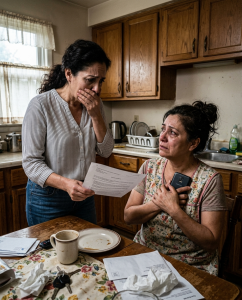
That night, after finding the DNR, I went into Rosa’s room while she was in the shower. I searched because suspicion makes hypocrites of us all. Under her bed I found an empty tissue box, soft and collapsing at the corners from overuse. Not one tissue left. It was the kind of detail you cannot explain away. Rosa had been crying alone long enough to finish box after box.
Then I saw an old cell phone charging on her nightstand.
Our mother’s phone.
We had all assumed it was lost.
The screen lit up when I touched it. Battery full. Notifications cleared. Kept alive on purpose.
The next morning I set the folded paper beside Rosa’s coffee.
“What is this?” I asked.
She looked at it once and said, “It’s what Mom asked for.”
“You forged my signature.”
“Yes.”
She did not flinch. She did not deny it. She did not ask me to lower my voice. Something in me had expected guilt, and when I did not find it, my anger sharpened.
“How dare you decide by yourself that Mom gets to die?”
Rosa set down her mug. When she looked up, I saw something in her face I had not let myself see in years: not sainthood, not patience, just the long, raw cost of carrying too much for too long.
“I cleaned her drool for eight years,” she said. “You sent money so you wouldn’t have to come. Tell me, Mari. Which one of us loved her more? The one who paid, or the one who stayed?”
There are some accusations you cannot answer because your answer would only prove them true. I stared at her, feeling my cheeks burn. Under the table, I reached for my phone and started recording, hand trembling so badly I nearly dropped it.
“You could have told me,” I said.
“Could I?” she shot back. “Would you have listened?”
“You could have waited until I arrived.”
“Waited how long? Another three years? You told the doctor to keep her alive, and you still didn’t come see her.”
Then her voice broke.
“You have no idea what she asked of me. You have no idea how many nights I heard her whisper that she was tired, that she was done, that she wanted to rest. I tried not to fail her. I tried not to fail you.”
“If you were so sure, why hide it?”
She grabbed the old phone from the table and pressed it to her chest. “Because she left you a message, and I knew if you heard it, you’d still make this about yourself.”
That landed because it was true often enough to sting.
I reached for the phone. Rosa pulled back. For one humiliating second we looked like children fighting over something our mother would have ordered us to share. Then I took it from her and hit play.
My mother’s voice filled the kitchen.
Not the broken version from her last years. Not slurred, not confused. Clear. Steady. Earlier. Saved from before the second stroke took most of her speech.
“Mari, Rosa,” she said, and I felt my knees weaken at hearing us together in her mouth.
She said she did not want tubes. She did not want to be forced through one more hospital, one more machine, one more helpless day. She said she was grateful. She said she was tired.
Then she said she wanted both daughters to sign.
Both.
“So neither one carries this alone,” she said.
I closed my eyes.
Rosa had not forged my name to trap me. She had done it because Mom had asked for both daughters, and I had not answered call after call. Rosa had faced the decision by herself and then done the one terrible thing she thought would honor what our mother wanted.
I should have apologized right then. Maybe I would have, if the nurse had not appeared in the doorway at that exact moment.
“The doctor is ready for both of you,” she said. “We need a decision today.”
Rosa stood. I stood. We followed the nurse down a hallway that smelled like antiseptic and old flowers. Somewhere a television was on low. Somewhere else someone was coughing. The ordinary sounds made it all worse.
In the consultation room, the doctor spoke gently, using words like comfort, progression, quality of life, aspiration risk, no meaningful recovery. Rosa listened with the stillness of someone who had already lived through the speech in private. I heard almost nothing because another voice was rising in my head.
The lawyer’s voice.
Three weeks earlier, I had gotten a call that changed everything. A piece of land outside Ensenada—small, overlooked, inherited through some old family tangle—was still in our mother’s name. A buyer wanted it. The value had jumped because of a new development nearby. The amount was not life-changing rich, but it was enough to clear debts, enough to set my husband and me right after two bad business losses, enough to breathe.
There was one problem: the sale needed our mother’s signature while she was still legally able to consent.
If she died first, everything would freeze into probate. Months, maybe years. Lawyers. Delays. Taxes. Family disputes.
So when I called Rosa that month and begged her to keep Mom alive at all costs, it was not because I believed in a miracle.
It was because I wanted time.
Time for one more signature.
The doctor finished speaking and turned to me.
“Mrs. Alvarez, do you agree with your sister?”
Rosa looked at me then. Not hostile. Just exhausted, waiting for me to decide whether I would finally step into the truth or keep hiding behind the language of love.
I could have lied.
I could have nodded, said yes, and buried the reason forever. Maybe that would have been kinder. Maybe it would have let Rosa keep the last decent version of me.
But my mother’s voice was still in my hand through that old phone. Neither one carries this alone.
So I said, “Before you do anything, Rosa needs to hear something.”
I told her about the land. About the lawyer. About the value. About the paperwork. About why I had panicked. I did not dress it up. I did not say it was for the family. I did not say I meant to share it all equally, though maybe I would have. I said the ugliest truth first: I asked you to keep her alive because I needed her signature.
The room went silent.
The doctor looked down. He had probably heard worse, but not from daughters in the same hour they were deciding whether their mother would die.
Rosa stared at me without blinking. The hurt in her face was so clean it almost looked calm.
“So that’s why,” she said.
I started crying. The kind of crying that humiliates you because it arrives after your mask is already gone. “I’m sorry,” I said. “I’m so sorry.”
Rosa laughed once, but there was no humor in it. “Do you know what Mom said yesterday when they tried to flush the tube? She cried. Not because of pain. Because she was embarrassed. She still says sorry when someone cleans her mouth. And you wanted one more signature.”
Every word hit exactly where it should.
I looked at the doctor. “Is she lucid enough? For legal documents?”
He answered immediately. “No.”
That should have ended the part of me still bargaining. Instead it made the shame worse. I had asked for more time even though the thing I wanted was likely already impossible.
Rosa stood up and walked to the window. Her shoulders were rigid. For a second I thought she might walk out and leave me there. Instead she spoke without turning around.
“She knew,” Rosa said.
“Knew what?”
“About the land.”
I stared at her.
Rosa turned back slowly. “Months ago, before she lost more speech, she had me bring the old metal box from her closet. The deed was in there. She made me read it out loud because she couldn’t see well. Then she said, ‘If Mari asks for signatures later, tell her no. If she needs money, help her. But don’t let me be kept here for paper.’”
My breath caught.
“She knew I’d do this?” I whispered.
Rosa’s eyes filled then, but her voice stayed steady. “Mom knew you. She loved you anyway.”
I sat down because my legs could no longer hold me.
In that moment, the story I had been telling myself for years shattered. That I was the practical daughter, the provider, the one keeping everything afloat from afar. Underneath it was something meaner and smaller: I had learned how to convert guilt into money and money into moral permission. Rosa had known it before I did. Maybe my mother had too.
The doctor asked if we wanted a few minutes alone before making the decision. Rosa nodded.
When he left, I said the only thing left to say. “Do what she wanted.”
Rosa looked at me for a long time, measuring whether she could trust those words. Then she gave the smallest nod.
They removed the feeding tube that afternoon and shifted our mother fully to comfort care. Rosa sat on one side of the bed. I sat on the other. Mom’s breathing was shallow, uneven, with long pauses that made my chest seize each time. Her eyes stayed closed most of the evening, but once, just before sunset, she opened them.
I do not know how much she understood. I only know that when Rosa told her, “We’re here,” our mother’s mouth softened.
I took her hand. “I’m sorry,” I whispered, though I could not tell whether I was apologizing for that day or all the years before it.
A little after midnight, she was gone.
There was no cinematic final speech. No magical forgiveness. Just a room that became suddenly, terribly still.
Rosa bent over and kissed our mother’s forehead. I stood frozen until the nurse touched my elbow and asked whether I wanted a moment. I almost laughed at the question. I had wanted a moment for years. A moment to arrive earlier, call back sooner, ask fewer things of a woman who had already given us everything. But moments do not keep. They pass, and then they become the shape of your regret.
The funeral was small. People praised Rosa openly. They praised me politely. I accepted both in silence.
A week later, I met Rosa at our mother’s house to sort through clothes and papers. The old metal box was on the table. Rosa slid the deed toward me.
“The land is still there,” she said. “Probate will be a mess, but it can be done.”
I pushed it back. “I don’t want it.”
“That’s not penance,” she said. “That’s theater.”
She was right, and I hated that she was right.
We ended up agreeing to sell it once the estate cleared and split everything exactly as our mother would have wanted. Half to Rosa. Half to me. Before we closed the box, Rosa added one more envelope.
“What’s that?” I asked.
“Mom’s last market savings,” she said. “Cash she kept hidden in the flour tin. She wanted it used for something joyful.”
I smiled despite myself. “That sounds like her.”
Rosa finally sat down across from me, and for the first time since I arrived, neither of us was standing like a witness on the stand.
“I was going to tell you about the DNR,” she said quietly. “I just… every day got harder. And every day I resented that you got to arrive at the moral part without living the physical part.”
“I know,” I said. “And I was going to tell you about the land after the paperwork. Which is worse.”
She nodded once. “Yes. It is.”
We both laughed then, a broken little laugh, but real.
There was no dramatic reconciliation. No arms thrown around each other. Healing did not arrive like mercy. It arrived like work.
Months later, I still listen to my mother’s voice on that old phone sometimes. Not because it absolves me. It does not. But because in the message she sounded fully herself—practical, loving, unwilling to let either daughter drown alone if she could help it.
She knew Rosa would carry too much.
She knew I would try to hide from what hurt.
She knew us both exactly.
And maybe that is the part I keep coming back to: the most honest person in the room had been the woman lying in bed unable to speak for herself. She saw the fault lines clearly. She knew who would stay, who would run, who would sacrifice, and who would rationalize. She knew mercy could look like betrayal to the daughter who arrived late. She knew guilt could dress itself up as devotion.
I still do not know who was the better daughter.
The one who stayed until staying cost her everything, or the one who paid and called and loved from a safer distance until love became entangled with something selfish.
Maybe that is the wrong question.
Maybe the real red flag was how easily I convinced myself that wanting more time made me noble, when what I really wanted was one more thing from a woman whose whole life had already been spent giving it.