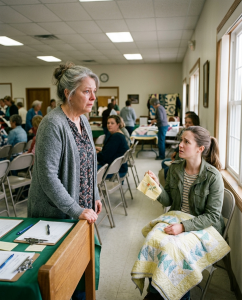
Margaret Elaine Hooper had spent most of her life becoming someone other people found easy to overlook.
She did not do it on purpose at first. It was simply what happened after grief settled into her bones and made noise feel dangerous. She became a woman who smiled politely, remembered birthdays, mailed thank-you notes, and never interrupted. A woman who shelved pain so neatly that even the people sitting closest to her in church had no idea how much of her life had been arranged around one terrible absence.
In Millbrook, Iowa, people described her as dependable.
They said she had a calming presence.
They said she had weathered life well.
Margaret accepted those descriptions because correcting them would have required too much explaining. The truth was less graceful. She had not weathered life so much as learned how to limp through it without letting anyone see the wound.
At sixty-one, retired from the post office after thirty-three years behind a counter and sorting case, she had a house that stayed tidy, a refrigerator covered in church fundraiser magnets, and a front porch with two flowerpots she watered every morning whether the petunias needed it or not. She volunteered at the Millbrook Community Center every third Saturday of the month. She arranged folding tables, sorted donated books, tagged casserole dishes for silent auctions, and wore a name badge that said MARGARET in block letters, as though something as simple as a label could tell people who she was.
The one role that mattered most to her had never once been spoken out loud in town.
Mother.
Not by her daughter.
Not by anyone.
Thirty years earlier, on October 14, 1994, Margaret had given birth to a baby girl at St. Luke’s Regional in Cedar Falls. She had been twenty-nine, unmarried, scared, and living under the heavy practical judgment of a family that did not know how to hold scandal and tenderness in the same hand.
Her father had died years before. Her mother, Dorothea, had tried to be strong in the stern way women of her generation understood strength. There had been no shouting, no dramatic ultimatums, no slammed doors. Just endless conversations filled with phrases like “what kind of life can you offer” and “this may be the loving choice” and “you’re not thinking clearly.”
Margaret had not felt loved by those conversations. She had felt cornered.
The father of the baby, Daniel Mercer, had vanished almost as soon as she told him she was pregnant. He had been charming in the casual, dangerous way of men who were most alive when promising things they never intended to give. He had worked construction off and on, drifted between counties, and treated sincerity like a costume he put on when it got him what he wanted. Once Margaret told him about the baby, he first claimed he would stand by her. Then he stopped answering calls. Then he reappeared angry, accusing, paranoid that she was trying to trap him. Then he disappeared for good.
By the time Margaret went into labor, she had been living inside fear for months.
The adoption papers were placed in front of her less than twenty-four hours after the birth.
She would remember that hospital room all her life. The smell of antiseptic and hand lotion. The rattle of a cart in the hallway. The nurse with kind eyes who avoided looking at Margaret for too long, as if she knew sustained compassion might break something open that could not be repaired. The cheap ballpoint pen that skipped over legal phrases. The weight of her own signature scratching across paper that made the surrender official.
The baby had only been in her arms twice.
That was all.
Twice.
Margaret had named her privately before anyone took her away. Not on the official forms. Not where social workers or agency staff could write it down. She whispered it into the baby’s tiny ear while no one else was in the room.
Anna.
Just Anna.
No middle name. No last name. Just the name that rose from somewhere deep and certain and hurt so much she never said it again.
Dorothea arrived at the hospital carrying a folded quilt.
She had spent months sewing it in silence at the dining room table, pale yellow fabric cut into Flying Geese shapes, each pointed triangle precise and careful. Dorothea was not a sentimental woman in any public way, but she stitched like someone who believed fabric could hold what words could not. When the caseworker came to take the baby, Dorothea pressed the quilt into her hands and said, “Then she should still have something made with love.”
Margaret never forgot that sentence.
Then the baby was gone.
For years after, Margaret survived by avoiding certain thoughts. Not all of them. Just the ones with teeth. She told acquaintances she had never married because life had “gone a different direction.” She let her mother’s silence become her own. When people asked whether she regretted not having children, she smiled and said some things just aren’t meant to be. That answer nearly killed her every time.
She searched when she could.
At first, the search was clumsy. Letters to agencies. Calls that ended with legal refusals. Old records closed to birth parents. Names of attorneys scribbled on napkins. Support groups two counties over where women cried in church basements and compared fragments of information like archaeologists working from bone dust. Later, when laws shifted and technology changed, she tried again with online registries, DNA databases she was too frightened to trust completely, and forms that promised connection but produced nothing.
Years passed. Seasons stacked themselves into decades. Dorothea grew old. Margaret grew careful. Somewhere out in the world, her daughter became a child, then a teenager, then a woman who might walk past Margaret on any sidewalk in Iowa and never know it.
When Dorothea died, Margaret’s grief was jagged in a different way than she expected. She mourned her mother, yes, but she also mourned every conversation they had never had. The apology Dorothea never made. The tenderness she only expressed sideways. The possibility that they had both loved the same baby fiercely and failed her in different ways.
After the funeral, Margaret stayed behind in Dorothea’s small house to sort sewing things from kitchen things, useful objects from meaningless clutter. In the back of a cedar chest she found fabric scraps tied with twine, a biscuit tin full of buttons, several old patterns, and finally the original paper template for the Flying Geese quilt.
Inside it was a note.
I made sure she’d have something to find, if she ever went looking.
Margaret read it once, then again, then a third time because her mind refused to move fast enough.
Tucked with the note was a sketch of the quilt border with a tiny X marked along the bottom edge. A hidden pocket.
Dorothea had done what she always did. She had concealed what mattered in seams and hems. Growing up, Margaret had found emergency money in apron cuffs, spare keys in pillow casings, and handwritten recipes hidden in potholder linings. Dorothea came from women who survived hard years by sewing secrets into what could not be stolen.
Margaret sat on the kitchen floor until her legs went numb, understanding at last what the note meant. Inside the quilt, her mother had hidden a small unfinished square embroidered with the baby’s secret name and birth date. A breadcrumb. A map fragment. A private proof meant only for the person who had reason to search.
It was the most loving and heartbreaking thing Dorothea had ever done.
It also came too late.
The quilt itself was gone.
After the hospital, it had disappeared into the sealed fog of adoption. Years later, after a legal handoff Margaret never traced successfully, the item must have been stored, passed on, donated, sold, or forgotten. It had slipped loose from family history and entered the anonymous river of old belongings.
Margaret wept so hard she frightened herself.
But once the first storm of grief passed, another feeling remained. Hope.
Not the foolish bright kind. The grim stubborn kind. The kind that keeps women alive.
If the quilt still existed, and if the hidden square was still inside it, then maybe one day it would land in the hands of the girl it was meant for. Or in the hands of someone trying to find her. Or, if the world was stranger and kinder than Margaret had allowed herself to believe, maybe it would circle all the way back.
That last possibility felt impossible.
Until it happened.
Two years after Dorothea’s funeral, the annual Millbrook Community Center auction was being assembled in a blur of donated odds and ends—cookie tins, framed mall art, side tables with one good leg, vintage dresses, boxes of Christmas decorations, rusted tools, and a cardboard carton labeled MISC TEXTILES. Margaret was sorting through linens when she unfolded a pale yellow quilt and all the blood rushed from her face.
Flying Geese.
Hand stitching that she knew like scripture.
A small irregularity near the lower border where Dorothea’s thumb had always tightened the final seam.
Margaret sat down hard in the nearest metal chair because her knees no longer trusted her.
The quilt had come back.
She did not tell the auction committee what it was. She could not bear the thought of explaining decades of shame and longing to a room full of well-meaning volunteers. She almost took it home then and there under some pretense. Instead she folded it again with trembling hands and placed it with the other sale items.
Then she made a decision that surprised even her.
She would not buy it.
The quilt had never truly been hers. It had been made for the baby. It had crossed thirty years of distance carrying a message intended for one person. Margaret could not bring herself to interrupt that path now, even if doing so shattered her. So she volunteered at every auction, every sale, every donation event where the quilt might appear, standing close enough to see who was drawn to it and too frightened to ask why.
For two years, nothing happened.
People admired it sometimes. A tourist from Des Moines nearly bought it once but changed his mind after his wife spotted a lamp. A teacher considered it for a guest room but found a cheaper blanket instead. Teenagers unfolded it and laughed about “grandma stuff.” Each time Margaret’s heart rose and fell again.
She started to think maybe Dorothea’s hidden act of mercy would end in a thrift bin or an attic trunk. Maybe the world did not reward faith. Maybe not every message reached its destination.
Then, on a windy Saturday in late October, a woman entered the community center and Margaret forgot how to inhale.
She was around thirty. Brown hair pulled into a practical ponytail. Minimal makeup. A canvas tote slung over one shoulder. She had the alert exhausted look of someone who had driven a long distance while trying to talk herself out of expecting anything. Her eyes moved across the room quickly, taking in exits, tables, faces, objects. She wasn’t browsing the way casual shoppers did. She was hunting.
Margaret noticed the resemblance only in flashes at first. The line of the jaw. The way the woman tilted her head when reading a handwritten label. Something about the mouth when it tightened in concentration. Not enough to trust. More than enough to make Margaret’s pulse pound in her ears.
The woman approached the quilt table and stopped.
For a moment she did not touch the Flying Geese quilt. She simply stared at it. Then she laid her fingertips against the yellow fabric so gently that Margaret felt the contact in her own chest.
When the bidding began, the woman waited through two boxes of kitchenware, a set of deer antlers, and a stack of holiday placemats. When the quilt was raised, she lifted her bidder card once.
Calm. Certain.
No one challenged her.
Margaret watched her win it for thirty-eight dollars.
The woman paid with a credit card. Her hand shook only slightly when she signed the receipt. Then she folded the quilt with reverence and carried it to a chair by the window, away from the crowd.
Margaret stood near the registration table gripping a clipboard so tightly the corners bent.
The woman spread the quilt over her lap.
She ran her fingers along the border.
Margaret’s heart lurched.
This was not admiration. It was recognition, or something close to it. The woman’s hands moved slowly, deliberately, inch by inch, until they reached the lower seam. She pressed there. Paused. Returned. Searched again with patient concentration.
Then she found the hidden opening.
Margaret forgot the rest of the room existed.
The woman slipped two fingers inside and drew out a folded square of pale yellow cloth. She looked startled before she even opened it, as if some instinct had told her that the object had been waiting personally for her. When the square unfolded and the embroidered name came into view, the color drained from her face.
Anna.
Below it, October 14, 1994.
The woman looked up.
Not generally. Not vaguely. Directly at Margaret.
In that instant, Margaret knew two things with a certainty stronger than thought.
First, this was her daughter.
Second, her daughter had not come to Millbrook by accident.
The woman stood. Her chair scraped loudly enough that nearby conversations faltered. She clutched the quilt in one arm and the square in the other hand. Her expression was not simple. It was too layered for that—shock, grief, anger, recognition, and something almost unbearable in its hunger.
“You knew where to find me,” she whispered.
The sentence pierced straight through Margaret.
Not “Who are you?”
Not “What is this?”
Not even “Are you my mother?”
You knew where to find me.
Meaning she had been looking too.
Margaret took one step forward. “I hoped,” she said, though the words came out thin and shaky. “I never knew if—”
The young woman swallowed hard and shook her head as if she were trying not to fall apart in public. “My name is Claire,” she said. “That’s the name they gave me. But when I was fourteen, my adoptive mom told me there had been a baby quilt. A yellow one. She said if I ever found it, I might find something else.”
Margaret’s breath hitched. “Your adoptive mother knew?”
Claire nodded. “Not everything. Just that there was a note once. Not from the agency. Something tucked with old records. She never showed me until she got sick.”
Margaret stared at her. “Sick?”
Claire’s mouth tightened. “She died last spring.”
The words landed with a familiar ache. Two women, two mothers, both gone, both leaving secrets stitched into silence.
Claire lowered herself back into the chair as if her knees had stopped obeying her. Margaret crossed the room and sat in the chair beside her. Neither reached for the other. Not yet. The space between them felt too holy and too dangerous to move through carelessly.
“What note?” Margaret asked.
Claire opened her tote bag and removed a manila folder thick with papers. She handled it with visible reluctance. “Three weeks ago,” she said, “I got an envelope with no return address. Inside was a photocopy of my amended birth certificate, a page from an old hospital admission log, and a note that said, ‘If you want the truth about who gave you away, go where the Flying Geese lands.’”
Margaret closed her eyes for a second.
Flying Geese. Dorothea’s phrase.
Only family should have known it.
Claire continued. “There was also a photo.”
She slid it from the folder.
Margaret’s stomach turned the moment she saw it. The picture had clearly been taken in the hospital room in 1994. Margaret was there in profile, pale and exhausted in the bed. A nurse was passing in the foreground. Near the doorway stood a man half cut off by the frame.
Daniel Mercer.
Older only in the way old photographs age. Still instantly recognizable. The slope of the shoulders. The dark work jacket. The stance that always looked casual from a distance and confrontational up close.
Margaret felt cold all over.
Claire saw the recognition. “You know him.”
Margaret nodded once. “He’s your father.”
Claire stared at her. “He contacted me six months ago.”
The room seemed to tilt. “What?”
“He found me through a DNA site,” Claire said. “Or at least that’s what he claimed. At first he acted like he was doing me a favor. Said he had always wanted to tell me the truth. Said you had abandoned me and your family paid to make sure he stayed away.”
Margaret’s face burned with disbelief and old anger. “That’s a lie.”
“I know that now.” Claire’s voice cracked. “At first I didn’t know what to believe. He had details. Names. Dates. He knew about the hospital. He knew about Millbrook. He said there were things in the records that would prove you didn’t want me.”
Margaret gripped the edge of the chair. “There weren’t records like that.”
Claire nodded, tears threatening. “I started asking questions. My adoptive father got nervous. Then he finally admitted my mother had always suspected there was more to the story. She told him, before she died, that if I ever wanted to search, I should start with the quilt. She said it mattered. She said the woman who made it loved me.”
Margaret’s throat closed.
Claire looked down at the stitched square in her hand. “I didn’t understand what she meant until today.”
For a long moment neither woman spoke. Around them, the auction resumed in awkward fragments, people pretending not to stare. Somewhere coffee was being poured. Someone dragged a box of books across the floor. Ordinary life continued at the edges of an impossible moment.
Margaret gathered the courage to say, “I did not give you away because I didn’t want you.”
Claire’s chin trembled.
“I was frightened,” Margaret said. “And pressured. And too alone. But I wanted you every second. I named you Anna. I’ve been searching for you almost all your life.”
Claire let out a sound halfway between a laugh and a sob. “Anna.”
Margaret nodded. “Only in my heart. I never wrote it anywhere official.”
Claire stared at the quilt square as though the stitched name had just changed the architecture of her life. “I used to hate that there was nothing from before. No real thing that belonged to me. Just paperwork and guesses.” She looked up, eyes red. “And all this time there was a message inside a quilt.”
Margaret almost reached for her then, but footsteps sounded near the entrance.
A man’s voice cut across the room.
“Margaret.”
She turned and saw Daniel Mercer standing just inside the community center doors.
He was older now, heavier in the face, his hair gone mostly silver, but his expression was the same dangerous mixture of confidence and grievance. He held himself like someone who had always believed he could rewrite any scene by simply entering it.
Claire went rigid.
Margaret stood slowly.
Daniel’s gaze flicked to the quilt, the folder, Claire’s face, and finally back to Margaret. “I figured she’d find you here,” he said. “You always were predictable.”
No one in the room pretended not to listen anymore.
Margaret felt thirty years collapse into one hard point inside her chest. “You should leave.”
Daniel ignored her. He took a few steps closer, putting on the falsely wounded tone Margaret remembered too well. “I was trying to help her. She deserved the truth.”
“The truth?” Claire stood up beside Margaret, shaking now not from fear but fury. “You told me she abandoned me.”
Daniel spread his hands. “I told you what I was told.”
“That’s not true,” Margaret said. “You disappeared before she was born.”
His jaw tightened. “You and your mother made sure I had no place.”
Margaret almost laughed at the absurdity, but there was too much pain in the room for that. “You had every chance to stand beside me. You ran.”
Claire looked between them, breathing hard. “Did you take that hospital photo?”
Daniel hesitated half a second too long.
That was answer enough.
Claire’s voice rose. “Did you send me those papers?”
“I was trying to make contact.”
“By lying?”
He turned to her with that old practiced softness. “Claire, listen to me. Families are complicated. Your mother here has always liked to make herself the victim.”
Margaret felt something in her go still. Not weak. Still. The kind of stillness that comes right before truth is spoken without fear.
“No,” she said. “Not this time.”
She looked at Claire, not Daniel.
“When I was pregnant, he wanted me quiet. When I refused, he threatened to make trouble. After the adoption, he came to the hospital once and was turned away. My mother never told me until years later because she thought she was protecting me. I think she was afraid of him.”
Claire’s face changed.
Margaret continued, “The photo must have been taken then, or by someone with him. I don’t know how he kept it. But he kept enough to use against you when it suited him.”
Daniel scoffed, but it sounded brittle.
Claire opened the folder again with quick angry movements. Tucked behind the photocopies was one more page she had not examined closely before: an old unsigned statement with margin notes. She held it up, eyes scanning. Then she stopped.
“What is this?”
Margaret stepped closer. It was a copy of a handwritten report from the hospital social worker. Near the bottom, partly obscured by a bad photocopy, were the words: birth father arrived unannounced… security notified… mother requested no contact.
Claire’s hand began to shake again.
Daniel saw it and moved forward. “That’s being taken out of context.”
Claire stepped back from him as though he were something burning. “Don’t.”
The room had gone completely silent.
“I came here thinking maybe I was going to meet two strangers and choose whose version sounded more believable,” Claire said. “But you walked in already trying to control the room. You lied before I even asked the first question.”
Daniel’s face hardened. The charm dropped away, leaving only resentment. “You don’t know what your grandmother did. You don’t know what kind of people—”
“My grandmother,” Claire cut in, lifting the quilt slightly, “sewed me a message and trusted I would find it. That tells me plenty.”
Margaret’s eyes filled.
Daniel looked around at the watching townspeople and seemed, for the first time, to understand he no longer owned the narrative. He muttered something under his breath and turned toward the door.
No one stopped him.
When he was gone, the room stayed quiet a few seconds longer, as if everyone needed help returning to the ordinary world. Then Margaret’s pastor, who had apparently arrived during the confrontation and was standing frozen near the coffee urn, quietly ushered the nearest onlookers back to their tables. The auction resumed with exaggerated gentleness.
Claire sat down again, all the fury draining out of her at once.
Margaret sat beside her.
For a while they simply breathed in the same space.
Then Claire said, almost shyly, “Did you really call me Anna?”
Margaret nodded, unable to speak.
Claire gave a watery laugh. “I don’t think I’m an Anna. But I’m glad somebody thought I was.”
This time Margaret did reach for her.
Very slowly, as if approaching a skittish animal, she laid her hand over Claire’s. Claire looked at it, then turned her own hand and held on.
That was the moment Margaret broke.
Not loudly. Not dramatically. Just tears sliding down her face while thirty years of held breath finally escaped her body.
Claire leaned into her shoulder.
They stayed like that until the light shifted across the window and the coffee went cold and the world adjusted itself around the fact that they had found each other.
In the weeks that followed, there were more conversations than either of them knew how to navigate neatly. Hard ones. Tender ones. Awkward practical ones about medical history, favorite foods, childhood habits, and all the milestones missed. Claire told Margaret about growing up in Cedar Rapids with adoptive parents who loved her but feared the fragility of the truth. Margaret showed Claire Dorothea’s sewing room, still half intact, and the biscuit tin of buttons that rattled like tiny memories. They looked through old photo albums. They cried over years no one could restore.
Claire did not forgive everyone. She did not need to.
She mourned her adoptive mother even as she cherished what the woman had quietly preserved. She remained angry at her adoptive father for keeping certain papers hidden too long. She cut contact with Daniel after one final message in which she told him blood was not the same thing as fatherhood. Margaret, for her part, stopped punishing herself for surviving a decision made under fear and pressure. The guilt did not vanish, but it loosened enough to let love breathe beside it.
By Christmas, Claire came to Millbrook for dinner.
She brought the yellow quilt.
After dessert, she unfolded it across Margaret’s sofa, and together they inspected the hidden pocket again. Claire tucked the embroidered square carefully back inside, then paused.
“Maybe we should add something,” she said.
Margaret looked at her. “Like what?”
Claire smiled through a familiar ache. “Proof that I found it.”
So Margaret fetched Dorothea’s sewing box. Claire chose matching pale yellow thread. On a new square they stitched a second date—thirty years after the first—and two names side by side.
Anna, for the child who was lost.
Claire, for the woman who came home.
They slipped it into the pocket together.
Sometimes healing looks dramatic from a distance, like reunions in movies and tears at airports. But more often it looks like two women bent over old fabric under a living room lamp, trying to make neat stitches with hands that shake for entirely different reasons.
The quilt stayed with Claire after that.
It had always been meant for her.
But Margaret no longer felt she was losing it when Claire carried it back to Cedar Rapids. The thing that mattered had already happened. The message had arrived. The silence had been broken. The daughter she thought she would never hold again now called every Sunday evening, sometimes about serious things, sometimes just to ask whether a pie crust looked right or to tell her some ridiculous office story.
Thirty years had been taken from them. Nothing could fix that.
Still, on certain quiet afternoons, Margaret sat by her front window with a cup of tea and thought about Dorothea’s note.
I made sure she’d have something to find, if she ever went looking.
For a long time Margaret had read that line as an apology from the dead.
Now she understood it as something else too.
A warning.
A promise.
And maybe the biggest red flag in any life is not the people who leave loudly, but the ones who spend years trying to control the story after they’re gone. Because in the end, what saved them was not paperwork, or legal truth, or even blood.
It was the thing no one managed to erase.
A hidden pocket.
A stitched name.
And one woman’s decision to follow a trail of love all the way back to the place where it began.