Eleanor Marsh had built her life on systems.
At seventy-one, she trusted systems more than she trusted feelings. Systems kept things in order. Systems prevented waste. Systems gave shape to grief when grief wanted to spread into every corner of a room and live there forever.
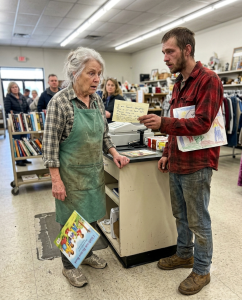
Every Tuesday morning, she drove her 2009 Camry to the Goodwill on Milton Road in Flagstaff, parked in the same spot near the side wall, and walked in with her canvas apron folded over one arm. She nodded to the cashier, waved at the volunteers in housewares, and disappeared into the back room where the donated books waited in uneven cardboard boxes.
That was where she felt most like herself.
Before retirement, she had spent thirty-four years as a school librarian. She had loved the order of the stacks, the low hum of fluorescent lights, the certainty that stories could reach children before life hardened them too much. Even now, years after leaving the school, her hands still knew what to do with books. She could sort them by age, condition, and category almost without looking.
But she had another ritual no one knew about.
Before she put any children’s book on the shelf, she opened the front cover and slipped inside a folded twenty-dollar bill and a handwritten note.
From a friend who was once lost too.
She had been doing it for two years.
It began on a lonely afternoon in February, when a donated copy of Charlotte’s Web fell open in her lap and brought back a memory she hadn’t visited in years: a rainy day after Gene’s death, a library book, fifty dollars tucked inside, and a note from a stranger that had carried her through the worst week of her life.
She never learned who had helped her then. She eventually stopped trying to find out. The gift had mattered because it arrived without demand, without witness, without the awkward weight of gratitude. It had simply appeared when she needed it.
So she began doing the same for others.
Never enough to ruin her budget. Just enough to matter. A twenty for medicine. Gas. Milk. A co-pay. Diapers. She imagined tired parents buying secondhand books because they wanted one small good thing for a child despite everything else pressing down on them.
She told no one.
Not her daughter, Natalie, who lived in Scottsdale and already worried that Eleanor was “too soft for this world.” Not Pastor Webber, who had a dangerous talent for turning private sorrow into public testimony. Not even Doreen, the volunteer who worked the register and had become Eleanor’s closest friend at the store.
The ritual was not charity in Eleanor’s mind.
It was repayment.
A way of honoring a kindness that had once kept her moving. A way of honoring Gene, too, though she would not have put it that plainly.
Gene had been gone twenty-three years, and he still inhabited the house in practical little ways. The hammer hanging exactly where he left it in the garage. The old denim jacket she could never bring herself to donate. The chipped mug with the trout on it that nobody was allowed to use. Her grief was no longer sharp, but it was permanent, woven into the grain of her life.
What never truly healed, though, was the loss that came before him.
Years earlier, Eleanor had been pregnant with a boy they had already named Peter. She lost him in the fourth month. The grief gutted her in a way she did not know how to explain. People told her she was young, that she could try again, that these things happened. She learned quickly how lonely certain kinds of pain made a woman.
Gene had grieved too, but differently. He spoke about the baby. Eleanor could not. He wanted to remember. She wanted to survive.
One sleepless night after the loss, Gene had sat beside her in the dark and taken her hand.
“If we can’t raise him,” he had whispered, “then we’ll spend the rest of our lives making sure children aren’t forgotten. We’ll do some good with the love we still have.”
It became a quiet promise between them. Not formal. Not discussed often. But real.
Over the years they donated books. Sponsored school lunches when they could. Paid fees for field trips. Left grocery cards with neighbors. Small things. Quiet things. Gene believed that kindness worked best when pride didn’t have to get involved.
After he died, Eleanor assumed the promise had died with him. She was wrong.
On the third Tuesday in October, she was sorting children’s books in the back room when she heard a strained voice from the front of the store.
She stepped out and saw a young man standing at the register holding a copy of Frog and Toad Are Friends.
He looked underfed and exhausted, with work-worn clothes and the careful posture of someone trying not to take up too much space. In the pocket of his flannel shirt was a folded child’s drawing.
He was asking if anyone knew who had left money in the book.
“My daughter was sick,” he said. “I found the twenty inside when I got home. It paid for her prescription. I just need to thank the person who did it.”
Eleanor recognized the book instantly. She had placed the money there three weeks earlier.
“That was me,” she said.
The young man turned. His expression shifted in a way she could not immediately read.
He reached into his jacket and pulled out her notecard.
Then he turned it over.
On the back, in unmistakable handwriting, were words that made the room tilt beneath her feet.
If this reaches Eleanor, tell her I kept my promise.
Gene’s handwriting.
For one wild second she thought she might faint. She gripped the counter and stared.
“How do you have that?” she asked.
The young man, visibly shaking now, told her his name was Caleb Vale. His mother, Teresa, had died two months earlier. While cleaning out her apartment, he had found a box containing old notes, grocery receipts, envelopes of cash, and several items signed with a single initial: G.
He had not known who G was until he found Eleanor’s note in the thrift store book. The phrase “once lost too” reminded him of something his mother used to say about the man who helped them when he was a baby.
According to Teresa, she had been seventeen, alone, and living out of her car for a stretch one brutal winter. One evening, she fainted in a library parking lot with her infant son in the backseat. A man named Gene found her, got help, paid for a motel room, and returned with groceries, diapers, formula, and children’s books.
“He said kids should always have books,” Caleb told Eleanor.
She could suddenly see it. Gene coming home late, quiet, carrying a paper sack from the grocery store and saying only that some people were carrying too much alone. At the time, she had been too wrapped in her own grief to ask more.
Caleb then gave Eleanor a sealed manila envelope. Gene’s handwriting was on the front.
For Eleanor. When the time is right.
Inside was an old photograph of Gene holding a baby outside a motel, a faded hospital bracelet labeled Baby Boy Marsh, and a letter.
Eleanor’s hands shook so badly she had to sit down on a cracked vinyl chair near the register before opening it.
The first lines were enough to make her cry.
Ellie, if you’re reading this, it means Teresa finally decided you were ready, or life did it for us. I’m sorry I didn’t tell you everything myself.
The letter was dated six months before Gene died.
He wrote that after Peter died, he had thrown himself into helping children and struggling parents partly for noble reasons, partly because he did not know what else to do with the love that had nowhere to go. He feared that talking too much about the loss only deepened Eleanor’s pain, so he carried part of the promise alone.
Then came the part that explained everything.
Several years after Peter’s death, Eleanor had joined a grief support group and written a private exercise about feeling abandoned in motherhood, even within her marriage. One sentence from that exercise had ended up in Gene’s possession through a counselor they both knew. It devastated him to realize Eleanor felt he was the only one who remembered their son.
Around that same time, he met Teresa and baby Caleb in the library parking lot.
Something about Caleb changed him. He never wrote exactly what, not at first. He only said that holding the boy felt like being entrusted with the small, fragile future he and Eleanor had lost. He knew he could not replace Peter, and he never wanted to. But he also knew this child needed someone, and he could not walk away.
So over the next several years, Gene quietly helped Teresa and Caleb. He paid rent once when they were about to be evicted. He brought children’s books. He fixed a broken car seat. He taught Caleb how to hold a hammer at age seven and how to throw a baseball badly at age nine. Teresa eventually stabilized, found work, and built a life. But Gene never completely stepped out of it.
Then Eleanor reached the part that made her stop.
There is something I need to tell you, and I pray you’ll understand why I waited.
Her eyes moved over the next lines so slowly they barely seemed to register.
Years before, during a period when Eleanor had withdrawn into grief and Gene had been spending more time away “helping at the library,” he and Teresa had crossed a line once. One night. A terrible, lonely mistake. He wrote that it happened during a season when both of them were broken and grateful and confused, and he regretted it immediately.
Caleb was not that child, Gene said clearly. Caleb had already been nearly two when the mistake happened. Teresa confirmed it. There had never been any question of paternity.
But the shame of that betrayal was why Gene had never told Eleanor the full story. He feared that if he confessed the affair, even brief and long over, it would poison the entire promise they had once made together. He kept helping Teresa and Caleb not out of romance, he insisted, but because leaving after what he had done would have been a second cruelty.
Eleanor had to lower the letter.
The store blurred around her. Caleb sat across from her, silent and pale, clearly knowing at least part of what the letter contained.
“You knew?” she asked.
“My mother told me before she died,” he said. “Not everything. Just enough to say there was one mistake between them, and that it haunted both of them. She said Gene never stopped loving you. She said whatever he did after that, he did with guilt in one hand and loyalty in the other.”
That was such a Teresa sentence, Eleanor thought, though she had never met the woman.
Gene’s letter continued. He wrote that he had planned to tell Eleanor after retirement, when life was quieter, when the truth would not detonate in the middle of jobs and bills and obligations. Then he got sick. Then sicker. Then time ran out.
I was selfish, he wrote. I wanted to die loved by you, and I did not have the courage to risk losing that.
Eleanor cried then, not delicately, but from some deep place she had kept padlocked for years. Not only because he had betrayed her, but because the man she loved so faithfully had been more complicated than memory allowed. More cowardly. More generous. More human.
She read the rest of the letter in full.
Gene explained that he had asked Teresa to hold the envelope until a day came when sharing it might do more healing than harm. He enclosed Peter’s hospital bracelet because he had kept it hidden after realizing Eleanor could not bear to look at it. He had wanted to return it when the right moment came, one where memory felt like love instead of injury.
And then, in the last paragraph, he wrote something that undid her completely.
Caleb is not our son. But he is one of the children our son sent us to. Please don’t hate the good because of the bad. Separate them if you can.
Eleanor folded the letter and held it to her chest.
For a long time, neither she nor Caleb spoke.
Finally he said, “I’m sorry. For all of it. I didn’t come here to hurt you. I just thought you deserved the truth.”
She looked at him, really looked. The tiredness in his face. The shame that wasn’t his but had landed on him anyway. The tenderness with which he handled every object connected to Gene.
“What happened to your daughter?” she asked.
He blinked, startled by the question. “She’s okay now. Ear infection. Antibiotics worked.”
“What’s her name?”
“Maisie.”
Eleanor nodded. She could not explain why that nearly made her smile.
In the weeks that followed, Eleanor did not become noble overnight. She was furious. She walked through her house touching Gene’s old things and feeling betrayed by every familiar object. She sat with Pastor Webber once and said almost nothing while he wisely refrained from turning any of it into a sermon. She called Natalie and told her more truth in one hour than she had shared in ten years.
But she also kept thinking about the photograph of Gene holding baby Caleb. The hospital bracelet. The note. The years of quiet help no one had known about. The fact that human beings could wound and love in the same lifetime, sometimes in the same act, and leave behind legacies impossible to sort cleanly into saint or sinner.
Three Tuesdays later, Caleb returned to Goodwill with Maisie, a solemn little girl in a purple sweatshirt clutching a stuffed rabbit by one ear.
Eleanor had not promised he should come. He had not asked permission. He just arrived, uncertain, as if prepared to leave the second she looked unhappy.
Instead, Eleanor crouched slowly in front of Maisie and handed her a copy of The Velveteen Rabbit.
“For your home library,” she said.
Maisie took it with both hands.
Inside the cover was no money this time. Just a note.
Books make brave company.
Caleb saw the note and looked at Eleanor with grateful disbelief.
Over time, their relationship settled into something quiet and undefinable. Not family in the official sense. Not charity. Not redemption. Something messier and, for that reason, more real.
Eleanor learned that Teresa had worked herself ragged to raise Caleb and had spent years paying forward Gene’s kindness in tiny, practical ways—covering someone’s gas, buying winter gloves for a neighbor’s child, leaving grocery gift cards taped inside church cookbooks at yard sales. Caleb, once he understood the full story, had begun doing the same where he could.
The hidden twenties in the books spread from one giver to another without any of them planning it.
One Tuesday in December, Caleb showed Eleanor a children’s book Maisie had chosen from a thrift bin across town. Inside was a ten-dollar bill and a note in crooked block letters obviously written by a child.
For medicine or snacks or something good.
Maisie, embarrassed, admitted she had used her allowance.
Eleanor laughed then cried, all in the same breath.
Years later, when she looked back on the day Caleb walked into Goodwill carrying Frog and Toad Are Friends, she no longer thought of it as the day Gene’s memory was ruined.
She thought of it as the day his memory became true.
Not polished. Not protected. True.
He had been a good man who had done a bad thing. A loving husband who had hidden a terrible failure. A grieving father who had spent the rest of his life trying to keep children from feeling forgotten. None of those facts canceled the others.
The bracelet for Baby Boy Marsh stayed in Eleanor’s nightstand after that. Not hidden in shame. Not displayed for sorrow. Just kept near.
And every Tuesday morning, she still drove her old Camry to Goodwill, tied on her apron, and opened the donated books one by one.
Sometimes she tucked in a twenty.
Sometimes she tucked in more.
Always, she added the note.
From a friend who was once lost too.
Only now, when her pen hovered over the card stock, she sometimes pictured not only the stranger who had once saved her, but Gene, and Teresa, and Caleb, and little Maisie with her earnest allowance money. A chain of wounded people passing small mercies hand to hand, none of them clean, all of them necessary.
It made Eleanor wonder, not for the first time, whether forgiveness was less about excusing the wound and more about refusing to bury the good that grew beside it.
She never fully answered that question.
But every Tuesday, she kept writing anyway.