By the time Lena Morales stepped onto the porch of the small white bungalow on Maple Street, she already knew the case would stay with her.
Hospice nurses learned to sense certain homes before they even walked inside. Some held panic. Some held denial. Some held the exhausted quiet of families who had cried so much there was nothing left in them but chores. This house held something else—a strange stillness, as if it had spent years waiting for a moment no one could stop.
Rain clouds were stacked low on the horizon, and the late afternoon heat clung to Lena’s scrub top as she rang the bell. A woman from the church opened the door, greeted her softly, and stepped aside.
“Mrs. Ward is in the back bedroom,” she said. “She’s been asking when the nurse would come.”
Lena smiled with professional warmth and carried her bag down a narrow hallway lined with framed Bible verses and old sepia photographs. She noticed straightaway that the house was spotless, but not in a cold way. It was cared for with devotion. The furniture had been polished. The curtains were freshly washed. Every table held either flowers or stacked letters.
The bedroom door stood half open.
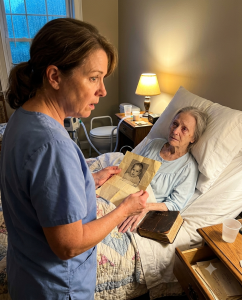
Inside, Evelyn Ward lay propped against pillows in a pale blue nightgown, her silver hair combed back from a face made delicate by illness. She was clearly close to the end. Her breathing was shallow. Her hands were thin and restless against the blanket. But her eyes were startlingly alert, and when they lifted to Lena, something in them changed.
Not surprise exactly.
Recognition.
Lena had seen that look before from patients with dementia or fever, people who briefly confused her with a daughter, a sister, a wife from long ago. She braced for it. Instead, Evelyn just kept staring, and then whispered, “You came.”
Lena gave a small smile. “I’m Lena. I’ll be helping take care of you this week.”
Evelyn’s throat worked. “Lena,” she repeated, as if testing the shape of the name.
The first visit passed normally enough. Assessment, medications, symptom charting, a review of pain levels and appetite. Evelyn was polite, cooperative, and almost painfully grateful. When Lena adjusted the pillows behind her shoulders, Evelyn closed her eyes and said, “You have kind hands.”
It was the sort of thing families remembered and wrote in condolence cards later. Lena accepted it with a nod. Still, the words landed strangely. The old woman was looking at her with an intensity she could not explain.
By the second visit, the pattern had sharpened.
Evelyn wanted the room warmer, then cooler, then warmer again. She asked for tea and barely drank it. She apologized repeatedly for being trouble. When Lena reassured her, Evelyn said, “I know I shouldn’t ask this, but… are you from around here?”
Lena capped a syringe and smiled. “Born in the state, raised nearby.”
“Raised by your family?”
The question was soft, almost casual, but Lena heard the hesitation under it.
“My parents, yes,” she said.
Evelyn’s fingers tightened on the blanket. “Your birth family too?”
Lena looked up.
Most people didn’t phrase it that way unless they already knew someone was adopted or were adopted themselves. She gave the same answer she had given for years, the version polished enough to keep curiosity at a distance.
“I was adopted as a baby. Closed adoption. I don’t have much information.”
Evelyn’s eyes filled before she could hide it. She turned her face toward the window. “I’m sorry,” she whispered.
Lena almost asked why she sounded personally sorry, but the oxygen machine beeped and the moment passed.
Over the next few days, Lena met the orbit of people moving in and out of Evelyn’s final week. A pastor. A longtime neighbor named Ruth. An attorney handling estate papers. There was no husband, no children, no siblings. No one spoke of a close relative. Every description of Evelyn circled the same facts. She had lived alone for years. She was active in church. She kept old papers no one else understood. She never missed a prayer request.
“She saved everything,” Ruth told Lena while sorting cardigans into neat piles. “Boxes and boxes. Especially anything to do with the past. She once told me there are losses you don’t throw away just because they’re old.”
It sounded poetic and sad, but grief made people hold onto odd things. Lena didn’t think much of it until later that evening when she found Evelyn unable to sleep.
The room was dark except for a lamp near the bed. Outside, cicadas buzzed in the trees.
“Can I get you anything?” Lena asked.
Evelyn shook her head. “Do you believe a person can ruin her whole life in an hour?”
Lena paused. “I think a person can spend a whole life regretting one.”
A tear slid from the outer corner of Evelyn’s eye into her hair. “Yes,” she said. “That’s what I mean.”
Lena stood there longer than necessary after giving the medication. She should have moved on to her next charting task. Instead she watched this dying woman struggle with a grief that felt fresh, not old. Something unresolved lived in the room with them.
By day five, the feeling had become impossible to ignore.
There were tiny similarities that made no rational sense. The shape of Evelyn’s eyebrows. The cleft in her chin. The way she twisted the edge of the sheet when anxious—a habit Lena had been teased for all through childhood. Lena caught herself staring and hated it. She was a nurse, not a daughter shopping for resemblance in strangers.
Still, she thought about Evelyn after shifts ended. On the drive home. In the grocery line. Brushing her teeth at midnight. She found herself replaying the old woman’s questions. Were you always local? Did you ever know your birth family?
The truth was Lena had wondered about her origins on and off her whole life, but carefully. Her adoptive parents had loved her fiercely. She had not wanted to hurt them. She also had not wanted to be hurt herself. Closed adoption was a wall easier to respect than to climb. So she had learned to keep the ache tidy.
On the sixth day, a thunderstorm broke over town just before dusk.
The house darkened under the clouds. Rain ticked against the bedroom windows. The oxygen machine hummed like a mechanical heartbeat beside Evelyn’s bed. The old woman had finally drifted into a shallow sleep after a difficult afternoon of pain and breathlessness.
Lena moved around the room in the low lamplight, gathering used cups, folding a blanket, resetting medication times. When she turned toward the nightstand, she saw an old leather Bible lying on the floor.
She bent to pick it up.
The cover was cracked and soft from decades of handling. Pages had been marked with ribbons and slips of paper. As she lifted it, a folded yellowed sheet fell halfway free from between the pages.
Her first instinct was to tuck it back untouched. It was personal. But the paper had already opened in her fingers, and one faded word stared up at her in large print.
MISSING.
Lena’s breath stopped.
The flyer was old—forty years old at least. The edges were worn white. Tape marks yellowed the corners. And centered beneath the headline was a grainy infant photo.
The room seemed to tilt.
The baby looked exactly like her.
Not generally. Not vaguely. Exactly. The same broad eyes. The same round cheeks. The same left ear that sat a little crooked. Lena felt a hot wave rush through her and then drain away, leaving her cold.
She stepped closer to the lamp.
Below the photograph was a date from the year she was born, and a paragraph partly blurred by time:
Infant girl. Taken through private placement. Mother attempting to locate after revoking consent…
Revoking consent.
Lena read the line three times because her mind refused to accept it. All her life, the story had been that a young woman chose adoption and disappeared into the past. Sad, yes. But final. This flyer told a different story. A mother who changed her mind. A mother who searched.
The sound of the rain grew louder, almost violent. Lena’s hand shook so badly the paper rattled.
There was a church number printed at the bottom, a P.O. box, and a plea for any information. The lower edge of the flyer was soft from years of touching, as if someone had unfolded it so many times the paper had become cloth.
Why would Evelyn Ward keep this inside her Bible?
Lena swallowed hard and looked again at the baby photo.
That was when she saw the faint crescent mark on the infant’s left shoulder.
She had that birthmark.
A small moon-shaped patch just below the collarbone. Same side. Same curve.
The room narrowed to the bed, the flyer, the sound of the machine.
“You found it.”
Lena jerked around.
Evelyn was awake.
She was not confused or startled. She looked exhausted, but fully aware, her eyes fixed on the paper in Lena’s hand with the expression of someone who had feared and hoped for this exact moment for decades.
“What is this?” Lena asked, though she already knew.
Evelyn’s mouth trembled. “Something I prayed you’d never have to carry,” she said. “And something I prayed every day you would one day see.”
Lena stared at her. “My adoption was closed.”
“I know.”
“My parents told me—”
“I know what they told you.”
The certainty in Evelyn’s voice made Lena’s chest tighten. She took an involuntary step backward.
Evelyn gathered breath with visible effort. “I was nineteen. My father arranged everything. He said I was ruining my life. I was in no shape to understand half the papers in front of me. I signed because they kept telling me there was no other future.”
Her eyes closed briefly. Tears leaked from the corners.
“The next morning I changed my mind. I went back. I begged. I said I wanted my daughter. They said she was gone. Then they said the process was complicated. Then they stopped returning calls. I borrowed money. I found a lawyer for a few weeks until I couldn’t afford one. I went to churches. I put notices in papers. I kept asking.”
She looked at the flyer in Lena’s hand.
“I never stopped asking.”
Lena felt fury surge up so suddenly it frightened her. Fury at faceless adults, at a system, at lies, at timing, at the impossible cruelty of discovering this in the final days of a stranger who wasn’t a stranger. Under it all was something worse—a grief so deep it felt ancient, like her body had recognized Evelyn before her mind did.
“Why didn’t you say anything?” Lena asked.
Evelyn turned her palm upward on the blanket, a gesture of surrender. “Because I wasn’t sure. Because every time you walked in, I thought I saw myself in your face, and I thought maybe I was just an old woman dying with unfinished business. Because if I asked and I was wrong, I would have made a fool of my last chance at dignity.” Her voice broke. “And if I was right… I didn’t know whether I had the right to ask anything of you.”
Lena said nothing. Her throat hurt too much.
“In the top drawer,” Evelyn whispered. “There are letters. Everything I tried. Every agency, every pastor, every person who might know. I kept all of it.”
Lena glanced at the nightstand but didn’t move.
Then she noticed writing bleeding faintly through the back of the flyer.
She turned it over.
Blue ink, faded but legible, slanted across the paper in a hand that matched the grocery reminders and medicine notes Lena had already seen around the room.
There was a name written there.
Not Lena.
A different first name.
A name Lena had never seen in any document, never heard from any relative, never been told belonged to her. Yet the moment she read it, a strange chill ran through her. It felt less like learning something new than remembering something stolen.
Below it, another line:
If I ever find her, I will tell her I looked every day.
Lena’s vision blurred.
“How do you know that name?” she whispered.
Evelyn gave a shattered little smile. “Because I whispered it to you before they took you from my arms.”
Lena had no language for what moved through her then. Anger and ache collided with a sudden, unbearable tenderness. She wanted to accuse. She wanted to demand dates, names, proof. She wanted to throw herself into the chair beside the bed and ask every question she had swallowed for forty years. She wanted to leave.
Instead she crossed to the nightstand and opened the top drawer.
Inside were packets tied with ribbon, all labeled in careful handwriting. Legal. Hospitals. Churches. Returned mail. At the very top lay a newborn ID bracelet sealed inside clear plastic. Beneath it sat an envelope marked in trembling script:
For my daughter.
Lena reached for it.
Behind her, Evelyn made a strangled sound—not pain exactly, but urgency.
Lena turned.
Evelyn was lifting one shaking hand and pointing not at the envelope, but toward the doorway.
A man stood there in the shadowed hall.
Tall, late sixties, expensive raincoat damp from the storm, one hand still on the doorframe as if he had come in without being invited and hadn’t expected witnesses. His face was pale in a way that had nothing to do with age.
Evelyn’s whole body seemed to tense around a fear older than illness.
“No,” she rasped.
The man looked at Lena, then at the flyer in her hand, then at the open drawer. Something hard and defeated crossed his features. “So it’s happened,” he said quietly.
Lena straightened. “Who are you?”
He took one step inside. “My name is Daniel Ward.”
The surname hit first.
“My brother,” Evelyn choked. “Get him out.”
Daniel ignored her. His gaze stayed on Lena, too intent, too familiar. “I tried to arrive before this,” he said. “I suppose I’ve failed.”
Every instinct in Lena went sharp. “Before what?”
Before Daniel could answer, Evelyn coughed violently. Lena moved to the bed out of reflex, checking her airway, reaching for tissues, steadying her shoulders. Evelyn clutched Lena’s wrist with astonishing strength.
“He knows,” she whispered. “He always knew.”
Daniel’s jaw tightened. “Evelyn—”
“Don’t,” she snapped, and for the first time Lena heard the younger woman she must once have been. “You don’t get to manage this now.”
Lena looked between them. “Manage what?”
No one answered quickly enough.
The silence was answer enough.
Daniel glanced at the packets in the drawer, at the hospital bracelet, at the envelope addressed to a daughter. “Your adoption,” he said at last, “was not as simple as anyone told you.”
Lena let go of Evelyn only long enough to step between the bed and the doorway. “Then start talking.”
The storm outside cracked with thunder. Daniel flinched.
He removed his glasses and rubbed them with a hand that clearly shook. “Our father arranged the adoption through someone at the clinic. He wanted the matter gone. Quietly. Permanently.” Daniel swallowed. “When Evelyn changed her mind, there was panic. Paperwork had been rushed. Rules had been bent. Money exchanged hands that should never have changed hands.”
Lena felt sick. “You’re saying I was sold?”
Daniel closed his eyes. “I’m saying crimes were committed.”
The room went so still the hiss of oxygen sounded deafening.
Evelyn’s tears came harder now, but she did not look away from Lena. “I didn’t know. Not then. I found out in pieces. Every time I got close, someone shut a door.”
“And you?” Lena asked Daniel. “What did you do?”
He looked older suddenly, as if whatever kept a man upright in his own story had given way. “At first? Nothing. I was a coward. I was twenty-three and dependent on my father’s money. By the time I understood how ugly it was, the records were buried and the people involved were protected.” He glanced at Evelyn. “I helped her later. Sometimes with cash. Sometimes with names. Never enough to matter.”
“Not enough,” Evelyn said with raw contempt.
Daniel accepted it. “No.”
Lena thought of every year that had passed. Every birthday. Every doctor’s form left half blank. Every time Evelyn had put another flyer somewhere and waited. Forty years measured in paper cuts and unanswered mail.
“Why come now?” Lena asked.
Daniel’s eyes dropped to the envelope in the drawer. “Because there is one part she never knew.”
Evelyn’s breathing turned ragged. “Don’t.”
But Daniel was already speaking, as if confession had finally outrun fear.
“The adoptive placement was changed at the last minute. The family originally chosen backed out. There was another arrangement made quickly.” He looked at Lena with unbearable directness. “And the couple who received you… they weren’t strangers to us.”
Lena felt the room slip under her.
“What does that mean?”
Daniel hesitated.
It was Evelyn who answered, each word scraped from the bottom of her strength.
“It means,” she said, “someone in this town knew exactly where you were all along.”
Lena stared at her.
Then she looked at the letters, the bracelet, the envelope, the flyer, the man in the doorway, and understood in one crushing wave that this wasn’t a story about being lost.
It was a story about being hidden.
The next hours passed in fragments. A call to Lena’s supervisor for coverage. A call to the on-call physician. More medication for Evelyn, whose body was failing under the strain but whose mind remained ferociously clear. Daniel stayed because Lena refused to let him leave until she heard everything.
Piece by piece, the buried history surfaced.
Their father had used church connections and private intermediaries to move the adoption through fast before Evelyn could challenge it. When the first adoptive couple withdrew, another local couple desperate for a baby was quietly offered the placement. There was money. There were favors. There were records altered just enough to create confusion. Not enough to look like a kidnapping on paper. Enough to bury accountability under respectable names.
Lena’s adoptive parents, Daniel insisted, had likely been told only part of the truth.
That mattered to her more than she expected. Her parents were gone now, dead within three years of each other, and she had loved them. She could not bear to picture them as villains. Desperate, misled, complicit by ignorance—those possibilities hurt less than deliberate theft. Still, the ache remained. How much had they known? Had they ever suspected why closed records had stayed so aggressively closed?
Evelyn listened, eyes shut, tears slipping silently into her hair.
When Daniel finished, Lena asked the only question left.
“Why didn’t you tell me sooner? Any of you?”
Daniel didn’t defend himself. “Cowardice. Shame. Fear of what would happen if the truth came out. Then time did what it always does. It made evil look complicated instead of evil.”
Near dawn, when the storm had passed and only dripping eaves remained, Lena finally opened the envelope marked For my daughter.
Inside were dozens of letters. One for every birthday.
Age one. Age two. Age ten. Age sixteen. Age twenty-one. Age thirty. Forty.
Some were only a page. Some were long enough to feel like years. Evelyn had written about the first day she saw a child at church with Lena’s smile and had to leave the sanctuary because she couldn’t breathe. She had written about taking temporary jobs to pay investigators who led nowhere. About calling old numbers from pay phones. About standing outside courthouses holding documents that never opened the right doors. About every holiday she lit a candle and imagined the daughter she had lost alive somewhere under the same sky.
Lena read until she could no longer see.
Morning light found the room pale and tender. Evelyn slept, then woke, then slept again. Around noon she became more alert than she had been all week, the way some dying people did just before the body let go.
She asked Daniel to leave them alone.
He obeyed.
Then Evelyn turned to Lena with a look that held no defense anymore, only naked truth.
“I don’t expect forgiveness,” she said. “I only need you to know I did not leave you on purpose.”
Lena sat beside the bed, exhausted beyond pretense. “I know that now.”
“I should have fought harder.”
“You were nineteen.”
“I should have burned the town down.”
A broken laugh escaped Lena through tears. “Maybe you almost did.”
For the first time, Evelyn smiled without pain twisting it. It was Lena’s smile. There was no denying it now.
Lena took her hand.
The hand in hers was feather-light, fragile, mortal. Yet the moment felt heavier than anything she had ever held. All her life, she had imagined a birth mother as either a ghost or a choice. Never as this: a woman of flesh and regret, messy and human, who had searched until searching became the shape of her life.
“I don’t know what to call you,” Lena admitted.
Evelyn’s eyes filled. “Anything you want.”
Lena was quiet for a long time. Then she leaned close and whispered the name from the back of the flyer—the name Evelyn had once given her in secret and lost.
Something in Evelyn’s face released.
She cried openly then, not with the violence of grief but with the relief of a wound finally acknowledged. She lifted Lena’s hand to her lips and held it there.
Two hours later, with Lena still beside her and the Bible on the blanket near her hip, Evelyn died.
Peacefully, the chart would later say.
It was true, but incomplete. She died after forty years of unfinished love finally finding a place to land.
In the weeks that followed, Lena sorted the boxes in Evelyn’s house. Daniel gave statements. Old church records were subpoenaed. A retired clerk admitted documents had been altered under pressure. The truth surfaced too late to punish everyone responsible, but not too late to name what had happened.
Lena also found proof that her adoptive parents had likely been deceived. They had written cautious letters through the agency asking whether the birth mother was certain, whether there had been any dispute. The replies had been brief, formal, and false. That discovery broke Lena’s heart in a different way. The people who raised her had loved her honestly while standing on a lie they may never have fully understood.
She chose not to let that love be erased by the crime that made it possible.
Months later, Lena framed the faded flyer. Not the front with the stark MISSING headline, but the back. The blue ink had been preserved carefully under glass.
If I ever find her, I will tell her I looked every day.
She hung it in her office at home where no one else would see it unless she wanted them to. On difficult nights after hard hospice shifts, she would stand in front of it and think about the strange mercy of the timing. How close she had come to never knowing. How love had arrived in the cruelest, latest possible form and still somehow arrived.
Sometimes she wondered whether forgiveness was too generous. Whether truth, even found at the end, could ever balance the years stolen. Other times she thought about a nineteen-year-old girl being pushed to sign while barely conscious, then waking up and running back for her baby. That image made moral certainty feel easy only to people who had never been cornered.
What stayed with Lena most was not the scandal or even the reunion.
It was the Bible.
A dying woman had hidden her oldest wound inside the pages she touched when she needed strength. Not because she wanted pity. Because she refused to let the world rewrite what happened. Inside Scripture and prayer and ordinary days, she had kept one ragged flyer alive until the daughter on it came home carrying a nurse’s bag.
And sometimes Lena still heard Evelyn’s first words when she opened that bedroom door.
You came.
As if somewhere, beneath all the paperwork and silence and wrong turns, her mother had been expecting her all along.
Who was right? Who was wrong? There were easy answers for the people who traded a child like a problem to be managed. Harder ones for everyone else. But Lena knew this much: the biggest red flag had never been that a young mother let go. It was how many respectable people helped make sure she could never reach back. And whether forgiveness belonged anywhere in that story depended entirely on who had the courage to tell the truth before death forced it into the light.