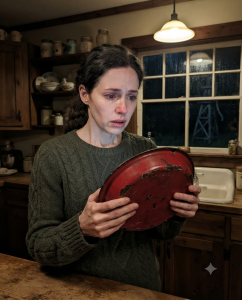
Nina Harper had not planned to come back to Willow Creek.
For twenty-nine years, she had managed that fact with the same stubborn discipline people used to avoid old addictions, old loves, and old wounds that still had a way of opening when touched the wrong way. She could drive through neighboring counties. She could attend conferences in St. Louis or Kansas City. She could sit through entire conversations about Missouri farmland and inheritance law and not let her voice change. But Willow Creek was different. Willow Creek was where memory had teeth.
So when her friend Kira texted her a vacation rental listing and wrote, Tell me this isn’t your old house, Nina almost didn’t click.
But she did.
And the second the photos loaded, she knew.
Same wide porch. Same long kitchen windows. Same oak tree in the side yard, still split by lightning, one half alive and the other reaching gray and bare toward the sky like something unfinished. The listing called it a restored farmhouse retreat in wine country. It promised rustic charm, curated vintage decor, and a peaceful weekend escape.
Nina stared at the photos until her coffee went cold.
She booked it that night under Nina Cole, a surname left over from a marriage that had ended six years earlier but still served a purpose when she wanted distance from herself.
The drive down felt unreal. She told herself she was only being curious. She told herself she wanted closure. She told herself plenty of things. But when her tires hit the old gravel lane and the house rose ahead of her through the late afternoon light, she felt thirteen again, then eighteen, then suddenly every age she had ever been on that property at once.
The place looked smaller than memory had kept it.
Fresh paint had brightened the siding. New planters sat on the porch. The old screen door had been replaced with a prettier one, though she noticed the frame still leaned the slightest bit left, the way her father used to threaten to fix every spring and never quite get around to. The fields beyond the house were no longer theirs, if they ever truly had been after Marsha got involved. A neighboring vineyard now ran rows where corn had once failed under her father’s tired efforts.
Inside, the house was staged for strangers. The furniture was tasteful, a little too tasteful. There were throw blankets folded with impossible neatness, cookbooks stacked in color-coordinated piles, little bowls of dried lavender no one in the Harper family would have paid money for. It was an edited version of a life like hers, a story of country living told by someone who had never scraped mud from the floor with a putty knife after a storm.
Still, under the polish, the bones remained.
The hallway was narrow in the same places. The back stairs still creaked halfway up. And when she stepped into the kitchen, something in her chest clenched so hard she had to put a hand against the counter.
The kitchen had been modernized, but not erased. The sink still faced the back field. The cabinets, though painted cream, were the same sturdy ones her mother had scrubbed until the knobs loosened. The room held a hundred invisible ghosts—her mother kneading dough, her father coming in with grease on his hands, Nina doing homework at the table while cinnamon and onion and weather drifted around her.
That was when she saw the pie tin.
It hung above the stove with three others, displayed like a charming antique. Red enamel, worn thin at the edges, one black speck near the rim where it had once struck the sink.
Nina crossed the room without thinking.
Her mother, Elsie Harper, had bought those tins one by one from the hardware store in town because that was what they could afford. She made peach pie in August, apple in October, chicken pot pie when the first sharp cold settled in for good. She never measured cinnamon exactly. She sang under her breath when she was tired. She had a laugh that arrived suddenly, like light through a broken cloud.
After Elsie died of ovarian cancer when Nina was thirteen, the house changed in ways no one ever spoke aloud. The rooms got quieter first. Then colder. Then somehow more fragile, as if everything in them knew the wrong person was touching it.
Marsha entered the picture less than a year later.
Nina had been fourteen the first time she saw her sitting at the kitchen table with a legal pad and a stack of bills. Marsha had short blond hair sprayed into control, practical shoes, and the kind of smile that seemed less about warmth than efficiency. She talked as though every problem was solvable if emotional people would just stop making things difficult.
Your father needs help, she told Nina once, not unkindly but not kindly either. He can’t keep running this place the old way.
The old way, Nina had learned, meant the way that belonged to her mother.
By fifteen, Nina’s father had married Marsha. By then the farm was already in trouble. There had been two bad harvests in four years, a machinery loan, medical debt from Elsie’s treatment, and the quiet shame her father carried anytime he had to admit that what he loved could no longer support the people on it.
Then came the tractor accident.
Nina still remembered the call, the smell of antiseptic at the hospital, the way her father looked afterward: alive, grateful, diminished. He limped permanently. His memory slipped in odd places. Not enough to be declared incompetent, but enough that Marsha started managing every paper, every bill, every decision. She sat beside him at the table with forms and signatures and explanations delivered too quickly.
It’s temporary, she would say.
This protects the property.
This keeps the bank from taking everything.
Nina was old enough to hear the words, young enough not to know which questions mattered.
Within three years, the language changed. Portions had been transferred. Assets consolidated. Liabilities restructured. By the time Nina left for college, no one ever said the farm was theirs without also adding something complicated after it.
When her father died seven years later, Marsha informed Nina that the remaining holdings had been sold. The conversation lasted less than six minutes. Nina remembered because she timed it by the microwave clock in her apartment, staring at leftover takeout while Marsha spoke as if narrating weather.
It’s done, Marsha said. There was nothing to save.
Nina had wanted to ask for documents, records, proof. Instead she said okay and hung up, then spent the rest of the night sitting on the floor.
Eventually she built a life elsewhere. Chicago first, then Indianapolis. Marketing, then consulting. A husband, then not a husband. Therapy. Better shoes. The talent for sounding detached when discussing things that still hurt. She told herself she had survived Willow Creek by leaving it.
Then she found her mother’s pie tin hanging in the kitchen of a rental house.
She lifted it from the wall.
It was unmistakable in her hands, memory made metal. Same dent. Same scratch marks. Same slight wobble when she balanced it against her palm.
Then she turned it over and found the carving.
E. HARPER.
And beneath it, etched harder, deeper:
HOLD FOR NINA.
The words rearranged the room around her.
Hold. Not give. Not save. Hold.
She ran her thumb over the letters and heard the tiny rattle hidden in the rolled lip. When she found the brass key taped there, her body went so cold she had to grip the edge of the stove.
Pump house, the masking tape said in her father’s handwriting.
Out the window, the pump house leaned in the distance exactly where it had always stood, half-swallowed by lilacs and years.
Then memory rose up with sudden force.
A week before the tractor accident, her father had stood at the sink holding that same pie tin while Marsha sorted receipts. He had looked at her—at the pan, maybe, or through it—and said in a strange hard voice, “That one stays in the family.”
Marsha answered too fast. “Of course.”
Nina had forgotten that moment until now.
Outside, dusk was falling. The sky had turned the color of bruised clouds, and the first damp wind moved across the yard. She grabbed a flashlight from her car and walked toward the pump house with the key clenched in her fist.
The building looked smaller than it had in childhood and more dangerous. The boards had warped. The roof sagged. One shutter hung broken. When she reached the door, she saw that the old rusted padlock was gone. A newer latch had been installed at some point.
The brass key fit anyway.
Inside, the smell hit her first: oil, wet wood, age. Dust swam in the flashlight beam. Shelves sagged under useless debris. A rusted hose reel sat in one corner. Her father’s old vise still clung to the workbench, orange with neglect.
At first it looked undisturbed.
Then she saw the pale scrape marks on one floorboard in the far corner.
She crouched and lifted the board with trembling fingers.
Beneath it sat a narrow hidden space containing a metal box and a single envelope.
The envelope had her name on it in her father’s handwriting.
Nina.
Nothing else.
Her hands shook so badly she nearly dropped it. For a moment she simply held it there, staring at the letters her father had made, letters written by a man who had known enough to hide something for the daughter everyone assumed had been left out of the story.
Then she saw the torn edge.
The envelope had already been opened.
Not by age. Not by accident. Torn, then pushed back together.
Someone had gotten there first.
Her breath turned thin and shallow. She opened the metal box. Inside were copies of county filings, old bank statements, deed transfers, insurance documents, and a photo of her father standing beside a county clerk outside the courthouse. On the back of the photograph, in her mother’s handwriting, were four words:
Don’t trust Marsha with anything.
Nina sat back on her heels.
Elsie’s handwriting. Her mother’s warning. Hidden with her father’s papers. Hidden long before the final sale. Suddenly the years of vague explanations collapsed into something sharper. This had not been carelessness. This had not been simple debt and bad luck. Someone had been preserving evidence.
She started with the deed copies.
The first shock came quickly. A transfer document had been signed two months after her father’s accident, but the signature looked wrong. Not completely unlike Glen Harper’s, but slower, heavier, as though guided. The second shock came in the attached witness page. The county witness was not the clerk listed in the photo. It was a private notary from two towns over.
The bank statements showed a line of credit taken against the farm that Nina had never heard about. Then another. Then a payment made to a consulting company registered to an LLC name she did not recognize.
She kept digging.
At the bottom of the box was a folded ledger sheet in her father’s hand, messy but unmistakable. He had written dates, amounts, and notes beside them.
Marsha moved operating funds.
Told me refinance papers. Not true.
Need to protect Nina’s share.
Need second copies.
The room seemed to tilt.
Marsha had not merely handled the farm after it went under. She had moved money. She had used his confusion. She had taken papers to him and told him they were one thing when they were another. And at some point, her father had realized it.
Nina opened the torn envelope.
Inside was a letter, four pages long, creased and softened by time. The first page began:
Nina, if you are reading this, I waited too long.
She sat on the dusty floor of the pump house and read every word.
Her father wrote that after the accident he knew his mind slipped in pieces, especially when he was tired or medicated. He wrote that Marsha had taken over the books and said she was saving the farm. At first, he had believed her because he needed to. Then he began to see statements he had never been shown, notices redirected before he could read them, signatures on papers he did not remember discussing. When he confronted her, she told him he was confused.
He wrote that he started making copies of everything and hiding them after finding out that part of the land had been placed into a separate entity he did not control. He suspected Marsha had planned for months to separate the assets before the final sale. He tried to reverse some of it, but each step made him look less reliable because she had already established herself as the practical one managing a damaged man.
Then came the line that made Nina put a hand over her mouth.
If anything happens to me before I can fix this, don’t let her tell you your mother wanted this.
Nina read on through tears she kept brushing away angrily.
He wrote that Elsie had known something was wrong with Marsha long before he married her. Marsha had once worked in the office of a lender handling distressed farm properties. She understood who was vulnerable and how to position herself as indispensable. Elsie distrusted her instinctively and made Glen promise that if anything happened to her, the house and the heart of the acreage would remain Nina’s no matter what.
Hold for Nina, he wrote near the end. Your mother said if the law failed, memory shouldn’t. I put enough here that the right lawyer will know where to look.
There was one more document in the box she had not examined closely, folded into quarters at the very bottom. It was a letter from an attorney in Columbia, dated six months before her father died. The attorney acknowledged receipt of copied records and warned that contesting the transfers would require the original loan files and proof of fraudulent inducement. Handwritten across the top in her father’s scrawl were three words:
She found me.
Nina heard tires on gravel before she understood the sound.
Headlights swept across the walls of the pump house. She killed the flashlight and stood in blackness, heart pounding so hard it hurt.
A car door opened.
Then Marsha’s voice, older but instantly recognizable: “I knew someone had touched the tin.”
Nina stayed still, breathing through her mouth. Rain began on the roof in quick cold taps.
Marsha was not alone. Another set of footsteps moved beside her, heavier, male.
“You said the box was emptied years ago,” the man said.
“I said I removed what mattered,” Marsha snapped. “I never found the letter.”
The latch rattled.
“Nina,” Marsha called, and the sound of her name in that voice after all these years was almost worse than the fear. “You were always going to come back sooner or later.”
Lightning flashed through the gaps in the boards. In that burst of silver light, Nina saw something she had missed: a second envelope wedged deep in the far back of the cavity, thinner and older than the first.
She reached for it just as the door opened.
Marsha stood there in the rain, elegant in a camel coat gone damp at the shoulders, older but still infuriatingly composed. Beside her was a broad man in work boots Nina didn’t know. Marsha’s eyes dropped to the papers in Nina’s hands, then to the open box, and for the first time Nina saw it: not guilt, exactly. Calculation mixed with fear.
“You shouldn’t have come in here alone,” Marsha said.
Nina held up the torn envelope. “You opened my father’s letter.”
Marsha exhaled. “Your father was sick.”
“You forged documents.”
“I kept that property from collapse.”
“You stole it.”
The man beside Marsha shifted uneasily. “Marsha—”
“Stay out of it, Dale.”
Nina’s voice sharpened. “Who is he? Another witness? Another notary?”
Marsha’s face changed then, just enough. “He owns the rental company.”
The answer landed hard. Of course. That was how she knew. That was how the house had been marketed, controlled, watched. Marsha had not fully let go of the property. She had stayed near it, near the evidence, near the one thing she thought Nina would never return to claim.
Nina pulled the second envelope free from the cavity. It was sealed with brittle glue. Marsha took one involuntary step forward.
“Don’t,” Nina said.
For the first time in Nina’s life, Marsha actually looked afraid.
Nina opened the envelope.
Inside was a handwritten note from Elsie dated three weeks before her death, along with a folded paper that looked older than everything else in the box. The note was brief, written in a weaker hand than Nina remembered:
Glen, if anything feels wrong, use this. Make sure Nina knows the house was promised before I got sick. Don’t trust promises that ask for signatures in grief.
Beneath it lay a notarized transfer-on-death deed.
Properly filed? No. But executed. Witnessed. Predating Marsha.
The house and twelve surrounding acres had been designated for Nina, contingent on Glen’s death, with language so specific even Nina, who was not a lawyer, understood its weight. If that document had been suppressed while later transfers were manipulated, there was enough here to reopen everything.
Marsha’s composure shattered.
“That paper was never valid,” she said too quickly. “Your mother changed her mind.”
“She wrote this three weeks before she died.”
“She was medicated.”
“So was my father when you put papers in front of him.”
The man beside her looked from Marsha to the documents and back again. “You told me the daughter signed off years ago.”
Marsha spun on him. “Because she disappeared.”
Nina almost laughed then, a sharp broken sound. “I disappeared? You told me there was nothing left.”
“There wouldn’t have been if your father had stopped digging,” Marsha snapped. Then she seemed to realize she had said too much.
Silence filled the pump house.
Rain hammered harder.
Nina lifted her phone with her free hand. “Say that again.”
Marsha lunged instinctively, not fast enough to reach her, but enough to confirm everything.
Dale stepped back. “Jesus, Marsha.”
Nina had already started recording.
What followed came out in pieces, half denials and half rage. Marsha insisted she had saved the farm from bankruptcy, that Glen would have lost everything anyway, that she had only accelerated what was inevitable. But the more she talked, the more she revealed: moving accounts, re-titling assets, isolating Glen from outside advice, intercepting mail from the attorney in Columbia. Every attempt to justify herself exposed a new layer of control.
By the time sheriff’s deputies arrived—called not by Nina, but by Dale, whose loyalty seemed to evaporate as soon as he understood the scope of what he had stepped into—the story had changed shape permanently.
The investigation took months.
The civil case took longer.
Some records had been destroyed. Some money was gone beyond recovery, filtered through entities Marsha had used for years. But enough survived in the pump house, enough remained in county archives, enough lived inside the recordings, the letters, the preexisting deed, and the old attorney correspondence that the court eventually ruled a portion of the transfers fraudulent.
Nina did not get all forty-two acres back.
Life was not that neat. Vineyards had been planted. Parcels resold. Boundaries redrawn by years and contracts and strangers who had bought in good faith.
But she got the house.
And twelve acres around it.
The heart of the place.
The court also awarded damages from the fraudulent sale proceeds still traceable through Marsha’s accounts. It was not justice in the pure cinematic sense. It did not return her father’s last years, her mother’s fear, or the decades stolen by a lie repeated often enough to harden into family history. But it was enough to crack that history open and let the truth breathe.
Marsha took a plea on related fraud charges the following year.
Willow Creek talked about little else for months.
People came out of the woodwork then, the way they always do once silence is no longer useful. A retired banker admitted he had always thought Glen looked confused during the refinancing meetings. A former courthouse clerk remembered Marsha pushing for speed. An elderly neighbor told Nina, with visible guilt, that Elsie had once said, “That woman doesn’t want in the family. She wants in the property.”
Nina moved slowly with the house.
She did not try to turn it back into the past. Some rooms were painted colors she chose herself. Some old things she let go. Some she restored. The kitchen she kept closest to what it had been. The pie tin no longer hung on the wall as decor. It lived in a drawer lined with clean dish towels, taken out when used and put away with care.
The first thing she baked in it was peach pie in August.
She invited Kira. She invited the lawyer who had won the case. She invited Dale, surprisingly, because remorse had made him useful and then, eventually, honest. She did not invite anyone who wanted a sentimental tour of a nearly stolen inheritance. She had no appetite left for that.
When the pie came out, fragrant and bubbling, she set it on the counter and stood there longer than necessary, looking at the steam. For one impossible second she could almost feel her mother beside her and hear her father at the back door wiping his hands on a rag.
Later that evening, after everyone had gone, Nina carried a slice onto the porch and sat facing the dark fields. The oak tree stirred in the wind. Crickets worked the edges of the quiet. The house behind her creaked in its old familiar way, no longer staged for strangers, no longer hiding its own name.
She thought about how close the truth had come to vanishing. A hidden key. A tin no one bothered to throw away. A note written by a man who had waited too long but not entirely too long. A mother who saw danger before anyone listened. A daughter who almost never clicked the listing at all.
For years Nina had told herself the worst thing Marsha stole was the farm.
She knew better now.
It was certainty. Trust in memory. The right to believe her own childhood without needing documents to prove it.
Getting the house back did not restore innocence. Maybe nothing could. But it did return something quieter and, in its own way, more solid: the knowledge that she had not imagined the wrongness of it all. The unease. The speed. The signatures. The way grief had been used as cover while adults rearranged her future around a kitchen table.
That was the aftershock that stayed with her longest.
Not whether Marsha had loved her father at all. Not whether desperation had curdled into greed, or greed had simply worn desperation as a disguise. Not even whether forgiveness belonged anywhere in a story like this.
It was the question Nina found herself carrying every time she touched the old red enamel tin and felt the carved letters beneath her thumb.
How many lives are rewritten because one person in the room knows exactly when everyone else is too hurt to fight back?