Every Saturday morning, Dolores Ruiz unlocked the same door she had unlocked for forty-one years.
By now the motion lived in her hand more than in her mind. Key in. A twist to the left. A slight shoulder against the stubborn wood because the frame had swelled again with the changing weather. The metal bell above the door gave its old, tired chime as she stepped into the dim coolness of Ruiz Blooms.
The sign still hung in the front window, painted in gold that had once been elegant and now looked simply persistent. Underneath the shop name was a set of hours that no longer meant anything. Monday through Saturday, 8 a.m. to 6 p.m. Fresh arrangements daily. Deliveries available.
The deliveries had stopped. The daily business had stopped. Some days it seemed time itself had stopped and only forgotten to tell the flowers.
Dolores came anyway.
The flower cooler hummed softly in the back. The worktable still held the tiny cuts and stains of decades of ribbons, shears, wire, stems, and water. The place smelled as it always had—green leaves, damp paper, rose thorns, chilled buckets, eucalyptus, and the faint sweetness of lilies that had not yet fully opened.
For thirty-eight of those forty-one years, she had opened this shop with her husband Manuel. He had handled the books, the customers, the deliveries, and the gentle charm people remembered long after they forgot what flowers they’d bought. Dolores did the work with her hands. Manuel did the work with his voice.
Then three winters ago, Manuel died after a short illness that did not feel short at all while it was happening.
After the funeral, Dolores locked the shop and left it dark for seven months.
People had been kind. Some asked whether she would reopen. Some suggested she sell. Some said, in voices meant to sound comforting, that maybe this was the universe telling her it was time to rest.
But one cold morning in February, she found herself standing outside the shop in her coat, key already in her hand, as if her body had remembered something before her heart had consented to it.
She had stared at the door and thought, Well, I’m here.
So she began opening on Saturdays only.
Not for business, exactly. Just to tidy. To deadhead roses. To throw away old ribbon. To remake arrangements no one would buy. To keep from becoming still in the wrong ways. To keep from talking to Manuel out loud for hours at a time.
When neighbors asked, she told them she did it for herself.
That was mostly true.
On the first Saturday in October, the weather shifted into a sharper cold. Dolores wore her heavy apron over a gray wool sweater and spent the morning cleaning buckets, trimming stems, and rebuilding a display arrangement from flowers left over from a canceled order weeks earlier.
She chose white chrysanthemums, ivory roses, lilies just beginning to open, and eucalyptus for movement. It became, without her consciously deciding so, the sort of arrangement people sent to funerals when they wanted elegance without spectacle.
When she was done, she set it in the front window.
Then she stood back and heard Manuel’s voice in her head, amused and warm as always.
You make funeral flowers prettier than wedding flowers.
She smiled despite herself.
Around noon, while she was trimming stray leaves from a bucket of stock, she noticed someone standing outside.
A young woman. Early thirties. Tired in a way that went beyond poor sleep. She wore a dark coat too thin for the weather and no gloves. Her hair looked as though she had tied it back in a hurry and forgotten about it. She wasn’t checking the posted hours or peering in hopefully like a customer gambling on a closed shop.
She was just standing there, staring at the arrangement in the window.
Dolores watched for a moment through the glass. The woman did not move. In one hand she held a folded piece of paper, pressing it flat with her thumb as if it might unfold on its own or vanish if she loosened her grip.
It was something about the way she stood there—not curious, not shopping, not merely sad, but fixed to the spot by some private effort—that made Dolores set down her shears.
She crossed the shop and unlocked the front door.
The woman startled slightly when it opened.
“It’s not for sale,” Dolores said at once, nodding toward the arrangement. “But I’d like you to have it.”
The younger woman blinked. “I’m sorry?”
“I made it this morning and it needs a place to go.” Dolores leaned one shoulder against the door. “You were looking at it like you needed it.”
A flush rose on the woman’s face, then faded. “I wasn’t trying to— I mean, I know you’re closed.”
“Yes.”
“And I can’t really—”
“Yes,” Dolores said again, gentler now. “Still.”
For a second the woman looked as though she might cry right there on the sidewalk. Instead she drew a breath sharp enough to hurt and said, “My name’s Renata.”
“Dolores.” She stepped back and held the door wider. “Come inside. It’s cold.”
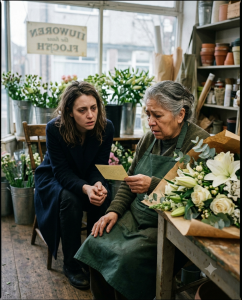
Inside the shop, Renata moved carefully, as if afraid of breaking the stillness. Dolores gestured toward the old worktable. Renata sat. Dolores began wrapping the arrangement in brown paper with the kind of neat folds that had once been second nature and now felt almost holy in their familiarity.
They did not speak for several minutes.
Dolores had spent her life learning how to read people who entered flower shops. People came to florists on birthdays and anniversaries, yes, but also on the worst days of their lives. By long practice she could tell which customers needed questions, which needed practical options, and which needed the gift of someone letting silence remain unbroken.
Renata was one of the silent ones.
As she shifted in her chair, the edge of an index card peeked from her coat pocket. Its corners were softened. The paper had yellowed with time. Renata’s fingers moved toward it reflexively, then retreated.
Dolores kept her eyes on the flowers.
“What was it about this arrangement?” she asked eventually.
Renata looked down. “It’s for a funeral.”
Dolores waited.
“I’ve been trying to find something right,” Renata said. “Something… worthy, I guess. I couldn’t afford much.” She laughed once, bitter and embarrassed. “I know flowers aren’t the important part. I know that. But this person mattered. A lot.”
Dolores nodded. “Then the flowers matter too.”
Renata’s gaze lifted, surprised.
“My husband used to say a good arrangement doesn’t come from the florist,” Dolores said. “It comes from whoever it’s for.”
That did it. Renata’s expression folded inward with the effort of staying composed. She reached into her pocket and took out the index card.
“This is going to sound strange,” she said, staring down at it. “But could you read this to me?”
Dolores frowned lightly. “You can read it.”
“I know.” Renata exhaled and looked away. “I’ve just read it so many times I think I don’t hear it anymore. Maybe if someone else said it out loud…” Her voice trailed off.
Dolores wiped her hands on her apron and held out her hand.
The card felt old. Tender, almost. The way paper did when it had traveled in a life with someone—through wallets, purses, pockets, drawers, moments of panic, moments of comfort.
She unfolded it.
Read the first line.
And the world narrowed to the size of her own pulse.
The handwriting was hers.
Not similar. Not close. Hers.
A looping capital D. Rightward slant. The little tails she always gave to y’s without realizing it. The slight indentation where she pressed too hard on downstrokes. The neat, careful spacing that Manuel used to tease her about, saying she wrote like a schoolteacher trying to impress a bishop.
Dolores read the first line again.
For the days when you think no one would notice if you disappeared…
Her throat tightened.
The second line:
Someone would. Someone always does.
She sat down abruptly on the stool behind her.
Renata leaned forward at once. “Are you okay?”
Dolores hardly heard her. She turned the card over, then back again. She scanned the words, the pacing of them, the way certain phrases curved. It was not just the penmanship. It was the voice. The exact emotional pitch she herself had once used when writing notes for people who came into the shop carrying pain they didn’t know how to name.
“I wrote this,” she said.
Renata stared. “What?”
“This is my handwriting.”
A few beats of silence passed between them.
“I’ve had that card since I was thirteen,” Renata said slowly.
Dolores looked up. “How?”
“My mother gave it to me.” Renata swallowed. “She said a florist gave it to her with flowers once. She kept it in her wallet for years. Then when things got bad for me, she handed it to me and said to keep it close.”
Dolores stared at her. “Your mother’s name?”
“Lucia Mendez.”
The name tugged at memory without fully opening it. Dolores closed her eyes for a moment and let the decades move through her. Weddings, funerals, hospital bouquets, corsages, apologies, births, condolences. Thousands of faces. Thousands of hands. So many people had cried in front of her over the years that grief itself sometimes felt faceless.
And then it came back.
A woman in a supermarket uniform. Near closing. Rain in her hair. Eyes swollen from crying. She had come in asking for something inexpensive to take to her sister, because she was “starting over” and didn’t want to arrive empty-handed. That had been her phrase. Starting over. As if she were speaking about a school notebook instead of a life.
Dolores remembered the woman’s sleeve slipping back as she reached for her wallet. A bruise on her wrist. Not fresh, but not old enough either.
Dolores had not asked questions she knew the woman could not answer honestly in a flower shop. Instead she had built a small arrangement of daisies, greenery, and a few roses left from a larger order. Something modest. Something brave.
And yes. She remembered writing a note.
Because after the woman left, Manuel had found the draft copy in the back room and said, “This one’s more you than customer.”
Dolores had laughed and said maybe that was the point.
Now she looked at Renata and felt the years fold.
“I remember your mother,” she said softly.
Renata’s breath caught.
“She apologized for crying three times in five minutes,” Dolores said. “As though tears were an inconvenience she was making me endure. She asked which flowers lasted longest, but she didn’t care about flowers. She was asking whether anything could survive what had already happened.”
Renata covered her mouth with her hand.
“She had a bruise on her wrist,” Dolores added quietly.
Renata’s eyes flooded. “She never told me that.”
“No.” Dolores looked down at the card. “Mothers don’t always tell daughters every weight they’re carrying. Sometimes they think they’re protecting them. Sometimes they just don’t have the words.”
For a while they sat without speaking.
Then Renata said, “My mother kept that card behind a photo of me in her wallet. After she died, I found it. On the back she’d written, ‘Keep this when you need reminding.’”
Dolores turned the card over.
There it was, in a different hand.
Keep this when you need reminding.
Below it, a date.
The numbers made Dolores’s chest go tight.
Because she knew that date.
It was the same day her son Rafael had stormed out of Ruiz Blooms after one of the ugliest fights they had ever had.
He had been twenty-three. Angry, wounded, restless, and tired of living in a family business that seemed to demand endless patience from everyone except him. There had been other things too: money troubles, Manuel’s rigid expectations, Rafael’s feeling that the shop came before everything else, even him. That day it had finally erupted.
The argument had started in the back room and ended by the front counter, where Rafael, white with rage, had said, “You’ll bend over backward for strangers but you can’t hear your own son.”
Dolores had fired back something equally sharp. She barely remembered the words now, only the damage.
Rafael had left and not come back.
There had been a few failed attempts at reconciliation in the early years. Then less. Then silence became habit, and habit hardened into history.
Dolores stared at the date again, then noticed something else beneath Lucia’s writing.
A faded phone number.
The old shop line.
And beneath that, three words in ink so rubbed-out they were almost ghosts.
Ask for Rafael.
Her breath stopped.
Rafael.
Not her writing. Not Lucia’s either. Different pressure. Different shape. Hers and not hers layered on the same card.
She looked up at Renata. “Did your mother ever tell you what happened after she got this?”
Renata frowned through her tears. “Not really. She just said the people at the flower shop were kind.”
“The people?” Dolores echoed.
“Yes.”
Dolores looked down again.
A memory surfaced, small but clear. She had been in the back room working when the shop bell rang. Rafael had been on front counter duty, sullen and distracted after their fight earlier that morning. She remembered stepping out briefly and seeing Lucia at the counter holding the arrangement. She remembered Rafael saying, in an unexpectedly gentle voice, “Hang on,” and reaching for a pen.
Then a delivery call had come in. Dolores had disappeared into the office. She had never seen the card again.
All these years she had assumed she’d tucked the note into the bouquet and forgotten about it.
But now she understood. Rafael had seen the note. Added the number. Told the woman to ask for him if she needed help.
A sharp ache moved through her.
The son she had spent nineteen years remembering mostly through anger and absence had, on the day of their worst fight, quietly attached himself to a stranger’s lifeline.
Renata was looking at her closely now. “What is it?”
Dolores turned the card toward her and pointed. “This name. My son.”
Renata wiped her cheeks. “Rafael?”
“Yes.”
Her face changed instantly. Not confusion. Recognition.
“My boss,” she said.
Dolores blinked. “What?”
“My boss’s name is Rafael Ruiz.” Renata’s hand flew to her coat for her phone. “He’s the one who told me about the funeral. He said there was a florist on this street his family used to own. He never said—” She broke off, eyes going to the window, the sign, Dolores, then the card. “Oh my God.”
She unlocked her phone and pulled up a work group photo from an office holiday dinner. There, standing in the back row with silver at his temples and the familiar stubbornness still set in his shoulders, was Rafael.
Older. Broader. Sadder around the eyes.
Still unmistakably her son.
Dolores reached for the phone as if it might vanish.
The room tilted. Her thumb moved over the image but stopped before touching his face.
“He still stands like Manuel,” she whispered.
Renata looked from the photo to Dolores. “He talks about his mother sometimes. Not often. Usually if flowers come into the office, he goes quiet after. I just thought…” She stopped. “I thought maybe she had died.”
“No,” Dolores said, though the word felt strange. “Not dead. Just… elsewhere.”
Renata sank back into her chair. “I can’t believe this.”
Neither could Dolores.
“Whose funeral is this for?” she asked after a moment.
Renata lowered the phone. “His stepmother. Sort of. The woman who helped raise him after his father left. She passed away this week. He asked me to help coordinate things because he said he couldn’t deal with flower shops himself.”
The sentence landed with exquisite precision.
Couldn’t deal with flower shops himself.
Dolores closed her eyes briefly.
Not wouldn’t. Couldn’t.
The difference mattered.
When she opened them, she stood. Her grief had taught her that some moments ask for tears and others ask for movement. She untied the twine around the arrangement and began rebuilding it with swift, precise hands.
Renata watched. “What are you doing?”
“Making it right.”
Dolores removed two roses, added more lilies, deepened the eucalyptus, adjusted the shape. It became fuller, steadier, more formal. Something not merely beautiful but honest.
She worked while memory worked beside her.
Rafael at fifteen, sweeping stems and complaining about pollen. Rafael at nineteen, carrying six centerpieces into a church and pretending not to enjoy being thanked. Rafael at twenty-three, furious and hurt and so much like Dolores herself that neither of them could forgive the other for it. Manuel standing between them too often, softening things that should have been spoken plainly long before they became jagged.
When the arrangement was done, Dolores wrapped it again, this time with more care than before.
Then she looked at the old landline phone mounted near the register that no longer rang.
For years she had imagined calling her son and hearing nothing, or worse—hearing polite indifference. She had also imagined him calling her, though less often as time passed. Sometimes pride masqueraded as injury until even the person wearing it couldn’t tell the difference anymore.
Renata stood. “You don’t have to do anything right now.”
Dolores almost smiled at that.
At seventy-two, she had learned that life rarely sent invitations twice. It simply placed the thing in front of you and waited to see whether you were brave enough to touch it.
“He gave your mother his name,” she said quietly, still looking at the phone. “On the same day he told me I cared more about strangers than my own family.”
Renata said nothing.
Dolores lifted the receiver, then set it down again.
Her hands trembled. She did not like that Renata could see it.
“Would you rather call from your phone?” Renata asked softly. “In case he doesn’t answer unknown numbers?”
Dolores looked up.
Renata held her own phone out. “He’ll answer me.”
Dolores took it. The screen felt too modern, too light, too intimate.
Renata found Rafael’s contact and handed it back.
Dolores stared at his name.
Rafael.
Nineteen years of not saying it aloud enough. Nineteen years of rehearsed speeches and no courage to deliver them. Nineteen years of assuming the story was fixed because time had passed.
She pressed call.
It rang once.
Twice.
Three times.
Each ring seemed to gather every unsent apology she had ever carried.
Then the line clicked.
“Renata?” a man’s voice said. Older, rougher, but hers to recognize instantly. “Did you find something for the service?”
Dolores opened her mouth and discovered that every prepared word had vanished.
So she told the truth instead.
“Rafael,” she said, and her voice broke on the second syllable. “It’s Mama.”
Silence.
Not the empty kind. The crowded kind.
The kind full of years.
When he finally spoke, his voice had changed.
“…How did you get this number?”
Dolores looked at the card on the table between the lilies and Renata’s tear-streaked face.
“From a woman who stood in this shop a long time ago,” she said. “From a note I wrote and a kindness you added when I wasn’t looking.”
On the other end, she heard him inhale.
For one terrible second she thought he might hang up.
Instead he said, very quietly, “You found that?”
“I think,” Dolores replied, “it found me.”
Another silence.
Then, to her astonishment, he laughed once. It was a broken sound, full of disbelief and something dangerously close to pain.
“That sounds like one of your lines,” he said.
She closed her eyes. “Maybe you kept more of me than you meant to.”
That almost undid them both.
Renata turned away politely, giving them the illusion of privacy in a room suddenly overflowing with it.
Rafael spoke first again. “Renata’s there?”
“Yes.”
“And you’re at the shop?”
“Yes.”
He let out a long breath. “I haven’t been inside that shop in nineteen years.”
“I know.”
“I drove by once after Dad died,” he said. “I couldn’t get out of the car.”
Dolores pressed her free hand to the worktable.
“You should have called.”
“I know.”
The mirroring of it nearly broke her. So much lost inside two identical words.
He cleared his throat. “I didn’t put my name on that card to be heroic, you know.”
“I know.”
“I was angry at you.”
“I know.”
“I thought… if you could help strangers, maybe I could too.” His voice roughened. “Maybe just to prove I wasn’t the only selfish person in the family.”
The honesty of it made something old and hard inside Dolores finally loosen.
“That sounds like our family,” she said.
This time his laugh was real, though brief.
They did not solve nineteen years in the next five minutes. They did not unpack every injury or assign perfect blame. Real life seldom offered such clean accounting. But the wall between them, once treated as permanent architecture, had cracked.
They spoke about practical things first because practical things are easier: the funeral home, the service time, the arrangement, where it should be delivered.
Then harder things crept in through the edges.
How long Dolores had been opening the shop on Saturdays.
How Rafael had changed jobs three times before settling into the one Renata knew him from.
How Manuel had asked for him near the end and whether Dolores had heard that correctly.
“She told me not to call,” Rafael said quietly when Manuel came up. “Aunt Celia. She said you needed peace.”
Dolores shut her eyes. “I never said that.”
“I know that now.”
The damage done by other people’s attempts at managing pain sat between them like yet another ghost in the room.
Eventually Rafael said, “I can come by.”
The words were simple. Their weight was not.
“Today?” Dolores asked before she could stop herself.
A pause. Then: “If that’s all right.”
Dolores looked around the shop—the buckets, the ribbon spools, the old clock, the arrangement waiting by the door, the years piled invisibly in every corner.
“Yes,” she said. “It’s all right.”
He arrived forty minutes later.
Renata stayed, though she moved quietly, pretending to fuss with ribbon so she would not intrude. Dolores was grateful. Witnesses mattered sometimes. Not to judge, but to prove a thing had truly happened.
The bell above the door rang.
Rafael stepped in and stopped.
For a second Dolores saw all his ages at once. The boy carrying boxes. The young man with anger sparking off him like live wire. The stranger in the office photo. The man standing before her now, silver at the temples, grief in his posture, and his father’s hands.
No one spoke.
Then Rafael looked at the funeral arrangement by the counter and gave a small, shaken laugh.
“You always did overdo the lilies.”
Dolores’s mouth trembled into a smile. “And you always complained before helping carry them.”
That was enough.
They crossed the room at the same time.
The embrace was awkward, too late, imperfect, and absolutely real. Dolores could feel the bones of his back, the tension he had worn for years, the small shudder he tried and failed to hide. Her own tears came without dignity, soaking his shoulder. He was crying too, though he’d always hated doing it in front of anyone.
“I’m sorry,” he said into her hair.
“I’m sorry too.”
It did not erase the years. Nothing could. But it gave them somewhere new to begin.
They spent the afternoon talking in pieces. Some memories came gently, some with hurt attached. There were things both wished they had done differently. There were old misreadings, outside interferences, and plain stubbornness laid bare under the light.
Rafael admitted he had expected rejection so often that eventually he stopped risking the chance to be wrong. Dolores admitted she had mistaken waiting for dignity when really it had just been fear.
They laughed once over how predictable that was.
Renata, who had begun the day trying to afford funeral flowers for her boss, sat at the worktable drinking tea Dolores insisted on making and watched the strangest chain of kindness she had ever seen complete itself across decades.
Before leaving for the service, Rafael picked up the arrangement with both hands and looked around the shop one more time.
“I used to think this place took you from me,” he said.
Dolores answered honestly. “Sometimes I let it.”
He nodded. “I know.”
Then he glanced at Renata. “And you found all this because you were standing outside a closed flower shop staring into a window?”
Renata gave a watery smile. “Apparently.”
Rafael looked at the card again, then at his mother. “Do you still write notes for people?”
“Not often.”
“You should,” he said.
The funeral passed with all the solemnity such days required. The arrangement stood at the front, luminous and dignified, carrying more history than anyone there could possibly have known. Renata noticed Rafael look at it several times during the service, each time with a different expression—grief, memory, disbelief, gratitude.
A week later he came back to Ruiz Blooms on a Saturday.
Then the next Saturday too.
He didn’t promise anything grand. He just showed up. Swept stems. Complained about pollen. Fixed the hinge on the cooler. Brought decent coffee. Once, while Dolores was wiring a bouquet, he found an old stack of index cards in a drawer and held one up with a half-smile.
“Dangerous things, these.”
“Apparently,” Dolores said.
The sign in the window still says Ruiz Blooms. The hours are still unofficial. The shop is still mostly quiet.
But now, on some Saturdays, that quiet contains two voices instead of one.
And on the back counter, under a ceramic dish of ribbon pins, Dolores keeps a worn old index card in a plastic sleeve. Not because she needs the words anymore, though some days she still does. She keeps it because it reminds her that the smallest kindness can travel farther than the hand that offered it ever knows. That hurt can last decades, yes—but so can mercy. So can proof that someone noticed. So can a road back.
Sometimes customers have begun drifting in again, one or two at a time, surprised to find the shop open and warmer than they remember. Dolores has not decided whether she is reopening for real. Maybe she is. Maybe she isn’t. At her age, certainty has become less important than presence.
What she knows is this:
A woman once carried away a bouquet and a note on the worst day of her life. A daughter carried that note through her own worst years. A son wrote his name beneath words his mother did not know would save anyone. And after nineteen years of silence, a family found its way back to one another through paper, flowers, and the kind of accident that feels suspiciously like grace.
Who was most at fault no longer seemed like the most interesting question.
The sharper one was this: how many lives had nearly gone in separate directions forever simply because pride knew how to speak faster than love—and how many people might still find their way back if they were brave enough to read, at last, what had been in front of them all along?