When Clara Mercer stepped into the Pine Valley County Historical Society on a windy Tuesday afternoon, she expected dust, old photographs, and the kind of pleasant small-town boredom she had always secretly loved. She did not expect to find herself dead.
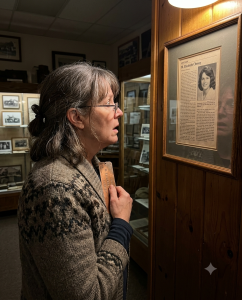
The exhibit sat in the back gallery beneath a handwritten sign that read Women of Lost Pine Valley. There were framed wedding portraits gone silver with age, school photographs of girls who had died in the influenza epidemic, and brittle newspaper clippings about flood victims, ranch accidents, and disappearances people still lowered their voices to mention. Clara would have walked past it if she had not caught the shape of her own face from the corner of her eye.
Then she stopped so hard her shoulder bag slid down her arm.
There she was.
A younger version, but unmistakably her. Brown hair pinned up. Nervous smile. Crooked cardigan button. The photograph had been taken for the library newsletter the year the Carnegie branch got its new roof. Someone had mounted it above a framed obituary and a short placard that called her Clara Mercer Holloway, beloved wife, devoted librarian, tragically lost in the spring river accident of 2009.
Never recovered. Forever remembered.
For several seconds, Clara could not breathe. The room seemed to narrow around the glass frame, the brass lamp, the neat typed label. She was aware of footsteps somewhere behind her, a volunteer rustling papers at the front desk, the muted whine of an old heater. But all of it felt far away.
She had spent seventeen years trying not to think of Pine Valley. And now Pine Valley had turned her into an exhibit.
She left the gallery only because the volunteer asked whether she needed help. Clara muttered no and walked back into the afternoon wind with her heart hammering so hard it made her vision pulse.
That evening, after the county library closed, she sat alone at her desk sorting returns and trying not to remember the year she disappeared.
She had not fallen into the river.
She had run.
Back then she had been married to Dean Holloway, a man the town admired for all the reasons that should have made her suspicious sooner. He was handsome in a controlled, respectable way. He shook hands too firmly, remembered names too easily, and could make concern sound like affection while he quietly rearranged your life around his needs. He handled insurance paperwork for local ranch families. He knew exactly how forms worked, how signatures could be copied, how the right story could harden into fact if enough respectable people repeated it.
Clara discovered the policies by accident.
She had gone into his desk looking for stamps and found two documents bearing her forged signature. The first increased the life insurance policy in her name. The second changed the mailing contact. When she confronted him, Dean did not shout. He never shouted when he was at his most dangerous. He leaned back in his chair and gave her a patient smile that said he had already stepped three moves ahead.
“You’re overtired,” he told her. “You’ve been imagining all kinds of things lately.”
She had driven out that same afternoon with one duffel bag and emergency cash hidden inside an atlas. She planned to stay away for a week, maybe two, while she figured out what to do.
Then she heard Dean had filed a missing persons report.
Then a search began.
Then the rumors started.
Then came notices, legal motions, a presumption of death.
By the time Clara understood the full scope of what he had done, she was living under borrowed addresses, working part-time in a shelter library in Spokane, and too frightened to step forward. Fear did not arrive all at once in those months. It accumulated. A letter forwarded where it should not have been. A man in a grocery store parking lot who seemed to know her old name. The knowledge that Dean had money, charm, and an entire town willing to believe him. She told herself she would fight later, when she had proof. Later stretched into years.
Dean collected her life insurance and remarried within twelve months.
Now, seventeen years later, Clara had returned to Pine Valley for practical reasons, not sentimental ones. Her aunt in Billings had died. The inheritance was small. The county library needed temporary help. An upstairs apartment over the old pharmacy was cheap. She planned to stay quiet, save money, and leave again.
Then a copper bookmark fell out of a returned novel and hit the circulation desk with a metallic click.
At first, it seemed like a donated oddity. It was narrow and worn, dark with age except where fingers had polished the edges. On the front, engraved in elegant script, was her maiden name.
Clara Mercer.
She stared at it until the room blurred.
Very few people in town knew that name belonged to her. She was hired under Clara Reed, the surname from a brief second marriage that had ended years earlier and left behind only paperwork and a preference for solitude. The old name lived in school records, a few county forms, and the years before Dean Holloway.
She turned the bookmark over.
Blank.
The next morning it was lying in the center of her desk.
The day after that, she found it slipped under her apartment door.
By then she understood the message clearly enough even if she did not understand the source. Somebody knew who she was. Somebody had always known.
Clara began watching faces. Marnie from archives, who talked too brightly whenever the historical society came up. Mr. Talbot at the grocery store, who stared at her a beat too long and then muttered that she reminded him of someone. A teenager whispering to another patron that the dead woman in the museum looked exactly like Miss Clara from the library. Everywhere she went, she sensed small hesitations, swallowed recognition, the faint tension of a town where knowledge traveled quietly but never really disappeared.
So she went back to the historical society and asked to see the exhibit file.
The volunteer, a white-haired woman with trembling lipstick, hesitated just long enough to confirm that something was wrong before she fetched a folder from the back. The contents were ordinary in the way documents become sinister only when stacked together: sympathy cards, a copy of the old newspaper clipping, a church bulletin, notes from the search effort, and an accession sheet listing donations. One line stopped Clara cold.
Personal effects donated anonymously, 2024. Included: memorial photo, river scarf, copper bookmark.
The bookmark had belonged to the exhibit before it began haunting her.
Then Clara saw the handwritten notation under the matting of the obituary clipping. Tiny blue letters. Almost hidden.
Saved by L.H.
Dean’s mother had been Lenora Holloway.
Everyone in Pine Valley said Lenora died the same year Clara disappeared. Stroke. Closed casket. Sad but straightforward. Clara remembered casseroles arriving at the house. She remembered Dean receiving condolences with his chin lowered and his eyes carefully reddened. At the time she had been too consumed by her own fear to question how quickly grief and administration seemed to sort themselves around him.
That evening she drove to the cemetery. Lenora’s grave sat beneath a cottonwood at the edge of the hill, plain and respectable. But at the base of the marker someone had left another copper bookmark, newer than the first, engraved with a different name.
Lenora Hale.
Hale was Lenora’s maiden name.
Clara took both bookmarks home and scrubbed the older one with the edge of her thumb until a faint inscription emerged on the back.
Property of Lenora Hale.
Below that, scratched so lightly it looked like an afterthought carved in fear, were four words.
I never left town.
That message sent Clara back into the cold night. First to the old Holloway house, where a lamp glowed in a rear room though the property was supposed to be vacant. Then to the county records office, where the volunteer schedule on the public bulletin board listed a name under archival assistance.
L. Hale.
Finally, she went to the historical society.
A note was taped to the inside of the locked front door, visible through the glass.
For Clara. Come alone.
The building was dark except for one office light at the back. A shadow moved behind frosted glass. Clara knew that posture before she fully knew why. Slight shoulders. Head tilted as if listening to a sound far away.
She tried the handle.
Unlocked.
The galleries smelled of paper, cedar polish, and old furnace heat. Her shoes sounded too loud on the floorboards. She followed the thin strip of light down the hall to archives and stopped in the doorway.
An older woman stood beside a table stacked with file boxes. Her hair was white now, her frame narrower, but Clara knew her immediately.
Lenora Holloway. Lenora Hale. Dean’s mother. The dead woman.
For a long moment, neither spoke.
Then Lenora said, “You came back sooner than I thought you would.”
Clara’s whole body went rigid. “You’re supposed to be dead.”
Lenora gave a small, exhausted laugh. “So were you.”
That answer hit Clara harder than denial would have. Anger came first, hot and immediate.
“You knew,” Clara said. “All these years, you knew I was alive.”
“I knew you survived,” Lenora said quietly. “That is not the same thing.”
Clara took a step forward. “Start talking.”
Lenora sank into the chair behind the table as if her bones had been waiting years for permission to collapse. Under the harsh desk lamp, her face looked older than Clara remembered but sharper too, as though secrecy had pared her down to essentials.
She told the story in pieces.
The day Clara fled, she had not gone directly west as Dean assumed. She had pulled over outside town because her hands were shaking too badly to drive. Lenora, who had gone looking after overhearing Dean on the phone with an insurance contact, found her on the road. Clara remembered almost none of that conversation now except sobbing and the smell of wet sage through the open car door. Lenora had believed her instantly because Dean had done something similar years earlier—small frauds first, then bigger lies, then threats wrapped in calm voices. By then Lenora had become terrified of her own son.
“You should have gone to the sheriff,” Clara said.
“I should have done a hundred things,” Lenora replied. “I did the one thing I thought would keep you breathing.”
Lenora sent Clara to a shelter contact in Spokane using money from an account Dean did not know she had kept. She promised to gather evidence and bring it once it was safe.
But Dean moved faster.
He filed the missing report, staged the river narrative, and exploited Lenora’s hesitation. When she threatened to expose him, he told her he would say she had helped Clara disappear to frame him. More than that, he hinted he would come after Clara wherever she was hiding. Lenora believed him because she had spent her life watching what Dean did when cornered.
So Lenora made another desperate choice.
She let Pine Valley believe she was dead too.
A closed casket. A falsified certificate with the help of an out-of-county contact connected to Dean’s earlier schemes. Once the funeral was over, Lenora reappeared only in fragments—under her maiden name, volunteering quietly in archives, renting a room through church contacts, surviving by being the kind of older woman people stopped truly seeing. Hidden in plain sight.
Clara gripped the back of a chair so hard her fingers hurt. “Why not tell me?”
“I tried.” Lenora opened a file box and drew out a packet tied with string. “Twice the letters came back. Once I thought Dean had intercepted them. After that, I stopped risking a trail.”
Inside the packet were copies of insurance amendments, bank transfers, and notarized forms bearing Clara’s forged signature. There were records of the payout, timelines, and one document that mattered more than the rest: a signed statement from a retired funeral director admitting Lenora’s burial had been staged to protect a witness from Dean Holloway.
Clara stared at the papers. Seventeen years of fear condensed into evidence.
“Why now?” she asked. “Why the exhibit, the bookmarks, all of it?”
Lenora’s eyes glistened. “Because Dean is selling his property and leaving the county. Once he goes, he’ll bury everything for good. And because when I saw your hiring notice at the library district office, I knew hiding had already failed. Someone else was going to recognize you eventually. It had to come from me before it came from him.”
A floorboard creaked in the hallway.
Both women froze.
Then came the sound of the front door opening.
Dean’s voice drifted through the building, older but unmistakable. “Mother?”
Lenora shut her eyes for half a second. “I thought I had more time.”
Clara’s pulse roared in her ears. Seventeen years collapsed into that one voice. Dean walked down the hall as if he belonged there, confident, unhurried, still trusting the power of his own version of events.
He stopped in the archives doorway and looked from Lenora to Clara.
For the first time in his life, he had no expression prepared.
He went white. Then red. Then smiling, impossibly, as if charm might still rescue him.
“Clara,” he said. “This isn’t what you think.”
It was almost enough to make her laugh.
Lenora stood. Frail, trembling, but upright. “It is exactly what she thinks.”
Dean’s eyes snapped to the file box. He lunged for it.
Clara moved before he did. Years of fear had taught her many ugly reflexes, but one useful one was speed. She caught the box and shoved it behind her as Dean grabbed her wrist. He was stronger, but not by as much as memory had allowed. Lenora struck his shoulder with the metal desk lamp, a desperate swing that sent him staggering sideways.
The volunteer at the front desk screamed.
Within minutes, police sirens cut through Main Street.
Dean tried to talk his way out of it while officers separated them. He called Clara unstable, said Lenora was confused, claimed the documents were fabricated. Then one of the deputies, a woman new enough to town not to care about old reputations, started matching the dates in Lenora’s file with archived insurance records and missing-person affidavits. The charm began to fail in real time.
By dawn, Dean Holloway was in custody on fraud-related charges, falsification counts, and the reopening of multiple older investigations tied to insurance documents he had processed over the years. The district attorney later said Clara’s case had been the keystone. Once it cracked, several others shifted loose behind it.
It did not feel triumphant the way she had imagined justice might feel.
It felt exhausting.
In the weeks that followed, reporters called. Lawyers called. Former neighbors avoided her in the grocery store or stared too openly, trying to reconcile the woman buying peaches with the woman they had spent nearly two decades grieving. The historical society took down the exhibit. The framed obituary was removed from public display and placed in evidence storage until the case settled.
Lenora did not go to jail. Her role had been tangled in fraud, yes, but also in witness concealment and coercion. More importantly, the documents and testimony made clear that she had acted first to protect Clara and later to survive her son. The county treated her as both participant and witness. It was an imperfect verdict for an imperfect woman.
Clara visited her once a week anyway.
They never became close in the easy, sentimental way people prefer to imagine after family betrayals. Too much had been lost. Too much had been chosen in fear. But they learned, cautiously, to sit in the same room with the truth between them.
One afternoon, months later, Clara returned to the library after lunch and found a copper bookmark on her desk.
For one sharp second her stomach turned.
Then she picked it up and smiled.
The engraving read simply Clara Mercer. No hidden message. No warning. Just the name that had once been buried under a husband’s lie and a town’s convenience.
She used it in the copy of Jane Eyre she kept by the circulation desk.
There was no perfect ending after something like that. Dean’s trial would take time. Pine Valley would spend years deciding whether to call what happened a tragedy, a crime, or an embarrassment. People would always ask Clara why she did not come back sooner, as if fear obeyed logic, as if survival owed anyone elegance.
But she was alive in a town that had framed her death, and every day she signed her real name a little more firmly.
The strangest part was not that Dean had lied. Men like Dean always believe they can turn paperwork into destiny if they are confident enough. The strangest part was how many people accepted the version of events that asked the least of them. A dead woman is easier for a town to carry than a living one with questions.
Sometimes Clara stood outside the historical society after closing and looked at the windows glowing gold in the evening. She would think about the obituary under glass, the grave with the wrong body beneath it, the mother who saved her too late and lied too long, and the husband who thought a signature could erase a person.
Then she would wonder what the bigger betrayal had really been: Dean’s greed, Lenora’s silence, or the fact that for seventeen years almost nobody in Pine Valley looked closely enough to notice the dead woman had come home.