By the time the invitation from the Branson National Quilting Exhibition arrived, Eleanor Hargrove had already read the envelope three times without opening it.
It had come tucked inside the official packet, almost as an afterthought. The judging schedule was on top. Then parking instructions, venue information, hotel recommendations. And beneath all that, unsealed, was a smaller plain white envelope with her name written across the front in handwriting she would have recognized in darkness.
Eleanor.
Her mother’s hand had always leaned slightly forward, as if even her penmanship were in a hurry to get to the truth.
At first Eleanor thought she was imagining it. She sat at her kitchen table in Rolla and held the envelope under the light, tracing the familiar letters with the side of her thumb. Her husband, Grant, had asked what was wrong, and she told him only that the exhibition paperwork had included something strange. She did not show him the envelope. She did not open it. She slipped it back into the packet and left it in the drawer where she kept rubber bands, spare keys, and recipes she no longer cooked.
For three nights, she slept poorly.
When morning came, she found herself thinking not about Branson or the exhibition, but about Glenstone Road and the little sunroom where her life in fabric had begun.
It had barely been a room. More of an enclosed porch, really, with narrow windows that trapped the heat in summer and let in drafts all winter. Dottie Hargrove had arranged it as if it were a studio in Paris instead of a patched-together extension on a Springfield house. The card table sat against the left wall. The Bernina occupied pride of place on a homemade cabinet. Shelves held folded cotton in neat stacks, sorted by color with the kind of seriousness other women reserved for wedding silver. There was always a pencil behind Dottie’s ear, always a pin cushion tied to her wrist, always coffee going cold somewhere within reach.
“Color is emotion,” she used to tell Eleanor. “Never let anybody convince you beige is neutral. Beige is surrender.”
Eleanor had loved that room with the fierce devotion only daughters are capable of. It was the one place where she was never too loud, too dreamy, too sensitive, too much. In the sunroom, all of that became useful. Her eye for detail mattered. Her stubbornness translated into precision. Her tendency to stare at the sky and notice how blue turned gray at the horizon became a gift when she chose thread.
That was where she began adding the bluebird.
The first one appeared almost by accident. She had been fourteen, maybe fifteen, working on a table runner with her mother while rain rattled the windows. On impulse, she stitched a tiny bird into the lower-left corner, just for herself. Six stitches for the body. Three for the wing. When Dottie found it, she laughed and said, “Well. A little Hargrove signature.”
From then on, Eleanor put it on everything she touched.
It was never public. Never announced to customers. Never used in branding. It was simply theirs, a quiet mark of shared work and belonging.
Years later, that tiny hidden bird would become the one thing no document could erase.
When Eleanor was nineteen, her mother remarried.
Harold Whitaker was polite, churchgoing, and deeply interested in every financial detail of Hargrove Heritage Quilts. He had a firm handshake, a booming laugh, and the sort of charm people praised because they never had to live with it. His daughter, Carol, was twenty-two then. Practical. Calm. Efficient. She wore crisp blouses and balanced ledgers for fun. Eleanor had disliked how quickly both of them settled into the house, but she told herself that resentment was selfish.
She was heading to the University of Missouri anyway. New life. New city. New future.
Her mother hugged her before she left and said, “This place will always be yours.”
For years, Eleanor believed that.
Then came the phone call.
She had already married Grant by then. They were living in Rolla with a toddler, a mortgage, and not much sleep. A woman from a local guild called to ask whether it was true that Eleanor had sold her stake in the family pattern line to her stepsister.
“I’m sorry?” Eleanor had said, standing at the kitchen counter with one hand still wet from washing dishes.
“The Hargrove Heritage papers,” the woman said. “I just assumed that’s why Carol Whitaker is listed now on the re-registration.”
Eleanor thought it had to be a mistake.
It wasn’t.
By the end of that week, she had copies of the filings. Her name was gone. Carol’s was there instead. Several early patterns were now registered under Carol’s authorship through the company. The dates lined up precisely with Eleanor’s first semester away at college.
She drove to Springfield the next morning with rage so clean and bright it almost felt like clarity.
But when she reached the house on Glenstone Road, Dottie was in bed with a blanket drawn to her chest, already thinner than Eleanor remembered. The cancer diagnosis had only just come. Harold took Eleanor into the kitchen before she could say a word and informed her, in an oily voice she never forgot, that stress was dangerous, that Dottie needed peace, and that business matters had been handled appropriately.
Eleanor demanded answers anyway.
Dottie cried.
That was somehow worse.
She said only, “It was complicated, Ellie. I thought I had time to explain.”
Eleanor asked, “Explain what? Why you signed my work away?”
Dottie covered her face and did not answer.
Eleanor left with every nerve stripped raw. Two months later, her mother was dead.
Harold handled the funeral. Carol handled the business. Eleanor handled her own grief by doing what women in her family had always done when suffering threatened to break them: she kept moving.
She raised children. She packed school lunches. She mended elbows and hems and Halloween costumes. She quilted privately, rarely showing her work outside close friends. In the hardest years, quilting became less an art than a form of breathing. But she never used the bluebird again.
It felt buried with her mother.
Then Branson called.
Her daughter, June, was the one who pushed her to accept.
“You don’t get to spend thirty years letting old pain choose for you,” June said. “Go judge the show.”
So Eleanor went.
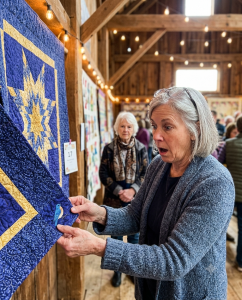
The exhibition was held in a converted barn off Highway 76, all cedar beams and white drapery and warm light pooled under strings of bulbs. The space was beautiful in that curated rustic way tourists loved, but under the polished charm was the familiar heartbeat of any serious quilting event: women and men moving quietly from piece to piece, studying stitches, whispering over technique, pretending not to compare themselves to one another.
There were sixty-three quilts in competition.
Anonymous judging was supposed to guarantee fairness. Each piece was identified only by number, title, and place of origin. Eleanor pinned her judge’s badge to her jacket, accepted her clipboard, and began.
For the first twenty entries, she found her rhythm. She admired a hand-appliquéd landscape from Kansas, frowned at tension issues in a modern geometric piece from Tulsa, and spent several minutes smiling at a child’s quilt whose uneven corners only made it lovelier.
Then she stopped in front of entry forty-one.
Ozark Morning Star.
Maker: Hargrove Heritage Quilts, Branson, Missouri.
The world narrowed.
She stepped closer. Indigo center. Gold outer field. The star broken with diagonal sashing to give the whole composition lift and motion. Even before she consciously recognized it, her body did. Her heart began to beat in her throat. She knew every line. She had drawn that pattern in pencil on graph paper on a rainy afternoon in October 1993 while her mother stood by the window cutting strips and humming Patsy Cline.
She did not need memory to tell her. Memory had already risen like floodwater.
Her fingers trembled as she touched the lower edge.
Quilters often examine the reverse side of a piece to judge finishing and technique. No one watching would have found it strange. But Eleanor’s hand shook so visibly that she clasped it with the other for a moment before lifting the quilt.
There, tucked precisely where the backing met the border in the lower-left corner, was a tiny stitched bluebird.
Six for the body. Three for the wing.
Her breath caught hard enough to hurt.
No one knew about the bluebird. Not Grant. Not June. Not her sons. Not guild members. Not even the women who had quilted beside her for twenty years in Rolla. That mark existed in only one shared language: hers and her mother’s.
“Ellie.”
The voice came from behind and slightly to the right.
She turned.
Carol stood ten feet away.
Time had silvered her hair and sharpened her face, but Eleanor recognized the same composed posture, the same careful stillness. Carol’s hands were folded in front of her, and there was something in her eyes Eleanor could not place. Not smugness. Not fear. Something harder to defend against.
Expectation.
“You knew I’d find it,” Eleanor said.
Carol nodded once. “Yes.”
Rage arrived late but all at once.
“You put my work under your name, and now you stand here like this is some kind of family reunion?”
Several nearby visitors glanced over. Carol kept her voice low. “This isn’t the place.”
“No,” Eleanor snapped. “The place would have been thirty years ago.”
Carol flinched but did not step back. “Your mother left instructions.”
Eleanor laughed once, sharp and bitter. “She left a grave.”
Carol reached into her leather bag and removed an envelope. Yellowed. Soft at the corners. Eleanor’s name across the front in Dottie’s unmistakable hand.
For a second Eleanor could not move.
“I’ve carried this for years,” Carol said. “She told me not to give it to you unless you found the bird yourself.”
Eleanor stared at the envelope, then at Carol. “Why?”
“Because she said you wouldn’t believe anything else.”
Her fingers closed around the paper. It felt both fragile and impossibly heavy.
“Read it,” Carol said.
Eleanor wanted to tear it apart in front of her. Wanted to walk out. Wanted never to hear another word connected to the Hargrove name again. Instead she broke the seal and unfolded the letter.
My Ellie,
If you are reading this, then you found the bluebird, and that means you know I did not forget whose hands helped build these quilts.
I pray you will let me explain, though I do not know if I deserve that grace.
The first paragraph blurred through sudden tears she refused to shed in public. She drew in a breath and kept reading.
Dottie wrote that Harold’s finances were worse than he had admitted when he married her. Debt, liens, and business trouble followed him. More than once, he had hinted that once he was her husband, Hargrove Heritage Quilts should be “restructured” to support the household. At first Dottie thought that meant tighter bookkeeping. Then she discovered papers he had drawn up to leverage the business itself as collateral.
He had wanted Eleanor’s name left on the filings because her original designs increased the company’s value.
Dottie, in panic and already ill, removed Eleanor’s name to separate her daughter legally from what Harold planned to do. Carol, who had discovered her father’s scheme first, urged Dottie to move quickly. Adding Carol’s name was not meant as theft, Dottie wrote, but as a shield. If Harold tried to claim ownership through marriage and debt, Carol could contest him from inside the company.
I thought I could fix it before you had to know, the letter said. I thought I had more time. I thought I could protect your work and then restore your name properly. I was wrong about time.
Eleanor read the final lines twice.
The original sketches, samples, and account ledgers are hidden in the cedar chest beneath the old batting rolls. Carol knows where. She knows the truth. I have made her promise to preserve everything until you are ready.
Forgive me if you can. If you cannot, I understand. But never believe your work was not yours to me. I hid the bluebird because I needed one thing in this world no lawyer could rewrite.
Love always,
Mama
Eleanor lowered the pages slowly.
The barn around her returned in fragments: conversation, footsteps, a burst of laughter near the vendor tables, the creak of wood under shifting weight. She looked at Carol and saw, maybe for the first time, not the woman who had stolen her place, but someone who had lived under the same roof of fear and calculation.
“You should have told me,” Eleanor said.
Carol’s voice was quiet. “I tried after the funeral. Harold intercepted everything. By the time I got free of him, you had moved, remarried, changed numbers twice. Then every year that passed made it feel more impossible.”
“Did you profit from it?”
Carol met her eyes. “Some. Not the way you think. Mostly I kept the business afloat so he couldn’t strip it. After he died, I kept waiting for the right way to say all of this. There wasn’t one.”
Eleanor folded the letter back along its old creases. “And the re-registrations under your name?”
Carol swallowed. “Temporary, your mother said. Then she died, and the lawyer told us changing them again would trigger questions Harold might use. After that everything became survival and delay, and delay turned into years.”
That did not erase the hurt. It did not restore birthdays, funerals, and ordinary afternoons lost to resentment. But it shifted the shape of the wound.
“What’s on the second quilt?” Eleanor asked.
Carol gave the smallest, saddest smile. “Come see.”
Across the room, near the historical display, hung a smaller antique piece Eleanor had overlooked when she arrived. The label identified it as noncompetitive, part of a retrospective on Missouri quilt makers. It was one of Dottie’s old sampler quilts from the mid-nineties, restored and mounted behind low protective rope.
Carol led her there.
“Look at the backing seam,” she said.
Eleanor bent closer. At first she saw only cream muslin, careful hand quilting, tiny age marks. Then she noticed a line of stitching in blue so faint it was nearly invisible. Not a bird this time. Words.
She leaned until she could read them.
Ellie made the morning. No one can take that from her.
Eleanor pressed a hand over her mouth.
Her mother had stitched the sentence into the quilt itself.
Not for customers. Not for judges. Not for legal records.
For her.
The award ceremony that evening passed in a blur. Eleanor completed her judging duties because decades of discipline carried her through, but every category, every ribbon, every announcement felt distant compared to the folded letter in her handbag.
After the crowd thinned, Carol asked whether Eleanor would come with her to the old storage property where Hargrove Heritage materials had been kept. Eleanor said yes before she fully knew why.
The building stood behind a small storefront on the edge of Branson, more practical than charming. Inside were shelves of boxed fabric, binders, pattern drafts, invoices, and years of accumulated history. In the back room, beneath plastic-wrapped batting rolls, sat a cedar chest.
Carol knelt and opened it.
Inside lay graph paper sketches in Eleanor’s teenage pencil hand, dated and initialed. Early sample blocks. Notes in Dottie’s looping script. Even photographs of Eleanor at the card table, hair pinned up with a pencil, grinning over a half-finished star block.
Eleanor touched the top sketch and began to cry in earnest.
Not delicate tears. Thirty years’ worth.
Carol stood nearby and let her.
When Eleanor could finally speak, she asked the question that had lived under every other question all day.
“Did she love me enough?” she said. “To fight for me?”
Carol answered without hesitation. “Everything she did at the end was fighting for you. She just chose badly in places where fear was making the decisions.”
That was, Eleanor thought, the truest sentence anyone had spoken.
Fear had chosen badly all through their family.
It had made Dottie hide instead of explain. It had made Eleanor leave instead of demand more answers. It had made Carol keep promises in silence long after silence had become its own kind of damage.
They spent hours cataloging what was in the chest. Original sketches. Receipts showing royalties set aside in a separate account Dottie had created in Eleanor’s name but never managed to transfer fully before she died. Draft letters to attorneys. Notes for a revised filing that had never been submitted.
By midnight, the path forward was clear.
The next morning, with a lawyer Carol trusted and Eleanor now insisted on meeting in person, they began the process of restoring authorship formally. Not just privately. Publicly. Correctly. The original patterns would be refiled under joint historical credit where appropriate, with Eleanor recognized as designer or co-designer. Later works that Carol had genuinely built herself would remain hers. The company archive would be preserved under both women’s names with a full written account of its history.
It was not neat.
Truth never is.
Months later, when the corrected announcement was published and a local paper ran the story of the restored Hargrove designs, people called it reconciliation. Eleanor disliked the word at first because it sounded soft and easy, as if one emotional conversation could cleanly mend thirty years of fracture.
But reconciliation, she learned, did not mean pretending harm had never happened.
It meant deciding the truth deserved daylight even when it made everyone look complicated.
Eleanor and Carol did not become instant sisters. That would have been false. But they began speaking. First about the business. Then about Dottie. Then, carefully, about Harold, and what living under him had cost each of them in different ways. Carol admitted she had envied Eleanor from the start, not because Dottie loved Eleanor more, but because Eleanor had once belonged to that sunroom without explanation. Eleanor admitted she had spent decades turning Carol into a villain because a villain was easier to survive than a mother who had failed her while trying to protect her.
The next spring, Eleanor stitched a bluebird into a quilt for the first time in thirty years.
Her granddaughter was the recipient, a baby not yet old enough to understand inheritance, let alone grief. Eleanor tucked the little bird into the lower-left corner, six stitches and three, and smiled through the ache that still lived there.
Some losses never leave. Some betrayals can be explained without ever becoming acceptable. Some acts of protection wound the very people they mean to save.
But that bluebird remained what it had always been: proof.
Proof of work. Proof of love. Proof that beneath filings and signatures and silence, some truths are too carefully stitched to disappear.
Even now, when Eleanor thinks back to that moment in the Branson barn, she does not first remember the shock of seeing her hidden mark on another woman’s quilt. She remembers the stranger feeling that came after, the one she had mistaken for dread.
Recognition.
Because the real question had never been whether her work had been stolen.
It was whether the people who failed her had done so out of malice, weakness, fear, or love twisted into the wrong shape.
She still is not sure there is comfort in the answer.
But she knows this much: the biggest red flag was never Carol’s name on the filing. It was every silence that made the lie possible. And forgiveness, if it comes at all, does not arrive as absolution. It arrives as a decision to stop letting the dead keep writing the story alone.