She walked into the genealogy center thinking no one on earth remembered her name.
By the time she reached the front desk, she had already regretted coming.
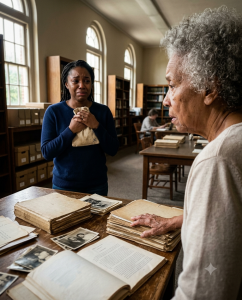
The building on Government Street was colder than she expected, the air-conditioning set high enough to fight the Louisiana heat and give every room the stillness of a church. People moved quietly between shelves and long tables, bent over records and photographs, tracing their histories with gloved fingers and lowered voices. Celestine Broussard felt clumsy among them, like she had shown up too late for something everyone else had been practicing their whole lives.
At seventy-one, she had learned how to make herself unnoticeable. She wore muted cardigans, sensible shoes, and the polite expression of a woman nobody needed to remember twice. For more than three decades, invisibility had not just been a habit. It had been survival.
Still, her doctor’s question from the week before had unsettled her in a way she could not shake.
Any family history of heart disease? Cancer? Strokes? Neurological conditions?
She had opened her mouth and realized she no longer knew.
Not in any meaningful way.
She knew she had once belonged to a place. She knew names, faces, roads cut through wet land, family stories told over boiling pots and bad coffee. But after thirty-one years of silence, estrangement, and deliberate forgetting, her past had begun to feel less like a life she had lived and more like something she had once overheard through a wall.
So she gave the woman at the desk her name.
“Celestine Broussard. Breaux Bridge parish.”
The woman, who had been typing without much interest, stopped.
Her eyes lifted to Celestine’s face, and for a fraction of a second something moved there—recognition, surprise, caution. It vanished quickly, but not quickly enough.
“We actually have a file under that name,” she said.
Celestine blinked. “Under mine?”
“Yes, ma’am.”
“That can’t be right.”
The woman hesitated. “Someone’s been compiling records for about ten years.”
Celestine put one hand on the counter. “What kind of records?”
But the answer came in the weight of the folder placed before her.
It was thick. Far too thick for a woman who believed she had been erased.
She carried it to a reading table and sat down slowly. Her fingers were stiff as she opened the cover. The first pages were ordinary enough—census pages, parish registries, old addresses, church records. Then she saw her own signature on a copied birth log and felt something drop through her chest.
She knew that signature.
A clean, slanting hand. C. Broussard. She had written it after births by kerosene light, by flashlight, by dawn seeping through kitchen curtains. She had signed papers with blood on her cuffs and mud on her shoes and babies still crying in the next room. She had signed those lines because names mattered. Records mattered. Witness mattered.
And yet she had been made to believe those records no longer carried her.
She turned another page. A second copied log. Then a third. Each one sourced from private archives, retired clerks, donated church books, county duplicates, papers that should have been forgotten but somehow had not been. Whoever built the file had not done so casually. They had chased every trace.
There were photographs too.
Celestine stared at the first one for several seconds before understanding she was looking at herself. She was younger by half a lifetime, standing on a dock road with her hair tied back, carrying her bag in one hand. The bayou behind her was dark green and still. In the photo, she looked busy, capable, real. Like a woman with a purpose no one could take from her.
She touched the edge of the image but did not lift it.
She kept turning pages.
There were notes in neat handwriting. Names connected to dates. Marginal remarks about private land transfers, unlisted structures on old tax maps, household employees who disappeared from one record and surfaced in another. Near the back sat photocopies of two letters between a retired housekeeper and a former parish clerk discussing “the November birth” as if both women had long ago decided the truth ought not die with them.
Celestine’s pulse began to pound.
Then she found the index card.
I know what happened.
Four words. Small, careful print.
She looked up so fast her chair scraped the floor.
At the far end of the reading room, near a row of windows, a woman sat alone at a corner table. She looked to be in her early thirties. Her hands were folded in front of her, but she was not empty-handed. Between her fingers was a small pouch of faded muslin, worn soft with age.
Celestine knew it before her mind could fully admit it.
The size of a man’s fist. Plain stitching. Undyed cloth. And in the corner, a tiny knot made with a cross stitch, so she could know it by touch in darkness.
Her pouch.
The one she had carried to every birth she ever attended.
The one she had left behind on the night she ran.
The young woman stood.
There was nothing theatrical in the movement. No smile, no dramatic rush across the room. Only a careful rising, as if she understood the moment was fragile enough to break under the wrong tone, the wrong step, the wrong word.
When she finally spoke, her voice shook anyway.
“I’ve been waiting to find you my whole life.”
Celestine stared at her.
Up close, the woman was beautiful in a way that made resemblance dangerous. Not because Celestine saw herself there, but because she saw pieces of that room in 1993. A brow line she remembered from another face. The shape of a mouth. The same dark, alert eyes that had opened on a stormy night under a lamp with a cracked ceramic base.
The baby.
The baby from the Thibodaux estate.
“I don’t understand,” Celestine said, though she did. At least enough to feel the room tilt.
The woman swallowed. “My name is Genevieve Landry. That’s the name I was raised with, anyway.” She looked down at the pouch. “My adoptive mother gave this to me before she died. She told me it belonged to the woman who was there the night I was born.”
Celestine’s fingers tightened against the back of the chair.
“My adoptive mother was a nurse,” Genevieve went on. “She worked privately for families with money. On her deathbed she told me I wasn’t born where I’d been told I was. She said there was another house. Another woman in the room. And she said that if I ever wanted the truth, I should start with the name stitched into this pouch.”
“There’s no name stitched in it,” Celestine whispered.
Genevieve gave a sad little shake of her head. “Not a name. A method. She said only the woman who made it would know how to open the corner.”
Celestine closed her eyes.
Thirty-one years collapsed inward.
She was back in that hidden bedroom on Thibodaux land, November rain tapping at the windows, a frightened young woman laboring under sheets too expensive for a room never meant to exist. Celestine had been summoned after dark by a man who would not tell her whose child it was, only that discretion would be compensated.
The mother had been barely twenty, exhausted, terrified, and watched by a silent housekeeper who cried without making noise. No husband. No relatives. Just pressure hanging in the air so thick it seemed to push down on the room.
The baby had arrived before midnight—a girl, healthy and fierce, with a cry strong enough to cut through the storm.
Celestine had wrapped her and placed her briefly on her mother’s chest.
The young woman had wept.
Then Rand Thibodaux entered.
Even now, Celestine could remember the smell of rain on his coat and the expression on his face when he looked at the child. Not tenderness. Not even anger. Calculation.
After the mother was settled and the room cleared, Rand had asked Celestine to step into the hallway. He spoke quietly, almost kindly, and laid out her choices. There was an envelope of cash. A bus ticket to Baton Rouge for the next morning. If she took both and left without speaking of what she had witnessed, she would be spared embarrassment. If she refused, he could make sure no one in Breaux Bridge ever trusted her again. He knew people on boards, in offices, in churches. A woman’s reputation could be ruined without a single public accusation. All it took was a few conversations in the right rooms.
Celestine had seen enough life to know an empty threat from a dangerous one.
She took the bus.
By the time she reached Baton Rouge, the threat was already becoming real. Calls back home went unanswered. Her certification renewal hit complication after complication. Records that should have included her seemed not to. She was never openly attacked. She was simply sanded down until the shape of her old life disappeared.
For years she had told herself she left the pouch behind by accident.
Now she wasn’t so sure.
Without another word, Celestine moved toward Genevieve and held out her hand. The younger woman placed the pouch in her palm like it was a relic.
The cloth was softer than she remembered. The knot in the corner was intact.
Celestine sat, took a breath, and began working the tiny stitched seam with fingers that had once tied surgical thread in the dark. There. A hidden fold. A second tuck. A narrow compartment, almost impossible to notice unless you had made it yourself.
Something small slipped into her hand.
A key.
It was no bigger than her thumbnail, darkened with age.
Genevieve sucked in a breath. “So that’s what was inside.”
Celestine stared at it.
“I put it there years before that night,” she said quietly. “For a deposit box at St. Martin Parish Savings. I kept private copies of birth notes there for cases families wanted sealed. Nothing illegal. Just protection. Dates, witnesses, names. Proof.” Her eyes lifted slowly to Genevieve’s. “When I was called to the estate, I took notes after the delivery and hid them before I ever went home. I must have slipped the key into the pouch because I didn’t trust carrying it loose.”
Genevieve’s face went pale. “Then he wasn’t sending you away because you saw me.”
“No.” Celestine felt the truth settle with horrible clarity. “He thought I had evidence.”
The next morning they drove to Breaux Bridge.
It was the first time Celestine had been back in thirty-one years.
The land looked both smaller and harsher than memory. Roads she once knew by instinct seemed narrowed by time, lined with cypress and old houses leaning under humidity and history. A few people stared when she stepped out of the car, but age is its own disguise. No one called her name.
St. Martin Parish Savings still stood, though under a new sign and with remodeled counters. The young manager blinked politely when Celestine produced the key and an old deposit number written in faded ink inside her leather journal. It took time, several calls, and the intervention of a senior records officer, but eventually a long-neglected box was brought from the back.
Celestine opened it with shaking hands.
Inside lay a bundle wrapped in oilcloth.
There were her original notes from that November night. The mother’s first name: Alaine. The hour of birth. Condition of mother and child. A description of who was present. A physical detail that made Celestine’s chest tighten even now: Rand Thibodaux entering the room before delivery had finished, intoxicated and furious, arguing with the mother in language too intimate and too controlling for an uncle or family friend.
There was also something more devastating.
A letter, hastily written the next day by the housekeeper who had summoned Celestine. The woman, Estelle, said she feared for the baby and had enclosed what she could. Pinned to the letter was a copy of a page from Rand Thibodaux’s personal ledger: monthly payments to Alaine Mercier over two years, marked privately. The final payment entry was followed by one note only.
For relocation after confinement. Child not to carry family name.
Genevieve read it twice before speaking.
“He was my father.”
Celestine said nothing. Some truths do not soften when spoken aloud. They only stop hiding.
Finding Alaine proved harder.
She had vanished from local records less than a year after the birth. But Genevieve’s decade of research had already traced hints—a marriage in Texas under a different surname, a death certificate from five years earlier in New Mexico. There would be no reunion with the mother who had cried when the baby touched her chest.
Only another grave.
Still, the evidence in the box changed everything. Genevieve already had enough to prove her birth had been concealed. With DNA testing and the ledger, she could establish paternity beyond rumor. More than that, she could expose the machinery that had buried her—money, intimidation, falsified silence.
They might have taken the evidence straight to lawyers if Rand Thibodaux had still been alive.
But Rand had died three years earlier, celebrated in the local paper as a businessman, donor, and “pillar of regional legacy.” The obituary made no mention of Alaine. No unnamed daughter. No displaced midwife. No hidden wing on a family property.
The living problem was his family.
When news of Genevieve’s inquiry reached the Thibodaux heirs, their attorneys moved fast. Letters arrived warning against defamatory claims. Suggestions were made that memories from decades ago were unreliable, that old household staff had a habit of embellishing, that perhaps Genevieve had been manipulated by someone seeking money.
Celestine read the first letter and laughed for the first time in days.
“Same voice,” she said. “Different stationery.”
This time she did not disappear.
A lawyer working with Genevieve helped secure certified copies, witness statements from surviving staff, and a formal petition to amend Genevieve’s birth record. A local journalist, initially skeptical, became interested after seeing the deposit box documents and the pattern of erased midwife logs that matched Celestine’s story. The article that followed did not scream scandal. It laid out fact after fact until denial looked childish.
Within weeks, people began calling Celestine by name again.
Former patients. Children she had delivered who were now middle-aged. One woman drove from Lafayette just to take Celestine’s hands and say, “My mama always said you were the one who saved us in that flood.” A retired clerk admitted records had been “adjusted” under pressure. Even Celestine’s sister, old and ashamed, sent a letter saying she had been warned their own family would lose contracts and standing if she kept contact. She had obeyed out of fear and regretted it every year since.
Celestine read that letter twice and put it away. Some wounds reopen neatly. Others stay tender even when understood.
The final hearing on Genevieve’s petition was held in a courthouse barely twenty miles from the estate where she had been born in secret. Celestine attended in a navy dress and held the muslin pouch in her lap while Genevieve testified. The Thibodaux representatives argued process, timing, reliability. Then the DNA report was entered. Then the ledger page. Then Celestine’s original notes. Then Estelle’s letter.
One by one, the objections lost their posture.
The judge ruled that Genevieve’s parentage would be legally recognized and the concealed birth record amended. The court did not try to rewrite the decades stolen from her. It simply did the only honest thing left: it named what had happened.
Outside, on the courthouse steps, reporters asked Genevieve how she felt.
She looked at Celestine before answering.
“Found,” she said.
That should have been the end of it.
In some ways, it was.
Genevieve did not inherit love from the Thibodaux family, but she did inherit truth, and that turned out to be worth more than any land parcel or guarded surname. She and Celestine began having Sunday lunches, then weekday errands, then the kind of ordinary closeness built not on blood alone but on having dragged each other through the dark into daylight. Celestine showed her the leather journal with the blue ribbon. Genevieve read every name in it. Sometimes she would stop and ask, “Did they all know what you did for them?” and Celestine would smile and say, “Enough of them did.”
The genealogy center asked permission to keep copies of the recovered records, this time under Celestine’s name in full. A local historical society interviewed her about midwifery in the bayou parishes. For the first time in thirty-one years, she told the story aloud without lowering her voice.
And yet the aftershock of it all remained difficult to name.
Rand Thibodaux was dead and could not be shamed by the truth. Alaine Mercier was dead and could not explain why she had never come back. Celestine’s sister had been weak, but also frightened. The housekeeper had tried, in the only way she could, to leave a trail for the future. Genevieve had grown up loved by an adoptive mother who kept a secret until her final breath because maybe she had promised, or maybe she had been afraid, or maybe both.
No part of the story was clean.
On an afternoon late that summer, Celestine and Genevieve stood outside the old estate gate, not to reclaim it but to look at it once without flinching. The hidden wing had long since been renovated. The windows were different. The past rarely leaves the room arranged the way memory wants.
Genevieve reached into her bag and pulled out the muslin pouch.
“You should keep it,” she said.
Celestine looked at the tiny knot in the corner.
For thirty-one years she had thought of that pouch as the symbol of everything she lost. Her work. Her name. Her place in the world. But standing there beside the woman whose first cry she had heard in a room built for lies, she understood something gentler and stranger.
She had not lost it.
It had survived.
So had the key. So had the notes. So had the witness. So had the child.
Celestine closed Genevieve’s fingers back around the pouch.
“No,” she said. “You keep it. It found its way to who needed it.”
On the drive back, neither woman spoke for a while. Cypress trees slid by in green silence. Finally Genevieve asked, “Do you ever think about what would’ve happened if you hadn’t come to the center that day?”
Celestine looked out the window.
“All the time,” she said. “But I think more about what would’ve happened if you had stopped looking.”
Genevieve smiled, but there were tears in it.
Some people would say the story was about justice. Others would say it was about family, or corruption, or the persistence of records. Celestine knew better. It was about one fact more uncomfortable than any court ruling.
The people with the most power had counted on silence lasting longer than memory.
They were wrong.
And if there was one question that remained after all of it, it was not whether Rand Thibodaux had been cruel, or whether Genevieve deserved the truth, or whether Celestine should have fought sooner. It was this:
How many lives get buried not because no one remembers them, but because everyone else decides remembering is too dangerous?