When Loretta Mae Halcomb stepped out of the cab in Ketchikan for the first time in nearly four decades, the rain hit her sideways so hard it felt personal.
That was the first thing she noticed.
Not the gate.
Not the old loading dock.
Not even the broad silhouette of the cannery building sitting dark against Tongass Narrows, larger in memory and somehow smaller in real life.
It was the rain.
Cold, slanting, familiar. The same kind of rain that used to slick the boards under her boots when she crossed the dock before sunrise. The same rain that soaked through jackets, curled hair at the temples, and made the entire town smell like brine and diesel and cedar and fish. The same rain she had not allowed herself to stand in since 1987.
The driver asked whether she wanted help with her bag.
Loretta said no, paid him, and stood still for a second after he pulled away, looking at the place she had once expected to inherit.
The development company’s email had called it the Norhaven Processing Site, a historic fish facility scheduled for adaptive renovation. A neutral name. A clean one. The sort of language investors used when they wanted the value of history without the discomfort of what history cost.
But Loretta knew what it was before the contract packet had even finished loading on her screen two weeks earlier.
The roofline had given it away.
The angled dock on the left side had done the rest.
Halcomb & Daughter Cannery.
Or what had once been Halcomb & Daughter Cannery.
She almost turned down the assignment on the spot. She had every reason to. She had plenty of work. Plenty of younger firms would have jumped at the chance to document a preserved coastal processing site in Southeast Alaska. She could have referred them, sent her regrets, and gone on with her life.
Instead she had stared at the photographs for a full hour, then emailed yes before she could talk herself out of it.
Now, as she stood at the gate with rain collecting at the edge of her collar, she wasn’t entirely sure whether she had accepted the job out of professionalism, weakness, anger, or something older than all three.
A man in a navy rain jacket came toward her from the office trailer carrying a hard hat and a key card.
“Ms. Vance?” he asked, using her married name.
“Loretta is fine.”
“I’m Daniel Mercer. Property manager.” He offered the hat. “You picked a wet one.”
“Ketchikan usually does,” she said.
That got half a smile from him. “Fair enough.”
He walked her toward the main building while explaining the renovation schedule, the development group’s preservation requirements, and which interior sections were still safe to access. Loretta listened, nodded, and kept her expression composed, but none of his words truly settled in. Her attention was fixed on the cannery itself.
The patched roof seam along the eastern side.
The side door with the replaced hinges.
The dock leaning very slightly downward off the left corner, exactly as it used to after one particularly brutal storm season when Earl had sworn he’d fix it properly in winter and then never found the time.
A person could lose whole decades, Loretta thought, and still recognize a building by its damage.
Daniel handed her a packet of reference materials once they stepped under cover.
“Historic photos, partial ownership records, and some old permitting files. We gathered what we could.”
She accepted the packet but didn’t open it. Not yet. There was a pressure building in her chest, and she knew if she looked at old photographs too soon, she might lose control of whatever thin professional distance she still had.
She began in the processing room.
That had always been her instinct. Start where the real work happened.
The room was dim, its high windows smeared with years of weather and neglect. Dust covered the old equipment in soft gray skins. Rust bloomed along metal edges. Conveyor belts sagged. Sorting tables stood where they had always stood, though time had reduced them to hulks. The boards beneath her feet gave their familiar complaints as she crossed the floor.
And under all of it—under the dust, the mildew, the disuse—the smell was still there.
Fish. Salt. Oil. Labor.
Home, her body said before her mind could stop it.
Loretta set down her bag and pulled out her notebook. Measurements. Materials. Beam conditions. Machine dating. Documentation gave her something structured to hold. Something dry and orderly. She moved methodically from station to station, jotting observations, photographing bolted joints, marking original infrastructure versus later retrofit.
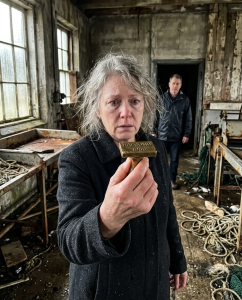
She was halfway through examining the sorting area when she looked up and saw the brass stamp.
It sat on a shelf above the rusted table, partly hidden behind a coil of old rope and a cracked red float. Small. Easy to miss. Absurdly ordinary.
For one full second her mind rejected what her eyes were seeing.
Then she climbed onto the lower rail, reached up, and took it down.
The moment it touched her palm, memory did something violent.
Christmas 1986. Earl grinning despite being too tired to hide it. His rough fingers folding hers over the cool metal. The smell of coffee and pine sap in the kitchen. His voice, low and proud.
This makes it official, Lou. This place belongs to you as much as it belongs to me.
Loretta turned the stamp over.
HALCOMB.
The room seemed to constrict around her. Her throat tightened. She could hear her own breathing, fast and uneven, sounding wrong in the silence.
“No,” she whispered, though she did not know whether she meant no, this can’t be real or no, this can’t still be here.
That stamp had been in her apron pocket on the day of the accident. She remembered checking for it at the hospital later, in one of those hazy, fractured moments when pain medication and fear made time feel ripped open. It had been gone. Along with her boots. Her watch. Her jacket. A dozen little things swallowed by the violence of that day.
She had assumed it was lost in the wreckage.
But here it was.
Not lost.
Returned.
Or planted.
Her father used to make her inspect every stamp twice before signing off on shipment crates.
“Once for what’s there,” he’d say, tapping the brass face, “and once for what’s missing.”
Loretta turned it over again.
There, near the edge, was the tiny nick she had put in it herself the first week she carried it. She had dropped it on the dock and cried out of embarrassment. Earl had laughed so hard he had to lean on a crate, then told her now it looked like a proper working tool.
It was hers.
Absolutely, unquestionably hers.
Footsteps sounded behind her.
She froze.
They were not hurried footsteps. Not startled. Just measured, approaching across old boards.
A man cleared his throat.
Loretta turned, the stamp still in her hand.
Daniel Mercer stood a few yards away, watching her with mild concern.
“Everything okay?”
She tried to answer, but the words tangled.
His gaze dropped to the stamp. Recognition flickered. “Oh,” he said. “Funny thing about that old stamp. The man who sold us the place mentioned it once. Said it belonged to the former owner’s daughter.” He paused. “He said she died in a car crash back in ’87.”
The silence after that sentence was so complete that Daniel’s face changed before Loretta even spoke. He saw it in her expression—the shock curdling into something sharper, older, more dangerous than grief.
“No,” Loretta said at last, her voice rough. “I didn’t.”
Daniel stared.
Rain struck the windows. Somewhere overhead, the building groaned.
Loretta took a step toward him. “Who sold you this property?”
He hesitated just long enough for her to notice, then answered. “Mark Halcomb.”
The name hit like another collision.
Gerald’s son.
Her cousin.
Daniel’s brows drew together. “You know him.”
“He’s my cousin.”
Whatever assumptions he had arrived with that morning fell apart visibly. “I’m sorry,” he said, and for once it sounded like he meant it.
Loretta’s hand tightened around the stamp. “I need to see the title history.”
Daniel looked toward the office. “I can get the records we have.”
“Now.”
He nodded.
They crossed into what used to be the administrative office, and that hurt almost more than the processing room had. The desk was different. The paint had peeled and been repainted badly. The filing cabinets were newer. But the room still held traces of Earl—its position facing the dock, the broad window line, the instinctive certainty Loretta had that her father used to stand exactly here at dawn with his coffee and inventory sheets.
Daniel pulled a thick binder from a cabinet and set it in front of her.
“These are copies,” he said. “Chain of title, transfer records, tax documents, sale agreements. Not everything, but a lot.”
Loretta opened it.
The first transfer was dated during the period she had been in the hospital in Juneau.
Her stomach dropped.
She knew that date. She remembered the week because it had been when the doctors first allowed her to stand with assistance. She had not signed anything that week. She had barely been able to hold a cup.
The document carried her name anyway.
Loretta Mae Halcomb.
Her signature, or something meant to resemble it.
She stared so hard at the line that the ink blurred. Not from age. From anger.
Daniel leaned slightly closer. “Is it forged?”
“Yes.”
He drew back.
Page after page followed. Gerald assuming control. Gerald restructuring ownership. Earl’s interest diluted under debt protections. New financial entities. Internal family transfers. Then, years later, Mark Halcomb holding authority to sell the property.
A neat progression.
Legal-looking.
Layered enough to survive casual scrutiny.
Built on rot from the first page.
Then Loretta saw something clipped behind the initial transfer.
Her hand stopped.
It was a draft affidavit referencing the incapacitation and “presumed non-return to active ownership” of one Loretta Mae Halcomb. Not filed. Not finalized. But prepared.
Her pulse pounded in her ears.
“This wasn’t part of the title records,” Daniel said quickly. “It must have been misfiled.”
Loretta didn’t answer. She kept reading.
There was more. A photocopy of the original co-ownership record. Her father’s and her names together. The official filing stamp. Nothing unusual until she reached the bottom margin.
Then she saw the handwriting.
She knew it instantly.
Earl Halcomb wrote in thick block letters, pressing hard enough to indent the paper. He hated fine pens and trusted only black felt tip markers or carpenter pencils. Even in a note, his writing looked built rather than written.
Three words sat in the lower margin:
Lou signs nothing.
Loretta stopped breathing for a second.
Daniel saw the change in her face. “What is it?”
She slid the document across to him and pointed.
He read the note, then looked back up at her. “Your father wrote that?”
“Yes.”
“Meaning he knew?”
“He suspected,” she said. “Or he was trying to stop it.”
And suddenly the scattered fragments she had carried for thirty-seven years began to align in a way that made her feel sick.
After the crash, everyone had told her Earl was overwhelmed. Distracted. Buried in debt. Gerald had handled the paperwork because family needed to step in. Earl had not argued in front of her, at least not in the moments she remembered. But Earl had visited her in the hospital looking more frightened than tired. He had squeezed her hand and told her twice—twice in the same conversation—not to sign anything until she was home.
At the time she had thought he meant insurance forms. Liability waivers. Medical nonsense.
Lou signs nothing.
He had known Gerald was moving.
Maybe not everything. But enough.
“What happened to your father?” Daniel asked carefully.
“He died that fall. Heart attack.”
Daniel was quiet.
Loretta kept turning pages. Buried deeper in the file was correspondence between Gerald and a local attorney. Most of it was procedural. One line wasn’t.
Given the daughter’s condition, delay may strengthen our position.
Loretta shut the binder.
The sound cracked through the room.
Daniel flinched. “Loretta—”
“He waited until I was injured.” Her voice trembled once, then steadied into ice. “He used the accident. He used my father’s panic. And when that wasn’t enough, he built a story that I was gone.”
Daniel rubbed a hand over his jaw. “I had no idea.”
“No,” she said. “You weren’t supposed to.”
She stood and crossed to the old window. Rain streaked the glass in crooked lines. Beyond it the dock leaned toward the water, stubbornly refusing to collapse. She thought of all the years she had spent telling herself the past was gone, inaccessible, too damaged to recover. She thought of the jobs she had taken, the buildings she had saved, the families she had advised to protect their records because paper mattered, because memory was never enough.
All that time, her own proof had been sitting inside this building.
Waiting.
“Do you have contact information for Mark Halcomb?” she asked without turning.
“Yes.”
“I want to see him.”
Daniel didn’t object. Maybe it was the look on her face. Maybe it was the binder. Maybe it was the simple force of truth finally finding enough room to stand.
Mark agreed to meet the next day, though not in Ketchikan proper. He suggested a marina café outside town, as if keeping distance from the cannery might somehow make the conversation safer. Loretta arrived ten minutes early. The place overlooked gray water and rows of fishing boats shifting on their moorings. Mark walked in wearing a soft-shell jacket and the careful expression of a man who had spent years assuming old things would stay buried.
He stopped when he saw her.
For a moment he looked exactly like his father.
Then fear replaced resemblance.
“Loretta,” he said.
“Don’t.” She remained seated. “Sit down.”
He did.
The waitress came. Nobody ordered anything but coffee.
Mark wrapped both hands around the mug when it arrived, though he never drank from it. “I heard you were in town for a project,” he said.
“On my property.”
His eyes flicked up. “Legally—”
“Choose your next word carefully.”
His mouth closed.
Loretta placed the brass stamp on the table between them. Then she laid down copies of the forged transfer, the original co-ownership filing, and the note in Earl’s handwriting.
Mark went pale.
“Where did you get these?”
“From the cannery.” She leaned forward. “Start talking.”
He looked around the café as though searching for some escape route through other people’s conversations. There wasn’t one.
“My dad handled everything,” he said finally. “I was young.”
“How young were you when you sold it?”
He swallowed. “Forty-two.”
“Old enough, then.”
His jaw tightened. “You don’t understand what things were like after your accident.”
“Then explain.”
He stared into the coffee. “There were debts.”
“There are always debts.”
“The place was unstable. Your dad was falling apart. My dad said if outsiders got involved, the cannery would be seized. He said he was protecting the family.”
“By forging my name?”
“I didn’t know that part at first.”
Loretta said nothing.
Mark exhaled shakily. “Later… later I understood enough to know something was wrong. But by then the ownership had changed hands several times. My father said if the old paperwork was ever reopened, all of us could lose everything.”
“All of us,” Loretta repeated. “Interesting phrase.”
“I know how that sounds.”
“Do you?”
His eyes lifted to hers, and for the first time she saw not just fear but shame. Real shame. Useless now, but real.
“He said you’d never come back,” Mark said quietly. “He said Alaska had almost killed you and you’d want nothing to do with the place. Then later he started telling people you died. Not formally. Just… in stories. To buyers. To people asking questions. I think it made things easier. Cleaner.”
Cleaner.
Loretta almost laughed.
Instead she asked, “Did my father know?”
Mark hesitated too long.
“Answer me.”
“He confronted my dad once,” Mark said. “I overheard part of it. Your father said he’d go to the clerk, reopen everything, call the hospital if he had to. My dad told him the bank would gut the business first and that you were too weak to survive a legal battle. They screamed at each other for an hour.” He rubbed his forehead. “A week later your dad collapsed on the dock.”
Loretta stared at him.
She had known about the heart attack. Known the date. Known the official details. But no one had ever told her about the argument.
Maybe because nobody wanted to.
Maybe because nobody wanted her asking why.
Mark looked wrecked now, like the act of speaking had aged him in real time. “When my dad died, I found a box in his garage. Deeds, notes, letters. He’d kept copies of everything. I told myself I was only hanging onto them until I understood what to do. Then years passed.” His voice cracked. “When the Seattle group approached me, I sold. I thought that was the end of it.”
Loretta’s face stayed still. “Bring me the box.”
He blinked. “What?”
“All of it. Every copy, every letter, every note your father kept.”
He looked stricken. “There are things in there that could—”
“Yes,” Loretta said. “Exactly.”
Two days later, Mark delivered the box.
Inside were originals and copies spanning years: unsigned affidavits, correspondence with attorneys, debt calculations, personal notes, and one sealed envelope in Earl’s handwriting addressed simply to Lou.
Loretta sat alone in her hotel room before opening it.
The paper inside was brittle at the folds.
Lou,
If you’re reading this, then either I failed to stop Gerald or I ran out of time before I could make it right. I am sorry for the first, and I am sorrier for the second.
You were never meant to lose this place. I put your name on it because you earned it. Don’t let anyone tell you otherwise. Don’t let family shame confuse theft for sacrifice. If Gerald says he did this for protection, he is lying. He wants control. He always has.
I should have seen it sooner.
Nothing signed while you were in that hospital came from your hand with my blessing.
This place is yours if you still want it. And if you don’t, let that be your choice, not one made for you.
I love you more than this business, but I know what this business means. Fight if you can.
Dad
Loretta cried then, not delicately, not quietly, not in the contained way she had taught herself over the years. She cried for the months after the accident when every adult around her had spoken in soft half-truths. She cried for Earl, who had tried to leave a trail and died before he could finish it. She cried because some part of her had spent thirty-seven years wondering whether he had let her go too easily.
He hadn’t.
That mattered.
The legal fight that followed was ugly, expensive, and brutally public in the small-world way Alaska disputes often become. But Loretta had documents now. Hospital records. Expert handwriting analysis. The affidavit draft. The correspondence. Earl’s note in the margin. Earl’s letter in the envelope. A clear chain showing that the first fraudulent transfer contaminated everything after it.
The Seattle development group backed away from the deal within weeks. Their attorneys did not need much persuasion once forgery entered the conversation. Mark cooperated fully, which did not erase his role but did shorten the battle. The court didn’t hand Loretta a miracle; it handed her what paper and proof could support. The fraudulent transfer was voided. Subsequent ownership claims tied to it collapsed. Settlement negotiations replaced denials.
In the end, Loretta regained legal control of the cannery property.
By then, though, the victory felt stranger than she had once imagined victory would feel.
She walked the site alone after the final documents were signed, carrying the brass stamp in one pocket and Earl’s letter in the other. The building was still damaged. Parts of it were unsalvageable. Whole sections would need careful stabilization if it was to survive. The business itself could never return as it had been. The world that made small family canneries like Halcomb & Daughter possible had changed too much.
But the place was hers to decide now.
That was the part that mattered.
She did not reopen it as a cannery. Instead, she established a preservation trust and maritime history center focused on working families of Southeast Alaska—the ones whose stories usually vanished behind corporate names and sanitized plaques. She restored the office window line exactly as Earl had left it. She kept one section of the processing floor untouched, dust and all, as a record of labor rather than a cleaned-up museum fantasy.
And in a glass case near the entrance, she placed the brass stamp.
HALCOMB. 1986.
Not as decoration.
As evidence.
On the day the center opened, people came from town, from nearby ports, from old fishing families who remembered Earl and remembered more than Loretta had ever known. They told stories. Some confirmed pieces of the old betrayal. Some admitted they had heard she was dead and never questioned it. Some apologized without being asked. Some stood awkwardly in silence, which was apology enough.
Mark came too.
He stayed near the back until the crowd thinned, then approached her by the dock.
“I don’t expect forgiveness,” he said.
Loretta looked out over the water. “That’s good.”
He flinched, then nodded.
After a long pause, she added, “But telling the truth when it became expensive mattered more than when it was easy.”
It wasn’t absolution. He knew that. So did she.
When he left, Loretta remained on the dock until evening. The boards still dipped slightly to the left. No one had corrected that yet. She wasn’t sure she wanted them to. Some flaws felt honest.
She took Earl’s letter from her coat and read the last line again.
Fight if you can.
She had.
Standing there with rain misting off the water and the restored cannery behind her, Loretta finally understood that what had been stolen from her wasn’t only property. It was authorship. Choice. The right to decide what to keep, what to leave, what to rebuild, and what to let die with dignity.
Now that choice was back in her hands.
Whether Gerald had once convinced himself he was saving the family or simply wanted what wasn’t his, Loretta no longer cared nearly as much as she once thought she would. The papers told the legal story. The building told the human one. And somewhere between those two truths was the red flag that should have been obvious from the beginning: the moment a person insists that taking your future from you is actually for your own good.
That lie ruins more families than greed ever admits.
As the light thinned, Loretta touched the brass stamp in the display case on her way out and locked the door behind her.
For the first time in thirty-seven years, leaving didn’t feel like losing.