Megan’s brothers sold their mother’s piano before the funeral flowers were even removed from the living room.
The decision was made with the kind of speed people usually reserve for flood damage or spoiled food, not for the instrument that had anchored an entire family’s history. Their mother had been dead less than a week. The sympathy arrangements still crowded every surface. White lilies drooped in crystal vases. Half-open condolence cards stood along the mantel. The black dresses from the funeral still hung over chair backs upstairs.
And in the middle of it all stood the piano.
It had occupied the same corner of the living room for as long as Megan could remember. A baby grand, black and elegant even in old age, with a finish softened by decades of polishing hands, sunlight, and use. Its lid carried faint scratches from school projects spread across it, Christmas ribbons, and the year Scott had slid a glass trumpet trophy too hard and chipped the edge. Its bench still creaked slightly on the left side. One ivory key had a hairline crack. The highest notes always sounded a little thinner in winter.
To anyone else, those were flaws.
To Megan, they were fingerprints of a life.
Her brothers saw square footage.
Daniel, the oldest, stood in the front hall reading estimates from an estate agent while movers measured the doorway. He was a man who loved efficient words: marketable, practical, streamlined, fair. He used those words now the way some people used prayer, repeating them until they sounded moral.
“It’s too big for the room if they stage the house,” he said without looking up.
Scott, who had spent most of his adult life agreeing with Daniel half a beat after Daniel spoke, nodded from the kitchen doorway. “And too expensive to move around later. Better to sell it now.”
Megan stared at them as if they were speaking a language she didn’t know.
“She just died,” she said.
Daniel lifted one shoulder. “Exactly. There’s a lot to handle.”
There had always been something about the way he said practical things that made them feel like verdicts. He wasn’t loud. He didn’t need to be. He simply announced what made sense and expected the rest of the world to catch up.
Megan stepped closer to the piano, resting one hand on the glossy edge. It was cool beneath her palm. For a wild second she remembered being six years old, chin barely high enough to peek over the keyboard, while her mother guided her finger toward middle C and said, “Listen before you press. Every sound begins before you hear it.”
A month before her death, in the hospice haze of dim lamps and whispered instructions, her mother had taken Megan’s wrist with surprising strength.
“Promise me one thing,” she had said.
Megan had leaned so close she could feel the warmth of her breath.
“Don’t let them take the piano.”
Megan had nodded instantly, assuming the request came from sentiment, not strategy. At the time it had seemed heartbreakingly simple. Keep the piano because it matters. Keep the piano because it was her mother’s voice after illness stole so many others. Keep the piano because some things should not be measured by convenience.
Now, as two movers rolled in a padded dolly, that promise came roaring back with painful force.
“You can’t sell it,” Megan said. “She asked me to keep it.”
Daniel gave a short laugh. “You live in a one-bedroom apartment. Where exactly were you going to put a grand piano?”
The movers avoided eye contact. Scott crossed his arms.
“Mom knew we were practical,” he said. “You were always sentimental.”
The word landed the way it had all her life: as dismissal disguised as description.
Sentimental was what they called her when she stayed the night after surgery while they sent flowers. Sentimental was what they called her when she drove across town with groceries because their mother sounded tired on the phone. Sentimental was what they called her when she learned every medication, every doctor’s name, every refill schedule, every detail that made aging less frightening for the woman who had once made everything less frightening for them.
Daniel handled the finances. Scott handled errands. Megan handled their mother.
No one had ever said it that plainly. They hadn’t needed to.
“She asked me,” Megan repeated.
Daniel signed the movers’ paperwork. “She asked a lot of things near the end.”
It was the cruelest thing anyone had said in the house all week.
Megan felt it like a slap. Not because it was entirely out of character for Daniel to weaponize truth when it suited him, but because it reduced their mother’s final wishes to confused noise. As if dying had erased her authority. As if weakness had made her ridiculous.
The movers wrapped the piano in thick blankets. One removed the music stand, setting it carefully aside before securing the lid. Another crouched near the curved leg and adjusted a strap. The instrument tilted slightly, and Megan thought she heard a tiny shift from somewhere inside the body. She almost spoke, then stopped. Old pianos rattled. Pedals loosened. Wood expanded and contracted. Grief made every sound feel meaningful.
They rolled it toward the door.
The funeral wreath still hung crooked in the entry hall.
Rain tapped the windows.
The whole thing felt obscene.
Megan followed them outside in a cardigan she had pulled on without fastening. Her shoes darkened on the wet pavement. The truck door shut with a metallic bang that made her flinch. For one awful second she imagined her mother hearing it from somewhere impossible and knowing exactly what had happened.
Then the truck pulled away.
Megan stood on the curb until the taillights disappeared.
When she went back inside, her brothers had already moved on. Daniel was discussing paint touch-ups with the estate agent over speakerphone. Scott was carrying framed family photos into a cardboard box labeled SORT. The speed of it made Megan feel unsteady, as if grief itself had become an inconvenience to be packed away.
That night, in her apartment, she sat at her tiny kitchen table and stared at a copy of the sale paperwork Scott had left carelessly under a stack of unopened condolence envelopes. The buyer’s name and phone number were at the top.
For nearly an hour she did nothing.
Then she called.
A woman answered. Her voice was older, cautious but not unkind.
Megan introduced herself and immediately felt embarrassed by the shakiness in her own voice. She apologized for intruding. She explained that the piano had belonged to her mother, who had just died. She said she knew the request was unreasonable, but could she come sit at it once? Just once. No trouble. No scene. She only wanted to say goodbye.
The woman was quiet long enough that Megan thought she had been refused.
Then she said, “Come now. Before it gets too late.”
The house was on the far side of town, a brick colonial with ivy climbing one side and yellow light glowing through rain-streaked windows. The buyer opened the door before Megan finished climbing the front steps. She wore a wool cardigan and soft house shoes and had the face of someone who had known grief well enough not to mistrust it in others.
“It’s in the den,” she said gently. “Take your time.”
The piano looked both familiar and wrong.
Familiar because every detail belonged to Megan’s muscle memory—the curve of the lid, the bench, the nick near the left pedal. Wrong because it sat against walls that had never heard her mother hum, in a room that smelled of cinnamon tea instead of lavender polish.
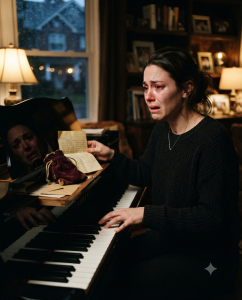
Megan approached slowly, one hand pressed against her ribs as if she could hold herself together by force. She sat on the bench and rested her fingers on the keys.
For a moment she couldn’t move.
Then she pressed one note.
The sound opened through the den like a held breath.
Beneath it came a second noise.
A dry little rattle.
Megan frowned and pressed another key. The note rang. The rattle came again, faint but unmistakable, somewhere under the music stand or within the body of the piano.
Her mother had always treated the instrument with near ceremonial care. Even when arthritis curled her fingers and she could no longer play a whole piece without stopping, she still polished the wood herself, wiping around the music stand in slow circles. Once, when Megan teased her for fussing over an old piano that went out of tune every winter, her mother had smiled and said, “Some things hold more than music.”
At the time, Megan had assumed she meant memories.
Now her pulse started to climb.
She leaned toward the stand and ran her fingers along the underside. Most of the wood felt smooth and solid. One section, however, sat just a hair lower than the rest. Not enough for a stranger to notice. Just enough for someone who had watched the same hands care for the same instrument over decades to feel the difference.
Megan pushed.
Nothing happened.
She shifted her thumb, found a tiny recessed notch, and pressed again.
Click.
A narrow panel sprang inward.
For several seconds Megan simply stared at the opening. Behind it, in the shadowed cavity, was a bundle of dark fabric.
Her breath shortened.
She reached in and withdrew a velvet pouch, burgundy and worn, the drawstring hardened with age. It felt heavier than it looked. Megan loosened the cord with shaking fingers and spilled the contents onto the closed lid of the piano.
War bonds in brittle paper sleeves.
A thick bank envelope.
Folded documents.
And a letter.
Even before she opened it, she knew the handwriting. Her mother formed her M’s with a graceful upward slant and crossed every t exactly in the center. Megan had seen that hand on lunchbox notes, birthday cards, permission slips, and later on the small labels taped to prescription bottles and casserole dishes.
She unfolded the page.
The first line made the room tilt.
My sons will sell what they cannot understand. My daughter will listen.
Megan sat down so abruptly the bench groaned beneath her.
Rain whispered at the windows. Somewhere deeper in the house, a kettle clicked off. Her hands trembled so badly she had to flatten the letter on her knee to keep reading.
The note was dated eight months earlier, long before the final hospital stays, long before the funeral, long before anyone had begun speaking in the softened voices people use around the dying. Her mother wrote that she had moved certain assets and instructions to a place she trusted would reveal them only to the child who valued the piano enough to seek it out. She wrote that she knew Daniel would call it impractical and Scott would agree. She wrote that she had watched her children closely in the last years of her life and had learned painful truths she could no longer ignore.
She did not write cruelly.
That was somehow worse.
She simply wrote what she had seen.
Daniel arrived when signatures were needed.
Scott arrived when Daniel asked.
Megan arrived whenever she was called—and often when she wasn’t.
Megan drove to appointments, stocked groceries, sat through long chemotherapy drips, massaged aching hands, reset internet passwords, listened to repeated stories, and stayed after the hard nights when fear made sleep impossible.
At the bottom of the letter was a second page listing account numbers, instructions for presenting specific documents, and the location of a safety deposit box held under a name Megan recognized from her mother’s maiden family line. There were amounts large enough to matter, old holdings matured over time, and directives that made it clear this was not impulsive hiding. It was considered planning.
It was a judgment.
The buyer appeared quietly in the doorway. “Is something wrong?”
Megan looked up with tears on her face and a laugh caught painfully between disbelief and grief.
“I think,” she said, “my mother wanted me to find this.”
The woman’s eyes moved to the letter, then to the open panel in the piano. She did not intrude with questions. She only brought Megan a glass of water and sat with her in silence until the first storm of shock passed.
By the time Megan left that house, she had photographed every page, repacked every document, and called the number listed for the bank’s after-hours service. She learned enough to know the letter was real, the account still active, the instructions valid pending formal review.
She did not sleep much that night.
At dawn the velvet pouch sat on her kitchen table beside her phone. She read the letter four more times. Each reading shifted her feelings slightly. First there was astonishment. Then vindication. Then sadness so deep it sat beneath every other emotion like bedrock.
Her mother had known.
Not just what the boys would do with the piano, but what kind of people they had become.
At 8:12 a.m., Daniel called to say the realtor needed access before noon.
At 8:19 a.m., Scott texted to ask whether she had moved the funeral portrait from the entryway because “it looks depressing in listing photos.”
Megan read both messages and felt something inside her go still.
For years, she had mistaken passivity for peace. She had let sharper people define the pace of every room because resistance was exhausting and grief had made her even softer. But now she held a letter written in the clean certainty of a woman who had seen more than Megan realized. Her mother had not died confused or helpless. She had looked at her children with startling clarity and placed her trust accordingly.
Megan drove back to the house.
Daniel and Scott were in the kitchen over a spread of paperwork when she walked in. The same kitchen where their mother had rolled pie crust on holidays, where she had once played jazz from the next room while bacon crackled on a Sunday morning. Now the counters held market analyses, repair estimates, and a legal pad with columns.
Daniel looked up. “There you are.”
Scott barely glanced over. “We need to decide about the silver set.”
Megan set the letter on the table between them.
Neither brother reached for it at first. Then Daniel saw the handwriting and his expression changed. His confidence didn’t disappear all at once; it fractured, one piece at a time, under the pressure of recognition.
“What is that?” Scott asked.
“You tell me,” Megan said.
Daniel picked up the first page. His eyes moved across the opening line. The color drained from his face with such startling speed that Scott snatched the second page from the table and began reading for himself.
The kitchen grew quiet.
Not stunned quiet. Threat-assessment quiet.
Scott was first to speak. “How much is this?”
Megan almost laughed. There it was. The instinct laid bare. Not Why did Mom do this? Not What else did she say? Not Did you know?
How much.
Daniel set the page down carefully. “Where did you get this?”
“In the piano.”
He stared at her. “That’s impossible.”
“Is it?”
Scott’s voice sharpened. “You expect us to believe she hid financial assets inside a piano?”
Megan looked at both of them and, for the first time in years, did not feel smaller under their scrutiny.
“She asked me not to let you sell it,” she said. “You laughed.”
Daniel’s jaw hardened. “The piano was part of the estate.”
Megan folded the letter and returned it to the envelope. “Not in the way you thought.”
He took a step forward. “Legally, if there are undisclosed assets—”
“Legally,” Megan cut in, “you sold property that contained documents you didn’t know existed because you couldn’t be bothered to honor the one request she made.”
Scott’s face tightened. “Don’t be dramatic.”
The old word. The old move.
It no longer worked.
Megan took out her phone, opened the photos she had made the night before, and then another message thread—the one with the probate attorney she had contacted at dawn, forwarding copies of the documents before she ever drove over. She had spent years underestimating what fear made her fail to do. Apparently action came easier once the fear burned off.
“I’ve already spoken to counsel,” she said.
That stopped them.
Daniel’s eyes snapped to the phone screen. “You what?”
“She’s reviewing the documents and contacting the bank.” Megan tucked the phone back into her coat pocket. “And before either of you asks, yes, I sent everything.”
Scott looked at Daniel, and in that glance Megan saw the old pattern: Daniel think, Scott follow, Megan absorb. But the pattern had broken. They knew it too.
Daniel changed tactics. His voice softened, acquiring the smooth reasonableness he used when he wanted to pass control off as calm.
“Meg,” he said, “we’re all upset. Mom was sick. People do odd things when they’re frightened. We should handle this together.”
It might have worked once.
Megan heard the manipulation now as clearly as a wrong note.
“She wasn’t frightened,” Megan said. “She was precise.”
Daniel’s mouth thinned.
Scott crossed his arms. “This is unbelievable. She wouldn’t cut us out.”
Megan held his gaze. “Then why did she write what she wrote?”
No one answered.
The silence dragged.
Then, in a voice stripped of every polite layer, Daniel asked, “What else was in there?”
At last. The real question.
Megan thought of the second page. The safety deposit box. The institutions. The possibility that the piano had only held enough to lead her toward a larger truth. Her mother had planned carefully. Maybe because she did not trust her sons to fight fair once they understood. Maybe because she wanted Megan to have a chance to move first.
Megan realized, standing in the kitchen of the house that still smelled faintly of funeral lilies, that her mother had not only left her money. She had left her position.
The moral center of the story.
The proof.
The authority to decide what happened next.
And her brothers knew it.
Daniel tried again. “Where is it now?”
Megan smiled for the first time since the funeral, and it was not a warm expression.
“Safe,” she said.
Scott took a step toward her. “You can’t keep this from us.”
“I’m not keeping anything,” Megan replied. “I’m following instructions.”
Daniel’s voice hardened. “From a private note hidden in furniture?”
“From our mother,” Megan said. “The same one you told me was too confused to take seriously.”
He recoiled as though she had struck him.
Good, Megan thought. Let it land.
The next forty-eight hours tore open every old family wound.
The attorney confirmed the authenticity of the letter and the account structures. Several assets named in the documents had indeed been intentionally arranged outside the expected estate process, legally and long before their mother’s final decline. The safety deposit box, accessed under the documented instruction, contained additional records: certificates, an updated memorandum, and one sealed envelope labeled for all three children together.
Megan opened that envelope in the attorney’s office with Daniel and Scott present.
Inside was a short final note.
It was even calmer than the first.
Their mother wrote that fairness was not sameness. She wrote that each of her children had received from her, over the years, what they seemed to value most. Daniel had received professional introductions and financial support for his first house. Scott had received repeated debt rescues and business loans never repaid. Megan had asked for less and given more. Therefore, what remained in the hidden accounts was to be directed primarily to Megan, with smaller specified sums to her brothers that would be released only if they did not contest the arrangement or harass their sister.
There it was.
Not revenge.
Accounting.
Scott flushed an angry red. “This is manipulation from beyond the grave.”
The attorney did not even blink. “It is estate planning,” she said.
Daniel tried dignity for a few hours and then abandoned it. He called Megan selfish. He accused her of influencing their mother during illness. He suggested the documents had been misunderstood, then hinted they had been planted, then circled back to “family should share.”
Megan listened more calmly than she would have believed possible a week earlier.
“What exactly do you want shared?” she asked him once. “Her money? Or her judgment?”
He had no answer to that.
Scott lasted longer in denial, mostly because anger gave him somewhere to stand. But even he eventually went quiet when the records showed the old truth their mother had named: who had received what already, who had kept asking, and who had kept showing up with no expectation of return.
In the end, neither brother contested.
The amounts left to them were too much to walk away from completely and too little to satisfy them. Contesting would have cost more, exposed more, and likely failed. Their mother had known them well enough to predict even that.
The piano, meanwhile, remained with the woman who bought it.
Megan visited her a week later with flowers and a check that repaid the purchase price plus moving costs. The woman refused the extra money and offered tea instead. They sat in the den while late sunlight warmed the floorboards.
“You should take it back,” the woman said.
Megan looked at the piano for a long time.
She imagined somehow fitting it into her cramped apartment. Imagined knocking out walls for a thing larger than the life she currently lived. Imagined trying to force history into a space too small to hold it.
Then she thought of what her mother had really done.
Not preserve an object for its own sake.
Create a path. Leave a message. Ask to be heard.
“No,” Megan said softly. “I think it’s done what she needed it to do.”
The woman laid a hand over hers. “Then maybe keep the music, not the furniture.”
That line stayed with Megan.
Months later, she used part of the money to rent a larger place. Not enormous. Just enough. Bright windows, wooden floors, a second room she called the music room before it held any music at all. She found an upright piano with a warm tone and one stubborn middle register that needed coaxing. It was not her mother’s piano. It did not need to be.
Above it, in a simple frame, she kept a copy of the first line from the letter.
My sons will sell what they cannot understand. My daughter will listen.
Daniel called once after everything settled. His voice had none of its old ease. He said he wanted to “move forward.” Megan told him she hoped he did. Scott sent a holiday card the first year with only his name signed inside. The next year he added a short note asking how she was. Families did not heal in dramatic speeches, she learned. They either changed slowly or they remained exactly what they were.
As for Megan, she still missed her mother in sudden, ordinary ways that no inheritance could touch. In the grocery store near the tea aisle. At dusk, when the light turned the room the same gold it used to on Sundays. In the pause before she put her hands on the keys.
Sometimes she would play a hymn her mother loved and stop midway because memory rose too fast.
Sometimes she would finish.
And sometimes, in the silence afterward, she would think about how completely her mother had understood them all in the end. Not just who they were when life was easy, but who they became when death entered the room and no applause was coming.
That was the part Megan could not stop turning over.
Not the money.
Not even the betrayal.
But the accuracy.
How often do we believe love has been seen when it has only been used? How often do we mistake reliability for invisibility until the quiet person finally stops accepting the role assigned to them? Daniel and Scott had thought the piano was the inheritance because they believed value lived where money obviously sat. Their mother knew better. She hid the truth in the one place that required memory, patience, and reverence to open.
And maybe that was her final lesson.
The biggest red flag is not always cruelty shouted out loud. Sometimes it is the casual way people dismiss what you cherish, the ease with which they call devotion impractical, the confidence with which they assume your softness means you will never defend yourself.
Megan’s mother had listened long enough to know the difference.
At the very end, Megan did too.