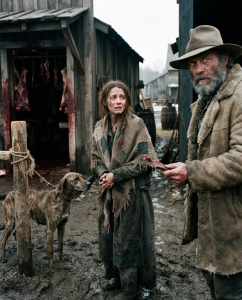
She had no choice but to leave her dog tied outside the slaughterhouse, knowing the butcher would put a bullet in his head before sundown.
By the time Kora reached the post, her hands were shaking so badly she could hardly manage the rope.
Black Creek was the kind of place that swallowed the weak and called it order. Men came there chasing silver and stayed for drink, gambling, and the chance to become crueler than the weather. The streets were churned into a black, stinking mire of melting snow, mule dung, ash, and ore dust. Every building looked temporary, as if the whole town knew it might one day be abandoned under a spring flood or buried by one hard winter and no one would come back for it.
Kora had lasted longer there than most women without family, and she no longer knew whether that counted as strength or punishment.
Three days earlier, she had still had a place to sleep on the floor of the laundry shed, where the steam kept the worst of the cold off her bones. Then the coughing got worse. She bent over a sheet she was scrubbing and blood hit the white cloth in three bright drops. The laundress saw it, made the sign of the cross, and shoved Kora out the back before sunset with her blanket, her shawl, and a warning not to come near the tubs again.
No room. No work. No food.
Only Rusty.
He had found her months ago, half-starved and limping, after following a butcher’s cart for scraps that never came. He was all awkward paws and hungry eyes then, but he wagged at her the first time she tore her own stale heel of bread in half and gave him the larger piece. Since that day he had stayed with her through every shift, every insult, every freezing night. He waited outside saloons. Slept against her legs for warmth. Barked when drunks wandered too close. Once, when a miner grabbed her wrist behind the assay office, Rusty had sunk his teeth into the man’s boot and held on until Kora broke free.
Nobody in Black Creek had ever chosen Kora.
Rusty had.
That made what she was doing unbearable.
The butcher came out wiping his hands on an apron dark with blood and grease. He didn’t even look surprised to find a woman trying to bargain with despair.
“We don’t buy dogs, ma’am.”
“I’m not asking for money,” Kora said. Her throat burned. “Just let him stay. He’ll work.”
The butcher’s eyes ran over Rusty’s thin body and came back empty.
“That hound’s one hard frost from dropping dead on his own. Tie him there if you like. When I’m done with the pigs, I’ll put him down. Quick.”
Rusty leaned his head against her leg as if comforting her.
Kora crouched in the mud, wrapped both arms around his neck, and pressed her face into his fur. He smelled like damp straw and cold wind and the little patch of safety she was about to lose forever.
“Forgive me,” she whispered.
His tongue brushed the tear from her face.
She tied the rope. Sloppy knot. Numb fingers. Then she made herself stand.
Two steps later, a voice came from the alley.
“Worthless knot.”
Kora spun around.
The man standing in the shadows was big enough to make the alley seem narrow. He wore a heavy coat of worn canvas and fur, boots stained with mountain mud instead of town filth, and a hat pulled low over a broad, weather-cut face. His beard was thick and streaked gray. He looked less like a man from Black Creek than something carved from the Bitterroot slopes and sent down among ordinary people by mistake.
He didn’t glance at Kora first.
He looked at Rusty.
“If you leave him like that, he’ll strangle himself fighting it.”
“He won’t be there long,” Kora said, hating the tremor in her own voice.
The stranger stepped closer. Rusty sniffed the air and, to her surprise, relaxed.
That alone unsettled her. Rusty distrusted nearly everyone.
“Are you starving?” the man asked.
“That’s none of your business.”
He pulled a strip of dried venison from his pocket and offered it. Rusty swallowed it so fast he nearly choked.
The man said quietly, “He is.”
Something in Kora gave way then. Pride was a fine coat until hunger tore the seams.
“I can’t feed him,” she said. “I can’t feed myself. No house. No job. No money. Nothing. I love him, but I can’t watch him die inch by inch.”
The stranger bent, untied the rope, and let it drop.
“My name’s Amos. I’ve got a cabin up in the Bitterroots. Need a dog to warn me off bears.”
Kora stared. “You want to take him?”
“Yes.”
Relief came first, so sudden it hurt. Then grief, because the relief meant losing him.
Amos read it on her face.
“That dog won’t stay with me if you’re not there,” he said. “Some animals change owners. Some don’t. He’ll break himself trying to get back to you.”
Kora blinked. Hunger made her thoughts slow. “Then what are you saying?”
Amos looked at her fully for the first time. His eyes were pale blue and steady, mountain eyes, cold in color but not in feeling.
“I need help. Someone to keep the fire going, salt meat, watch the place when I’m running the trapline. You need a roof. He needs both.”
Every warning she had ever learned rose at once.
In Black Creek, offers from men came with hidden prices.
“I won’t be your woman,” she said.
“No,” Amos replied. “You won’t. You’ll sleep in the loft. I’ll sleep by the hearth. You work, you eat. You leave if you want. That’s all.”
He turned and started walking.
Rusty followed, then stopped and looked back over his shoulder with a small whining sound that went through Kora like a blade.
She looked at the slaughterhouse post. At the mud. At the life she had left, if it could still be called that.
“Wait,” she said.
Amos stopped.
She hurried after them, clutching her shawl tight. “I’m coming.”
He nodded once. “Wagon leaves in ten minutes.”
The wagon was little more than a narrow flatbed with high sides, loaded with sacks of flour, a coil of rope, iron traps, and a crate of smoked fish. Amos drove. Kora sat beside him with Rusty pressed against her legs, as if the dog feared she might disappear the moment he closed his eyes.
The town fell away behind them. Ramshackle roofs gave way to bare pines, then thicker timber. The road narrowed. The wind sharpened. Snow lay in gray sheets under the trees where the sun could not reach.
For the first hour Amos spoke only to the mule team. Kora was grateful for the silence. It gave her time to study him without being caught.
He was older than she first thought, maybe forty-five or fifty, though mountain life wore years harder than town life. His hands were scarred and broad, the nails split and blackened by work. A faded line ran from just below his ear into his beard. Not a fresh wound. Not old enough to be forgotten either.
Rusty watched him constantly, but not with fear. With attention.
Finally, Amos said, “There’s one thing I didn’t tell you.”
Kora felt every muscle in her back go taut. “What thing?”
He took a while answering, eyes fixed on the trail.
“The cabin was my brother’s first.”
She waited.
“That’s all?”
“No.”
The wagon jolted over a frozen rut. Amos lifted a hand to steady the rifle wrapped in wool beneath the seat.
“My brother Eli lived there alone after our father died. I traded pelts lower down every few weeks. Last winter I came up and found the place empty.”
Kora turned to stare at him. “Empty how?”
“Fire dead. Supper pan still on the table. Axe by the door. Bed slept in. Boots gone.”
Rusty’s ears lifted.
“You never found him?”
“No.”
“And you still live there?”
Amos’s jaw hardened. “It’s my place now.”
That wasn’t an answer, but it was all he meant to give.
The trail climbed steeper. By late afternoon the sky had gone from iron gray to blue-black at the edges. Snow clung to the boughs in quiet drifts. The mountains rose around them like walls.
Kora should have been afraid. Instead, beneath the fear, she felt something stranger.
Space.
No shouting from saloons. No boots following too close. No men calling things after her in the road. Only the creak of harness leather, the snort of mules, Rusty’s breathing, and the occasional crack of a branch under snow.
They reached the cabin just before dusk.
It stood in a clearing ringed by spruce, broad and low with a steep roof and a stone chimney. Smoke did not rise from it. The front door was shut. One side of the porch sagged where winter had split a support beam. Beside the woodshed hung strips of old hide stiffening in the cold.
Amos stopped the wagon and didn’t move right away.
Then he reached beneath the seat, unwrapped the rifle, and checked the chamber.
Kora’s mouth went dry. “Why do you need that?”
He kept watching the door. “Because sometimes things return to a place even when they shouldn’t.”
“Do you mean bears?”
“No.”
The clearing went still.
Rusty stood, the fur along his spine lifting.
Amos climbed down from the wagon. “Stay here.”
Kora almost laughed at that. As if she would sit alone on a wagon in a darkening mountain clearing while a stranger approached a cabin with a rifle.
Instead she climbed down silently on the far side and kept Rusty close.
The snow near the porch was old and crusted, but one patch near the steps had been broken more recently than the rest. Amos saw it too. His shoulders tightened.
He moved to the door and listened. Then he shoved it open with the rifle barrel.
Nothing happened.
He stepped inside first. Kora followed, heart hammering so hard she could feel it in her throat.
The cabin smelled of cold ash, cedar, and something stale underneath.
Amos lowered the rifle slightly. “No one.”
Kora let out a breath, then stopped. There was a lantern on the table.
It was clean.
Not polished, exactly, but wiped more recently than the layer of dust on the shelf beside it.
She pointed. “Did you leave that like that?”
Amos looked. His face changed.
“No.”
The room was simple: a table, two chairs, rough shelves, a hearth of stone, hooks for meat, a ladder to the loft. A blanket lay folded on a chest. Tin cups hung from nails. On the far wall was a row of pegs for coats.
One peg was empty.
Amos stood very still.
“What was there?” Kora asked.
“My brother’s coat.”
“Maybe you moved it.”
“I didn’t.”
Rusty crossed the room slowly, nose low, then stopped at the trapdoor beside the hearth.
He began to growl.
Kora stepped back.
Amos swung the rifle down and stared at the floor hatch. “That goes to the root cellar.”
The growl deepened.
Neither of them had heard footsteps. No creak. No breath from below. But something had made the dog stiffen like that.
Amos handed Kora a lantern and struck a match with fingers that were steady only because they were used to fear.
The cellar hatch opened with a long, dry scrape.
Darkness waited underneath.
Amos lowered the lantern. The light spilled down rough steps and over shelves of potatoes, jars, and onions. A barrel. A broken crate.
And in the far corner, half in shadow, a bedroll.
Not old. Not abandoned. Used.
Kora whispered, “Someone’s been here.”
Amos’s grip tightened on the rifle. He descended first.
The cellar was colder than the cabin above. Kora followed with Rusty crowding so close to her knee she nearly stumbled. On one shelf sat three tins of coffee. Another held cured meat wrapped in cloth. A man could have hidden there for weeks, coming up only when the cabin stood empty.
Amos crouched beside the bedroll and picked up a spoon, then a pocketknife worn smooth at the handle.
He closed his fist around it and shut his eyes.
“That was Eli’s.”
Kora felt the air thin around her. “Then he is alive.”
“Maybe.”
“That’s not maybe.”
Amos rose too quickly and hit his head on a beam with a hollow crack. He didn’t seem to feel it. “Or someone found his things.”
But hope had already entered the room, and hope is harder to silence than fear.
They searched the rest of the cabin before full dark. Behind the shed Amos found rabbit bones picked clean and buried shallow under snow. In the loft Kora discovered a blanket that was not Amos’s—thicker, patched with blue thread. Under the bunk downstairs lay a bootprint in old dust leading toward the back wall where a narrow window overlooked the ridge trail.
Whoever had been there knew the cabin. Knew where to hide. Knew when Amos was gone.
That night they barred the door.
Amos insisted Kora take the loft exactly as promised. He made himself a place by the hearth with the rifle across his chest. Rusty refused both of them and lay at the base of the ladder where he could watch the door and the trapdoor at once.
Kora did not sleep much. Every settling timber sounded like a hand on the latch. Every hiss from the fire sounded like a breath.
Near midnight she heard Amos move.
“You awake?” he asked quietly.
“Yes.”
For a long moment he said nothing. Then: “Eli was younger than me by six years. Smarter with traps. Worse with people. He used to say the mountain was cleaner than town because at least anything trying to kill you out here didn’t smile first.”
Kora looked down through the dim light. Amos’s eyes were open, fixed on the rafters.
“Why did he stay here alone?” she asked.
“He trusted almost no one.”
“That includes you?”
A long pause.
“Some days, yes.”
There was more in that silence than in the words. Old arguments. Pride. Regret.
The next morning Amos checked his trapline while Kora swept, hauled water, and took stock of the cabin. The work steadied her. There was flour, salt, beans, smoked meat, and dried apples. Real food. Enough for weeks if managed carefully. She fed Rusty twice. He ate with shocked urgency the first time, then slower at supper, as if he was beginning to believe the bowl would not vanish.
By the third day color had started to come back into Kora’s face.
By the fourth, Amos stopped looking at her as though she might disappear by dusk.
He kept his word in every way. No wandering hands. No loaded looks. When he spoke, it was about practical things: where the spare wood was stacked, how long to simmer beans, which windows drifted shut with snow. Trust did not arrive all at once, but it began to take shape in ordinary acts. A cup left warm for her by the stove. Her shawl drying near the fire after he found it frozen stiff outside. Rusty choosing to sleep closer to Amos each night.
Then the tracks appeared.
Kora saw them first at dawn—a single line of prints cutting across the slope above the cabin and vanishing into the trees. Too narrow for Amos’s boots. Too deliberate for an animal.
She called out.
Amos came to the door, one glance was enough, and all the hard calm in him snapped taut.
“He was watching,” Kora said.
“Or waiting.”
That evening Amos confessed the part he had hidden.
A month before Eli vanished, a man named Harlan Pike had ridden up from town with two partners, claiming there was silver on the north ridge and asking to dig near the spring. Eli refused. The brothers’ father had trapped and hunted that land for twenty years. Pike returned drunk the next week and made threats before Amos ran him off with a shotgun.
“After Eli vanished,” Amos said, “Pike swore he’d never been back.”
Kora stared at him. “And you believed him?”
“I didn’t have proof.”
“But you stayed.”
Amos looked toward the dark window. “Because if Eli came home, I meant to be here.”
The answer landed somewhere deep in her chest.
For the first time she understood that Amos had not rescued her out of simple kindness. He had been living with his own kind of hunger—a waiting so long and bitter it had become part of him.
Two mornings later, Rusty began barking before dawn.
Not the warning bark he gave for deer or foxes. This was sharper. Furious.
Amos was on his feet with the rifle before Kora had both boots on. Snow blew through the gap under the door as somebody pounded once, hard, from outside.
Then came a voice.
“Open up before I freeze, you stubborn bastard.”
Amos stopped as if shot through.
Kora had never seen a man go white so fast.
He opened the door.
The figure on the porch swayed where he stood. Taller than Amos by an inch, thinner by twenty pounds, wrapped in a coat patched at one shoulder with blue thread. His beard was ragged. One eye was purple-yellow with healing bruises. His left arm hung stiff against his side.
Rusty lunged forward, barking so hard his whole body shook—then abruptly whined and wagged, unsure whether to attack or rejoice.
The man on the porch looked at Kora, then at Amos, and gave a cracked half-smile.
“Hell of a welcome,” he muttered. “You could’ve at least offered coffee.”
“Eli,” Amos said, and the name broke in the middle.
Whatever lived between brothers too proud to say they loved each other showed itself then in the way Amos grabbed him with one arm and hauled him inside before he could fall.
Eli had been alive all along.
Once he was fed and thawed enough to speak, the story came out in pieces.
Harlan Pike had come back after midnight with two men, planning to force Eli to reveal where old survey stakes marked a vein of silver higher in the ridge. Eli fought. One of them cracked him over the head. When he woke, he was tied in a hunting shack near the north cut, guarded off and on while Pike searched the slopes. Eli escaped after three days, stole a horse, and nearly made it back before the animal broke a leg in a ravine. After that he survived where he could—abandoned camps, line cabins, stolen jerky, cached supplies. Every time he tried to approach the cabin, he saw signs that someone had been watching it.
“Pike wanted the place,” Eli said, teeth clenched around the memory. “Not just the ridge. This spring, this valley, all of it. Easier to take if folks think I’m dead and you’re next.”
Kora thought of the clean lantern. The missing coat. The tracks.
“Why didn’t you come in sooner?” she asked.
Eli looked straight at Amos. “Because I didn’t know if he was alone.”
Silence followed that.
At last Amos said quietly, “You thought I’d brought Pike here?”
“I thought grief makes fools of men.”
“And fear makes cowards.”
Eli’s face hardened. “Maybe. Still kept me alive.”
Kora expected shouting after that, maybe fists. Instead Rusty trotted between them and planted himself squarely in Eli’s lap, demanding attention with the shameless force only a dog can use against human pride.
It broke the tension just enough.
They made a plan the same day.
Pike would come back. Men who wanted land and silver never stopped at one attempt, especially after months of stalking. Amos and Eli knew the ridge better than anyone. Kora knew something Black Creek men never bothered to study in women—how to watch quietly and be underestimated.
At dusk they left the cabin dark and scattered signs of absence. Amos and Eli took positions above the trail among the rocks. Kora stayed inside with Rusty and one lantern turned low behind a blanket so the light would barely show.
The knock came after moonrise.
Then a voice. Smooth this time. Almost friendly.
“Amos. Heard tell you’re home.”
Kora didn’t answer.
The latch shifted.
Rusty growled low, every muscle gathered.
A second later the back window creaked.
Kora moved before the man had both boots through. She slammed the iron stew pot into his hand. He cursed, dropped the pistol he’d been carrying, and Rusty hit him square in the chest with enough force to throw him backward into the snow.
At the same instant, a rifle shot cracked from the ridge.
Then another.
Shouting erupted outside. Amos bellowed. Someone screamed. Kora ran to the door with Eli’s revolver and found Harlan Pike on his knees in the yard, blood from a grazing shot running down his temple, both hands raised while Amos stood over him with the rifle.
One of Pike’s men had fled into the trees. The other lay face-down in the drift, pinned by Eli’s boot and cursing like a man who had just discovered the mountain did not care about his plans.
Pike spat red into the snow and glared at Kora.
“This was never your fight.”
Kora stepped forward, thin as she still was, shawl whipping in the wind, and said the truest thing she had learned since Black Creek.
“It became mine when you came to my door.”
By morning they had Pike and his men bound for transport. Amos took them down to the sheriff in the next settlement with Eli riding beside him and enough proof—stolen maps, Eli’s knife, Pike’s own threats muttered through split lips—to make the charges stick. Whether the law would do enough was another question, but Pike’s power died the moment Eli walked into that office alive.
When Amos and Eli returned to the cabin two days later, something in the place had changed.
Not the walls. Not the trees. Something harder to name.
Waiting had ended.
Spring came slowly to the Bitterroots, but it came. Snow gave way to wet earth. The creek swelled. Kora planted onions beside the shed. Eli repaired the porch support. Amos built shelves in the loft without being asked, measuring them twice as if pretending the task was purely practical.
Rusty grew sleek again. His ribs vanished. He took to sleeping on the porch in sunlight as though he had personally defeated winter.
One evening, after supper, Kora stood in the doorway watching the last light fade over the ridge. Amos stepped beside her holding two tin cups of coffee. He handed her one and kept his gaze on the mountains.
“You can stay,” he said. “Not because of debt.”
Kora looked at him.
He went on, voice rougher than usual. “Not because I saved you. Truth is, you saved this place from turning into a grave with a roof.”
For a moment she couldn’t speak.
Black Creek had taught her that every kindness carried a hook. But some offers, it turned out, were not traps. Some were doors.
Eli, listening from the porch rail, snorted. “He’s trying to say we’d be a mess without you.”
Amos shot him a look. Eli grinned into his coffee.
Kora laughed, and the sound startled her because it came easily.
She thought of the slaughterhouse post. Of the rope in her numb hands. Of the moment she believed she was choosing the least cruel ending left to her.
Instead, she had chosen the road.
Years later, she would still remember that day whenever Rusty laid his graying muzzle across her lap by the hearth and Amos looked up from mending traps with that same quiet steadiness in his pale eyes. One act of desperation had carried her into a life she never would have dared ask for.
But even after everything was settled—after Pike was imprisoned, after Eli stopped sleeping with a knife under his pillow, after the cabin grew warm with routine and laughter—one question never completely left Kora.
When the world corners you hard enough to make you loosen your grip on the one thing that still loves you, is survival a kind of courage… or just the moment before fate decides whether to destroy you or lead you home?