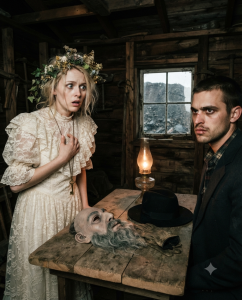
They forced Lucía to marry the man everyone called Don Esteban Rivas, the mine owner who had quietly bought her father’s debts one by one until the family had no room left to bargain. By the time the wedding day arrived, the choice had already been made everywhere except in her own mouth.
No one asked what she wanted.
Not her father, who spoke of sacrifice as if it were noble only when it belonged to someone else. Not her younger brother, who had started talking about her marriage in the language of acreage, grain, and credit. Not her stepmother, who seemed more concerned with whether Lucía looked obedient than whether she looked terrified.
The wedding took place under a harsh afternoon sun, the kind that made every face shine and every smile look strained. Lucía stood at the altar in a dress that had belonged to her late mother’s cousin, altered in haste and pulled too tight at the ribs. In her hair sat a small crown of white flowers already beginning to wilt at the edges. Her sister had pinned them there with the trembling care of someone trying to fix a wound no one else was willing to see.
Across from her stood the man she was being given to.
Don Esteban Rivas was not handsome, and Lucía was grateful for that much. Beauty would have felt like one more insult. He looked older than she had expected—gray beard, weathered skin, broad shoulders hidden beneath a dark formal coat. He wore leather gloves despite the heat and kept his head slightly bowed, as though he found the ceremony tedious or beneath him.
But when he took her hand to place the ring, something in her sharpened.
His fingers were too firm.
His pulse was too quick and steady.
His hand did not feel old.
Lucía glanced up, searching his face, but his expression remained hidden beneath the brim of his hat and the downward tilt of his gaze. If there was anything unusual about him, no one else seemed to notice. The priest droned on. Her father stood nearby with the fixed smile of a drowning man watching a rescue boat approach. Her brother looked impatient for the toasts. Her stepmother looked triumphant.
Lucía said her vows because silence would have changed nothing.
By nightfall, the wedding feast had become a celebration of the family’s rescue. Her father drank wine he could not have afforded a month earlier. Her brother made loud predictions about next year’s harvest and the loans they would now be able to secure. Men who had avoided their house during the worst of their debt came forward to clap her father on the shoulder and speak as though fortune had returned to the bloodline through virtue rather than purchase.
Lucía sat through it like a ghost.
She barely ate. She watched. She listened. She remembered.
She remembered the way her father had first introduced the idea, speaking gently, almost tearfully, about necessity. He had used the old language of duty, family, and inheritance. He had said a daughter sometimes had to do what sons could not. He had said land was more than property. It was legacy. It was survival.
Yet all Lucía had heard was this: We would rather sell you than lose what is ours.
The final veil fell from her eyes when her stepmother bent near during the feast, smiling as if sharing some harmless household wisdom.
“Do whatever he asks,” she whispered. “Men like him don’t pay that much for company.”
Lucía turned and stared at her.
The woman was still smiling for the guests.
That was the moment guilt left her. Not slowly. Not partially. Entirely.
Until then, some part of her had been trying to forgive them in advance. Trying to believe they were desperate, not cruel. Frightened, not calculating. But those words exposed the truth with obscene clarity. They had not reluctantly sacrificed her. They had appraised her.
When the feast ended, Lucía was escorted to the main cabin near the mine. The house stood apart from the workers’ quarters, built of heavy timber and stone darkened by years of soot and weather. Lamps glowed in the windows. Behind it, the slope of the hill rose toward the old mine entrance, a black opening in the earth that seemed to swallow even moonlight.
The servant who brought her there avoided her eyes.
Inside, the air smelled of lamp oil, dust, and iron. The bedroom prepared for the newlyweds was larger than any room Lucía had ever slept in, yet it felt tighter than a coffin. She heard the door close behind her. Then the lock turning.
Her breath caught.
She turned immediately and backed toward the window, gripping the folds of her dress so tightly her knuckles hurt. Don Esteban remained by the door for a moment, his shape throwing a long shadow across the floorboards.
Then he crossed the room and placed his hat on the table.
He removed his gloves.
Lucía braced herself.
Instead of reaching for her, he raised both hands to his beard.
At first she thought he meant to straighten it. Then she saw his fingers slide beneath it. The beard lifted from his skin like damp cloth. Her eyes widened. He peeled it away in one motion, revealing not wrinkled flesh beneath but a younger jaw, tense and strong. Next came the loosened edges of false skin at his neck, then the carefully attached age from his face itself.
A mask.
A perfect one.
By the time he laid the final piece on the table, Don Esteban Rivas had disappeared.
The man standing before her was perhaps thirty-two or thirty-three, with dark hair damp at the temples, a pale scar near his upper lip, and eyes that looked stripped clean of pretense. He was broad-shouldered, powerful, and fully awake in a way the old man never had been.
Lucía forgot her fear for one stunned heartbeat and felt something almost worse.
Confusion.
“My name is not Esteban Rivas,” he said.
His real voice was lower and younger, clear as steel. “I’m Tomás Varela.”
The name meant nothing to her at first.
Then he said, “Your father signed his sentence the day he burned the mine where mine died.”
The room seemed to tilt.
The mine fire had happened when Lucía was a child. It lived in the family story as a tragedy, a terrible accident, proof that fortune could turn without warning. Her father always told it the same way: a lantern overturned, supports failed, men were trapped, and no one could have prevented what followed. He would shake his head solemnly and speak of loss as though he had stood shoulder to shoulder with the bereaved.
But even as a girl, Lucía had sensed fractures in the story.
Certain names were never mentioned at table.
Certain laborers were never invited back after asking questions.
Old workers lowered their voices whenever the fire came up in conversation, and her father’s temper grew frighteningly sharp whenever anyone spoke of records, ownership transfers, or insurance.
Tomás opened his coat and pulled out a folder thick with papers. He threw it onto the table. Sheets fanned open across the wood.
Lucía stepped closer despite herself.
There were copies of deeds, debt transfers, insurance documents, and receipts for payments made through third parties. Signatures appeared under false names. Dates overlapped in ways that exposed planning rather than accident. One contract in particular caught her eye: the marriage settlement itself. Attached to it was a clause so severe it made her stomach tighten. If her family failed to honor any condition of the debt agreement—even a minor one—they would forfeit every remaining parcel of land.
Tomás watched her face carefully.
“I bought every debt your father was hiding,” he said. “Every note, every lien, every quiet promise he made to stay afloat. He thought he was marrying his daughter to a tired old man who wanted a young wife before death. Instead, he tied himself to the son of one of the men he buried.”
Lucía looked up sharply. “Your father died in the fire?”
Tomás’s expression hardened. “Not immediately.”
There was enough pain in those three syllables to tell her the rest had been worse than death alone.
He continued. “My mother begged for answers after it happened. Your father paid people to keep silent. He used the insurance to buy influence. Anyone who challenged his account lost work, land, or both. My mother spent years trying to prove what he did. The stress broke her before the truth ever surfaced.”
Lucía swallowed. “So this marriage—”
“Was never about you,” he said. “It was about getting close enough to destroy him with his own signature.”
He expected her to collapse then, she realized. To cry. To defend her father. To plead for mercy.
Instead, a different memory surfaced.
She was sixteen, sent to fetch fabric from a locked storeroom because the housemaids were busy. In the far corner she had found a trunk beneath old harnesses and moldy blankets. Inside lay ledgers bound in cracked leather, not with household accounts but with columns of figures she did not recognize. There were mine references, names of laborers, payouts, and coded notes. Before she could read further, her father had appeared in the doorway with such fury on his face that she still remembered the color draining from her hands. He had yanked the ledger away and told her never to touch what she didn’t understand.
That night he had moved the trunk.
Years later, she overheard him arguing with a clerk about “real books” and “clean books,” about what had to be shown and what had to be buried.
Now Tomás stood before her, carrying vengeance like a second skin, and suddenly the fragments aligned.
Slowly, Lucía reached up and removed the wilted flower crown from her hair.
She walked to the table and placed it beside the false beard and the discarded mask.
Then she slipped her hand into the hidden seam of her corset and withdrew a small brass key.
Tomás went still.
“Then you chose the wrong daughter to frighten,” she said. “Because I know where my father hid the real ledgers.”
For the first time since revealing himself, Tomás looked surprised.
“Where?” he asked.
Lucía closed her fingers around the key instead of answering.
“You expect me to help you because I hate what they’ve done to me,” she said. “Maybe I do. Maybe I don’t. But if those books prove what you think they prove, this is no longer about revenge. It’s about what really happened in that mine.”
Tomás’s eyes narrowed. “You believe me.”
“I believe my father lies.” She let out a thin breath. “And I believe he lies most when death and money are in the same room.”
Something shifted in Tomás then. Not trust. Not yet. But a recognition that she was not merely collateral in his plan. She was a witness standing at the edge of the same abyss, looking down from a different side.
Lucía told him what she knew. Her father never kept true records in the house itself. He hid them close enough to control, but far enough to deny. He preferred forgotten places—storage cellars, feed sheds, abandoned rooms no one cleaned. Anywhere filthy enough to repel curiosity. The key she held fit a small iron lock attached to a cedar chest she had seen only twice, both times moved just before dawn from one outbuilding to another under the supervision of men her father trusted more than family.
Tomás listened without interrupting.
“The chest is somewhere on this property?” he asked.
“It has to be,” Lucía said. “He wouldn’t risk transporting it far. Not with so much in writing.”
Tomás looked toward the window, toward the darkness outside. “Then we leave now.”
Lucía took one step toward him and stopped. “And if the ledgers prove he planned the fire?”
His face hardened again. “Then he answers for every life.”
Before she could say more, a sound sliced through the room.
Boots on the porch.
More than one set.
Both of them turned toward the door.
The handle shifted.
Once.
Then again, slower.
Tomás moved instantly, snatching up the gloves from the table and pushing the papers back into the folder. Lucía felt her pulse hammering in her throat.
“Who has a key?” he asked quietly.
She stared at the door, every nerve lit. “My father never trusted closed doors,” she whispered.
A voice came through the wood.
“Lucía,” her father said, smooth and almost cheerful. “Open the door. We need to speak with your husband.”
Tomás’s gaze snapped to hers. He mouthed, Husband.
Then her father added, in a tone gone suddenly flat, “About something he was never supposed to find.”
Lucía’s blood ran cold.
Tomás crossed the room without a sound and extinguished one of the lamps, throwing half the space into shadow. He picked up the false beard, but Lucía grabbed his wrist.
“There’s no time,” she breathed.
The handle rattled harder.
Her father was not alone. She could hear at least two men behind him, maybe three. One heavy enough that the boards complained under each shift of his weight. Hired hands. Not guests from the wedding.
Tomás looked at the window. Too narrow for a clean escape. Too high for silence.
Lucía’s eyes darted around the room, then fixed on the tall wardrobe near the bed. She shook her head at once. Too obvious. Her gaze dropped lower—beneath the bed, no. The trunk at the foot? Locked and shallow.
Then she saw the old coal hatch in the floor near the hearth, half-hidden beneath a woven rug.
Tomás followed her line of sight.
“You trust me enough for that?” he asked.
“No,” she said. “But I trust my father less.”
The handle jerked again.
Lucía yanked back the rug, found the iron ring, and lifted. Beneath it was a narrow storage cavity dark with soot, likely used years ago when the cabin still relied on coal hauled from the mine. It was tight, filthy, and barely large enough.
Tomás slipped the folder inside first, then lowered himself into the darkness with the efficiency of a man long familiar with cramped spaces. Before pulling the hatch down, he caught Lucía’s wrist.
“If this goes wrong—”
“It already has,” she whispered.
Their eyes locked for one charged second. Then she lowered the hatch, kicked the rug back over it, and straightened just as the pounding started.
“Lucía!” her father barked.
She crossed the room on trembling legs, forcing herself not to look toward the hearth.
When she opened the door, her father stood there with his wedding smile gone. Behind him were her brother and two men from the mine, broad-armed and expressionless. Her brother’s face was flushed with drink and nerves. Her father’s eyes swept over the room, calculating, sharp.
“Where is he?” he asked.
Lucía let confusion fill her features. “Inside.”
Her father took one step in, then stopped when he saw the table.
The hat.
The gloves.
The beard.
The mask.
His face changed so completely that for one instant he looked like a stranger.
Her brother inhaled sharply. One of the hired men muttered a curse.
Her father turned to Lucía, and she saw it clearly at last—not panic, but fury at losing control.
“What did he tell you?” he asked.
Lucía had spent years fearing that voice. Years folding herself around it, shrinking before it, doubting her own instincts when it turned soft or cruel without warning. But now she saw the truth underneath it: not authority, only desperation wearing better clothes.
She lifted her chin. “Enough.”
He stepped closer. “Did he say Varela?”
The name struck the room like a spark in dry grass. Her brother looked between them, bewildered. “Who is Varela?”
Her father ignored him.
Lucía’s answer came slowly. “Why are you afraid of that name?”
Something in her father’s expression cracked.
He motioned the hired men inside and shut the door behind them. “Search the room.”
Her brother stared. “Father, what is this?”
“This,” her father snapped, “is what happens when fools leave old graves closed halfway.”
The men began overturning drawers and opening cabinets. Lucía’s heart pounded against her ribs so hard she thought surely they could hear it through the floor. One man moved toward the hearth. Tomás lay hidden just beneath it with the evidence.
Then her stepmother appeared in the doorway, breathless from the walk. She looked from the scattered room to the false face on the table and blanched.
“I told you this would come back,” she hissed at Lucía’s father.
He spun on her. “Not now.”
“Yes, now,” she shot back, voice trembling. “You said the fire would bury all of it. You said the dead man’s family had nothing left.”
Lucía’s brother turned white. “What fire?”
No one answered him.
The man searching near the hearth nudged the rug with his boot.
Lucía moved before she could think. “Stop!”
Every head turned toward her.
If she looked at the rug now, they would know. So she looked instead at her father.
“You sold me to save yourself,” she said, her voice ringing through the room. “At least have the courage to tell your son what you did.”
The accusation hit exactly where she meant it to. Her brother recoiled, shocked into speechlessness. Her stepmother began crying in angry, jagged breaths. Her father took a step toward Lucía, forgetting the rug, forgetting the search, forgetting everything except the challenge.
That was all Tomás needed.
The coal hatch exploded upward.
The hired man nearest the hearth staggered back as Tomás surged out of the floor blackened with soot, folder in hand. He drove one shoulder into the second man, slammed him against the wall, then planted himself between Lucía and her father with terrifying speed.
Her brother shouted. Her stepmother screamed.
Lucía’s father froze.
Not because of Tomás’s strength.
Because Tomás had opened the folder.
And in his hand, visible even from across the room, was a page covered in figures, signatures, and a line written in her father’s own unmistakable hand.
Delay rescue until collapse is complete.
Silence swallowed the cabin.
Lucía stared.
Her brother stared.
Even her stepmother stopped crying.
Tomás’s face had gone frighteningly still. “You didn’t just burn the mine,” he said. “You kept the men inside.”
Her father opened his mouth, but no words came.
Lucía took the page from Tomás with shaking fingers and read the line again, as if the second time might change it. It didn’t. Below it were payout amounts. Insurance references. Initials of officials who had been bribed. Names of laborers marked as expendable because their families had no leverage and no land.
One name was Varela.
Not just Tomás’s father.
His mother too—listed beside a note about debt pressure and “containment.”
Tomás saw it the same instant Lucía did.
“My mother?” he said, voice hollow.
Lucía looked up at her father. “She knew.”
Her father tried to recover then, tried to gather the fragments of command around himself. “Those notes don’t mean what you think.”
Tomás stepped forward. “Then say what they mean.”
But it was not the father who broke next.
It was the stepmother.
“No,” she whispered. Then louder, shaking, “No more. Tell them.”
Everyone turned.
She pressed both hands to her mouth for a moment, then dropped them. “The fire wasn’t supposed to spread that fast,” she said. “He only meant to frighten the workers and force the sale. But once it started—once one tunnel gave way—he ordered the exits blocked. He said if the men came out alive, they’d talk. He said ruin would take us all.”
Lucía felt as if the floor had vanished under her.
Her brother backed away from their father as though seeing him for the first time.
“And Varela’s mother?” Tomás asked.
The woman closed her eyes. “She found copies. She threatened to go public. He had men hound her, cut her off, call her mad. By the time she stopped fighting, she was half broken.”
Tomás stood utterly motionless.
All those years, Lucía thought, he had come for one truth and found a worse one.
Her father lunged—not at Tomás, but at the folder. Desperation finally stripped him of all disguise. Tomás caught him by the collar and shoved him back hard enough to knock the breath from him. One of the hired men started forward, then stopped when Lucía’s brother stepped between them.
“No,” her brother said hoarsely, staring at their father with revulsion. “You don’t touch those papers.”
Outside, voices rose. The commotion had drawn workers from nearby cabins. Faces appeared at the windows. Questions spread like sparks in dry grass. All the secrets her father had spent years sealing underground were climbing into the night.
Tomás turned to Lucía. “Once these leave this room, there’s no undoing it.”
She looked at the papers, at her father, at the remnants of her wedding lying beside a false face on the table.
“There was never anything to undo,” she said.
By dawn, the magistrate from town had been summoned. So had two former clerks, an insurer’s representative, and half a dozen workers eager to speak now that written proof existed. The ledgers were enough to begin the collapse. The testimonies that followed made sure it would not stop there.
Lucía’s father was taken away before noon.
Her brother said nothing to him.
Her stepmother tried once to beg Lucía’s forgiveness, but whatever fragile arrangement had passed for family between them had already turned to dust. Lucía only looked at her and wondered how many nights she had slept beside that secret and still found the will to smile.
As for Tomás, the victory he had pursued for so long did not look like triumph on his face. It looked like grief finally given shape. He had wanted justice for his father. Instead, he learned how much had also been stolen from his mother, how deeply the cruelty had spread, how many years of silence had been purchased with terror.
The marriage was voided within the week, the contract declared fraudulent under false identity and criminal coercion. Some people in town called it scandal. Others called it divine exposure. A few, usually the ones who had profited most from men like Lucía’s father, called it misfortune and preferred not to discuss it at all.
Lucía left the family house before the month ended.
She did not leave with wealth. Most of the land was seized, contested, or sold to repay claims. What remained was little enough to fit inside a cart. Yet for the first time in years, she felt no one’s hand on the back of her neck pushing her toward a fate she had not chosen.
On her last evening there, she found Tomás standing near the sealed entrance of the old mine. The setting sun turned the hillside red. Wind moved through the dry grass with a sound like whispered names.
“You got what you came for,” she said.
He did not answer immediately. “Not in the way I imagined.”
“No,” she said. “Probably not.”
After a long silence, he looked at her. “You could have handed me over.”
“You could have used me and walked away.”
He gave a small, humorless smile. “I nearly did.”
Lucía looked toward the black mouth of the mine. “I know.”
He nodded once, accepting the weight of it.
There was too much between them for anything simple. Too much deception, fury, grief, and strange reluctant recognition. He had entered her life wearing another man’s face. She had entered his carrying the bloodline of the man who ruined his family. Yet when truth finally came into the open, they had stood on the same side of it.
Sometimes that is not redemption.
Sometimes it is simply the refusal to remain buried with the lie.
When Lucía walked away from the mine that evening, she did not know whether she would ever see Tomás again. She only knew the wedding meant to seal her obedience had instead cracked open the hidden rot beneath her family’s name. In the end, the man who came for vengeance had uncovered something larger, and the daughter sold to preserve a fortune had become the one who destroyed the silence protecting it.
People later argued over who was right, who was monstrous, and who had merely done what desperation demanded. But Lucía knew exactly where the line had been crossed. It wasn’t at the wedding altar, or the forged contract, or even the moment a daughter was traded for land.
It was the instant a man decided other people’s lives were cheaper than his own ruin.
Everything after that had only been the bill coming due.