The same morning Evelyn Heartwell arrived in Granger to marry a stranger, she heard two women on the train platform whisper that she would be another poor fool gone before the first hard freeze.
Neither of them lowered their voices.
“That Calloway place eats women alive,” one said.
“The last one didn’t even stay a month,” the other replied. “This one looks too proud to last through lambing.”
Evelyn kept walking as if she hadn’t heard them, though every word struck cleanly. The train hissed behind her, its steam rolling low across the platform. Kansas met her with knife-cold wind, frozen dust, and a town that seemed to have already decided her story.
She stepped down carrying one small valise, a borrowed trunk, and the last of her courage stitched into the lining of her coat with $14.60. Rhett Calloway’s letter was folded in her pocket, softened by rereading. Widower. One daughter. Sheep ranch. Practical arrangement. Need for capable wife. Fair home. No nonsense.
It was not romance. It was not rescue. It was not even hope, exactly.
But it was a door.
And Evelyn had run out of places where doors opened for women with no dowry, no father left living, and too much stubbornness to become someone’s burden.
Rhett stood near the end of the platform, broad-shouldered beneath an old coat gone shiny at the seams. He was not handsome in any soft way. He looked weathered, restrained, and deeply tired, like a man who had been bracing against bad years for so long that bracing had become his natural posture. Beside him was a little girl in a dark wool coat, with two neat braids and a face too solemn for seven.
“Miss Heartwell,” he said.
“Evelyn,” she answered. “You must be Rhett Calloway.”
“Rhett.”
That was all.
No smile. No warming courtesy. Just an efficient glance toward her trunk.
“You bring much?”
“Only what I own.”
He nodded once.
His daughter did not move.
Evelyn turned to her. “And you must be Maisie.”
The girl lifted her chin. “You’re taller than I expected.”
“Should I apologize?”
“I haven’t decided.”
For the first time that day, Evelyn nearly smiled. “Then I’ll wait for your judgment.”
That earned her a blink, which on that child felt like progress.
The ride to the ranch was a study in distance. The prairie spread outward in dun-colored waves, fences bending under old weather, trees sparse and wind-twisted, the sky white and enormous overhead. Maisie sat between them on the wagon seat, closer to Rhett than to her. Evelyn let the silence be until she could no longer stand it.
“How many head?”
Rhett glanced over. “Sheep?”
“It would be a strange question otherwise.”
“About two hundred. Rambouillet crosses mostly.”
“How many bred ewes?”
Something changed in his face. “Sixty-three.”
“Any first lambers?”
“Around eighteen.”
“You’ll need eyes on them early if the weather turns.”
He studied her a moment longer. “You know stock.”
“My grandfather raised merinos. My brothers hated lambing season. I didn’t.”
That seemed to land somewhere in him, though he offered no praise. Maisie, however, looked openly interested now.
“My favorite is Biscuit,” she said. “She’s got a torn ear.”
“I’ll be sure to pay proper respects.”
The ranch came into view an hour later, and Evelyn understood immediately why people whispered. The place had good bones and tired skin. The house needed paint. One side of the porch sagged. A fence line leaned like old soldiers. The barn was sound, but only just. The pastures carried sheep, yes, but also strain—thin spots in the grass, deferred repairs, too many signs of a place surviving one season at a time.
“It needs work,” Rhett said as if issuing a warning.
“The worthwhile things usually do,” Evelyn replied.
Inside, the house was clean in the particular way that speaks of effort without comfort. Swept floors. Washed dishes. A weak fire. Curtains faded by years of prairie light. In the front room stood a framed photograph of a dark-haired woman with calm eyes and a half-smile. Clara, Evelyn assumed.
No one had moved the picture. No one had dusted away the grief.
Maisie took Evelyn to the back bedroom and stood in the doorway while she set down her bag.
“The others didn’t stay,” the child said matter-of-factly. “Mrs. Beaumont cried a lot. Miss Alcott was scared of the barn. Another one tried to throw away Mama’s aprons. Papa told her no. Then she left too.”
“You keep careful records.”
Maisie shrugged. “It matters.”
“Yes,” Evelyn said gently. “It does.”
At supper they ate venison stew and coarse bread. Maisie watched everything. Rhett spoke only when necessary. Evelyn understood enough about wounded houses not to force herself into the empty spaces. She observed where the flour was kept, which cupboard stuck, how Maisie looked toward the front room whenever Clara’s name hovered in the silence but was never said.
Afterward, Evelyn stood at the kitchen window looking out over the dark yard.
“I’d like to see the flock before breakfast,” she said.
“I’m out before dawn,” Rhett answered.
“So am I.”
“It’ll be cold.”
“I did not come here for the temperate society.”
This time, very faintly, one corner of Maisie’s mouth threatened to move.
Before dawn, the cold went through Evelyn’s boots and into her bones. But the instant she stepped into the barn, something steadied inside her. The smell of wool, hay, animal breath, and lanolin carried memory with it. Work memory. Useful memory. Life that demanded action.
Rhett was checking pens when Evelyn spotted the ewe lying off by herself.
“That one’s sick.”
He came over. “Hasn’t eaten since yesterday.”
Evelyn crouched beside the ewe, ran practiced hands along jaw, ribs, belly, and fleece. The animal’s breathing was too fast. Eyes dull. Heat under the skin.
“Fever. She may be fighting pneumonia. Or parasites on top of the cold.”
“We’ll see how she does.”
“If we wait, we may lose her.”
He folded his arms. “I can’t spend the night over every weak ewe.”
“I can.”
Maisie stood in the doorway in her little boots and shawl. “Her name is Clover.”
Evelyn looked up. “Then Clover and I are acquainted now.”
Rhett did not stop her. That was the permission she needed.
She mixed warm water with molasses and salts, coaxed the ewe to drink, made a mash, checked the bedding, rubbed warmth back into chilled ears, and stayed. Rhett brought coffee once, silent as ever. Maisie came and went, each time pretending not to worry.
Near midnight, Evelyn sat on an overturned bucket, wrapped in an old blanket, talking softly to Clover because sometimes tone mattered more than words. At some point she drifted. She woke when the ewe stood, trembling, and pressed her nose into Evelyn’s palm.
At dawn, Rhett found them that way.
“She’s up,” he said, almost to himself.
“She chose not to quit.”
Clover nudged his hand too. And in that quiet moment, with gray morning pouring through the cracks in the barn wall, Evelyn saw the truth about the man before her. He was not hard because he felt nothing. He was hard because too much had gone wrong, and softness had become dangerous.
“Thank you,” he said.
It was the first thing he had said to her that sounded unguarded.
Then Maisie screamed.
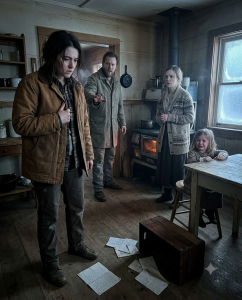
The sound hit the barn like a dropped lantern. Rhett moved instantly, racing across the yard. Evelyn was right behind him. They reached the kitchen to find Maisie frozen by the table, white-faced and shaking.
A cedar box sat open on the floor by the stove, papers scattered in every direction.
And in the middle of the mess stood a woman in a dark traveling coat, pale with strain, her breathing quick, one gloved hand clenched around the edge of the table.
On her finger gleamed a gold wedding band.
Clara’s wedding band.
Rhett stopped so abruptly the floorboards groaned beneath him. “Lenora.”
The woman looked at Evelyn first, then at him. “I had to come before you lied to her too.”
Maisie let out a choking sob. Evelyn moved to her side at once, instinctively placing herself between the child and whatever storm had just entered.
“Who is she?” Evelyn asked.
The woman laughed without humor. “That depends which version he’s told you. My name is Lenora Voss. And the ring I’m wearing belonged to Clara Calloway.”
Rhett’s face emptied of color. “Take it off.”
“No.”
“You don’t belong in this house.”
Lenora’s eyes flashed. “Clara invited me into this house. More than once. More honestly than you ever invited anyone.”
Evelyn looked down. The top sheet among the scattered papers had been opened and flattened by someone’s hand. The writing was slanted, feminine, deliberate.
If anything happens to me, do not trust the man in this house with—
The sentence ended where the page folded under itself.
Rhett stepped forward. “Don’t read that.”
It was fear, not anger.
That was what chilled Evelyn most.
Maisie began crying harder. “Papa, please.”
Evelyn crouched beside the girl. “Maisie, sweetheart, look at me.”
Maisie tried.
“Do you know this woman?”
The child nodded once, miserably. “I saw her before. A long time ago.”
Rhett shut his eyes for the briefest second.
Lenora seized on it. “Then tell her. Tell her why Clara was making copies of deeds. Tell her why she was writing letters in secret and hiding them in that box. Tell her why the bank man came twice in one week the month before she died.”
“That is enough,” Rhett said.
“No,” Lenora snapped back, voice shaking now with years of something old and bitter. “Enough was when she begged me not to leave her alone in this.”
Evelyn straightened. “Start at the beginning.”
Neither of them spoke.
So she did the only sensible thing. She picked up the next page.
Rhett said her name, sharply this time, but she had already begun to read.
The letter was dated nine days before Clara’s death.
If he tells anyone the ranch has always been his, he is lying.
Evelyn looked up slowly.
Lenora’s chin trembled, but she held steady. “There it is.”
Rhett’s voice dropped. “You know nothing about this.”
“Then explain it,” Evelyn said.
Maisie was staring at the floorboards now, breathing too fast. “I remember the well,” she whispered.
Every adult in the room went still.
Evelyn turned at once. “Maisie?”
The girl wrapped her arms around herself. “Mama and Papa were shouting outside. I wasn’t supposed to hear. Mama said she wouldn’t sign. Papa said she had no choice. Then I heard something fall. I thought—” Her voice cracked. “I thought maybe the bucket.”
Lenora closed her eyes in pain.
Rhett crouched before his daughter, horrified. “Maisie, listen to me. Your mother slipped. I told you that because it was true.”
“Did she?” Lenora asked.
He rose so fast his chair toppled behind him. “You were not here.”
“I came the next day,” Lenora shot back. “And Clara had bruises on her wrist in the coffin.”
Maisie whimpered.
Evelyn’s pulse thundered, but she forced herself to stay still. “No more in front of her unless every word is true.”
That, unexpectedly, reached Rhett. He dragged a hand over his mouth and stepped back.
Lenora swallowed and spoke more quietly. “Clara inherited this ranch. Not Rhett. Her father left it to her before they married, through a trust until title could be properly transferred. But there were debts. Bad weather. A note called in early. Clara found out papers had been filed giving the bank the impression Rhett had authority he did not actually have.”
Rhett cut in immediately. “I was trying to save it.”
“By forging her consent?” Lenora asked.
“I never forged anything.”
“Then why was she writing to a lawyer in Wichita?”
Evelyn scanned the pages. There, tucked among Clara’s letters, were copies of legal descriptions, account balances, signatures practiced and repenned. A corner of one page bore a man’s name—Harland Pike, Granger Savings & Loan.
Lenora pointed. “Pike knew. He was helping arrange a transfer after Clara signed. Only she never meant to sign the version they gave her.”
Rhett’s expression changed. Not to guilt. To fury.
“Pike,” he said flatly.
It was the first moment Evelyn felt the ground shift under the whole story.
“You’re saying the banker altered the papers?” she asked.
“I’m saying Clara thought I was involved,” Rhett said, each word controlled with effort. “Because by the time I realized what Pike had done, we were already drowning. I told her I could fix it. She thought that meant I wanted to hide it.”
Lenora stared at him. “You expected her to trust that?”
“No,” he said, and for the first time the hardness broke fully. “I expected time. We ran out of it.”
The room went quiet except for Maisie’s uneven breathing.
Evelyn turned back to the letters. On the next page Clara had written of fear, yes—but fear that the ranch would be stolen, that Rhett was making desperate choices without telling her everything, that Pike had pressured them both. There were references to arguments, to signatures, to the well house where she had gone to clear her head the night she died.
Not proof of murder.
Not proof of innocence either.
Only a house full of half-truths and grief.
“We need facts,” Evelyn said. “Not ghosts.”
Lenora gave a brittle laugh. “Facts in Granger? You’ll have to dig.”
“Then that’s what we’ll do.”
It began with the well.
That afternoon, while Maisie stayed with the pastor’s wife, Evelyn walked with Rhett and Lenora behind the house. The wind had sharpened, driving low clouds across the sky. The old well stood a little way off, ringed with stone, its cover newer than the surrounding timbers.
“This was replaced,” Evelyn said.
Rhett nodded. “After Clara fell.”
“Who found her?”
“I did.”
“And the banker?”
“He came two days later asking about the papers,” Rhett said, disgust rough in his throat. “Too quickly, if you ask me now.”
Lenora folded her arms. “I always thought so.”
“Then why come here accusing him?” Evelyn asked.
Lenora looked ashamed. “Because Clara’s letters stopped before she could write what happened next. And because grief turns unfinished stories into the worst version first.”
Evelyn knelt by the base of the well house and found what time had almost erased: a rusted hinge fragment in the dirt, and near it, remnants of broken latch hardware.
“This cover was damaged before it was replaced,” she said.
Rhett came closer. “The latch snapped that night in the storm.”
“But Maisie heard arguing first,” Evelyn said. “And Clara wrote that she would not sign.”
Lenora looked at Rhett. “So what really happened?”
He stared into the dark mouth of the well for a long time before answering.
“Pike came here that night,” he said. “He shouldn’t have, but he did. Clara had confronted him in town and he came afraid she’d expose him before he could get the title filed. I found them by the well house shouting. Clara had the original trust letter in her hand. Pike lunged for it. She jerked back. The latch gave way when she hit the cover.”
Lenora’s breath left her.
“You let everyone think it was only an accident.”
Rhett’s face twisted. “By the time I hauled her out she was gone. Pike swore if I accused him, the bank would bury me, say I was inventing it to cover debt fraud. Then he threatened to take the ranch for default within the month. I had a child. I had no witness. And Clara was dead because I had brought that man into our business in the first place.”
“So you lied,” Evelyn said softly.
“Yes.”
“Why not tell Maisie at least that her mother wasn’t careless?”
“Because she was seven,” he said, voice breaking. “Because I could not bear for her to know her mother died in a fight over land and debt and my failures.”
Lenora looked wrecked by what she was hearing. “She gave me the ring because she was scared,” she whispered. “She said if anything happened, I should keep proof she had planned to act.”
“Why didn’t you come sooner?” Evelyn asked.
“Cowardice,” Lenora said. “And because after the funeral Pike spoke to me too. He told me Clara had accused Rhett before she died. I believed what matched my anger.”
Evelyn closed her eyes for one moment. It was all so terribly human—fear, pride, half-seen truths, people choosing silence where courage was needed.
“Then we stop letting Pike write the story,” she said.
The next morning they rode into Granger together.
Harland Pike was exactly the sort of man Evelyn expected: polished boots, smooth voice, clean cuffs, eyes that calculated while pretending to sympathize. He welcomed them into his office until he saw Lenora, then the old certainty in his posture faltered.
Rhett set Clara’s letters on the desk.
Pike barely glanced at them. “I don’t see what old family grief has to do with banking.”
Evelyn placed the copied land records beside them. “Enough, when signatures don’t match dates and title authority was misrepresented.”
His smile thinned. “Careful, ma’am.”
Lenora took off Clara’s ring and set it on the papers like a challenge. “Careful, Mr. Pike. Clara told more than one person she meant to expose you.”
Rhett said nothing at all. Somehow that was more frightening than if he had shouted.
Pike looked from one face to the next and judged wrong. He thought intimidation still belonged to him.
“You have no proof.”
“Yes, you do,” Evelyn said, and turned toward the doorway.
Two men stepped in—the county clerk and the sheriff.
Evelyn had gone to them first thing that morning with Clara’s letters, the copied trust descriptions, and one crucial discovery she had made the night before while sorting the papers: a receipt showing Pike had charged filing fees for a transfer that had not yet been legally signed.
The clerk lifted the receipt now and frowned. “This should not exist.”
Pike’s face blanched.
The sheriff rested a hand on the edge of the desk. “You’ll come with me.”
Then Pike did the most revealing thing a guilty man can do.
He looked straight at Rhett and said, “You let her think it was you.”
No denial. No outrage. Just resentment.
Rhett’s jaw tightened. “I know.”
It unraveled quickly after that. Under questioning, and faced with the irregular filings, Pike admitted he had manipulated the debt paperwork to pressure Clara into transferring control of the ranch before legal title issues were fully settled. He had counted on the Calloways’ desperation and silence. On the night Clara confronted him, he went to the ranch to force the matter. He denied intending harm, but in trying to seize the trust letter from her, he caused the struggle by the well that ended in her death.
It was not murder in the cold, planned sense people imagine in stories. It was greed, panic, and one terrible shove in the wrong second.
The sheriff called it involuntary manslaughter and fraud.
The town called it scandal.
Maisie called it her mother not being foolish after all.
That mattered most.
The legal aftermath took weeks. The trust documents were reviewed. Clara’s ownership was confirmed. Her interest passed properly to Maisie, with Rhett as guardian under court oversight until she came of age. It was humiliating for him in some ways, a public reckoning with his own secrecy and poor judgment. But it also saved the ranch from being swallowed by a lie.
Evelyn stayed.
At first because someone had to steady the house through the storm. Then because leaving no longer felt truthful.
She repaired routines before she repaired rooms. She set lambing charts in the kitchen. She cataloged feed. She made Rhett talk before debt decisions. She taught Maisie how to spot bloat, bottle-feed weak lambs, and knead biscuit dough without overworking it. She opened windows on warm days and packed away the air of mourning bit by bit.
Rhett did not ask for forgiveness he had not earned. That, more than any speech, changed things.
One evening in early spring, they stood together in the lambing barn while a storm rolled purple over the far pasture. A ewe strained in the straw. Maisie held the lamp. Evelyn worked calmly, guiding the lamb free.
When the wet little creature finally cried out, Maisie laughed—clear and bright, a sound the house had almost forgotten.
Rhett looked at Evelyn across the pen.
“I brought you here for practical reasons,” he said.
She did not look away. “I know.”
“I thought I needed a woman who could keep the house from collapsing.”
“And?”
He watched Maisie cradle the newborn lamb under her coat. “Turns out you saved the whole kingdom.”
Evelyn laughed softly. “This place was never a kingdom.”
He glanced toward the fields, the barn, the repaired porch beyond. “Not then.”
By summer, the ranch looked different. Not grand in the city sense. Better than that. Fences mended. Wool prices improved. The flock steadier. Window boxes on the porch. Fresh paint beginning to cover old weather. The place had dignity again.
People in town began calling it, half-jokingly, the prairie royalty place because Evelyn somehow made even hard work look like command. She did not fuss. She did not preen. She simply saw what was broken and refused to let it remain that way.
Lenora came sometimes on Sundays. She and Maisie planted herbs behind the kitchen. Grief no longer entered that house as an accusation. It came as memory, which is gentler when truth has been given room.
As for Clara, her photograph remained in the front room. But now it was dusted, framed properly, and flanked by fresh wildflowers when the season allowed. Not a shrine to silence. A place of honor.
Months later, after the fall shearing, Evelyn found Rhett standing on the porch at dusk.
“Are you regretting your practical arrangement?” she asked.
He looked at her for a long moment. “It stopped being practical some time ago.”
The prairie wind moved her hair loose around her face. The sun was going down gold across the pasture. Sheep drifted like cream-colored shadows. Inside the house, Maisie was singing to a lamb with a bad leg.
“What is it now?” Evelyn asked quietly.
He stepped closer. “A home. If you still want it.”
Evelyn thought of the train platform, the pitying stares, the whispers that she would run. She thought of Clover pressing her nose into a cold hand, of Clara’s letters, of the lies that nearly buried them all, of one frightened child finally laughing again.
Then she took Rhett’s hand.
“Yes,” she said.
The prairie did not turn soft for them after that. Winters still bit. Lambs still came wrong-footed sometimes. Markets still rose and fell with no regard for anyone’s heart. But the house was no longer ruled by silence, and the ranch was no longer a ruin pretending to stand.
It had become something rarer: a place remade by truth after almost being destroyed by it.
And that was the part people in town never fully agreed on afterward.
Some said Rhett deserved forgiveness because he had lost as much as anyone and finally faced what his fear had cost. Some said Clara paid the highest price for his silence, and no good ending could erase that. Some said Evelyn was brave. Others said she was reckless to build her life atop so much old sorrow.
Maybe all of them were right.
But anyone who saw Maisie running through the pasture with wind in her braids, or Evelyn on the porch in the evening light with wool ledgers under one arm and laughter in the doorway behind her, knew one thing for certain:
The biggest red flag had never been the broken ranch.
It had been the secrets buried inside it.
And the only reason that prairie ever got its queen was because she refused to look away.