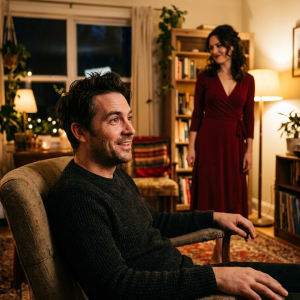
They told Clara it was the only way to save the family.
By the time the proposal reached her, it no longer looked like a proposal at all. It looked like a decision that had already been made in rooms she was never invited into, between voices that spoke in legal terms and social codes and old-money euphemisms designed to make brutality sound civilized.
Her mother delivered it first, seated in the blue drawing room with a teacup she never touched.
“You need to understand what is at stake,” she said.
That was how difficult things were always introduced in the Ferrán family. Never with honesty. Never with guilt. Just with stakes, expectations, consequences. As though the emotional devastation of one person could be neatly folded into household management.
Clara had already sensed something was wrong long before that conversation. For weeks, the house had been vibrating with a kind of curated panic. Her father no longer exploded in public. That was how she knew it was serious. He became quieter when he was truly afraid. Controlled. Pale. Abrupt. The kind of silence that made everyone around him move faster.
Calls came at all hours. The family attorney started using the back entrance. Her brother Álvaro, who usually treated business like a game he was born to win, began sleeping at the office attached to the private banking wing downtown. Staff stopped making eye contact. Newspapers disappeared before breakfast.
The Ferrán family empire had always rested on appearances as much as capital. Their surname carried the weight of old institutions, inherited confidence, and the dangerous illusion that wealth made people untouchable. But now something had cracked beneath that polished image. Investments had collapsed. Auditors were approaching. Creditors who had once waited politely were now demanding access. There were whispers of frozen assets, buried liabilities, internal lending irregularities.
Clara was not included in the details, but she was smart enough to read dread when it moved through a house.
Then came the solution.
León Arístegui.
Retired founder of the very bank now holding much of the debt strangling the Ferráns. A widower. Elderly. Powerful. Quiet. According to her mother, he had retained enough influence to calm the panic if he wished. According to her brother, he represented a bridge deal, a strategic alliance, a temporary shield until the family could stabilize.
According to Clara, he was a buyer.
“He wants to marry you,” her mother said.
Clara almost laughed, because the sentence was so absurd it arrived sounding theatrical. But her mother’s expression never changed.
“No,” Clara said.
Her mother set down the untouched cup. “This is not the moment to be childish.”
Childish.
It had been years since that word stopped hurting, but in that moment it returned with all its old force. In the Ferrán household, resistance was childish. Anger was childish. Self-preservation was childish. Only obedience was considered mature.
“Does he even know me?” Clara asked.
“That’s irrelevant.”
“Does he want a wife or a signature?”
Her mother’s face hardened just slightly. “He wants an alliance.”
Clara looked toward the window and saw her own reflection floating faintly over the gardens. Well-dressed. Composed. Expensive. Replaceable.
“What happens if I refuse?”
For the first time, her mother answered plainly. “Then your father loses everything. Your brother goes down with him. The estate will be dismantled. The papers will have a feast. And this family will be finished.”
Not I’ll be disappointed.
Not Please.
Finished.
By dinner, the pressure had expanded to include everyone. Her father did not beg. He paced and spoke about sacrifice. About legacy. About how every generation had obligations. Álvaro reframed it as intelligence.
“It’s not romantic,” he said. “No one is pretending it is. But these things happen. You do this now, and in a year you’ll have freedom, security, everything.”
“After marrying an old man I’ve met twice?”
“A powerful old man,” Álvaro corrected.
That was the night Clara understood no one in the family was even trying to hide the exchange. They simply expected her to cooperate with the language around it. They thought that by avoiding crude words, they could avoid crude truths.
But truth did not care about manners.
The ceremony was scheduled with astonishing speed. Invitations were limited. The chapel was private. The guest list was half family, half finance. Clara stood through fittings and floral meetings and legal rehearsals with the eerie sensation of being prepared for transport rather than marriage.
She met León Arístegui only once before the wedding, in the presence of both families and two attorneys. He looked exactly as described. Frail. Polite. Deliberately restrained. He walked with a walnut cane and wore his age like a carefully arranged costume of decline. His voice came thin and worn. His eyelids drooped. His smile barely moved.
Yet even then, there was something that did not fit.
He watched too carefully.
Not like an old man overwhelmed by fatigue, but like someone counting exits.
On the wedding day, Clara felt less like a bride than a witness to her own replacement. The chapel smelled of wax and expensive roses. The guests smiled with the glossy hunger of people attending both a union and a transaction. Investors who had threatened action days earlier now stood shoulder to shoulder with her father, suddenly warm and gracious, as though disaster had never existed.
León walked down the aisle slowly, leaning on his cane.
Then he took her hand.
It lasted only a moment, the exchange of the rings, but his grip was unmistakable. It was firm, exact, and entirely inconsistent with the weakness he had displayed all afternoon. No tremor. No hesitation. Just the controlled pressure of a man whose body was obeying him perfectly.
Clara looked up fast enough to catch nothing. His face had already settled back into age-softened passivity.
Still, the feeling remained.
At the reception, the performance became unbearable. Her father laughed too loudly. Álvaro moved from guest to guest like a man already rebuilding his future. Her mother glowed with brittle relief. Every glass raised in celebration seemed to carry a hidden calculation.
At one point, her mother drew close and said, very softly, “Do not ruin the last chance this family has.”
Something about that sentence changed Clara.
All her life she had been trained to believe the family’s emotional weather was partly her responsibility. If her mother was disappointed, Clara had failed. If her father raged, Clara had provoked strain. If her brother dismissed her, she should have been more useful, less difficult, more strategic, less sentimental.
But that evening, surrounded by people who had converted her life into a financial instrument, Clara felt something inside her detach.
She was done carrying guilt for damage she had never done.
The wedding ended late. The staff guided them to a private suite in the upper floors of the old historic bank, now converted into a discreet luxury hotel for elite clients and sealed events. It was an appropriate setting for the Ferráns: opulent, secretive, built on money and memory.
Clara entered first.
León followed, closed the door, and turned the lock with a motion too swift to belong to a frail man.
Then he leaned the walnut cane against the wardrobe.
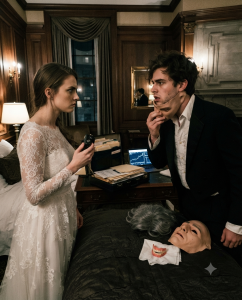
He faced her in silence, lifted both hands to his mouth, and removed his false teeth.
Clara froze.
He laid them on the bed as calmly as someone setting down cuff links. Then he reached to his cheeks and jaw and began peeling away thin latex prosthetics that had given his face a sagging, softened age. Underneath emerged firmer skin, sharper contours, a completely different expression. Finally, he removed the gray wig.
The old man vanished.
In his place stood someone younger, harder, fully present.
When he spoke again, the tired rasp was gone.
“My name is Simón Arístegui,” he said. “And your father stole the trust fund that belonged to my mother when she was no longer able to defend herself.”
Clara stared at him, the room suddenly too still.
He crossed to a black briefcase, flipped the latches, and spread the contents across the table. Documents, bank statements, account ledgers, notarized filings, copied signatures, internal memoranda. The evidence was not theatrical. It was methodical. That made it more frightening.
He pointed as he spoke.
“These are the original trust disbursements. Here are the parallel accounts. Here—double signatures. Here—charitable donations that were never real. Here—the same loan disguised through separate entities so it could be absorbed without triggering a flag.”
Clara moved closer, feeling her heartbeat sharpen. Each page revealed another layer of planning. Her father had not stumbled into a bad decision under pressure. This was structure. Deliberate structure. Money had been drained, rerouted, disguised, folded into other vehicles until ownership became blurred and recovery nearly impossible.
“My mother was ill,” Simón said. “She trusted your father. He managed portions of her holdings while she was declining. By the time anyone checked, the trust had been hollowed out.”
“Why the marriage?” Clara asked.
His eyes lifted to hers. “Because debt can become a weapon if you place it in the right legal frame. Your family is desperate. My name still opens doors. The marriage legitimizes emergency interventions, restructuring, private settlements. It gives me access and timing. Once the hidden obligations surface through the alliance, the collapse points inward. Lawfully.”
He had not come to rescue the Ferráns.
He had come to dismantle them from within.
Clara should have recoiled. Instead, another realization settled over her with chilling ease. If Simón had spent years building this counterstrike, then whatever her family had done was worse than the rumors. More intimate. More predatory.
And somehow, she had been offered up as the final seal on it.
Simón studied her face, perhaps waiting for outrage on her family’s behalf. But there was none. Only a hard, quiet clarity.
She walked to the tall mirror near the window.
From behind its ornate frame, she pulled a tiny hidden camera.
When she set it beside his documents, Simón’s expression changed for the first time.
“I’ve been recording them for two months,” Clara said.
“You knew?”
“I knew they were hiding something. I didn’t know this. But I knew they were going to use me.”
He looked at the device, then back at her. “Why record your own family?”
The answer came easily because she had been forming it long before tonight.
“Because a daughter who’s been sold learns quickly that truth is worth more than a last name.”
Simón let out a breath that sounded almost like disbelief. Then, carefully, he reached for the camera.
“What do you have?”
“Meetings. Arguments. Pieces. My father avoided specifics around me, but Álvaro talks too much when he thinks no one matters in the room.”
She scrolled through saved files until she found a sequence recorded in her father’s study. The audio was imperfect, the camera angle poor, but the voices were clear enough.
Her brother’s voice came first, brisk and cold: “Once the old accounts are folded in, no one will ever separate them again.”
A pause.
Then her father: “That only works if the marriage closes before the auditors look deeper.”
Simón went still.
Again Clara played another clip. Papers rustled. Her mother’s voice entered this time, clipped and anxious. “She doesn’t need details. She just needs to stay calm through the wedding.”
Her father replied, “By the time she understands anything, it will be attached to her as much as to us.”
The room seemed to contract around them.
Simón lowered the camera slowly. “They planned to tie liability to you.”
Clara felt cold all over. She had known she was being used, but hearing the mechanism out loud was something else. They had not merely sold her to buy time. They had positioned her as insulation, a new legal surface onto which blame could be transferred if the structure collapsed.
“A wife,” Clara said hollowly. “A Ferrán by birth and an Arístegui by marriage. Convenient.”
Simón’s jaw tightened. “They wanted a buffer.”
A sound outside the door cut through the room.
Both of them turned.
Footsteps. One person, maybe two. Then a soft knock.
Clara’s pulse kicked hard. No one should have come up unannounced. The suite had been marked private. Staff would never interrupt unless instructed.
Then her mother’s voice drifted through the wood.
“Clara,” she said, calm and precise. “Open the door. We need to discuss what your husband has already told us.”
Clara looked at Simón. He looked back at her, every line of his body alert.
“They know,” she whispered.
Simón moved soundlessly to the side of the door, picking up nothing that looked like a weapon because he needed none. He needed information.
Her mother knocked again, gentler this time. “Open the door. There is no reason to make this uglier.”
Clara felt something inside her snap into place.
She crossed the room, unlocked the door, and stepped back.
Her mother entered first, immaculate as always, not a hair out of place. Behind her came Álvaro, tie loosened but expression composed, and then, several steps later, her father. He looked older than he had at the wedding, as if the strain of keeping secrets had finally started consuming him from the inside.
None of them looked surprised to see the disguise gone.
That was the first shock.
Her mother’s gaze flicked to the false teeth on the bed, the latex on the chair, the open briefcase on the table. “Well,” she said, “at least we no longer have to pretend.”
Clara stared at her. “You knew he wasn’t León?”
Álvaro answered instead. “Of course we knew.”
For a second, the room tilted.
Simón’s voice turned dangerously quiet. “Then you knew who I was.”
Her father stepped forward. “We knew who you believed you were.”
Simón’s face changed. Not with confusion. With fury.
“What does that mean?”
Her father’s mouth tightened. “It means your mother was not robbed by me. She was robbed by my father first, then yours, then everyone who touched those accounts after them. You’ve been chasing the wrong man while standing inside the right system.”
Simón took one step toward him. “I saw the transfers.”
“You saw selected transfers,” Álvaro cut in. “Because someone wanted you to see them.”
Her mother folded her hands. “There are family arrangements older than any of you seem willing to understand. Trusts moved through marriages. Holdings were protected through proxy names. Elderly heirs were managed. Debts were buried and reborn. Ugly? Yes. Unusual? Hardly.”
Clara looked from one face to the next in disbelief. “You sold me into this because it was all some inherited crime no one wanted exposed?”
“No,” her father said, and for the first time his voice cracked. “Because the auditors finally found the layer no one could patch. And once Simón resurfaced, we had two disasters to solve at once.”
“By making me the shield,” she said.
No one answered.
That silence told her everything.
Simón reached for the documents again. “Then say it plainly. Did you steal from my mother or not?”
Her father held his gaze. “I moved money that should never have existed in the structure it was in. By the time it passed through my hands, it was already contaminated. I protected this family and I protected the bank. Your mother’s trust was one victim among many.”
It was not a denial.
Simón looked like he might tear the room apart.
But Clara suddenly saw something even worse than the betrayal. No one here considered any of this extraordinary. Not really. Her mother saw it as management. Álvaro saw it as adaptation. Her father saw it as duty under pressure. Simón had arrived believing he was exposing a single monstrous act, and instead he had stepped into a lineage of theft polished into tradition.
Her brother glanced at the hidden camera on the table. “You recorded us. That was shortsighted.”
Clara laughed once, sharp and joyless. “No. Getting caught selling your daughter was shortsighted.”
Álvaro moved toward the camera, but Simón stepped between them.
The pause that followed was electric.
Then her mother spoke, and her composure finally cracked at the edges. “Listen to me carefully, Clara. If those files leave this room, the scandal will not stop with us. The bank will implode. Accounts tied to families, charities, endowments—everything will be scrutinized. Innocent people will be hurt.”
“Innocent people are already hurt,” Clara said.
Her mother’s eyes flashed. “Do not become self-righteous now. You have lived comfortably on the same money.”
The accusation landed, because it was not entirely false. Clara had worn the clothes, slept in the house, accepted the polished life funded by structures she had never questioned deeply enough.
But knowledge changed obligation.
“Yes,” Clara said quietly. “And that may be the ugliest part.”
Her father looked at her then with something like real grief. “You think truth will free you. It won’t. It will bury you with us.”
Clara looked at Simón, then at the evidence, then at the family who had built their survival on concealment.
Maybe he was right.
Maybe truth would bury everyone.
But lies had already done that, only more slowly.
She picked up the camera in one hand and one of Simón’s folders in the other.
Álvaro lunged first.
Simón intercepted him so fast the movement barely registered. A chair crashed sideways. Her mother shouted. Her father grabbed the edge of the table as if his own body could no longer support the strain. Clara moved backward, heart slamming, and reached the suite phone.
“Don’t,” her mother snapped.
Clara met her eyes and pressed the emergency line anyway.
The words came out clear. “Send hotel security to the Arístegui suite. Now.”
Everything after that happened with brutal speed. Security arrived. Lawyers followed. Then regulators. Then investigators, because wealthy families can contain private disgrace but not once official processes begin in a building already tied to financial scrutiny. One intervention led to another. Documents were seized. Servers were frozen. Private records became evidence.
The Ferrán name did not collapse in one cinematic moment.
It rotted in public, layer by layer.
The audits opened wider. Transfers linked to dormant trusts surfaced. Charitable vehicles were exposed as cover. Emergency restructuring attempts became proof of concealment. Investors fled. Old allies denied knowledge. Newspapers that had once printed flattering profiles now ran diagrams showing money moving through a maze of shell entities and inheritance structures.
Her father was charged. Álvaro too. Her mother was not spared simply because her hands had looked clean. She had signed enough, authorized enough, concealed enough.
And Simón?
He recovered a portion of what had been stolen from his mother’s estate, though not all of it. Too much had been absorbed, spent, dissolved into the bloodstream of institutions that only admitted guilt when forced. But he did recover the truth, which turned out to matter more than he had expected and less than he had hoped.
As for Clara, every paper described her differently. Heiress. Bride. Whistleblower. Co-conspirator turned witness. Victim. Opportunist. No version was complete. Maybe none could be.
She left the family estate before the first winter hearing. She moved into a quiet apartment with no staff, no inherited silver, no portraits watching from walls. Her life became smaller, then stranger, then finally her own. Some days she woke furious. Some days ashamed. Some days relieved with a force that felt almost like mourning.
Months later, after one of the final court decisions, she met Simón for coffee in a place so ordinary neither of them would have noticed it before all this.
He looked at her across the table for a long moment and said, “I used to think there was one person to blame.”
Clara stirred her coffee and watched the milk disappear into the dark. “And now?”
“Now I think systems survive because people keep calling them family, tradition, protection. Whatever makes betrayal easier to inherit.”
She nodded slowly.
Outside, people passed without recognizing either of them. The world had moved on, as it always does, leaving ruin behind for the ruined to sort through themselves.
When they stood to leave, Simón thanked her.
Not for the evidence. Not for the marriage. Not even for helping expose the truth.
For choosing not to stay loyal to a lie simply because it had raised her.
Clara walked home alone after that, thinking about all the years she had mistaken belonging for safety, obedience for love, silence for elegance. Maybe that was the biggest red flag of all—that the people who claimed to protect her were always the ones asking her to understand what could not be defended.
She still didn’t know whether blood deserved forgiveness simply because it was blood.
She only knew this:
The night they sold her, they thought they were securing the future.
Instead, they handed the truth its perfect witness.