She noticed the dark house first.
Not because anything was wrong with it. The little yellow ranch on Clover Street was tidy enough — flowerpots by the door, a welcome mat, curtains that never moved. But every evening when Dottie Marsh drove her old Buick past on her way home from bingo, that house was black as midnight.
No porch light. No kitchen glow. No flicker of a TV.
Just dark.
Dottie had delivered mail on this route for thirty-one years. She knew every house on Clover Street the way you know an old song — by feel, by habit, by the things that were slightly off. And a house where a young woman lived alone, dark every single night?
That sat wrong with her.
She started paying attention.
The name on the mailbox said R. CALLOWAY. The mail was always the same — bills, a nursing journal, the occasional package from Amazon. Young woman. Medical work, maybe. Long hours.
But the lights.
Dottie thought about it all through October. Thought about it the way she thought about her daughter, Patty, who had been gone eleven years now and left a hollow in her chest that no amount of casseroles or church socials had ever quite filled.
She didn’t let herself stay in that hollow too long.
Instead, she did what she always did when she didn’t know what else to do.
She cooked.
A big pan of chicken and rice, covered tight in foil, left quiet as a secret on the porch of the dark little house on Clover Street.
And tucked underneath the dish — a small paper star, hand-drawn with a black marker, the five points a little wobbly.
She’d made a hundred of them once. For Patty’s kindergarten class, the week before Christmas. Patty had loved stars. Said they were God’s night-lights, left on so nobody had to be scared of the dark.
Dottie didn’t know why she made one now. Her hands just did it.
She drove away before anyone could see.
—
The dish was gone by morning.
No note. No knock on her door. Just gone, and the porch empty again.
Dottie told herself that was enough. But the next week she brought chicken pot pie. Left it the same way. Same quiet porch. Same dark windows.
Same little paper star tucked underneath.
She watched from down the street, just long enough to see a shadow pass behind the curtain.
Someone was in there. Someone saw.
November came. She brought a green bean casserole. Then sweet potato soup in a mason jar with a lid she’d painted with tiny daisies because she couldn’t help herself. And every single time — every single time — she folded a small paper star and tucked it beneath the dish like a signature she didn’t mean to leave.
The dishes always disappeared.
The stars too.
She tried not to wonder. Tried not to hope. Hope had a way of making the hollow bigger if you weren’t careful.
But then came the night in early December when Dottie climbed those porch steps with a pan of her mother’s lasagna and stopped dead in her tracks.
There was something on the doormat.
A piece of notebook paper, folded in half, held down by a small stone.
She picked it up with cold fingers. Unfolded it in the glow of her phone.
In careful, tired handwriting, it said:
Thank you. I don’t know who you are. But some nights, this was the only warm thing.
Dottie stood on that porch for a long time.
Then she did something she hadn’t planned to do.
She knocked.
—
She heard movement. A long pause. The soft sound of a chain sliding back.
The door opened.
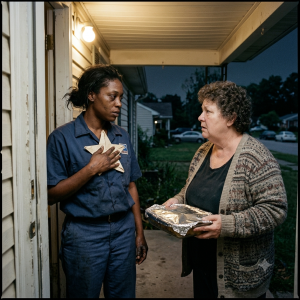
The young woman standing in that rectangle of yellow light was still in her uniform.
A postal uniform.
Dottie’s breath caught somewhere between her throat and her chest. The woman looked exhausted in the particular way that grief exhausts a person — hollowed out, careful, like she was carrying something she’d learned not to set down.
In her hand, pressed against her chest like something precious, she held a small folded paper.
A paper star.
Not the one from tonight. An older one, soft at the edges from being handled too many times.
The young woman’s chin trembled. Her eyes went to Dottie’s face and stayed there, searching for something she seemed to recognize and couldn’t believe.
Her hands were shaking when she whispered —
“I know who left these. And I’ve been trying to find you for eleven years.”
Dottie couldn’t speak.
The star in the woman’s hand. The uniform. The dark house full of something Dottie suddenly understood wasn’t emptiness at all.
It was waiting.
—
The young woman’s name was Rosa. Rosa Calloway. And she was thirty-one years old, which meant she had been twenty when whatever this was had started, and Dottie’s mind was moving too slow to catch up with what her heart had already figured out.
“Come in,” Rosa said. “Please. Please come in.”
The house wasn’t dark on the inside. It was small and warm and careful — a nurse’s apartment, tidy the way someone gets tidy when they need one thing in their life they can control. A secondhand couch. A lamp with a yellow shade. Books stacked in honest piles, not arranged for show.
And on the kitchen table, in a mason jar with a painted daisy lid, a bouquet of dried wildflowers. The jar Dottie had brought the sweet potato soup in, three weeks ago.
She’d kept it.
Rosa sat down across from her and set the paper star on the table between them like an offering.
“I was in kindergarten,” she said. “Mrs. Tillman’s class. Harvest Creek Elementary.”
Dottie’s hand went to her mouth.
“My mom used to volunteer in the class sometimes,” Rosa said. “But she got sick that fall. Really sick. She couldn’t come in anymore. And I was five and I didn’t understand why she couldn’t get up in the morning, and I started to think—” She stopped. Pressed her lips together. Started again. “I started to think that maybe the school stuff, the holiday stuff, all of it was going to disappear along with her getting sick. That everything was going to get dark at the same time.”
Dottie remembered that class. She remembered every year she went in, every face. The construction paper chains and the paste that smelled like almonds and the way five-year-olds sang off-key with such complete conviction that it made your sternum hurt in the best way.
“The week before Christmas,” Dottie said. Her voice was barely there.
Rosa nodded. “You came in and you brought a hundred paper stars and you let every kid make their own. You told us—” Her voice caught. “You said stars were God’s night-lights. So nobody had to be scared of the dark.”
Dottie had said that. She’d said it because Patty said it, and she’d wanted to carry some of Patty into that room, into those little hands.
“I brought mine home to my mom,” Rosa said. “She was having a bad day. She was in bed. And I put it on her nightstand and I told her what you said. That nobody had to be scared of the dark.” Rosa’s eyes were full. “She kept it for six years. Until she died. And then I kept it.”
The star on the table between them. Not six weeks old. Twenty-six years old. The paper gone soft as cloth, the marker lines faded to the color of a shadow, the five points still slightly wobbly because Dottie had never been able to make them even no matter how many she drew.
Twenty-six years that little star had been in someone’s hands.
Dottie was crying. She hadn’t known she’d started.
“I became a postal carrier because of you,” Rosa said quietly. “I know that sounds like a strange thing. But after my mom died, I kept thinking about that woman who came into my kindergarten class. Who showed up. Who didn’t know me or my mom and just — showed up with something warm.” She wiped her face with the back of her hand. “I wanted to be that. I wanted a job where you show up for people every day whether they know you’re coming or not. Whether they notice or not.”
Dottie thought about thirty-one years of early mornings. Of learning every name on every box. Of noticing when the mail piled up, when something felt off, when a dark house on Clover Street started to worry her the way a mother worries.
She thought about how she’d never known, not once in all those years, whether any of it had mattered.
“I transferred to this route eight months ago,” Rosa said. “And the very first week, I saw the name on the truck. Marsh. D. Marsh. I looked you up in the department directory.” She let out a breath that was almost a laugh. “I’ve been trying to work up the nerve to knock on your door every single day since August.”
Dottie looked at her. “Why didn’t you?”
Rosa looked at the star. “Because what do you say? How do you explain to a stranger that they’re the reason you made it? That a piece of paper they folded in five minutes has been in your family for twenty-six years?” She shook her head. “I was afraid it would sound like too much. Like I was too much.”
Dottie reached across the table and put her hand over Rosa’s.
“Honey,” she said, “I lost my daughter eleven years ago. I have been making paper stars into the dark ever since, hoping one of them would land somewhere it was needed.”
Rosa went very still.
“Patty was twenty-four,” Dottie said. “Car accident. February. She never had children, so I never got to be a grandmother, and I’ve had so much love sitting around the house with nowhere particular to go.” She squeezed Rosa’s hand. “Every casserole. Every soup. Every star. I was sending them out like I was still looking for someone to find.”
For a moment neither of them spoke. The lamp with the yellow shade made a warm circle on the table. Outside, the first real snow of December was beginning to come down.
Rosa turned her hand over and held Dottie’s.
“I found you,” she said.
—
That was seven months ago.
Dottie still drives past the little yellow ranch on Clover Street on her way home from bingo on Tuesday nights. But the house isn’t dark anymore.
Rosa leaves the porch light on now. Says it helps her remember to come home like a person and not just a body that runs routes and eats crackers over the sink.
They have dinner on Sundays. Nothing fancy. Dottie cooks, Rosa does the dishes, and afterward they sit at the kitchen table with decaf and talk about the people on their routes — the ones who seem like they might need something, the ones who light up when they hear a knock, the ones whose lights have been off a little too long.
They pay attention. It runs in them now, that particular kind of attention.
Rosa has the paper star framed. A small silver frame on her nightstand, right where her mother kept it. She says she knows it’s a little silly, a faded scrap in a frame. Dottie tells her it is not one bit silly and means it down to her bones.
Dottie has a photo on her own nightstand now. Her and Rosa at Thanksgiving, standing in Dottie’s kitchen with aprons on and flour on their hands, laughing at something one of them said right before the timer went off.
Patty would have loved Rosa. Dottie is certain of this the way she’s certain of very few things.
She told Rosa that once. Rosa cried. Then she said, “Tell me about her. Tell me everything.”
So Dottie did.
And the hollow in her chest, the one the casseroles and church socials never touched, got a little smaller. Not because it was filled with something new, exactly. More like a light came on inside it. Like someone had finally found the switch.
Like a star left on a doorstep had come all the way home.