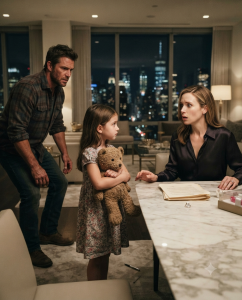
Evelyn Kensington had spent most of her adult life proving that money could solve anything faster than emotion ever could.
It was the principle her empire had been built on. If a building failed, buy the land beside it. If a rival got loud, buy their debt. If a board member turned hesitant, buy their loyalty before they found courage. She had turned instinct, calculation, and a near-supernatural ability to stay cold under pressure into Kensington Global, one of the most aggressive real estate and tech firms in the country.
By thirty-four, she had more wealth than she could reasonably spend, more influence than most elected officials, and more enemies than she could count without a spreadsheet.
She also had a reputation.
In Manhattan, people called her the Silicon Widow.
She was not widowed. She had never been married. The nickname came from the quiet brutality with which she destroyed careers. Executives who underestimated her were gone by lunch. Competitors who mocked her in public often ended up negotiating with her in private three months later, weaker and poorer.
Evelyn never corrected the nickname. It amused her.
Fear was efficient.
Then a photograph hit the internet and efficiency stopped working.
The image had been taken outside one of Kensington Global’s charity events. Evelyn stood in a cream coat, face hard with anger, shouting at a former executive named Amanda Price, who was crying into her hands. The photograph caught none of the context and all of the damage. It did not show the evidence Evelyn had uncovered that morning: forged approval chains, false transfers, millions missing from the company foundation. It did not show the confrontation inside the office or the confession that almost came before Amanda ran outside. It showed only a billionaire screaming at a crying woman on a Manhattan sidewalk.
By noon, the image was everywhere.
By evening, the headlines had decided who Evelyn was.
Cruel. Unstable. Vindictive. Soulless.
Under ordinary circumstances, she would have crushed the story with lawyers, interviews, and pressure. But the timing made that impossible. She was in final-stage negotiations to acquire Whitmore Group, a respected European company valued at $12 billion. The acquisition would expand Kensington Global into markets she had been circling for years.
Arthur Whitmore, the company’s aging patriarch, had one weakness no analyst could model: morality, or at least his version of it.
He admired family. He distrusted spectacle. He believed private character predicted public judgment. Evelyn’s team knew exactly what the viral image would do to him.
“It makes you look volatile,” Harrison Cole, her head of PR, told her carefully while they sat in the conference room watching the metrics rise. “And Arthur Whitmore hates volatility in people even more than he hates it in markets.”
Evelyn stood at the window with her arms folded. “Then fix it.”
“We are trying.”
“Try faster.”
Harrison exhaled. “There’s one angle people still respond to. Humanizing pressure. A private life. Context that softens the image.”
She turned. “Meaning?”
He hesitated for half a second. “We leak that you’ve been under strain because you’re preparing for a wedding.”
Evelyn’s stare would have melted weaker men.
“You want me engaged by sunrise?”
“I want Whitmore wondering if he judged a private moment too quickly.”
She should have rejected it. Instead, she nodded.
The rumor moved fast. News sites ran with it. Anonymous sources confirmed that Evelyn Kensington was quietly planning a wedding. Comment sections softened. Business channels speculated that marriage had changed her priorities. People were embarrassingly eager to believe tenderness had fixed a woman they had spent years calling dangerous.
For forty-eight hours, it worked.
Then Arthur Whitmore called himself.
“Congratulations, Ms. Kensington,” he said in his gravelly voice. “My wife and I look forward to meeting your fiancé at Saturday’s gala.”
After the line went dead, Harrison slowly set his phone on the table.
Evelyn did not throw anything. That was how he knew she was furious.
“I need a real man,” she said at last. “Someone believable. Not a failed actor with veneers and rented confidence.”
“You’re not serious.”
“I need someone with records. A job. A past that can survive scrutiny.”
“You can’t buy a husband like office furniture.”
She looked at him without blinking. “Find me someone who needs money more than pride.”
The universe, which had a dark sense of humor, had already placed that someone in her building.
David Miller owned a small landscaping company called Miller Greenworks. He specialized in high-end urban installations—rooftop gardens, green walls, interior botanical designs that made rich people feel environmentally soulful while still living in glass towers. His company had once been stable. Then his wife got sick.
Leukemia had consumed five years of his life in invoices, specialist visits, insurance fights, and hope rationed so carefully it became another form of exhaustion. He sold equipment, refinanced loans, emptied savings, and took every contract he could physically survive.
Sarah died in spring.
Debt remained.
So did their daughter Lily, eight years old, observant enough to make adults uneasy, gentle enough to make them lower their voices without knowing why.
David’s house would be in foreclosure within a month. The house mattered because Sarah had loved it. She had planted yellow roses by the fence and painted the kitchen herself while pregnant with Lily. David could lose the truck, the business, the tools, the pride. The house was harder. It felt like the last physical place where his wife had not fully disappeared.
On Thursday morning, David and his crew were installing a multi-tier vertical garden in the lobby of Kensington Global. He was on the ground with a tablet and rig map when he noticed one of the secondary support cables on the suspended planter had begun to fray under uneven strain.
“Stop movement,” he called. “Tape it off. Now.”
His crew responded instantly.
Yellow warning tape went up. Signs were placed. One worker started redirecting foot traffic.
Then the private elevator opened.
Evelyn Kensington stepped out, eyes fixed on her screen, walking fast enough to signal that everyone else’s urgency was decorative compared to hers. She was typing an email, irritated and distracted, and she crossed the tape line without once looking up.
David saw the cable snap.
He moved before fear formed into language. He lunged, hit her hard around the waist, and drove both of them to the floor as the suspended planter crashed down behind them. Marble cracked. Soil and steel exploded across the lobby. Someone screamed.
For a second, all Evelyn heard was ringing.
Then she found herself half-shielded by the body of a man she didn’t know, dirt in her hair, pulse slamming in her throat.
David stood up first, one hand gripping his shoulder. He looked at the wreckage, then at her.
“Are you blind,” he demanded, “or do you think gravity works for you too?”
It was not the tone people used with Evelyn Kensington.
She rose slowly, stunned less by the near-death experience than by the fact that this stranger looked genuinely angrier about her behavior than afraid of her response.
“There was tape,” he continued. “There were signs. You almost got yourself killed, and if that thing had landed differently, my crew would’ve carried your mistake.”
Security hurried over. Her assistants appeared from nowhere. Nobody knew whether to help her or drag him out.
Evelyn brushed dust from her sleeve and looked straight at him.
“What’s your name?”
“David Miller.”
She noticed his hands first. Scraped, dirty, capable. Then the way the workers watched him, waiting. He had no polish, no performance, no concern for who she was. Just competence and anger.
That evening she had his file.
The report was concise, and therefore devastating. Widower. One daughter. Heavy medical debt. Business on the edge. No criminal history. No public scandal. No signs of gambling, substance abuse, or reckless behavior. Several references independently described him with the same two words: decent and stubborn.
She smiled for the first time all day.
David arrived at the executive suite at six expecting legal threats over the damaged lobby.
Instead, he found Evelyn alone at a conference table, a velvet ring box near her hand and a contract prepared in duplicate.
She slid his financial records toward him.
He didn’t sit. “How did you get these?”
“I have people who are very efficient.”
“My debts aren’t your business.”
“They are if I’m offering to erase them.”
Then she explained.
The fake engagement. The Whitmore gala. The public appearances. The terms. Two years of marriage in name only. Separate rooms. No emotional obligations. In return, $5 million wired through a structured agreement, enough to save his house, his company, and every bill still haunting his kitchen counter.
He stared at her as if she had suggested selling air.
“You don’t want a husband,” he said. “You want to rent a decent man so people can believe you are one.”
She didn’t flinch. “I want a solution.”
“And you think I’ll let my daughter be dragged into your solution?”
“I think your daughter deserves security.”
He laughed once, without humor. “Don’t talk about what she deserves like you know her.”
He should have walked out. In his mind, he did walk out—three or four times in the span of a minute. Then reality showed him the bank notice, the payroll deadlines, the house, the roses, Lily asking if they would have to leave the room where her mother used to sing while folding laundry.
“There’s one condition,” he said finally. “You meet Lily. If she says no, this dies.”
Evelyn nodded, inwardly relieved. She believed children were predictable. Offer warmth, gifts, and enough charm, and they leaned wherever adults guided them.
On Friday evening, David brought Lily to Evelyn’s penthouse.
The apartment sat above the city like a private nation. Glass walls, museum-grade art, floors so flawless they reflected the lights. Evelyn had prepared with the confidence of someone who had never failed at persuasion once she decided to perform it. A child consultant had been contacted. Expensive gifts were arranged in deliberate abundance.
Lily entered holding a faded teddy bear.
She took in the room in one glance, then the gifts in another. Her expression did not change.
“All of this is for you,” Evelyn said.
Lily hugged her bear a little closer. “No, thank you. Barnaby would get jealous.”
David almost smiled. Evelyn almost didn’t know how to respond.
They sat for dinner.
Evelyn tried questions first. School. Favorite books. Activities. Future goals. She meant to sound interested, but years in boardrooms had trained all softness out of her rhythm. Every question sounded like due diligence.
Lily answered politely. That was the worst part. She never misbehaved. She simply remained unconvinced.
David watched the night curdle in slow motion.
Then Evelyn made her fatal mistake. Believing clarity was strength, she brought out the contract, the ring, and a designer watch she intended to gift David if he signed.
“Your father and I are considering an arrangement,” she told Lily. “He helps me with something important, and I help your family.”
Lily looked at the ring so long that David’s chest tightened.
Then she said, “You want to buy my dad.”
Evelyn smiled with visible effort. “No. It’s a partnership.”
“You want to buy him,” Lily repeated. “Just like you bought those toys.”
David murmured her name, but Lily wasn’t being rude. She was telling the truth with a child’s merciless accuracy.
“You didn’t ask what I like,” Lily said. “You just bought expensive things and thought that meant they were right.”
Then came the sentence that cut through David before it reached Evelyn.
“My mom’s ring was tiny. But when my dad looked at her, his eyes smiled. When he looks at you, he looks like he’s working.”
The room fell silent.
Lily stood, clutching Barnaby.
“My dad still buys my mom yellow flowers every Tuesday,” she said. “He still plays her song in the truck. He loves her for free.”
Evelyn, who had stared down hostile investors and prosecutors without visible discomfort, felt something unfamiliar rise in her throat.
Lily’s final words landed like judgment.
“You have a billion dollars, Miss Evelyn, but if you have to pay five million for someone to eat dinner with you, then you must be the poorest person in the world.”
The pen dropped from Evelyn’s fingers.
Then Lily reached into her cardigan and pulled out a folded letter.
David’s expression changed instantly. Not anger. Panic.
“Lily,” he said. “Not that.”
She looked at him with wet eyes. “Mom wrote it.”
Evelyn had the strange sensation that someone invisible had entered the room.
Lily unfolded the paper and began to read.
“If you’re hearing this, it means I’m gone, and your father is still trying to carry the world alone.”
David turned away. He pressed one hand against the edge of the table like he needed it to stay upright.
Lily continued, voice small and steady. Sarah’s letter was not dramatic. That made it worse. It was full of plain truths. That David would punish himself with loyalty if nobody stopped him. That grief could become a home people were afraid to leave. That loving the dead should never require the living to stop being loved.
“Don’t let him stay lonely just because he thinks loving me forever is the same as living,” Lily read.
The words changed the air.
Evelyn looked at David and saw not a useful man, not a solution, not a role to cast, but a husband whose love had survived the person it was meant for and turned into a kind of sacred pain.
Then Lily lowered the letter and asked Evelyn quietly, “So are you kind, or are you just expensive?”
Before Evelyn could answer, her phone lit up.
Arthur Whitmore was calling early by video. His wife sat beside him in the preview frame. They were ready to meet the fiancé and child whose existence was supposed to certify Evelyn’s hidden softness.
David looked at the phone, then at Evelyn.
“Pick it up,” he said.
She hesitated.
“Pick it up,” he repeated, “and don’t lie to them with my daughter in the room.”
Evelyn answered.
Arthur smiled politely. “Ms. Kensington. I hope we’re not interrupting family dinner.”
She could have done what she always did—perform, control, reshape reality with confidence. But Lily stood there with the letter in her hands, and David’s silence felt like a wall she no longer had the right to step around.
“This is David Miller,” Evelyn said at last. “And his daughter, Lily.”
Arthur greeted them warmly. His wife complimented Lily’s dress. For a brief and terrible moment, it would have been easy to continue the fiction.
Then Evelyn heard herself say, “There’s something I need to clarify. David is not my fiancé.”
On-screen, Arthur’s smile vanished.
Harrison, watching the security feed from another room and probably having a stroke, would later describe the next thirty seconds as career-ending. Evelyn did not stop.
“My team leaked false information after the photograph surfaced,” she said. “That was wrong. The woman in that photo had stolen money from our foundation, but the story that followed was partly my fault because I let image management replace honesty. David saved my life yesterday in the lobby after I ignored a safety barrier. Today I offered him money to help repair my reputation. He refused to let me buy what I hadn’t earned.”
David stared at her.
Arthur Whitmore said nothing.
Evelyn inhaled once. “If that costs me your deal, I understand.”
Then Lily did something none of them expected.
She walked closer to the screen and said, “She was mean. But she told the truth just now.”
Arthur’s wife looked at her husband. Arthur leaned back slowly, studying Evelyn with a gaze that had probably unraveled weaker negotiators for decades.
“I despise public deception,” he said finally. “But I despise cowardice more.”
No one spoke.
He continued, “You should have told the truth sooner. But tonight, under pressure, you chose honesty against your own immediate interest. That matters.”
Evelyn almost didn’t trust what she was hearing.
Arthur was not forgiving her. He was reevaluating her.
The call ended with no guarantee. Just a promise to continue discussions after the gala.
When the screen went dark, the apartment seemed unfamiliar, as though confession had changed the architecture.
David took the letter gently from Lily and folded it again. “We should go.”
“Wait,” Evelyn said.
He paused, not turning fully.
She looked at the contract, the ring, the gifts, the table that had become a courtroom. Then she did something even Harrison would never have predicted.
She tore the contract in half.
Then again.
“You were right,” she said, her voice rougher than usual. “All of you.”
David watched the papers fall. “That doesn’t fix anything.”
“I know.”
Lily studied her. “Are you still trying to buy us?”
“No,” Evelyn said. “I’m trying not to.”
That answer earned her the first real pause from the child.
They left a few minutes later. Evelyn stood alone in a penthouse full of untouched luxury and understood, with humiliating clarity, that she had built a life optimized for victory and almost no space for tenderness. She had acquaintances, subordinates, strategic allies, people who admired her and people who feared her. She had no one who would have spoken to her the way Lily had unless they had nothing to lose.
The next week was brutal.
The false engagement story was exposed because Evelyn exposed it herself before anyone else could. Her board raged. Share prices dipped. Commentators sharpened knives. Harrison considered resigning and didn’t only because somewhere beneath the panic he respected what she had done.
Then something unexpected happened.
A fuller accounting of the charity theft came out. So did internal footage from the lobby showing Evelyn ignoring the safety barrier and David saving her life. Public opinion, always chaotic, began to split. Some still hated her. Others admired the confession. Investors liked that the Whitmore deal was not dead.
Arthur Whitmore requested another meeting.
This time it was private, formal, and absent all pretense.
“I don’t do business with saints,” he told Evelyn. “They rarely exist. I do business with people who understand the cost of appearing honest without being it. You seem to have learned that lesson unpleasantly.”
The acquisition moved forward, not as easily as before, but on stricter governance terms. Evelyn accepted every condition.
She also did something else.
Without fanfare, through Harrison and a third-party legal team, she arranged emergency refinancing for Miller Greenworks under a small-business sustainability program Kensington funded publicly but rarely discussed. The terms were real, fair, and carried no personal obligation. David almost rejected them on principle until he realized they were clean enough to preserve his pride.
He called her once.
“Did you do this?”
“Yes.”
“Why?”
“Because your company is good. Because your crew deserves work. Because help shouldn’t always arrive wearing a leash.”
He was quiet for a moment. “Thank you.”
It wasn’t forgiveness. It was something better: honest distance.
Months passed.
Spring returned to the city. So did the yellow roses outside David’s house. Lily drew a picture one afternoon of her mother in the sky, her father in the garden, and a very tall woman in heels standing awkwardly beside a flower bed. David asked who the woman was.
“Miss Evelyn,” Lily said. “She looks less scary outside.”
The first time Evelyn visited the house, she arrived without gifts. No assistants. No driver waiting with the engine running. Just Evelyn, in simple clothes, standing by the fence looking at the roses Sarah had planted.
Lily watched her closely. “You didn’t bring anything.”
“I was told that was part of my problem.”
Lily considered this. “It was.”
Evelyn nodded. “Then I’m learning.”
David came out carrying pruning shears. He still looked guarded around her, but not angry in the old way. Grief was still there. Sarah was still there too, in all the ways that mattered. Evelyn had stopped competing with ghosts the moment she understood that love was not a seat someone vacated when they died.
It was a room that changed shape.
They talked. Slowly at first. Then more often. Sometimes about business. Sometimes about Lily. Sometimes about nothing important, which might have been the most important thing of all.
Evelyn never asked David to stop loving Sarah.
David never asked Evelyn to become soft in the way the world demanded from powerful women.
Lily remained the strictest judge of all progress.
One Tuesday, Evelyn noticed fresh yellow flowers on the passenger seat of David’s truck.
“You still bring them every week,” she said.
He looked at the bouquet for a long moment. “I always will.”
Evelyn nodded. “Good.”
Something shifted after that.
Not dramatically. Not all at once. No orchestral swell, no miraculous healing, no betrayal of the dead in favor of a cleaner ending. Just patience. Respect. A thousand small moments built honestly instead of purchased in bulk.
When David did eventually take Evelyn to dinner, many months later, it was at a tiny place with scratched wooden tables and terrible parking. She laughed more there than she ever had in restaurants where reservations required status and planning. He noticed. She noticed that he noticed.
And when he looked at her that night, his eyes did not look like he was working.
They looked uncertain.
Interested.
Alive.
It would take even longer before love dared to use its name.
Lily noticed first, of course. Children usually do.
One evening she found Evelyn and David on the back porch arguing quietly about whether rooftop beehives were an acceptable idea for a school garden grant. Lily crossed her arms and announced, “You two talk like married people, except less annoying.”
David nearly choked. Evelyn laughed so hard she had to sit down.
Years later, when people told the story badly, they said a billionaire tried to buy a husband and accidentally found a family.
That wasn’t true.
She found the boundary first.
She found the place where money stopped working, where grief could not be negotiated, where a child could identify poverty in the middle of unimaginable wealth.
Only after that did she begin, slowly and imperfectly, to become someone who could be loved without payment.
And David?
He learned that staying faithful to Sarah’s memory did not require building a permanent life inside loss. Love had not asked him to forget. It had only asked whether he was brave enough to keep living.
Maybe that was the real scandal beneath everything else.
Not that Evelyn Kensington offered $5 million for a fake marriage.
But that the only person powerful enough to change her mind was an eight-year-old girl holding a one-eyed teddy bear and a dead mother’s letter.
Even after everything was resolved, people could still argue over who had been right at the beginning. Maybe David was right to be furious. Maybe Evelyn was more broken than cruel. Maybe grief had protected him and trapped him at the same time. Maybe the biggest red flag was never the contract at all, but the fact that Evelyn had gone so long without anyone honest enough to tell her what she had become.