My mother had been dead for twenty-three days when someone knocked on her front door and changed my life so completely that, for a few seconds, I couldn’t even remember my own name.
Up until that knock, grief had been simple in the ugliest possible way. Heavy. Quiet. Repetitive. It lived in the body more than the mind. You folded towels that still smelled like your mother’s detergent. You found grocery lists written in her hand and had to sit down. You opened closets and got hit with perfume and mothballs and the shape of a life that had ended while the dishes were still in the drying rack.
My mother, Loretta Mae Simmons, had lived in the same little white house in Clover, Tennessee, for forty-one years. She taught Sunday school for half of them, worked the front desk at Dr. Milton’s dental office for twenty-six, and could make chicken and dumplings without looking at a recipe. She was not a dramatic woman. She was not a careless woman. She labeled freezer bags in perfect block letters and paid bills three days early. She folded wrapping paper after Christmas so she could use it again next year.
She was the kind of woman who left order behind.
So when she died in her sleep at eighty-two, I assumed the rest of her life would be as neatly arranged as the stack of utility receipts in her kitchen drawer.
I was wrong.
For the first three weeks after the funeral, I stayed in the house to sort things out. My husband had offered to help, but we’d been circling each other for months anyway, and I found I couldn’t bear another voice in those rooms. My daughter lived in Memphis and called every night. My sister didn’t call at all because, according to everything I had been told for fifty years, I didn’t have one.
Still, her name had always lived in the house like a draft you couldn’t locate.
Ruthanne.
I first heard it when I was maybe eight or nine. I had been looking through an old photo box and found a baby picture with “R” written on the back in faded blue ink. I asked my mother who it was. She took the photo from my hand so fast it startled me. Then she said, “That was Ruthanne. She’s gone.”
“Gone where?”
Her mouth flattened into a line so tight it turned white. “She died. Don’t ask again.”
I never forgot the look on her face. It wasn’t just sadness. It was fear.
Later, Aunt Darlene, my mother’s younger sister, told me Ruthanne had died of crib death before I was born. “It nearly killed your mama too,” she said in that brisk way she had. “Some things are too painful to drag around forever.”
So I learned not to mention the name.
After my mother died, though, the silence around Ruthanne began to feel less like grief and more like architecture. Built. Maintained. Defended.
That Tuesday I was cleaning the hallway shelf when I found the Bible.
It had been hidden behind a row of Reader’s Digest condensed books, tucked so far back it took both hands to pry it loose. It was an old King James Bible with a cracked black cover and brittle pages, the kind people used to save all their important papers in. Inside the front cover, in faded fountain pen, was my mother’s maiden name:
Loretta Mae Greer. Her Book.
I took it to the kitchen table because the light was better there. The late afternoon sun was coming through the gingham curtains, and the house was so quiet I could hear the refrigerator hum and the ticking wall clock over the sink.
When I opened the Bible, a pressed violet slipped out and landed against my wrist.
It was beautiful. Deep purple, almost blue at the center, flattened perfectly between the pages. But what caught my attention was not the flower itself. It was how alive it looked. A flower pressed for decades should have been papery and brown. This one looked newly laid down. The petals still had color. The stem wasn’t crumbled. When I touched it, I expected it to crack.
It didn’t.
I remember staring at it with my fingertip still resting on the petal, an absurd chill moving over my arms.
Then an envelope fell out.
It was sealed. Across the front, in my mother’s unmistakable handwriting, were the words:
For Carol. When you’re ready.
I was in no sense ready, but grief makes thieves of us. I opened it.
The paper inside was folded carefully. At first glance, I thought it was another letter. Then I saw the legal language. It was a handwritten will, dated eighteen months earlier and witnessed by two signatures I didn’t recognize. I skimmed the usual things first: the house, the car, the jewelry box, the savings account, the china cabinet I’d been telling myself I didn’t want. Then my eyes dropped to a line under additional heirs.
Ruthanne Colby, née Simmons. My firstborn daughter. Alive.
There are moments when the body understands before the mind does. My pulse stumbled. My hands went cold. I read the line again, then again, then out loud.
Alive.
Not dead.
Not gone.
Alive.
I sat there for what could have been ten minutes or an hour. Outside, somebody drove past with their radio too loud. A dog barked two houses over. Sunlight shifted across the table and caught the violet beside my hand.
The flower still looked fresh.
Then someone knocked on the front door.
I remember carrying the will with me halfway to the hall and then setting it down again because my hand was shaking too badly. I remember thinking it was probably a neighbor with another casserole dish I’d have to return. I remember feeling irritated at the interruption.
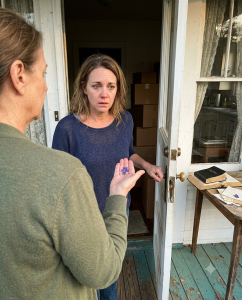
When I opened the door, a woman stood on the porch holding a violet in her palm.
She was tall and straight-backed, maybe late sixties, maybe early seventies. Her hair was white, not yellow-white with age but a clean silver-white pulled back neatly at the nape of her neck. Her dress was simple. Her handbag was old leather, good quality, polished from years of use.
I looked at her face and felt the bottom drop out of the day.
Her eyes were grey-green.
My mother’s eyes.
My eyes.
Not similar. The same.
She studied me for half a second, and I had the strange feeling she was recognizing things she had already imagined: my chin, maybe, or the shape of my mouth. Then she said, softly and with absolute steadiness, “My name is Ruthanne Colby.”
The world narrowed.
“And,” she said, lifting the violet slightly, “I’ve been waiting my whole life for someone in this family to finally open that Bible.”
I did not faint, though later I thought perhaps I should have.
Instead I stepped back and let her in.
She stood in the living room like someone entering a church after years away. Her gaze moved over the family photographs, the afghan on the sofa, the figurines my mother dusted every Saturday, and I saw sorrow pass over her face so quickly it was almost invisible.
“You knew her,” I said.
“Yes,” she answered. “Just not the way you were told.”
She sat at the kitchen table across from me. The will lay between us. The violet from the Bible sat beside the violet in her hand like a matched pair. She noticed me looking at them.
“She used to pick them behind the church,” Ruthanne said. “Pressed them in books because her mother hated wildflowers in jars. Said they looked messy.”
That was exactly the sort of complaint my grandmother would have made. My stomach tightened.
“You could have learned that from anybody.”
“Yes.” Ruthanne reached into her handbag. “So could this.”
She handed me a photograph. It was old and worn nearly white at the corners. My mother was maybe nineteen or twenty in it, young and scared-looking and beautiful in a way age had later made gentler. She was sitting on a porch swing, holding a baby in a crocheted blanket. On the back, in my mother’s handwriting, were five words:
My Ruthie before they came.
My vision blurred.
“Who came?”
Ruthanne inhaled slowly before answering. “Your aunt Darlene. And the man who arranged my placement.”
Placement.
Not adoption. Not rescue. Placement. The word sounded cold, official, immoral.
I stared at her. “Darlene told me you died.”
“She told your mother that’s what she ought to say if she wanted to survive it.”
I pushed back from the table so hard my chair legs scraped the floor. “No.”
Ruthanne didn’t flinch. “I know.”
“No, you don’t understand. My aunt can be difficult, she can be mean, but she would not—”
“She was twenty-one and desperate to protect the family’s reputation,” Ruthanne said quietly. “And your mother was unmarried, broke, and in love with the wrong man. In 1956, that was enough to ruin more than one life at a time.”
I sank back down because my knees had gone weak.
What came next arrived in pieces.
My mother had been nineteen when she got pregnant. The father was a married traveling salesman named Clyde Harlan who promised to leave his wife and did not. My grandparents were furious. According to Ruthanne, the baby was hidden as long as possible, the neighbors told my mother had gone to stay with cousins, and when Ruthanne was born, my grandmother insisted the child be given up quietly. My mother refused.
That’s where Darlene came in.
“She told Mama she had found a way for me to stay nearby,” Ruthanne said. “A good family. Temporary, she said. Until things settled. Your mother believed she would still see me.”
“But she didn’t.”
Ruthanne’s expression changed. “No.”
A week after the baby was taken, Darlene returned before dawn and told my mother there had been a tragic accident. She said the infant had died in her sleep. She said the adoptive couple wanted privacy. She said there was no grave to visit because the burial had already taken place.
“It broke her,” Ruthanne said. “But not enough to make her stop doubting.”
“Then how did you find each other?”
She looked down at her violet before answering.
“Because Darlene lied badly.”
Years later, when Ruthanne was in her twenties, the woman who had raised her died. While sorting through papers, Ruthanne found a receipt from a maternity home in Knoxville, an unofficial transfer record with the name Simmons crossed out, and a note pinned to it with a single sentence: Tell her I was sorry.
She spent years trying to untangle the truth. Sealed records. Dead ends. Changed names. Half-burned documents. Finally, she tracked down one retired county clerk who remembered that babies placed through that network often carried their mother’s birth county on the original intake sheet. That led her to Clover. Clover led her to church ledgers. Church ledgers led her to an old woman who remembered “that Greer girl with the sad eyes.”
Ruthanne found my mother when both of them were already old.
“And she just… knew it was you?”
Ruthanne gave a tired, sad smile. “She opened the door and looked at me for one second and said, ‘Darlene didn’t bury you.’”
I covered my mouth with my hand.
My mother had found her daughter. And never told me.
For a moment anger flared so sharp it surprised me. How could she not tell me? How could she let me go on believing a lie when the truth was breathing somewhere only hours away?
As if she heard the thought, Ruthanne said, “She wanted to. More than once.”
“Then why didn’t she?”
“Because she was ashamed. Because she thought you’d hate her for lying. Because Darlene threatened to deny everything and drag all the old ugliness into public. And because by then there were other complications.”
She hesitated.
“What complications?”
Ruthanne folded her hands. “The man who had arranged my removal wasn’t a stranger to your mother.”
I waited.
“He was our grandfather’s cousin, Eli Greer. He ran favors for families who wanted problems handled quietly. By the time your mother found me, Eli was dead. But his son was not.”
“Clyde?”
“No.” She looked straight at me. “Your father.”
I felt the room tilt.
My father had died years earlier, and my memories of him were sparse and mostly kind: tobacco on his jackets, rough hands, easy laugh. He married my mother when I was four. I had always been told he was the one who steadied her after tragedy.
Ruthanne’s face softened with pity. “He knew some of it. Not all, maybe. But enough. Your mother told him before they married. He made her promise not to bring me back into the family once you were born. Said one scandal was enough.”
I stood so abruptly my chair fell over.
“No.”
“Carol—”
“No.” My voice cracked. “You don’t get to walk in here and rewrite my entire life.”
“I’m not rewriting it,” she said, tears bright in her eyes now too. “I’m telling you what your mother wrote.”
She pointed to the Bible.
“There’s another envelope. Taped inside the back cover.”
My hands shook as I picked up the Bible again. I ran my fingers along the loosened leather and felt a ridge. Carefully, I peeled the lining back and found a second, thinner envelope. The paper inside was yellowed and folded so many times the creases looked ready to split.
On the front, in my mother’s handwriting, was a single name.
Darlene.
I opened it.
The letter was six pages long and blistering with controlled fury. My mother had written it twenty-nine years earlier and apparently never sent it. In it she accused Darlene of lying about Ruthanne’s death, colluding with Eli Greer to take the baby out of county before dawn, and then standing on her porch afterward telling her to forget she had ever been a mother.
Halfway down page three I found the line that made the air leave my lungs:
You let him drive her away before dawn, and you stood on my porch and told me my child was dead.
And later:
Thomas says dragging the past into this house will only poison Carol against us, but I am already poisoned by what you did.
Thomas.
My father.
I sat back down because I no longer trusted my legs.
The letter explained more than Ruthanne had known. My mother had spent years quietly searching. After she married my father, she found a trace through church charity records and wanted to pursue it. He begged her not to. Then he warned her. Then, according to my mother’s own hand, he gave her an ultimatum: the dead stayed dead if she wanted peace in the home.
She obeyed for a while. Then she began searching again in secret.
She found Ruthanne nine years before she died.
For those nine years, my mother and sister had met in careful, hidden ways. Lunches in the next county. Letters mailed to a post office box. Three Christmas ornaments Ruthanne had bought for a tree she was never invited to stand beside. There were photographs in the envelope too. My mother and Ruthanne on a park bench. The two of them smiling in front of a diner. One picture of them standing shoulder to shoulder under a dogwood tree, both laughing at something beyond the frame.
My mother looked younger in those photos than she had in years.
I cried then, not delicately, not gracefully. I cried with my whole body. For my mother at nineteen. For the baby she was told to bury without seeing. For the woman who found that child again and still could not bring herself to break the machinery of silence all the way open. For myself, sitting in that kitchen at fifty-two realizing I had been the beneficiary of other people’s cowardice.
Ruthanne came around the table and put a hand on my shoulder.
“She loved you,” she said. “Please don’t doubt that.”
“I know she loved me.” I wiped at my face with the heel of my hand. “I just don’t know what to do with the rest of it.”
“We start with Darlene,” Ruthanne said.
Aunt Darlene lived twelve minutes away in a brick ranch house with fake shutters and too many ceramic geese on the porch. She was eighty now, sharp as a nail and twice as unforgiving. By the time we got there, evening had turned the sky the color of bruised peaches.
She opened the door with irritation already loaded on her face. It vanished when she saw Ruthanne.
For one naked second, her age peeled back and something much younger and guiltier stared out at us.
“You,” she said.
So much for denial.
I held up the letter. “You want to tell me why I grew up thinking my sister was dead?”
Darlene gripped the doorframe. “Carol, this is not the place—”
“This is exactly the place.”
She looked from me to Ruthanne and seemed to realize there was no arrangement of words left that could save her dignity. She stepped aside. We went in.
What followed was less a confession than a collapse.
Yes, she had lied.
Yes, she had worked with Eli Greer.
Yes, she had convinced herself she was helping. Their mother had been furious, their father violent, the town merciless. An unmarried girl with a baby would have been marked forever. Darlene said she thought if the child was gone quickly enough, Loretta could still have a life.
“And she did, didn’t she?” Darlene snapped once, tears suddenly rising. “She married. She had you. She had respect. A home. A church family. All the things she would have lost.”
“At the price of her child,” Ruthanne said.
Darlene looked at her then, really looked, and whatever defense she had left seemed to drain out through her shoes.
“I told myself you were too little to remember,” she whispered.
Ruthanne’s voice was flat. “That made it easier for you. Not for us.”
Then I asked the question that had been burning hottest.
“Did my father know?”
Darlene closed her eyes. “Some.”
“Some what?”
“He knew enough to stop asking when it benefited him.”
It was not a dramatic answer. It was worse. Small. Human. Cowardly.
When we finally left, night had come on. I stood on Darlene’s porch shaking, not from fear now but from the awful recognition that monsters are often just ordinary people who choose themselves over someone else’s pain, one practical decision at a time.
Ruthanne and I drove back to my mother’s house in silence.
Inside, the kitchen still smelled like cold coffee and old paper. The Bible lay open where we’d left it. The two violets sat beside each other on the table, dark and perfect in the yellow overhead light.
“She used those flowers as promises,” Ruthanne said. “Whenever she wrote me, she tucked one into the envelope. Said if it survived the mail, so would we.”
I almost laughed through my tears.
There was one more item in the hidden envelope I had not opened yet. A letter addressed to both of us.
Carol and Ruthie, it began.
We sat shoulder to shoulder and read.
My mother wrote that shame had made a coward of her, then grief, then habit. She wrote that losing Ruthanne had been the deepest wound of her life, but hiding the truth from me had become the second. She wrote that she had once believed secrets could protect children, then lived long enough to understand secrets mostly protect the people who create them.
She asked Ruthanne for forgiveness she did not deserve.
She asked me not to waste too many years being angry at a dead woman who had finally tried, however late and imperfectly, to put the truth in my hands.
And then she wrote the line that undid me completely:
You were both my daughters every day of my life, whether the world allowed me to say so or not.
We sat in silence after that.
Not comfortable silence. Not healed silence. Just the stunned, reverent stillness that comes after something sealed has finally broken open.
Around midnight, Ruthanne asked if she could see the backyard.
We stood together under the dim porch light where the grass ran uneven to the fence. Along the back edge, half-choked by weeds, was a strip of wild violets I had never paid attention to.
“She planted those when she found me again,” Ruthanne said.
I turned to her. “You knew?”
“She told me she needed something alive in the yard that nobody else would notice.”
That sounded so much like my mother I had to smile.
In the months that followed, Ruthanne and I did the awkward work of becoming sisters in late middle age. It was not instant. We did not dissolve into a perfect reunion. We argued over what to do with the house. We learned each other’s habits. We discovered she loved black coffee, hated country music, and had my mother’s talent for slicing tomatoes paper-thin. She learned I talked too much when nervous and avoided conflict until I exploded.
We went through photographs together. We compared memories of the same woman from opposite sides of a torn life. Sometimes that was beautiful. Sometimes it was brutal.
Darlene wrote twice. I answered neither letter for a long time. Eventually I met her for lunch. I listened. I did not absolve. Some wounds do not close just because the guilty finally use the correct words.
As for my father, I had to remake him inside my head. The man who taught me to ride a bike was real. So was the man who asked my mother to keep her first child hidden in order to preserve peace. Both things could exist at once. That was perhaps the ugliest lesson of all.
We probated the newer will. The attorney fought it at first, then stopped when the documentation piled too high to ignore. Ruthanne did not want money. She wanted recognition. Her name went where it should have been all along.
On the day we finished clearing out the house, Ruthanne found one last violet pressed inside a recipe book between chess pie and chicken casserole. No note. No date. Just the flower.
She handed it to me.
“You keep this one,” she said.
I still have it.
Sometimes I think about how close I came to never knowing any of this. If I had donated those books without checking. If I had trusted the attorney’s version of the will. If I had ignored the knock. If grief had made me shut the world out one day harder than usual.
A whole life can hinge on a hidden page and the courage to open a door.
The hardest part, even now, is deciding who was right to fear the truth and who was wrong to bury it. My mother was robbed, but she also participated in the silence that robbed the rest of us. Darlene told herself she was saving the family while she was really saving its appearance. My father chose comfort over honesty and called it stability. And me? I lived peacefully inside a lie I never thought to question because it had been handed to me by people I loved.
That may be the cruelest inheritance of all: not the secret itself, but how normal it can feel while it is shaping your life.
Some days I think forgiveness belongs to the living because they’re the only ones still carrying the weight. Other days I think some betrayals should stay heavy.
What I know is this: my mother planted violets at the edge of her yard where no one was meant to see them, and all those years they bloomed anyway.