Eli Harper only meant to buy a winter coat.
That was the truth of it. Nothing bigger. Nothing dramatic. He hadn’t walked into the church thrift store expecting his life to split into a before and after. He hadn’t expected a red sweater, a missing pearl button, or a stranger whose face would drain of color at the sight of his daughter standing under fluorescent lights.
He especially hadn’t expected his six-year-old to begin speaking for a dead girl.
But by the time he understood that the battered little music box on the counter held more than soot and old paint, the ordinary world had already stepped aside.
It began with cold.
November had turned savage overnight, all sharp wind and brittle sidewalks, and the radiator in Eli’s apartment had developed the kind of personality flaw that landlords call “temperamental” and tenants call “we’re wearing socks to bed again.” He had wrapped towels against the window seams, boiled water for steam, and played the game he hated most: deciding what counted as urgent when everything was urgent.
His daughter needed a coat.
Not later. Not next week. Not after overtime came through. Now.
Nora had never asked directly. That made it worse. She had simply started tugging the sleeves of her too-small jacket farther down over her hands and hunching her shoulders in the morning on the walk to school. Eli saw everything. Fathers in his position learned to notice tiny signs because tiny signs were often the only warnings they got before something became a problem they could no longer afford.
So on his day off, after doing the math on rent, gas, and groceries until the numbers blurred into resentment, he took Nora to the church thrift store two blocks off Main.
He didn’t like thrift stores, though he would never have admitted that to her. It wasn’t pride about used things. Used things had saved him plenty. It was the feeling of being observed while needing help. The bright fake-cheerful kindness. The possibility that someone might look at his daughter and know their life was hanging together by coupons, overtime, and denial.
Nora, as usual, had none of his shame.
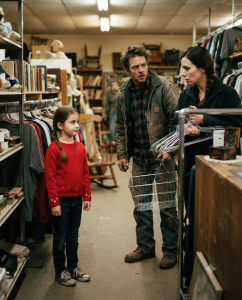
She loved the place instantly. She drifted through the aisles with both hands out, grazing textures, lifting toys, whispering discoveries to herself as though the whole store were a museum of secret lives. Eli watched her pause at a shelf of old board games, then at a basket of scarves, then at a pair of patent leather shoes in a size no child could possibly wear.
He kept close enough to look responsible, far enough to let her enjoy herself.
He was thirty-four and permanently tired. Two years divorced. Working maintenance nights at the middle school. Sleeping in fragments. Smiling on purpose for Nora because children always knew when smiles were rationed. His ex-wife, Dana, lived in another county with a man who owned a boat and said things like “blended family” as if language could soften impact. Dana sent child support late, called unpredictably, and had an astonishing ability to make Eli feel unreasonable for expecting reliability.
Still, he managed. He and Nora had their routines. Pancakes on Sundays if there was enough mix. Library Wednesdays. Hot chocolate on the first cold day of the year. He told himself they were building something sturdy out of whatever hadn’t been taken.
Then Nora found the red sweater.
She reached between two bulky cardigans and pulled it free like she already knew it was there. Red wool, richly colored despite age. Small white embroidered stars at the cuffs. Pearl buttons at the collar and lower hem, except the lower button was missing, leaving a frayed pale thread against the knit.
“This one,” she announced, holding it to her chest.
Eli looked over and chuckled. “That’s not exactly a winter coat.”
“It’s magic red.”
He was about to tease her when a woman came from the back donation room carrying a tagging gun and a cardboard tray of hangers. She moved with the practiced economy of someone who had done too much with too little for too long. Dark hair in a braid. Plain gray sweater. No ring. Tired eyes that looked older than the rest of her.
She took one glance at Nora and stopped.
The shift in her face was so immediate and total that Eli felt it before he understood it.
“Can I help you?” he asked.
Her eyes were fixed on the sweater. “Where did she get that?”
“From the rack,” he said, more sharply than he intended.
“No.” She swallowed. “I mean before now.”
Nora had already pulled it over her head. The collar sat crooked. A strip of her T-shirt showed where the lower button should have closed the sweater properly.
The woman stared at the missing button thread and made a sound like a wound opening.
“My sister died in that sweater,” she said.
The sentence landed so heavily that Eli almost looked around to see if everyone else had heard it. But life in the thrift store carried on. A volunteer chatted with an old man near the dishes. A radio murmured a holiday song from somewhere in the back. A toddler whined by the toy bins. The world had the decency to keep moving even when your own had stalled.
“What are you talking about?” Eli asked.
The woman seemed to gather herself by force. “My sister. Lena. She was twelve. There was a fire in our house when we were kids. They returned some of her things later, but not everything. That sweater was gone. It had a button missing near the bottom because she caught it on the banister the week before.”
Nora touched the collar button as though introducing herself to the sweater. “It’s warm,” she said.
The woman shut her eyes briefly.
Eli studied her. She wasn’t guessing. The missing button was too specific. The way she was looking at the sweater was not performative grief or confusion or the hunger people sometimes had to attach themselves to a story. It was recognition. Instant, intimate, involuntary.
“What was your sister’s name?” he asked.
“Lena Whitmore.”
The name meant nothing to him, which should have made it safer somehow. Instead it deepened the wrongness of the moment. He had no connection to this woman. No way for Nora to know anything. No reason for any of it.
Then Nora looked up and said, “The girl said you’d be mad if I picked blue.”
Eli turned to her. “What girl?”
She pointed toward the books. “The one over there.”
There was no one there. Just crooked shelves of paperbacks, a cardboard display of jigsaw puzzles, and an old wooden rocking chair that sat empty under a hand-lettered sign for children’s reading hour.
The woman’s lips parted. Color left her face so fast Eli thought she might faint.
“My sister hid in the library room when the fire started,” she whispered.
He felt the cold move through him in a clean straight line.
Children said odd things. They imagined invisible friends, repeated scraps of adult conversation, invented connections without understanding them. Eli knew that. He wanted desperately to stay inside that explanation.
But Nora went on, unconcerned by the adults’ silence.
“She said red makes people remember,” Nora said. “Blue makes them pretend.”
The woman gripped the tray of hangers so hard one cracked in her hand.
“My mother used to say that,” she whispered. “At funerals. When people wore pale colors because they couldn’t handle grief.”
Eli’s mouth went dry.
Then Nora smiled — not strangely, just gently — and said, “She said you still keep the music box.”
That did it.
The woman crouched behind the register counter so quickly Eli thought she might be panicking. Instead she reached beneath a shelf and pulled out a dented tin cash box. She lifted the lid and moved aside old tape, receipt rolls, and a bundle of rubber bands until she found a small painted music box with one blackened corner.
It looked as if it had once been white with blue flowers, though smoke had darkened much of the finish.
Nora leaned forward. “That’s it.”
The woman opened it with both hands. The hinge gave reluctantly. A few warped notes spilled into the air, thin and metallic but unmistakably a tune. Eli didn’t know it, but the woman did. He saw it hit her like memory made physical.
Then Nora whispered, “She says you weren’t supposed to believe him.”
The woman almost dropped the box.
“What?” Her voice broke.
Eli moved closer to Nora. He wasn’t sure whether he was shielding her or anchoring himself. “Nora, enough. We’re going.”
But Nora wasn’t playing. That was what frightened him most. She was not excited or theatrical or eager for attention. She looked as calm as she did when describing a picture at the library.
The woman took one unsteady breath. “Please,” she said to Eli, eyes never leaving Nora. “Please ask her what she means.”
He almost refused. Every sensible instinct in him was screaming to leave. He had brought his daughter here for a coat, not for somebody else’s buried trauma. But another part of him — the part that had watched this woman identify a missing button and produce a scorched music box from under the register — knew they had already crossed too far into this to pretend it hadn’t happened.
Nora gazed at the music box. “She says the fire started before the lamp fell.”
The woman swayed against the counter.
For twenty years, Eli would later learn, the Whitmore family had lived with one story. Faulty wiring. A toppled lamp. Old house. Fast flames. Tragedy. Their father, Arthur Whitmore, had survived with smoke inhalation and burns to one arm. He had repeated the same account to police, neighbors, insurance investigators, and eventually his daughters until grief hardened into accepted fact.
But accepted fact and truth were not always neighbors.
“Ask her who,” the woman whispered.
Nora tilted her head, listening to something that wasn’t there for Eli.
Then she said, “She says you already know. You just never wanted to say his name because once you do, everything after changes.”
The woman covered her mouth with her hand. Tears welled and spilled.
“Did she say Dad?” she asked.
Nora’s expression turned solemn. “She says he told everyone the lamp tipped when she ran. But she didn’t run.”
A volunteer at the far register looked over, sensing distress, but the woman — who finally introduced herself as Mara — lifted one hand to indicate she was fine. She wasn’t fine. No one in that radius was fine.
Nora touched the scorched corner of the music box. “She says check inside.”
Mara stared down. “Inside where?”
“The bottom,” Nora said. “Where he never looked because he was in a hurry.”
Mara turned the box over. The velvet on the underside was loose and blackened at one edge. With shaking fingers she peeled it back and found a folded scrap of paper pressed into a hidden recess.
For a second she only stared at it.
Then she unfolded it.
The paper was browned with age and smoke, the fold lines fragile. It took Mara several tries to smooth it open. Eli could see handwriting, childish but careful.
Mara read the first line and made a sound that brought everyone nearby to a standstill.
It was a note from Lena.
Not a diary page. Not a random scribble. A note. Addressed in pencil to Mara.
He says don’t tell. He says it’s our secret because Mom gets too loud when she’s been drinking and he has to scare her sometimes. He burned the curtain with a match to prove he means it. I hid the box because if anything bad happens you have to know I didn’t do it.
Mara’s knees nearly buckled. Eli caught the counter with one hand, ready to catch her with the other if needed. She kept reading, tears falling onto the paper.
There were more lines. Fractured, hurried, written by a girl trying to record something she didn’t know how to survive. Lena wrote that their father had been angry. That there had been shouting downstairs. That he had grabbed the lamp but the flame had already touched the curtain first. That he told her to keep Mara in her room. That she was scared. That if Mara ever found the note, she needed to remember it wasn’t an accident.
The volunteer came closer then, alarmed, but Mara shook her head violently and clutched the note to her chest.
“My God,” she said. “My God.”
Eli looked at Nora. She was no longer speaking. The strange attentiveness had drained from her face, leaving only the soft concern of a little girl watching an adult cry. He crouched beside her.
“Did you know what you were saying?” he asked quietly.
Nora looked confused by the question. “She just wanted her sister to know.”
That answer would haunt him more than anything supernatural ever could.
Mara told him the rest in fragments while the volunteer discreetly locked the front door and switched the sign to Closed. Arthur Whitmore had died three years earlier in a nursing facility two states away. Mara had gone through his things and found nothing but bitterness, unpaid bills, and old photos. Her mother had died before him, taking with her her own version of the fire — one filled with alcohol, shame, and confusion. Mara had always suspected pieces of the official story didn’t fit. Her father had changed details over the years. He had hated being questioned. He had once slapped her hard enough to split her lip when, at sixteen, she asked why Lena’s bedroom door had been found open if she’d supposedly knocked the lamp over while running.
But suspicion was one thing. Proof was another.
The note in the music box was proof.
Mara sat in the chair behind the register like a woman who had aged and unaged at once. At last she asked the practical question that should have come first.
“How did that sweater get here?”
No one knew.
The donation logs were unreliable. Bags arrived anonymously all the time. Church members cleaned out attics. Estates got emptied. Things moved from one house into another into storage and finally into charity bins. Objects drifted. The sweater could have spent twenty years in a cedar chest before being dropped off that morning by someone with no idea what they were handing over.
But to Mara, and increasingly to Eli, coincidence now felt too thin to carry the weight of what had happened.
Mara insisted they not leave yet. Not until she made copies of the note. Not until she wrote down exactly what Nora had said, word for word, while it was fresh. Eli agreed on one condition: Nora would not be questioned like a witness. She was a child. Whatever had happened, whatever channel of memory or mystery had briefly opened, he would not let grown adults turn his daughter into a spectacle.
Mara nodded at once. “Of course.”
She treated Nora afterward with a kind of reverence that made Eli uneasy but not threatened. She found a navy winter coat in the donation room, one still with tags attached, and said the church had plenty of funds to cover it. Eli tried to protest. Mara silenced him with one look.
“Take the coat,” she said softly. “Please. Let me at least do that.”
Nora chose the coat, but when Mara asked whether she wanted the red sweater too, the child shook her head.
“She said you need it more,” Nora replied.
Mara folded over as though struck.
Over the next week, the practical world caught up.
Mara contacted the police department, not because she expected a criminal case — Arthur Whitmore was dead, and the fire was decades old — but because the note constituted newly discovered evidence attached to a historic fatal incident. The department reopened the file for review. Old records were pulled. Photographs reexamined. Statements compared. An aging investigator, now retired, admitted the original conclusion had relied heavily on Arthur’s account and the fire scene’s severe damage.
Mara also contacted a local attorney to settle questions around insurance fraud and property records, since the original claim might have been based on false statements. It would never become the headline-grabbing prosecution people imagine from television. Dead men do not stand trial. But truth still has consequences, even when punishment arrives too late.
Eli tried, for several days, to convince himself that there had to be another explanation. Nora had overheard something. Mara had unconsciously signaled details. The note, while real, might have primed interpretation. Human beings were pattern-making creatures. He knew this. He repeated it to himself while replacing air filters at school and mopping corridors under strip lights at midnight.
Then, on the third night after the thrift store, Nora asked from the back seat on the drive home, “Do you think Lena’s still scared?”
His hands tightened on the steering wheel. “Do you remember what happened at the store?”
“Some of it.”
“What do you remember?”
She thought for a long moment. “Mostly that she didn’t want her sister to keep calling it an accident if it wasn’t.”
“Did you see her?”
Nora looked out the window at the dark storefronts passing by. “Not like in cartoons. More like when you know someone is standing in a room before you look.”
He had no answer to that.
Mara came by the apartment the following Sunday with photocopies of the note, a bakery box of pastries Nora immediately adored, and a careful gratitude that never became intrusive. She told Eli the police believed the handwriting on the note matched samples from Lena’s school papers Mara had kept. The scorch pattern on the music box was consistent with prolonged heat exposure, and the hidden compartment explained why the note had survived.
She also brought something else: an old photograph.
In it, two girls stood on a porch in winter coats. Mara, around nine, was missing one front tooth. Lena, older and serious, wore the red sweater. One lower pearl button was gone.
Eli stared at the picture a long time.
Nora touched the edge of it with one finger. “That’s her.”
Mara’s eyes filled, but this time she smiled through it. “Yes,” she said. “That’s her.”
They talked for nearly two hours. About grief. About memory. About whether the dead lingered when the living left things unfinished. About how many truths families bury simply because naming them would require rearranging every story that came after.
Mara confessed she had spent years defending her father in subtle ways. Not publicly, not with conviction, but enough. Enough to spare herself the pain of imagining she had grown up with a man capable of terrifying one daughter and sacrificing another to save himself. The note shattered that mercy.
“I keep thinking,” she said quietly, “that she hid proof for me when she was twelve. Twelve. And I lived all these years letting his version sit there because it was easier than questioning the dead.”
“No,” Eli said. “Because sometimes children survive by believing what the adults tell them.”
Mara looked at him with something like relief. “You’re kind.”
“No,” he said, and surprised himself with the honesty of it. “Just tired.”
That made her laugh, briefly and painfully.
When she left, she asked if Nora wanted anything from the store set aside in the future. A toy, books, another sweater.
Nora shook her head. “I’m okay now.”
Mara understood. She hugged her once, gently, and thanked her in a whisper that sounded too private for Eli to hear.
In the months that followed, the official findings were updated. Not in a dramatic courtroom scene, not with television cameras or a grand reckoning, but on paper — the place where so much truth lives or dies. The old fire was reclassified as suspicious with credible evidence contradicting the original accidental cause. Arthur Whitmore’s statement was noted as inconsistent with later-discovered material. Lena’s death, while never legally avenged, was no longer filed under a lie.
Mara framed a copy of Lena’s note and kept the original sealed in archival plastic. The red sweater never returned to the sales floor. She stored it with the music box and the photograph in a cedar chest in her home.
Eli and Nora still went by the thrift store sometimes. Less out of need as winter eased, more because Mara had become part of the shape of their lives. She found good books for Nora and once slipped a pair of gloves into their bag without charging them. Eli always noticed. He never always objected.
As for Nora, she never again spoke for Lena.
Whatever had happened that day happened once, with the clean purpose of a message delivered. When Eli later asked whether she missed “the girl from the store,” Nora answered, “I think she’s not trying so hard anymore.”
That was all.
Spring eventually arrived. The radiator stopped mattering. Eli found steadier work with better hours at a property management company. It wasn’t a miracle. Money was still tight. Dana was still Dana. Life remained stubbornly ordinary in all the ways that count. But some tension in him had eased. Perhaps because after seeing the impossible, ordinary hardship had lost a little of its power to terrify him.
One evening, while hanging Nora’s coat by the door, he found himself thinking about how close he had come to not taking her into that thrift store at all. He had nearly turned back when the wind bit through her sleeves. He had almost said they’d wait until payday. He had nearly chosen practicality over embarrassment and embarrassment over timing and timing over fate.
A single errand had uncovered twenty years of buried truth.
That was the part he still couldn’t fit inside reason.
Mara said once that she no longer cared whether people believed the supernatural side of the story. The note existed. The lies existed. The reclassified report existed. That was enough. Maybe she was right.
Still, Eli sometimes thought about the precision of it all. The missing button noticed at a glance. The words only a sister would recognize. The hidden compartment no one had found in twenty years. A child in a dead girl’s sweater saying, with complete calm, exactly what needed saying.
Maybe coincidence can do astonishing things.
Or maybe some truths refuse to stay buried, and sometimes they borrow the smallest, gentlest voice in the room because adults have spent too long ignoring the louder ones.
Eli never settled that question.
But he knew this: a little girl had needed a winter coat, and instead she carried someone’s last chance back into the light.
And depending on how a person chose to tell the story, the most unsettling part was not that the dead might speak.
It was that the living so often need them to.