The lawyer called on a Wednesday morning and used the kind of voice people reserve for bad news they hope sounds tidy.
“Nora, I’m very sorry for your loss.”
I thanked him automatically, still half asleep, still staring at the light moving across my apartment ceiling. My mother had been dead for four days. The casseroles had stopped arriving at my aunt’s house. The funeral flowers were already browning. I thought this call would be about paperwork, signatures, practical things.
Instead he said, “There’s one detail in the will you should be aware of before we meet.”
I sat up.
“The family property on Maple Lane has been left to Evelyn Hart.”
I frowned. “I don’t know an Evelyn Hart.”
There was a pause, gentle and terrible.
“She is listed as Elise Hart’s biological daughter.”
For one ridiculous second, I thought he had mixed up my file with somebody else’s. Then he started explaining, carefully, that the will was valid, recently amended, properly witnessed, unlikely to be overturned. He talked about the house, the condition it was in, the closing timeline, the possibility that “all parties” could remain civil during the transition.
All parties.
That was when I understood. My mother had not simply died with a secret. She had arranged for it to outlive her.
By the time I reached the lawyer’s office, I had already gone through rage, disbelief, and the strange numbness that comes when something is so deeply insulting it almost becomes abstract. I kept waiting for the facts to rearrange themselves into something more ordinary.
They did not.
The will named Evelyn Hart, age thirty-two, biological daughter of Elise Hart, sole beneficiary of the Maple Lane property. I was left a small cash amount so modest it felt less like inheritance and more like postage. A polite legal acknowledgment that I existed.
I read the name again and again, trying to place it. Cousin? Mistake? Fraud? Secret adoption? But the math formed faster than my emotions did. I was thirty-six. Evelyn was thirty-two. Younger half-sister.
My mother had another daughter.
Not after I left home. Not after my father died. Not during some period of separation no one mentioned. Evelyn had existed while I was still a child.
“You may retrieve your personal effects before the new owner begins renovation,” the lawyer said, avoiding my eyes. “Ms. Hart has authorized one week of access.”
Ms. Hart.
I almost laughed.
The last time I had stood in my mother’s house, I was nineteen, home from St. Agnes for a holiday visit that lasted forty minutes. My bedroom had been turned into a sewing room. My posters were gone. Half my books had disappeared. My mother had stood in the doorway with her hands clasped and told me, in that composed voice of hers, that some distances were better for everyone.
When I asked why she had sent me away in the first place, she said the same thing she always said.
“Nora, you were not well.”
I had spent years trying to decide whether that was a lie she told me or a lie she had told herself.
The house looked smaller when I returned after the funeral. The white paint had grayed. The porch sagged. Ivy clawed its way up one side of the brick chimney. But the front door still stuck in damp weather, and the foyer still smelled like lemon oil, dust, and old steam heat.
I stood in the kitchen first because I didn’t know where else to begin.
That was where my mother used to mark my height every birthday. Same doorway. Same pencil. Same ritual. I’d stand barefoot against the trim and try to stretch taller without lifting my heels. She would tap my head lightly and say, “Don’t cheat.”
The marks were still there.
NORA — 7
NORA — 8
NORA — 9 1/4
My chest tightened. It was the closest thing to tenderness I had found in that house in years. I traced the age-eight line with my fingertip and remembered insisting on writing my own name that year. I had made the N wrong the first time. I cried. My mother laughed and let me do it again.
Then I saw a lower line almost buried under newer paint.
NORA — 12
October 14
I stopped breathing.
I had been sent to St. Agnes in July.
I knew the month because I remembered the heat trapped inside the car, my suitcase sticking to my knees, my mother refusing to look at me when the gates opened. I remembered counting forward obsessively after that. Birthdays. Holidays. The date on every letter I wrote and most of the letters she never answered.
October 14 was three months later.
The handwriting on the kitchen frame was not adult handwriting. It was not my mother’s slanted script. It was mine—childish block printing pressed too hard into wood. The four leaned left. The R had the same stubby leg it always had.
I took a picture. Then another.
For an hour I told myself there had to be a reasonable explanation. Memory was unreliable. Dates blurred. Perhaps I had written it earlier and recalled it wrong. Perhaps my mother copied my style. Perhaps grief was doing something to my brain that grief does to many brains, making coincidence look deliberate.
Then I found another mark beneath loose wallpaper in the dining room.
NORA — 10
June 3
It floated in the middle of the wall with no doorframe around it, no trim, no reason to exist.
I peeled farther.
More pencil lines appeared under the paper and plaster, some straight, some slanting, all trapped inside the wall as if written on raw boards before the house was sealed up. I found two by the parlor fireplace. One inside the upstairs linen closet. Several in a narrow space behind bathroom pipes. Each one in my childhood hand.
By late afternoon the house no longer felt like an old building full of damage. It felt like evidence.
As a child, I had insisted there was another side to the house.
Not exactly another room. More like a hidden layer. I heard footsteps that didn’t belong to my mother. I heard giggling through the vent beside my bed. Once during a renovation I pressed my face against exposed studs and heard a little girl whisper, “Do it here.”
I scratched my name into the bare wood. There was a scratching sound back from the other side, as if someone else were writing too.
When I told my mother, she went so pale I thought she might faint. When I told a school counselor, all hell broke loose. Words like fantasy and disturbance and fixation began to orbit my life. Within weeks I was at St. Agnes, a place with locked medicine cabinets and staff who wrote things down while you cried.
Every time I repeated the truth as I knew it—there was another child in that house—someone translated it into illness.
By six o’clock I had stopped packing boxes and started hunting. I scraped wallpaper. I tapped walls. I followed odd seams in the hall. I found a section beside the staircase that answered hollow when I knocked.
The demolition foreman came by that evening to confirm his crew’s start time. I told him no one was cutting into anything until I said so. He took one look at the exposed pencil marks and frowned.
“Were there kids in the walls?” he asked, trying for a joke and not quite landing it.
I said, “Maybe.”
That night, a woman called from an unrecognized number.
“This is Evelyn,” she said.
Her voice was low, cautious, nothing like the triumphant thief I had imagined. She said she’d heard I was at Maple Lane. She said our mother had instructed her not to contact me before the funeral. I asked how old she was.
“Thirty-two.”
The answer settled in my bones like ice water.
“You existed while I was living there,” I said.
Silence.
Then: “Yes.”
After I hung up, I took a box cutter to the hallway wallpaper. That corridor had always terrified me as a child. The walls there were too thick. The sound carried strangely. If someone walked behind one end, it often seemed to answer from the other.
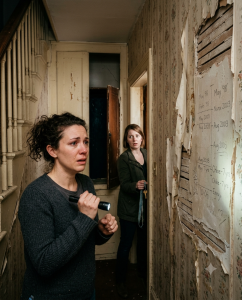
I cut strip after strip, paper tearing in long dry curls. Underneath I found more of my own writing. Heights. Dates. Small arrows. A penciled star. My name repeated like a breadcrumb trail.
At the very end of the hall, under the last strip near the stairs, I found different writing.
My mother’s.
Two words.
She stayed.
I heard the front door open downstairs a minute later.
Evelyn came up slowly, as if she remembered the house in the dark. She was taller than I expected, with my mother’s mouth and somebody else’s gray eyes. She looked at the ripped paper, the exposed wood, the words on the wall.
Her face drained of color.
“She wrote that for you,” Evelyn said.
“For me to find after she died?” I asked.
“For when the walls came down.”
I should have hated her. I had spent the drive over hating the outline of her, the legal fact of her, the way her existence had been used to push mine aside. But the woman standing in my hallway looked frightened, not victorious.
“Who stayed?” I asked.
Evelyn swallowed. “Me.”
The word struck harder than any accusation.
She reached into her coat pocket and pulled out a brass key hanging on a frayed blue ribbon. Then she went to the built-in linen cabinet at the end of the hall, pressed her thumb under the lowest shelf, and something clicked inside the wall.
A panel opened inward.
Cold stale air flowed out.
Behind it was a narrow hidden passage running between the hallway and the back bedrooms. It was barely wide enough for a child to stand sideways. Shelves were built into one section. There was an old mattress folded at the far end, a lamp, a vent cover, children’s books gone soft with damp. Pencil marks lined a hidden jamb inside the passage at different heights, some in my hand, some in another childish imitation of it.
I gripped the frame to stay upright.
“You lived here,” I said.
Evelyn nodded once. “For years.”
The story came out slowly after that, not because she wanted to hurt me, but because some truths resist being spoken in ordinary tones.
Our legal father, Malcolm Hart, was mine. He was not Evelyn’s. By the time my mother became pregnant again, Malcolm had already turned hard in the way charming men sometimes do when they realize everyone around them depends on their version of events. Divorce would have ruined her financially. Public scandal would have ruined her socially. And when Evelyn was born with a heart defect, needing quiet, medication, and frequent supervision, my mother panicked.
She told the world the baby had died.
A midwife was paid. Records were altered. Malcolm, furious about the affair but unwilling to endure the shame of exposure, agreed to a monstrous compromise: the child could remain in the house only if no one outside a tiny circle ever knew she existed. Hidden. Temporary, he said. Until arrangements could be made.
Temporary became years.
The house on Maple Lane had once belonged to Malcolm’s aunt and still contained old service passages from an even earlier era. My mother sealed some, widened others, and turned one stretch behind the hallway into a concealed living space. A private nurse came at odd hours under the pretense of tending to my mother’s “migraines.” Groceries disappeared. Medicine was hidden. A child grew in the dark margin of our home.
And I found her.
Not fully at first. I heard her. I played knocking games through the walls. During repairs I saw a small hand slip through a gap in the studs. I scratched my name into wood. She copied it back. We marked our heights where the hidden frame met the passage wall because, in a child’s logic, that made us sisters long before either of us understood the word.
“Did she tell you who I was?” I asked.
“She told me you were my sister,” Evelyn said. “She also told me never to say it where he could hear.”
The night everything changed, I had told a teacher there was a girl living in my house. The teacher told the school counselor. The counselor called home.
Malcolm acted first.
He had me evaluated. Frightened children are easy to discredit if you call their memories fantasies and their certainty instability. St. Agnes took girls with “adjustment difficulties.” Money smoothed the rest. My mother protested, Evelyn said, but not enough to stop it. Perhaps she couldn’t. Perhaps she didn’t know how. Perhaps by then she was so deep inside survival that she could only choose which child remained visible and which one vanished.
“When you were gone,” Evelyn said quietly, “she still marked the walls. She’d read your height from the numbers in your letters, from your medical forms, from the hems she let down in the clothes you outgrew when you visited. She said if the house ever opened, you deserved to know you were remembered.”
That explained the October date on the kitchen frame. It did not excuse it. But it explained it.
“Why leave you the house?” I asked.
Evelyn’s eyes flicked toward the passage. “Because everything proving I existed is in here. And because she thought you’d burn it down.”
She wasn’t wrong.
Inside the hidden passage was a cedar box with my name on it and an envelope addressed to both of us. We carried them into the kitchen like contraband.
My mother’s letter was six pages long.
She confessed the affair, Malcolm’s bargain, the false stillbirth, the hidden years. She admitted that sending me away was the greatest cowardice of her life. She said she told herself it was temporary, that once Malcolm died she would bring me home and tell the truth. But shame calcified. Time passed. I came back older, colder, impossible to approach without reopening everything she had done. So she chose silence again and again until silence became the structure of the family more than brick or wood.
She left the house to Evelyn because the hidden rooms and the documents in them were the only proof of Evelyn’s legal identity before later corrections. There were amended birth records, medical files, a notarized statement from the midwife, letters from a private physician, even photographs of Evelyn at different ages inside those narrow rooms. There was also a second packet my mother had never filed with the lawyer: a transfer deed splitting the sale proceeds equally between us once Evelyn’s claim was secured.
She had not trusted herself to say any of it aloud.
So she hid it in the walls.
I expected fury when I finished reading. I got something messier. Grief, certainly. Rage, yes. But also the disorienting ache of realizing my mother had loved both of us in ways too damaged to save either of us cleanly.
Evelyn sat across from me with her hands folded around a mug she never drank from. She told me she had envied me my whole life—my school photos, my public birthdays, the fact that neighbors knew my name. I told her I had envied a ghost I thought I invented less than I envied the children who got to stay home.
Near midnight we went back into the hidden passage with a crowbar and the foreman’s flashlight. Behind a false board near the far end, we found one final row of marks. Two names this time.
NORA — 11
EVE — 7
Then below it, in my mother’s hand: Sisters.
The next weeks were ugly in practical ways. Lawyers had to be corrected. Records had to be reopened. Family friends who had called my mother noble discovered she had built a second life inside her own walls. Some relatives defended her. Some condemned her. Malcolm, being dead, escaped the worst of what he deserved.
Evelyn canceled the demolition.
Together we sold the property to a preservation buyer who agreed to keep the original hallway intact. The proceeds were split according to the unsigned deed and a settlement no one had the appetite to challenge after the documents surfaced. I do not know whether that was justice. It was, at least, a refusal to let the lie finish what it started.
Months later, Evelyn invited me to a small apartment full of plants and open windows and shelves placed proudly in the sunlight. On one wall she had framed a photograph of the old kitchen doorframe before restoration. Our pencil lines were still visible beneath the stripped paint.
“Do you think she loved us?” Evelyn asked.
I looked at the picture for a long time.
“Yes,” I said finally. “I think she loved us badly.”
That was the hardest truth. Not that our mother had hidden a child. Not that she had let one daughter be called unstable to protect another. But that love, when mixed with fear and shame and cowardice, can become almost unrecognizable to the people who needed it most.
Sometimes I still think about those words in the hallway.
She stayed.
For years, I thought they were about the child hidden in the walls.
Now I think they were about something else too. About the part of me my mother could not entirely erase, no matter how many files were altered or rooms repurposed or stories rewritten. It stayed in the wood. In the pencil grooves. In the pressure of a backward N corrected by a stubborn little hand.
The house was built to keep secrets. In the end, it failed because children had written the truth down where adults forgot to look.
And when I wonder who was more wrong—my mother for hiding, Malcolm for forcing, or the rest of the family for not seeing—I always come back to the same detail: a child asked to be believed, and everyone chose the version that was easier to live with.
That was the real red flag.
Not the noises in the walls.
The silence after.