When Darlene Mutter walked into the Pinehurst Lodge for the first time in twenty-two years, she did not look like a woman arriving for revenge.
She looked composed.
That was the part nobody in the lobby understood at first.
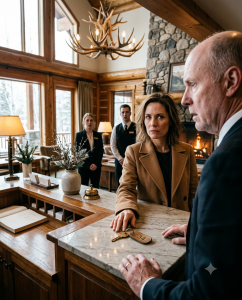
She came through the front doors in a camel coat, her dark hair pinned neatly back, a leather folder tucked under one arm. She paused only long enough to take in the room she had not seen since the worst day of her life. The antler chandelier still hung over the center of the lobby. The stone fireplace still threw soft heat across the polished floors. The same grandfather clock still stood near the far wall, its brass pendulum swinging with an arrogant steadiness that made the years between then and now feel both impossible and very small.
The Pinehurst Lodge had changed its rugs, its paint colors, its branding, even its logo. It had not changed its smell.
Cedar polish. Fireplace ash. expensive hand soap. And underneath it all, the strange stale perfume of old money and older secrets.
Behind the front desk stood Gary Fenwick.
For one absurd second, Darlene felt as if time had split open under her feet.
He had aged, of course. The black hair she remembered had receded and gone silver at the temples. His face had softened, his waist thickened. But his posture was the same: straight-backed, hands folded, smile professional and bloodless. The sort of smile that reassured paying guests and warned employees to stay in line.
He looked at her with polite indifference.
“Welcome to Pinehurst Lodge,” he said. “Do you have a reservation?”
Darlene almost smiled.
Not because it was funny.
Because after everything he had taken from her, the man did not even remember her face.
She stepped up to the counter. “No reservation.”
His smile did not move. “May I help you with something?”
“Yes,” she said. “My name is Darlene Mutter.”
The change in him came in stages.
Confusion first. Then attention. Then the smallest shift in his eyes, like a door cracking open somewhere in the back of his mind. By the time recognition landed, she saw it hit him physically. A stillness spread through him, too deliberate to be calm.
“Mrs. Mutter,” he said.
“Ms. Mutter,” she replied. “And as of this morning, owner.”
She placed the leather folder on the counter and turned it toward him. On top sat the title transfer documents for Pinehurst Lodge Holdings, signed, stamped, and completed at 8:17 a.m.
Gary did not touch the pages right away. His fingers hovered over them as if proximity alone might burn.
Around them, the lobby continued its soft morning movements. A bellman crossed near the door. Two housekeepers wheeled a linen cart toward the service hallway. A young woman from accounting stepped out of the office carrying a clipboard, saw Gary’s face, and stopped dead.
The room had begun to notice.
Gary lowered his voice. “I’m sure there has been some confusion.”
“There hasn’t,” Darlene said.
He picked up the top page, read enough to understand he was not looking at a prank, and set it down again. “This change in ownership was not communicated to management.”
“I’ve noticed communication was never this place’s strongest skill.”
The line landed. His jaw tightened.
“If you’d like,” he said, with a careful smile that convinced no one, “we can discuss this in private.”
The words struck her like an echo from another life.
Private.
Now he wanted private.
Twenty-two years ago he had denied her that mercy.
She remembered every second of that day with a cruel clarity. She had been twenty-nine, a widow for less than three years, raising her son Ben alone. She worked six days a week at Pinehurst because rent did not care about grief. The housekeeping job was not glamorous, but she was good at it. She was quick. She was reliable. She knew how to make a room look untouched by the people who had just lived inside it. She knew how to leave no trace.
And then one morning, just before lunch, Gary had called her into the lobby.
Not the office.
The lobby.
She could still feel it: the way her shoes squeaked faintly on the polished floor, the way conversation dropped when staff realized she was the one being summoned, the way a honeymoon couple standing by the brochure rack pretended not to stare while staring harder than anyone.
Gary had stood behind the desk then too. Calm. Ordered. Almost bored.
He told her a guest in the owner’s suite had reported a gold bracelet missing after checkout. He asked whether there was “anything she wanted to hand over before this got uglier.”
She had felt the blood rush to her face. “I didn’t take anything.”
He nodded as if she had said something expected and disappointing.
“The room was serviced by you,” he said.
“Yes. Along with every room on that floor.”
“The item disappeared during your shift.”
“I didn’t take it.”
He never raised his voice. He never needed to. The humiliation was cleaner that way. He spoke like a man stating a weather report while her entire life cracked open in public.
When she denied it again, he dismissed her on the spot for violating lodge policy. He said Pinehurst had a reputation to protect. He said he was choosing not to involve the police and advised her to be grateful. Then he signaled to security.
She had been escorted out in her housekeeping apron while everyone watched.
Nobody stopped it.
Nobody asked if she was all right.
That was the part that hurt almost as much as the accusation. Not just the loss of the job. The silence. The ease with which everyone accepted that a tired widow in a housekeeping uniform was the obvious answer.
She went home that afternoon and found her son sitting cross-legged on the living room floor, building a fort from couch cushions. Ben had been eight. He looked up and said, “Why are you home early?”
She had no good answer.
She remembered standing there with one hand on the wall because the room had started to tilt. She remembered saying, “I’m just tired, baby.” She remembered her sister later that night telling her not to make trouble with men like Gary Fenwick because places like Pinehurst always protected their own.
And she remembered the object still sitting in her apron pocket.
A brass room key attached to a worn leather fob.
She had found it that same morning in the owner’s suite.
At the time, it had seemed odd but not alarming. The room had already looked wrong when she entered. One drawer was slightly open. A lamp near the fireplace sat crooked. A whisky glass rested on the writing desk though she had been told the guest checked out before sunrise. Darlene had noticed these things because noticing things was half her job.
Then, while making the bed, she saw something glint near the edge of the carpet.
She crouched, reached beneath the dust ruffle, and pulled out the brass key.
It was heavier than the standard guest keys, older too. Not part of the main room set, not marked like the others. Private. Important. She had slipped it into her apron pocket to turn in after finishing the floor.
Then Gary had accused her before she could say a word about anything.
In the chaos that followed, the key stayed with her.
At first she kept it because she was too shaken to think straight. Then because returning to the lodge felt impossible. Then because the longer she held it, the more convinced she became that it mattered.
Not because it opened a room.
Because it proved something had been off in that suite before anyone ever called her a thief.
The days after her firing were worse than the firing itself. Pinehurst was the largest employer in that town. Hospitality people talked. Soon she could not get steady work anywhere nearby. Nobody said why. They simply chose someone else. She cleaned private homes for cash. She worked late shifts at a diner. She patched together babysitting and laundry service and whatever else came her way. There were months she went without new shoes so Ben wouldn’t have to.
But she did not break.
Years passed. Ben grew. Darlene learned how to turn endurance into discipline. She started a tiny cleaning business with two borrowed vacuums, a stack of handwritten flyers, and an old hatchback that coughed every winter. She worked harder than she had at Pinehurst because this time nobody was going to hand her dignity. She was going to build it herself.
Her company grew from two clients to twenty, then fifty. She hired women who had been ignored, talked down to, pushed aside. Divorcees. Single mothers. Women too old, according to everyone else. Women fresh out of bad luck and bad marriages and bad managers. She paid them on time, promoted them when they were ready, and insisted customers learn their names.
Twelve years later, she sold that company at a number that would have stunned the woman who once counted coins for groceries at the kitchen table.
Then she invested.
Not recklessly. Carefully. Patiently. In rental properties first, then a laundromat, then a catering supply business with a woman she trusted. She had no interest in proving anything to Pinehurst at first. She simply wanted a life that nobody could snatch out from under her with a false smile and a public accusation.
But Pinehurst stayed with her.
She carried the brass key in her coat pocket almost every day. Sometimes it sat there like a private superstition. Sometimes like a stone. Sometimes, on her worst nights, she would take it out and turn it over under the lamp, rubbing her thumb across the worn leather fob and asking the same question she had asked for years.
Why had Gary looked so ready?
A missing bracelet could have been anything. Misplaced. Left in a purse. Packed by mistake. Hidden by a spouse. Yet he had moved with absolute confidence, as if the theft accusation was less a discovery than a decision.
That thought never left her.
Then, a year earlier, she learned Pinehurst’s ownership group was in trouble. Declining bookings. Deferred maintenance. Quiet debt. There were rumors the property would be sold. Darlene heard them through a banker she knew, then through a local attorney, then through a hospitality consultant looking for buyers.
At first she laughed at the idea.
Then she stopped laughing.
She toured the financials twice. Walked the grounds anonymously once. Slept on the decision for three nights. On the fourth morning, she told her lawyer to make an offer.
When the sale finally closed, she drove to the lodge alone.
Now, standing in the lobby with Gary across from her, she felt the full shape of twenty-two years compress into a single clear moment.
“What exactly is it you want?” he asked.
People always asked that when the person they had hurt came back stronger.
What do you want? Revenge? An apology? Public humiliation?
Darlene looked at him and realized the answer had not changed in all those years.
“The truth,” she said.
He held her gaze. “About what?”
She slipped one hand into the pocket of her coat.
That was the second everything changed.
He noticed the motion instantly. His expression sharpened. His eyes dropped to her hand as she drew it back out, closed around something small. When she opened her fingers and let the brass key rest on the marble counter between them, the sound it made was very soft.
Gary reacted like she had placed a live wire in front of him.
Every trace of color drained from his face.
Darlene felt a cold certainty settle in her chest. He knew it. Not vaguely. Not as an old object from storage. He knew it in the deep, involuntary way the body knows danger before the mind can lie about it.
She said, “I believe this still opens the owner’s suite.”
He stared at the key.
“And as of this morning,” she added, “that suite is mine.”
His mouth opened.
Before a word came out, the door behind the front desk swung wide.
A woman stepped into the lobby.
Darlene knew her face, though time had redrawn it. Evelyn Cross. The old bookkeeper.
Back then Evelyn had been one of those quiet fixtures nobody noticed until they were gone. She lived in the back office with ledgers and invoices and little wire-rimmed glasses that always slid down her nose. Three days after Darlene’s firing, Evelyn had disappeared from Pinehurst. People in town said she’d had some kind of breakdown and moved away.
The woman who entered now looked many things. Fragile was not one of them.
She was thinner than Darlene remembered, older of course, one hand braced briefly against the doorframe as though she had moved too quickly. But when her eyes landed on the key, then on Gary, something fierce flashed across her face.
“Don’t,” Evelyn said.
Gary’s shoulders locked. “You shouldn’t be out here.”
That told Darlene more than either of them intended.
Evelyn ignored him and looked directly at Darlene. “You kept it.”
Darlene nodded once. “Yes.”
Evelyn gave a breathless, disbelieving laugh. “My God.”
“What is it?” Darlene asked. “What is this key?”
Gary came around the desk too fast. “This discussion is over.”
“No,” Evelyn said, louder. “It should have happened twenty-two years ago.”
The younger employees had stopped pretending not to listen. The accountant stood frozen near the office door. A valet had set a suitcase down and forgotten it. Somewhere beyond the dining room, someone dropped a tray.
Darlene did not move her eyes from Evelyn. “Tell me.”
Evelyn’s gaze flicked to Gary, and when she spoke, her voice trembled with anger that had clearly outlived fear.
“The bracelet was never the real problem,” she said. “You were.”
Darlene felt a flash of heat rise up her spine. “Why?”
“Because you entered that suite before they were ready.”
They.
Not he.
They.
The word landed heavily.
Evelyn swallowed. “The key was never supposed to be left behind. It belongs to the inner study attached to the owner’s suite. Private records were kept there once. Contracts, letters, cash, things no one wanted in the office safe. The old owner used it. After he died, almost nobody had access. Then that morning, the room had visitors before dawn.”
Gary snapped, “Enough.”
Evelyn turned on him with a fury that transformed her. “You had enough years.”
Darlene’s pulse thundered in her ears. “Visitors?”
Evelyn looked back at her. “One of them wasn’t supposed to be there. You found the room before Gary could clean up what had happened and before I could fix the books to match the story they wanted.”
Darlene stared. “What story?”
Evelyn’s eyes filled, but she did not look away. “That a bracelet was missing. That the guest was upset. That you had motive and opportunity. That everything else about that morning was perfectly normal.”
Nothing in the room seemed solid anymore. Darlene heard herself ask, “Who was in the suite?”
Evelyn’s lips parted, but Gary stepped between them.
“That’s enough,” he said, and now the polished manager voice was gone. In its place was something raw and dangerous. “This is private business. Staff back to work. Now.”
Nobody moved.
Darlene had spent twenty-two years imagining what this confrontation might feel like. In those fantasies Gary would deny everything with that same cold certainty. Or he would panic. Or he would crumble. What she had never imagined was this: that the silence around her would finally crack because another witness had gotten tired of carrying it.
She reached for the key.
Gary’s hand shot out first.
He did not grab her wrist. He grabbed the key.
For one second both of them held it, the worn leather fob stretched between their hands like a fraying nerve.
“Let go,” Darlene said quietly.
He did not.
That was when a new voice spoke from the staircase balcony above the lobby.
“She should hear it all.”
Every head turned.
An elderly man stood at the top landing, one hand resting on the banister.
Darlene recognized him after only a beat. Theodore Vale, the younger brother of Pinehurst’s late former owner. He had disappeared from public life years ago after a stroke, or so the town believed. Yet here he was, dressed in a dark robe and leaning on a cane, pale but very much alive.
Gary let go of the key as if it had burned him.
Theodore descended slowly while the entire lobby watched. By the time he reached the floor, even Gary looked less like a manager and more like a man trapped inside a room that had just lost all its exits.
Theodore stopped a few feet from Darlene. “I hoped,” he said, voice rough with age, “that this day would never come.”
Darlene closed her hand around the key. “I didn’t.”
His face tightened with something like shame. “No. I suppose you wouldn’t.”
Evelyn stepped closer. “Tell her.”
He looked at Gary first. Then at the staff. Then finally at Darlene.
“The bracelet did exist,” he said. “But it was not stolen by you. It belonged to a woman who was in the suite that morning with my brother’s son.”
Darlene frowned. “There was no son.”
“There was,” Theodore said. “Just not one the family acknowledged publicly.”
The room seemed to inhale.
Theodore continued. “My nephew had debts. Gambling. Business losses. He had started taking money and records from the inner study, intending to sell information tied to the lodge and other properties. The woman with him that morning was helping him. They argued. Something was broken. In the rush to leave, the study key was dropped. Gary found out before the board did. Evelyn found the ledger discrepancies. If the truth came out, the family name would be dragged through the mud, the lodge might collapse, and certain very powerful men would be implicated.”
Darlene looked at Gary. “So you framed me.”
He did not answer.
Evelyn did. “He was told to make the problem disappear. Fast. Quietly. Publicly enough to make the story stick.”
Gary’s face had gone gray. “I protected this place.”
“You protected yourself,” Evelyn said.
Theodore closed his eyes for a moment as if the effort of standing inside the truth was exhausting him. “I learned what had happened after the fact. By then you were already gone. I should have corrected it. I did not. I convinced myself that reopening it would ruin everyone. That it was too late. That no one would believe it anyway.”
Darlene thought of every month she had scraped through, every interview that ended politely, every time she had watched her son go without and told herself not to cry in front of him.
“Too late?” she said. “You decided that for me.”
He bowed his head.
Gary finally spoke, but the voice that came out no longer sounded like authority. It sounded like a man hearing his own excuse rot as he said it. “You don’t understand the pressure. The owners wanted it contained. There were investors, guests, legal exposure—”
“And so the housekeeper did what?” Darlene asked. “Conveniently became disposable?”
He had no answer.
The silence that followed belonged to her.
She could have shouted. She could have thrown the key in his face. She could have dragged every ugly detail into the street before lunch.
Instead she stood very still and let him feel the full weight of being seen.
Then she turned to the accountant near the office door. “Please call legal counsel and the board liaison. Also HR.”
The young woman blinked. “Right now?”
“Right now.”
She turned to the rest of the staff. “I own this property. Which means what happens next will be documented properly, not buried. No one is losing their job today for standing here. But anyone who alters records, destroys documents, or removes files from this building will be terminated and referred to law enforcement.”
Gary took half a step forward. “You can’t—”
She looked at him.
It was enough.
The staff scattered into motion, not from panic but from the sudden release of years of tension they did not know they had been breathing. The accountant hurried toward the office phone. The valet vanished to lock the side entrance. Someone from security appeared in the hallway, visibly confused.
Evelyn swayed, and Darlene caught her elbow.
“Sit down,” Darlene said.
Evelyn gave a faint, exhausted smile. “I’ve waited twenty-two years to stand in this exact spot while he stopped being untouchable. Let me enjoy one more minute.”
Despite everything, Darlene nearly laughed.
By sunset, attorneys had arrived. Records from the old accounts room were sealed. Theodore signed a statement. Evelyn gave another. Several archived insurance files contradicted the official incident summary from Darlene’s firing. The guest bracelet report itself turned out to have been logged after Darlene was already escorted out, not before.
Gary resigned before midnight.
Three months later, after formal investigation and a very public civil settlement, Pinehurst issued a written apology to Darlene Mutter. It ran in the local paper, on the lodge website, and in framed form in the employee corridor near the service entrance where staff came in every morning. Darlene insisted on that last part.
Not for vanity.
For memory.
She did not stay on as day-to-day owner forever. She hired better managers. Honest ones. She renovated the old owner’s suite and opened the sealed inner study for the first time in decades. Inside were dusty ledgers, rotted folders, and one cracked whisky glass wrapped in a towel and forgotten behind a false back panel, an absurd little relic of a morning that had altered an entire life.
She kept the brass key.
Not because the room still needed locking.
Because some objects stop being tools and become witnesses.
One crisp autumn afternoon, her son Ben — now grown, broad-shouldered, kinder than the world had any right to let him be — stood beside her in the lobby while guests checked in beneath the chandelier. He looked around at the restored woodwork, the smiling staff, the warmth of the place, and said, “You really bought the place that broke you.”
Darlene watched a young housekeeper laugh with the front desk clerk over a misplaced luggage cart. Nobody lowered their eyes when management walked by. Nobody looked afraid.
“No,” she said softly. “I bought the place that thought it could.”
Ben smiled at that, but after a moment he asked the question that lingered under everything. “Do you forgive them?”
Darlene turned the key in her palm, feeling the worn leather, the softened brass.
Forgiveness, she had learned, was not a door that swung open because someone finally admitted what they had done. It was not owed to silence just because silence had ended. Some people deserved peace. Some deserved consequences. Sometimes the same person deserved both at different times.
She looked across the lobby to the front desk where Gary once stood as if he owned every breath in the room, and she thought about power, and shame, and how quickly a lie can become somebody else’s history if enough people decide convenience matters more than truth.
Then she slipped the key back into her pocket.
“I think,” she said, “the biggest red flag is anyone who needs an innocent person to pay for their panic.”
And as the fire crackled, the clock swung, and the lodge carried on under different hands at last, that answer felt less like revenge than something far rarer.
It felt like the truth arriving late, but still arriving.