By the time Diane Whitmore arrived in Chattanooga, her sister had already buried her without ever touching a shovel.
The death existed only on paper, but paper was enough.
A judge had signed the declaration. A probate attorney had filed the estate settlement. A bank had closed accounts in Diane’s name. Their mother’s property had changed hands. Family trust paperwork had been amended. The state had accepted that Diane Louise Whitmore, age fifty-two, had been missing so long that she should now be presumed dead.
Meanwhile, Diane had been splitting firewood in western Montana, buying coffee with cash, and trying to live quietly enough that the noise in her own head would stop following her from town to town.
She found out by accident.
The letter reached her after months of wrong turns, each forward stamp another sign of how completely she had slipped from every official map that had once known her. It waited in a Missoula post office box beside feed store receipts and a catalog she hadn’t ordered. The envelope was legal-sized and thin. She almost threw it away unopened.
Then she saw the name.
The Estate of Diane Louise Whitmore.
She read the letter standing up, then sank onto a plastic milk crate against the wall. The language was bloodless. Distribution completed. Assets transferred. No further action required. She read it again, slower this time, until she reached the paragraph identifying Carol Whitmore as the petitioner who had initiated the presumption-of-death proceedings.
Carol.
Even alone in a dusty post office, Diane felt the old family weather return.
Carol, the older sister by fourteen months, had always known how to sound responsible while doing damage. As a child, she broke a vase and explained so calmly that Diane must have knocked it over that even their mother hesitated. As a teenager, she borrowed money and forgot to repay it with a sincerity so polished it looked like innocence. As an adult, she wore reliability the way some people wore perfume—everywhere, generously, and to strategic effect.
Diane had spent half her life underestimating what that polish covered.
For two weeks she did nothing but think.
She sat in the cabin she rented outside a Montana town so small it barely deserved a sign. She made coffee and let it go cold. She spread the probate letter on the table and stared at the words until the legal language became personal. It wasn’t just theft. It wasn’t even just betrayal. It was erasure.
Then memory led her to the box in the closet.
She had carried that box for years through four moves and one collapse. It held random things from Tennessee she had never been ready to sort: a quilt square, a church bulletin from her mother’s funeral, recipe cards, and the black leather Bible their mother used until the cover cracked at the spine.
Diane opened it without much thought. The pages had the dry, onion-skin smell of old paper and dust. She turned to Ruth because her thumb landed there naturally.
Something slipped free and struck her lap.
A pearl earring.
Diane froze.
It was unmistakable. Small cream pearl. Old gold post. A slight nick in the setting on the back left edge where their mother once caught it on a sweater. Diane remembered that because she had been ten and had watched her mother fix it with a butter knife at the kitchen table.
This was the missing earring.
The one Carol had mourned for years in that soft, public way she did everything important.
At their mother’s funeral, Carol had worn the matching pearl and told anyone who mentioned the pair that the second one had sadly vanished during the chaos after the burial. Since then, she had worn the surviving earring to every major event of her life. Fundraisers. School ceremonies. A television interview after winning principal of the year. She always touched it when she spoke about family, as if the pearl itself certified her loyalty.
Diane held the earring in her palm and thought, with total clarity, You lied about this too.
The drive east took three days.
She crossed Montana, Wyoming, Nebraska, Missouri, and Tennessee with the probate letter in her glove compartment and the pearl earring tucked into a motel soap box in her bag. She did not call anyone ahead of time. She did not even know exactly what she was going to say when she saw Carol. Some wounds sharpen into language on their own. Diane trusted this one would.
The week she arrived, she saw Carol’s retirement notice in a local newspaper at a diner outside Chattanooga.
After thirty-one years in education, Principal Carol Whitmore would be honored at a formal reception in a downtown ballroom. Community leaders, faculty, former students, and family friends were invited to celebrate her service and character.
Diane stared at the article until the waitress asked whether she wanted more coffee.
Character.
That decided it.
On the night of the party, Diane dressed carefully in a black dress she had bought secondhand in Bozeman. She pinned up her hair. She put on lipstick she hadn’t used in years. Then, standing beneath the yellow bathroom light of a budget motel, she lifted the missing pearl to her left ear and fastened it in place.
In the visor mirror of her truck, she barely recognized herself.
Older, yes. The years in Montana had weathered her. Grief had taken its taxes. But she looked steadier than the last time she had been in Tennessee. More exact. Like the woman in the mirror had lost enough to stop bargaining with anyone.
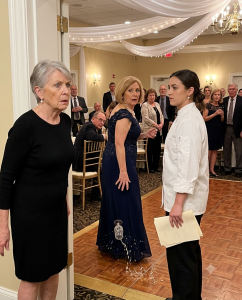
The ballroom was glowing when she arrived. White lights looped the ceiling beams. A jazz trio played near the far wall. Servers moved between round tables carrying champagne and small crab cakes. A giant display board near the entrance showed photographs of Carol through the years—graduations, ribbon cuttings, school plays, district banquets. In half of them, there was the single pearl in her ear.
Diane stepped inside and let the room notice her.
Recognition spread slowly, then all at once. People she had not seen in a decade stared as if a photograph had started breathing. A retired teacher touched her own throat. Someone whispered Diane? Another said that’s impossible.
At the center of the room, Carol was laughing at something a superintendent had just said.
Then a woman beside her turned, saw Diane, and went pale.
She touched Carol’s arm.
Carol turned.
The champagne glass slid from her hand and shattered on the floor.
For a second, Diane thought the reaction belonged entirely to her. Then she saw where Carol was actually looking.
Not at Diane.
Past her.
At the catering station, a young woman in a white service jacket had stepped forward from the shadows.
She wore the other pearl.
The room seemed to tilt.
Diane instinctively reached for her own earring, as if to confirm she was not suddenly misseeing things. But no—there it was, cool against her skin. Which meant the woman across the room was wearing its match, the surviving pearl Carol had always claimed as the only one ever found.
The woman was young, maybe twenty-six. Dark hair pinned cleanly back. Steady posture. Pale blue eyes fixed on Carol with startling composure. She did not look confused to be there. She looked prepared.
“Take that off,” Carol said, her voice cracking in the silence.
The woman smiled faintly. “I don’t think so.”
Diane moved closer, feeling every gaze in the ballroom follow her.
“Who are you?” she asked.
The young woman turned to her, and for an instant Diane felt something strange and familiar stir in the shape of her face. Not resemblance exactly. Something more troubling. Recognition without memory.
“My name is Ellie Mercer,” the woman said. “And Carol knows who I am.”
Carol’s face lost what little color it had left. “This is not the place.”
Ellie looked around the ballroom. “No? It seems perfect to me. Everyone who thinks you’re honorable is already here.”
A murmur went through the crowd.
Ellie reached into the pocket of her apron and removed a folded set of papers. “My mother told me if Carol Whitmore ever lied again in public, I should stop her in public.”
Carol took a step forward. “Don’t you dare.”
Diane said, “Ellie—what is this?”
Ellie looked at her more softly than she had looked at Carol. “I’m trying to figure out how much you know.”
“About what?”
“About me. About my mother. About what Carol did.”
Diane felt the answer before she heard it. Something hidden. Something old. Something buried in the same dark place as the paperwork that had declared her dead.
Ellie unfolded the documents.
“My mother worked as a home aide for your father in 1998,” she said. “After his stroke.”
Diane remembered those months dimly. Hospital visits. Insurance arguments. Carol taking over everything. Their father, proud and difficult even when healthy, reduced to frustrated silence in a recliner by the window. A few hired women in and out of the house. Diane had been living in Nashville by then and came mostly on weekends.
“She was twenty-two,” Ellie continued. “Poor, pregnant, and too ashamed to tell anyone she’d gotten involved with a married man before she realized how bad the situation really was.”
Carol shut her eyes briefly. “Stop.”
Ellie didn’t.
“She said Carol found out first. Not your mother. Not your father. Carol.”
The room was absolutely still.
“She begged Carol not to tell. She said she would leave, disappear, do whatever was needed. But Carol told her she had a better idea.”
Diane’s mouth had gone dry. “Pregnant by who?”
Ellie’s eyes moved to Carol, then back to Diane. “That was the leverage, wasn’t it? My mother could be frightened into silence because your father was sick, your mother was exhausted, and Carol cared more about the family’s reputation than any of them.”
Carol’s voice came out sharp, brittle. “Your mother was unstable.”
Ellie laughed without humor. “And yet you paid her.”
Another wave of murmurs swept the room.
Ellie lifted one of the pages. “This is a copy of a private settlement agreement from 1998. Signed by Carol Whitmore and witnessed by the same attorney who later handled the petition declaring Diane dead. My mother was paid to leave Tennessee, never seek child support, never contact the Whitmore family, and never identify the father publicly.”
Diane turned to Carol so fast her neck hurt. “You knew?”
Carol’s answer came too slowly. “I handled a problem.”
“A problem?” Diane said.
Ellie’s voice cut in quietly. “He was my father.”
No one breathed.
Diane looked at Ellie again, truly looked this time. The jaw. The eyes. Not Carol. Not her mother. Their father.
The resemblance hit with sickening force.
Their father had died years ago. Their mother too. Carol had kept the secret longer than either of them had lived to answer for it.
Diane whispered, “All these years…”
Ellie nodded. “My mother gave me the earring the week before she died. She said Carol handed it to her the night they made the deal, after it came off in the kitchen during the argument. She kept it because she said one day the truth might need proof that had touched the room where it happened.”
Carol took another step forward. “That earring proves nothing.”
Ellie raised the second document. “Then perhaps the DNA results will help.”
Carol stopped cold.
Ellie placed both documents on the nearest table. “I didn’t come for money. I came because last year, after my mother died, I searched Carol’s name and found a probate notice involving a missing sister. Same attorney. Same town. Same pattern. Then I saw a photograph of you, Diane. You looked like my mother described—kind, tired, and very easy for Carol to use.”
Diane could not take her eyes off Carol. “You declared me dead.”
Carol swallowed. “You vanished.”
“I moved.”
“You disappeared for years.”
“I sent Christmas cards for the first two!”
“They stopped.”
“So that makes me dead?”
Carol’s composure finally cracked. “Do you know what it was like cleaning up after everyone? After Daddy got sick, after Mama died, after you ran off and wouldn’t answer a phone? Do you know what it cost me to keep everything together?”
Diane stared at her. “So you stole it.”
“I preserved it.”
“You erased me.”
Carol’s eyes flashed. “You had already erased yourself.”
The sentence landed with brutal precision because some piece of it was true. Diane had withdrawn. She had left. She had made herself hard to reach. But truth used in service of a lie is still a lie, and standing there in front of half of Chattanooga, Diane finally saw the engine inside her sister clearly.
Carol did not merely want control. She wanted authorship. She wanted to be the one who decided whose absence counted, whose silence could be converted into advantage, whose pain could be edited into a cleaner family story.
Ellie said, “Tell them what you told my mother.”
Carol said nothing.
Ellie’s face hardened. “Tell them you said no one would ever believe a scared young aide over a respected daughter. Tell them you said families survive by sacrificing the weak part.”
A soft sound broke from someone in the crowd. Disgust, maybe. Shock.
Diane felt something inside her settle.
She had arrived hoping to confront theft.
Instead, she was standing at the exposed foundation of her sister’s life.
The ballroom manager must have called security at some point, because two men appeared near the entrance, hesitating as if unsure whom to remove. Then one of Carol’s former colleagues stepped away from her and said, very clearly, “Don’t touch either of these women.”
That broke the spell enough for people to move. Phones appeared. Someone called an attorney. Someone else said there should be police. Carol looked around as her audience became witnesses.
She tried one last time. “Diane, please. We can discuss this privately.”
Diane almost laughed.
“Privately is where you do your worst work.”
It ended there, at least publicly. Carol left through a side door before the police arrived. Ellie stayed. Diane stayed. Statements were taken. Copies were photographed. Names of attorneys were exchanged. More than one guest quietly admitted they had always wondered about certain inconsistencies in Carol’s stories over the years but had never challenged her because she seemed so certain whenever she spoke.
Certain people usually go unchallenged.
The legal fight took months.
The declaration of Diane’s death was reversed. Her identity and records were restored. The estate transfers were reexamined. Some assets could be recovered, some couldn’t. The attorney who had handled both the 1998 settlement and the later probate filing came under investigation. Carol resigned from two community boards before anyone could ask her to. Former colleagues stopped returning her messages.
Ellie did not sue. At least not at first. She said she had lived too long under a secret to spend the rest of her life chained to courtrooms. But she did amend her birth records with the documentation her mother had preserved, and she met Diane for coffee three weeks after the retirement party, then again the week after that.
The first few conversations were awkward. They weren’t sisters. Not exactly. They were strangers connected by the same architecture of concealment. But there was relief in not having to pretend.
Diane learned Ellie worked nights while finishing a nursing degree. Ellie learned Diane still hated sweet tea and still folded napkins into squares when nervous. They spoke about their father in fragments, about their mothers with more tenderness, and about Carol only when necessary.
One rainy afternoon in Knoxville, Ellie asked, “Do you think she ever loved either of us?”
Diane took a long time before answering.
“I think she loved being needed,” she said. “And confused that with love.”
That seemed, to both of them, the closest honest thing.
The pearl earrings remained separated.
Diane kept the one she found in the Bible. Ellie kept the one her mother had saved. Neither woman suggested putting them together. By then they understood that matching things do not always belong in pairs just because they began that way.
Months later, Diane visited her mother’s grave alone.
She stood in the damp grass and thought about all the women in the story who had been expected to stay quiet to preserve someone else’s version of decency. Her mother, who probably never knew the full truth. Ellie’s mother, who had been frightened into exile. Diane herself, signed out of legal existence because distance made her convenient. Even Ellie, waiting twenty-six years to walk into a room and make the right person afraid.
Diane touched the pearl at her ear and felt, for the first time in a very long while, fully present inside her own life.
Carol was still alive somewhere, still capable of explanation, justification, maybe even self-pity. Diane no longer needed any of it. Some people spend years arranging the world so their reflection appears in every piece of glass. Then one day the glass breaks, and all that careful image becomes evidence.
What lingered was not triumph. Not exactly.
It was the uncomfortable aftershock of seeing how easily a family can mistake competence for goodness, silence for peace, and reputation for truth.
And once you see that clearly, the hardest question is no longer what Carol did.
It is how many times everyone else looked away because she did it so beautifully.