When Maren Holt returned to Briar Glen for the first time in nearly four decades, people noticed three things before they noticed her name.
The first was the car—quiet, black, too expensive for this town to pretend not to envy.
The second was the coat—simple, perfectly cut, the kind rich people wore when they no longer needed logos to prove anything.
The third was the fact that she walked into the Briar Glen Hotel like she already owned it.
Which, as it turned out, she did.
By then, most of the town had heard rumors about the mysterious buyer who had stepped in after the hotel’s collapse. Some said it was an investment group from Atlanta. Others swore it was a preservation trust. A few people, the ones who still believed in dramatic irony as a civic sport, thought maybe one of the Bellamys had quietly moved money around to save face.
No one guessed Maren.
No one guessed the girl who used to carry trays in low black shoes had come back with the deed in her purse and payroll in her name.
And absolutely no one guessed she had kept a hotel key card in her wallet for thirty-eight years.
The Briar Glen had once been the town’s crown jewel—its ballroom all gold trim and mirrored walls, its lobby lined with black-and-white photos of men who built mills, banks, and family reputations sturdy enough to outlive facts. The Bellamys had funded two wings, hosted the gala every winter, and treated the place less like a business than a stage set built to flatter them.
When Maren worked there in the late eighties, she learned quickly that the hotel had two entrances even if only one appeared on the map.
There was the front way, with polished marble and smiling doormen.
And there was the invisible way, used by waitresses, cleaners, delivery drivers, kitchen staff, florists, and anyone whose labor was welcome but whose presence was not.
Maren was born knowing which one she was expected to use.
Her mother, Ruth Holt, ironed table linens for women who would later compliment the “quality” of cloth they had never washed. Their house sat on Ash Street, just close enough to the Bellamys’ world to feel its weather and just far enough to never be invited in. Maren learned early how to carry herself without apology. She also learned that dignity and comfort were not the same thing.
At nineteen, she took banquet work at the hotel because the tips beat the diner and because she was too sharp to spend her life pretending coffee refills were a future. She had a good memory, steady hands, and the kind of composure wealthy people mistook for natural obedience. That mistake benefited her. They told the truth around her because they assumed she was not important enough to repeat it.
That was how she first noticed Thomas Bellamy.
He was easier to watch than to understand. He moved through rooms like someone raised to be looked at, but there was always a fraction of hesitation in him, a pause before the performance landed. He thanked servers. He listened when old men boasted too loudly. He seemed almost embarrassed by the way girls tried to catch his eye.
Almost, Maren would later think, could ruin a life.
The first thing he ever said to her was after a winter gala when she was folding napkins alone near the stage.
“You look like you belong at the head table more than anyone who sat there.”
She should have laughed. She should have walked away. She should have recognized the sentence for what it was—a beautiful match held near dry wood.
Instead she looked up.
And Thomas smiled.
After that, the town felt smaller. The spaces where they could safely meet became precious because they were limited: a diner forty minutes outside Briar Glen where no one knew his family’s name, a coffee shop on the far side of the county, roads that cut through orchard land and made it easy to pretend the world was only as complicated as the person in the passenger seat.
He was attentive in a way that made her feel seen instead of merely selected. He asked questions no one else bothered to ask. What she wanted. What bored her. Why she never stayed after work when the other staff went drinking. Once, when she admitted she liked reading hotel management manuals because the logistics fascinated her, he laughed with delight instead of condescension and said, “Of course you do. You don’t just do the job. You study the machine.”
It was a dangerous kind of kindness, the kind that feels like respect.
For four months, Thomas painted himself as the exception to everything she had learned to distrust. He talked about leaving Briar Glen. He talked about opening his own practice somewhere his last name didn’t arrive before he did. He talked, increasingly, about a future that had room for her in it.
Then came April 18, 1988.
There had been a spring charity dinner that night, all polished silver and speeches about community stewardship delivered by men who underpaid half the room. Thomas found a moment alone with Maren near the service corridor and pressed something into her hand—a key card with 614 written on the back.
“After,” he said quietly. “Wait for me there.”
She looked at him. “Thomas…”
“I’m done hiding,” he said. “I mean it this time.”
There is a very specific kind of hope that only exists when a person is young, scared, and one sincere sentence away from rearranging her life. Maren carried that hope upstairs with trembling fingers and a blue dress she had bought on store credit.
Room 614 was unlocked.
Champagne waited in a silver bucket. Two glasses stood by the window. The lamp light was warm. The bed was made too neatly for romance, but she didn’t notice that right away. For fourteen seconds she believed him completely.
Then the bathroom door opened, and Evelyn Bellamy stepped out.
Evelyn in pearls. Evelyn in cream silk. Evelyn holding a stack of folded documents with the calm of a woman who considered humiliation a domestic skill.
She didn’t raise her voice. She didn’t need to.
“Thomas won’t be joining you,” she said.
Maren remembers that sentence more clearly than her own name some days. Not the words themselves. The composure of them. The certainty that the room belonged to Evelyn simply because she had decided it did.
Thomas had made “a sentimental mistake,” Evelyn explained. He had obligations. A future. A family position. Maren’s role in all this, however unfortunate, could still be handled discreetly.
She pointed to an envelope on the dresser.
Inside was money. Enough to stun a girl who had been counting tips to pay rent.
“Take it,” Evelyn said. “Leave through the service elevator. We can all spare ourselves something ugly.”
Maren didn’t touch the envelope.
“What are those?” she asked, nodding toward the papers in Evelyn’s hand.
Evelyn smiled. “Protection.”
That answer chilled her more than the money did.
Maren glanced at the papers. She only caught fragments because Evelyn did not offer them to her. A typed heading. Her own name. Thomas’s. The word settlement. Another page beneath it with medical language she didn’t understand. She saw enough to know the documents weren’t for her benefit.
And then she understood something that split her open so cleanly it almost felt like clarity.
Thomas had known enough.
Enough that a room had been booked. Enough that his mother had access. Enough that whatever was happening here had involved discussion, planning, and the assumption that Maren would be easy to erase.
Maybe he hadn’t written the script. Maybe he hadn’t approved every line. But he had failed the moment that mattered.
On the nightstand sat the hotel key card. Black marker on the back. 614.
Maren picked it up.
Evelyn frowned. “That is not the part you should be taking.”
Maren put the card in her purse, looked Evelyn dead in the eye, and walked out without the money.
She left Briar Glen before sunrise.
What happened next looked, from a distance, like grit and luck.
Up close, it was much uglier and more disciplined than that.
Chicago gave her anonymity, which was almost as useful as money. She waitressed double shifts, learned inventory, learned payroll, learned supplier negotiations, learned that men in restaurant ownership often made the same mistake as men in ballrooms—they underestimated women who paid attention. She became a manager before thirty, then helped a friend named Celia Alvarez buy a bakery everyone else had already decided was dead.
Celia understood numbers the way Maren understood people in rooms. Together they turned one tired storefront into a business that supplied half the city’s boutique hotels. Then they expanded into event catering. Then restaurant consulting. Then acquisition. By forty-eight, Maren no longer interviewed for jobs. She interviewed general managers.
She kept the key card through all of it.
Not because she wanted to relive the humiliation.
Because she wanted to remember the cost of believing someone else would hand her dignity back.
Over the years she heard things about Briar Glen. That Thomas married a woman from Raleigh, then divorced her. That Evelyn still ruled family decisions like a queen guarding the last dry acre in a flood. That the Bellamy money was less immortal than advertised. That poor investments and legal disputes had gnawed through the estate. That the hotel itself had become too expensive to maintain properly.
When the boiler failure shut the Briar Glen down for good, Maren read the article twice. Then she requested the financials.
The property was more damaged than the town realized, but the bones were solid. The ballroom could be restored. The guest floors could be modernized. The kitchen could be rebuilt into something serious. It would be expensive.
She bought it anyway.
Not as revenge, she told herself.
As reclamation.
Though sometimes those two words stand closer together than people like to admit.
The restoration took eighteen months. She insisted the ballroom be returned exactly to its 1988 appearance: the chandeliers, the trim, the mirrors, even the pattern of the restored dance floor. Her team assumed it was branding. A heritage play. Nostalgia with better bookkeeping.
Only Maren knew she was rebuilding a witness stand.
On reopening night, the room gleamed. Candlelight trembled against polished glass. The old families of Briar Glen arrived in their best clothes, eager to attach themselves to renewal after doing nothing to prevent decay. The mayor gave the sort of speech mayors always give—heavy on continuity, light on accountability.
Then he announced the owner.
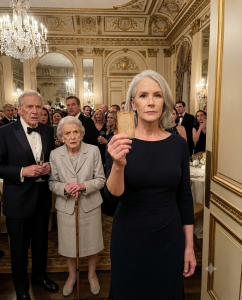
Maren walked toward the stage holding the old key card in one hand.
The gasp that moved through the room came in waves. Some people recognized her from her mother’s face. Some from old stories. Thomas recognized her instantly.
He looked older than she expected. Not ruined. Not tragic. Just worn in the expensive way men become when disappointment has been professionally managed but never emotionally faced.
Beside him stood a young woman in a dark green dress, maybe twenty-six, with Thomas’s eyes and someone else’s caution.
His daughter, Maren guessed.
And beside her, Evelyn.
Smaller now. Frailer if one looked only at the cane. But her eyes were unchanged—cool, measuring, insulted by time itself.
Maren reached the podium and let silence widen around her.
“I was told to leave this hotel through the service elevator,” she said.
The room went still.
“I was also told some things disappear if the right family decides they should.”
Thomas whispered her name. Evelyn did not.
Maren held up the key card. A prop, to everyone else. A key, to the people who mattered.
“I kept this because I wanted to remember the room,” she said. “But over time I realized it wasn’t the room I was remembering. It was the papers.”
That landed.
Thomas’s daughter turned sharply toward him. “What papers?”
Thomas shut his eyes for one terrible second.
Evelyn spoke first. “This is not the place.”
Maren almost smiled. “Actually, for once, I think it is.”
She reached into her coat and removed a yellowed envelope made of hotel stationery.
The room changed.
Not in volume. In pressure.
“Your mother handed me money that night,” Maren said to Thomas. “But while she was talking, she set the folder down. She underestimated how fast humiliated women can think.”
Evelyn’s jaw tightened.
Maren continued, her voice steady. “I took one envelope when I left. Not hers. Mine.”
A rustle spread through the crowd.
“I didn’t open it for two days,” Maren said. “When I finally did, I found a settlement agreement drafted in anticipation of a claim I had never made. Attached to it was a signed statement from Thomas Bellamy asserting that our relationship had been brief, one-sided, and encouraged by me for financial gain.”
Thomas made a sound that barely counted as speech. “Maren, I never signed that.”
Maren looked at him. “Your signature was on it.”
Evelyn cut in sharply. “Prepared documents are not proof of intent.”
“No,” Maren said. “But the second document was more interesting.”
She opened the envelope carefully. Age had made the paper delicate, but not unreadable. Her lawyers had long since made copies, verified dates, and tucked the originals into a safe. Tonight she had brought one certified copy and the courage to use it.
She held up the page.
“It was a draft transfer agreement,” she said, voice carrying through the ballroom. “From the Bellamy family trust to me. One lump sum in exchange for a permanent confidentiality clause regarding paternity.”
The room seemed to inhale.
Thomas’s daughter stepped backward as if someone had shoved her.
Thomas stared at his mother. “Paternity?”
Maren turned her eyes to Evelyn. “Would you like to tell him? Or shall I?”
For the first time all evening, Evelyn Bellamy looked old.
“You were pregnant,” Thomas said, the words barely leaving him.
“I was,” Maren answered.
His daughter covered her mouth.
Thomas shook his head violently. “No. No, Maren, I didn’t know that. I swear to you, I didn’t know.”
Maren believed, suddenly and unwillingly, that he was telling the truth about that part.
Not because he deserved mercy. Because shock has its own posture, and his was too raw to fake.
She nodded once. “I miscarried three weeks later. Alone. In Chicago.”
The silence after that was merciless.
Thomas looked like a man who had been hit with the missing weight of his own life. He sat down without meaning to, finding a chair by accident.
His daughter whispered, “Dad…”
Evelyn adjusted her glove with trembling precision. “This spectacle helps no one.”
Maren’s laugh was quiet and stunned. “You still think that sentence works.”
Evelyn lifted her chin. “I was protecting my son.”
“No,” Maren said. “You were protecting your name.”
The older woman said nothing.
Maren set the document on the podium. “I didn’t come back for revenge. If I wanted a lawsuit, I had the paper decades ago. I came back because you taught me something in Room 614. That people like you counted on silence more than money. You counted on shame doing your work for you.”
She looked out across the ballroom—the same room where she had once been invisible.
“So I bought the building where you thought I’d learned my place. And I reopened it with my name on the deed.”
Thomas finally stood again, unsteady. “Maren… I need you to know I never knew about a pregnancy. I knew my mother wanted us apart. I knew she threatened to cut me off. I was a coward. I let her handle it because I thought she was arranging some ugly payoff and I told myself I was trapped.” His voice broke. “But I did not know about a child.”
Maren studied him for a long moment.
“I know,” she said.
That hurt him more than accusation would have.
Because forgiveness was not in her voice. Only recognition.
Thomas’s daughter looked from one face to another and then directly at Evelyn. “You let him believe whatever was easiest for him, didn’t you?”
Evelyn said, “Your father had a future.”
“And she didn’t?” the daughter snapped.
It was the first honest thing spoken in the room by someone born into Bellamy privilege, and it cracked something open. A few guests looked away. A few stared harder. The mayor appeared to be reconsidering every life choice that had placed him near a microphone tonight.
Thomas turned to his mother with an expression Maren suspected he should have worn forty years earlier.
“What else did you decide for me?”
Evelyn’s answer came cool and final. “Everything that kept this family standing.”
Thomas looked around the ballroom—at the chandeliers, the mirrors, the polished floor restored by the woman he had failed—and said, almost to himself, “No. It didn’t keep us standing. It just delayed the collapse.”
After that, the night lost its ceremony.
People left in clusters, whispering in the lobby. Some offered Maren awkward sympathy. Some offered admiration disguised as respect for “the restoration.” A few old women pretended they had always thought highly of Ruth Holt’s daughter. Maren let their revisions pass through her like weather.
Thomas approached her near the empty dance floor once the room had thinned.
“I’m sorry,” he said.
It was the right sentence. It was also forty years late.
Maren looked at him and saw not the boy she had loved, but the man made from every moment he failed to stop someone else from doing harm in his name.
“I know,” she said again.
He swallowed. “Is there anything I can do?”
She glanced around the ballroom. Staff were clearing glasses. A pianist was closing the lid over the keys. Her general manager was speaking quietly with security near the door.
“Yes,” she said. “Leave this place understanding it was never yours to define.”
He nodded once, as if the sentence had taken all the air with it, and walked away.
Evelyn did not come over. She left with her cane striking the floor in hard, offended taps. Thomas’s daughter followed several paces behind, but not beside her.
Maren remained under the chandelier until the room was nearly empty.
One of her assistant managers, a sharp young woman named Lena, approached carefully. “Are you all right?”
Maren looked up at the mirrored walls, the gold trim, the floor reflecting light like a held breath finally released.
“Yes,” she said, and realized she meant it.
Later that night, after the last guest had gone and the staff had finished resetting the room for a breakfast meeting no one in this town would attend without gossip, Maren rode the service elevator alone.
The old one had been replaced, but she had kept the route.
When the doors opened to the lower corridor, she stood there for a moment, remembering the twenty-two-year-old girl who once left through a passage meant for people no one intended to acknowledge. That girl had walked out carrying humiliation, fury, and a stolen envelope she didn’t yet understand would save the truth from disappearing.
Now Maren stepped back into the same corridor wearing ownership like fact.
She took the key card from her pocket. The corners were soft. The ink had faded almost to brown.
For years she had thought of it as evidence.
Tonight, at last, it felt more like a receipt.
Proof that survival had cost what it cost. Proof that class cruelty was rarely loud when it believed itself justified. Proof that cowardice could ruin just as thoroughly as malice. And proof—most satisfying of all—that a woman dismissed as temporary could become permanent in brick, payroll, deed, and memory.
She slipped the card back into her wallet instead of throwing it away.
Not because she still needed it.
Because some reminders earned the right to stay.
Outside, Briar Glen was dark and cold. The hotel windows glowed behind her. On the sidewalk, people still stood in small clusters under streetlamps, dissecting the scandal as if it belonged to history and not the living people who had carried it into the room.
Maren watched them for a moment, then turned toward her car.
The town would talk for years. About Evelyn. About Thomas. About the papers. About the child who never got to exist beyond a secret document and a grief carried alone. Some people would say Maren had done the right thing. Some would call it vindictive. Some would insist old wounds should stay buried, usually the ones who benefited most from burial.
But as she left the hotel behind, one thought stayed with her more than any other.
The biggest red flag had never been Evelyn Bellamy’s cruelty.
Cruelty announces itself, eventually.
The bigger danger had been Thomas—his softness, his hesitation, his belief that doing nothing was somehow different from choosing a side.
Maren had once mistaken that weakness for gentleness.
She never would again.