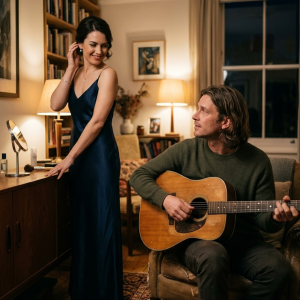
Thirty years ago, Luanne Beauchamp stood in the Whitmore Country Club ballroom in a yellow dress she had saved three paychecks to buy and learned exactly how expensive humiliation could be when rich people did it elegantly.
She had driven in from Macon that evening with both hands gripping the wheel and one wild, aching thought in her head: maybe there had been some misunderstanding. Maybe the call she’d gotten that afternoon had been wrong. Maybe Carter Whitmore, who had spent two years looking at her like she was the answer to a question he had been asking his whole life, would see her walk in and finally tell the truth in front of everyone.
Instead, she made it eleven steps into the ballroom before his mother stopped her.
That part never faded. Not the band still playing as if nothing unusual was happening. Not the slow turn of heads as conversation died table by table. Not Eleanor Whitmore’s pearls or the glass of bourbon in her hand or the calm, chilling way she crossed the floor like this was already handled.
Into Luanne’s palm, Eleanor pressed two things.
A Greyhound bus ticket back to Macon.
And a small index card.
Then she covered Luanne’s hand before she could read it and said, quietly, “Keep that. You’ll want it someday.”
The room had gone silent enough to hear cutlery touch china.
Luanne didn’t cry there. She did it outside, in the parking lot, bent beside her car with the warm night air pressing against her face and the sound of music leaking through the closed doors behind her. When she could finally breathe again, she unfolded the card.
It held seven words in Eleanor Whitmore’s sharp, unmistakable handwriting.
Carter Whitmore is not a Whitmore at all.
For a long time Luanne only stared at it. She read it once, then again, then a third time because her mind refused to accept that anyone would write something like that on an index card and hand it to a woman they were publicly dismissing.
Then she turned it over.
On the back was a single line.
Ask Eleanor about Thomas Bell, June 1965.
Luanne sat in her car with the card in her lap and felt her heartbreak change shape.
That didn’t make it hurt less. Carter had still lied. He had still let her hear from someone else that he was engaged to another woman. He had still hidden her in private and abandoned her in public. But whatever game his mother had been playing that night, it had gone beyond cruelty. It felt reckless. It felt desperate. It felt like a mistake made by a woman too certain nobody at the bottom of the room would ever know what to do with what she’d been handed.
Luanne drove home without using the bus ticket.
She burned it in a coffee can behind her parents’ house the next morning.
The card, she kept.
At first she told herself she was saving it because she might need proof that the whole evening had happened exactly the way she remembered it. Then she told herself she was saving it because one day she wanted to understand why Eleanor Whitmore had done something so bizarre. Eventually she stopped explaining it. The truth was simpler: the card had weight. It felt like a door to a room people like the Whitmores kept locked. And every now and then, when she couldn’t sleep, she would take it out and read it again.
Carter tried to call her twice in the weeks after the engagement party. She never answered. He sent flowers once. She sent them back. Then, a month later, she got a letter in his handwriting. Three pages of apologies without a single truthful explanation inside them. He said he had been weak. He said his family expected certain things. He said he had cared for her more than she knew. He said he hoped one day she would forgive him.
He did not deny the engagement.
He did not come to Macon.
And he did not mention the card, which told Luanne one of two things: either he didn’t know what his mother had written, or he knew and was too frightened to touch it.
She chose silence.
It saved her.
The years immediately after were not glamorous. She worked everywhere she could, first at restaurants, then with a local property owner who needed dependable hands to manage small rental houses. Luanne learned faster than most men expected and said less than they liked, which turned out to be useful in business. She noticed what broke often, what tenants actually cared about, what landlords ignored, and where money leaked when nobody responsible was watching. She also discovered she had a talent for making unreliable systems behave.
At twenty-eight she borrowed money from a cousin and bought a used truck. She started a landscaping service with handwritten flyers and a listing in the Yellow Pages. She mowed lawns in the heat, trimmed hedges until her shoulders burned, hauled debris herself, and underbid men who laughed at her until they realized she showed up on time and finished what she started.
One client became six. Six became contracts. Contracts became crews.
She hired carefully, paid fairly, and remembered every insult anyone had ever disguised as advice.
When a small apartment owner asked whether she could also handle unit turnover between tenants, she said yes and figured it out. When another asked whether she knew anyone who could manage rent collection, maintenance scheduling, and repairs across multiple properties, she said yes again. The landscaping business grew into property maintenance. Property maintenance grew into property management. What began as survival slowly hardened into strategy.
Luanne discovered something that old families often forgot: pride is expensive, but competence compounds.
By forty, she had real money. Not inherited money. Built money. The kind earned in invoices, payroll, bank meetings, busted knuckles, and nights spent comparing line items until dawn. She bought an office, then a second one. She invested in neglected commercial properties and made them useful. She acquired a reputation for being impossible to bluff and almost impossible to outwork.
Through all of it, she kept the index card.
She tucked it into the left glove she wore in winter, then later transferred it into better gloves as her life changed. Cheap knit. Leather. Finally silk. She liked knowing it rested against the hand Eleanor had grabbed that night. A private reminder. A splinter she chose not to remove because it helped her remember what she was building away from.
Now and then she heard things about the Whitmores. Carter had married the Beaufort heiress. The wedding had been large. The marriage, less impressive. There were whispers of infidelity, of debt, of business decisions made under the influence of entitlement rather than arithmetic. Eleanor remained formidable in public. Men still stood straighter when she entered a room. But Savannah had changed. Banks cared less about bloodlines than balance sheets, and younger board members had fewer sentimental attachments to surnames.
Then came 2019.
A banker Luanne knew socially mentioned, over cocktails, that the Whitmore family had overleveraged one of their holdings. A few months later another contact mentioned a note coming due. Then came more murmurs: legacy assets were being shuffled, obligations refinanced, timing getting dangerous. The Whitmore Country Club, centerpiece of their social standing for generations, was no longer protected by prestige alone.
Luanne listened. She never gossiped back.
When her attorney called one Tuesday morning in October and said, “There may be an opportunity involving the Whitmore club, and before I continue I need to know whether you’d consider a majority acquisition,” her left hand rose automatically to the glove in her lap.
The card was there.
Soft now from years of being folded and unfolded.
“Yes,” she said.
Her attorney paused. “You haven’t heard the details.”
“I’ve heard enough.”
The negotiations took months. There were shell entities, confidentiality agreements, strategic delays, and a great deal of pride being translated into paper. The Whitmores fought for terms that would preserve appearances. Luanne was happy to let them have some of those appearances, provided the controlling stake transferred cleanly. She wanted ownership, not theater. Though if theater happened to accompany it, she wasn’t opposed.
What she did not anticipate was Carter Whitmore’s decision to host a centennial gala before the transition became public. It was pitched as a final celebration of the club’s history, a glittering evening to honor legacy and usher in a new era. Invitations went out before he knew who the new majority owner would be. Luanne’s attorney, upon learning this, called to ask whether she wanted to attend.
She looked at the glove.
“Yes,” she said again.
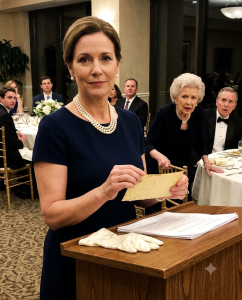
On the night of the gala she dressed in navy silk, understated and exact. Pearls at her throat. Ivory gloves on both hands. She stood for a long moment before getting in the car, not because she was afraid but because she understood the difference between revisiting a wound and entering the place where it happened with the deed in your name.
The country club looked almost unchanged. Same columns. Same brick. Same honeyed light spilling from the entrance. The past was so physically intact it might have frightened her once. Instead, it sharpened her.
Inside, the ballroom glowed with candlelight and old money. Waiters crossed the room with silver trays. Crystal chimed. A jazz band played in the corner. Guests drifted in black tie and polished smiles, many of them too young to remember the girl in the yellow dress but old enough to recognize Luanne Beauchamp, the businesswoman whose name now carried real weight in Savannah.
When she reached the front table and saw her name card beside the evening’s hosts, conversation around her shifted almost imperceptibly. Confusion. Curiosity. Then calculation.
Carter saw her first.
Time had softened him in the way expensive lives sometimes soften men. He was still handsome, still carrying himself on charm and breeding, but something in his face had gone looser around the edges. He approached with a smile that didn’t quite know which history it was meant to wear.
“Luanne,” he said. “This is a surprise.”
She let her eyes linger on him just long enough to make him feel the years. “No,” she said pleasantly. “Not for me.”
He blinked.
Before he could answer, Eleanor appeared at his shoulder.
Age had touched her more carefully than it touched most people. Her hair was silver, her posture still immaculate, her expression trained into gracious neutrality. But when her gaze dropped to Luanne’s gloves, it stopped for the smallest fraction of a second.
That was enough.
“Mrs. Whitmore,” Luanne said.
“Ms. Beauchamp.” Eleanor’s smile was flawless. “How lovely to see you.”
Luanne smiled back. “Isn’t it.”
Throughout dinner she could feel the tension moving through the room in thin invisible currents. A few people clearly knew something unusual was afoot. Others were only sensing it. Carter made the rounds with studied ease. Eleanor drank less than everyone else and watched more.
After dessert, speeches began.
There was the usual parade of polished nonsense: legacy, stewardship, tradition, community, the proud future ahead. Men praised institutions built by other men, pretending continuity was a moral virtue instead of a business arrangement. Luanne listened with the patience of someone who had spent a lifetime watching people mistake inheritance for excellence.
Then came the introduction for the evening’s honored guest and incoming ownership representative.
A murmur passed through the room as Luanne rose.
Carter’s smile vanished first. Eleanor’s color drained second.
Luanne walked to the front without hurrying. The microphone was waiting. So was the silence.
She looked out over the ballroom and saw, layered over the present, the ghost of another room: herself at twenty-four, clutching a bus ticket, the audience enjoying its own cruelty because it had been delivered with etiquette.
She placed one gloved hand lightly on the podium.
“Thank you,” she said. “It’s a special thing to be welcomed into a room that once made its feelings so clear.”
A few uneasy laughs flickered and died.
“Some of you may know,” she continued, “that I was here thirty years ago. Briefly.”
Nobody moved.
“I learned a great deal that night. Including the difference between having access to a place and having power over what happens inside it.”
Eleanor stood up. “Luanne,” she said quietly, warning in every syllable.
Luanne turned her head. “You told me to keep something,” she said.
Then she slipped off the left glove.
The room watched as she reached inside and withdrew a folded index card gone soft with age.
Eleanor made a strangled sound that didn’t belong to a woman like her.
Carter looked from his mother to the card and back again. Confusion tightened into fear. “Mother?”
Luanne unfolded the card at the microphone.
“On the night I was asked to leave this ballroom,” she said, “Mrs. Whitmore put this in my hand.”
“Don’t,” Eleanor snapped, moving forward now, dignity finally cracking.
Luanne read anyway.
“Carter Whitmore is not a Whitmore at all.”
The silence that followed felt physical, as if the air itself had recoiled.
Carter stared at his mother. “What is she talking about?”
Luanne turned the card over. “There’s more.”
Eleanor stopped walking.
Luanne read the line on the back. “Ask Eleanor about Thomas Bell, June 1965.”
A man near the back whispered, “Thomas Bell?” Another older guest muttered a curse under his breath.
Carter had gone gray. “Mother.”
Eleanor’s hands were shaking now. Not visibly to everyone, but enough for those closest to see. She looked around the room and realized the one thing that had protected her all her life had just failed: collective agreement. No one was going to save her by pretending.
“It was before I married your father,” she said at last, and the room leaned forward as one. “Thomas Bell worked for my family. At the stables.”
Carter swallowed. “And?”
Eleanor closed her eyes for a second that seemed to cost her everything. “And he was your father.”
The words shattered what remained of the evening.
Voices erupted. Chairs scraped. One woman burst into tears for reasons that were probably not entirely about paternity. Carter stepped back as if the floor had shifted beneath him. For a moment he looked not like a Whitmore heir but like a little boy who had just discovered the adults built his whole identity out of a lie.
“My father knew?” he asked.
Eleanor’s silence answered first.
Then: “He suspected. Later he knew.”
“And kept it secret?”
“For the family.”
Carter laughed once, a broken, ugly sound. “For the family,” he repeated.
Luanne watched him and felt something she hadn’t expected.
Not triumph. Not exactly.
Recognition.
Because whatever else Carter had done to her, he had also been raised inside a machine that taught love as transaction and truth as a luxury for people without something to lose.
None of that excused him. But it rearranged him.
One of the older board members, red-faced and trembling, demanded to know who else had known. Another guest whispered that Thomas Bell had died decades earlier. Eleanor sank slowly into a chair she had not intended to take, all the force gone out of her.
Carter turned to Luanne then, eyes wet with shock. “You knew this all these years?”
“I knew what she wrote,” Luanne said. “I didn’t know whether it was true.”
“Why didn’t you tell me?”
The room seemed to hold its breath again.
Luanne considered lying, but she had not climbed this high to start doing that now.
“Because when a man lets you hear about his engagement from somebody else,” she said evenly, “he does not get to ask why you protected him from his mother’s secrets.”
That landed harder than the revelation.
Carter looked away first.
The gala never recovered. People left in clusters, speaking in stunned, hungry murmurs. The story would be all over Savannah by morning. Lawyers would be called. Genealogies would be reexamined. Family narratives polished over generations would begin to crack under scrutiny. None of that interested Luanne much anymore.
She had not come for public humiliation, though she understood why some would interpret it that way.
She had come because a woman once tried to send her out of a room carrying shame that was never hers.
Instead, Luanne handed it back.
A week later, the club formally entered its new era under her control. Staff changes were handled carefully. Membership rules were rewritten. Legacy privileges were reviewed against actual financial contribution. A portrait wall that had displayed generations of Whitmore men near the entrance was moved to a smaller historical corridor where it belonged. In its place, Luanne commissioned a series honoring the workers who had built and maintained the grounds, kitchens, stables, and orchards tied to the club’s history. Men and women whose names had never been framed before.
Carter sent her a letter two months after the gala.
It was not an apology in the old style. There were no excuses in it, no talk of pressure or expectations. He wrote that he had taken a DNA test. He wrote that the results had confirmed what Eleanor had admitted. He wrote that he had spent weeks trying to understand which parts of his life had been lies and which parts had only been cowardice. He wrote that what he had done to Luanne all those years ago was still his, regardless of what had been done to him. He said he did not deserve forgiveness and would not ask for it.
This time, she believed him.
She did not write back.
One spring afternoon, long after the scandal had cooled into local legend, Luanne stood just inside the club entrance watching new members arrive for a fundraiser benefiting hospitality workers’ families. The doors opened and closed. Laughter drifted in. No one was checking whether a woman belonged by the quality of her surname or the softness of her hands.
Her left glove was in her purse. The index card was gone.
Not destroyed. Just finally moved where it belonged, into a locked file with papers from a life she no longer needed to carry against her skin.
For years she had thought revenge might feel hot. Sharp. Satisfying in a dramatic way.
It didn’t.
It felt quiet.
Like setting down a weight and realizing how long you’d mistaken it for part of your body.
Still, now and then, she thought about that night in the yellow dress. About Eleanor pressing a secret into the palm of the very woman she believed she was crushing. About the arrogance it takes to assume humiliation makes people smaller instead of more observant. About Carter, who had inherited a name that was never truly his and still managed to squander the heart he was freely given.
In the end, maybe that was the strangest part of all.
The Whitmores had spent generations protecting bloodlines, and the thing that brought them down wasn’t an outsider forcing her way in.
It was the truth they placed in her hand themselves.
And depending on who you asked, the biggest scandal wasn’t that Luanne read the card out loud.
It was that out of everyone in that ballroom, she was the only one who had known what to do with it.