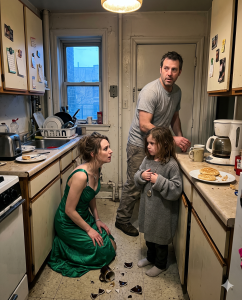
A single dad took his drunken boss home after a charity gala, expecting awkward explanations and maybe a pink slip by Monday morning.
He did not expect her to collapse in his kitchen after seeing the silver locket around his daughter’s neck.
And he definitely did not expect to hear that the necklace had supposedly been buried with a dead man from one of the richest families in New York.
By the time the pounding started on his apartment door, Taylor Hayes understood one thing with absolute clarity: the woman he had once married had not simply abandoned him.
She had left him inside a lie.
The Hawthorne Global charity gala had never been Taylor’s kind of world.
The Plaza Hotel ballroom glowed under chandeliers the size of small cars. Everything glittered—glass, gold, polished marble, designer gowns, rehearsed smiles. Men who moved markets drank whiskey older than Taylor’s career. Women drifted through the room in diamonds and silk while cameras followed them like obedient pets.
Taylor stood among them in a secondhand tuxedo that fit well enough from a distance and pinched everywhere up close. He was thirty-two, an internal auditor with military posture and permanent tiredness in his eyes, the kind of employee no one noticed unless a spreadsheet turned ugly.
He had not wanted to attend, but at Hawthorne Global skipping the annual gala meant becoming memorable for the wrong reasons.
So he shook hands, nodded at donors, listened to speeches, and checked his watch every fifteen minutes.
His daughter, Maya, was at home in Astoria with Mrs. Gable from downstairs. She was seven years old, bright, stubborn, and prone to asthma attacks that came with terrifying speed and expensive bills. Taylor’s life revolved around inhalers, overtime, rent, and making sure she felt loved enough to outweigh the fact that her mother had disappeared.
Three years earlier, Brenda had left a note on the kitchen table.
I can’t do this anymore.
No explanation. No return address. No call. No custody fight. Just absence.
Taylor had hated her for that.
He had hated himself even more for still not understanding it.
At 11:45 p.m., he decided he’d stayed long enough. He slipped through a side corridor, hoping to leave without getting trapped in another empty executive conversation.
That was when he saw Victoria Hawthorne.
He recognized her instantly, of course. Everyone did.
At thirty-six, she was one of the youngest CEOs in Manhattan and easily one of the most feared. Since taking over Hawthorne Global after her father’s death, she had gained a reputation for being cold, brilliant, and impossible to manipulate. People called her the Ice Queen when she wasn’t in the room and Ms. Hawthorne when she was.
But the woman he saw in the service hallway did not look untouchable.
She looked drugged.
One hand pressed against the wall. Steps unstable. Eyes struggling to focus. Her emerald gown was immaculate, but the woman inside it was unraveling.
Taylor’s first instinct was to keep walking.
His second was the one that mattered.
He had learned, long before finance, to trust the feeling that something was wrong. In the military, danger often announced itself in strange quiets and tiny details. The hallway was too empty. The timing was too late. And Victoria Hawthorne did not stumble.
He followed her through the loading exit and into the alley.
The November cold hit hard. A black Lincoln Navigator idled under a failing streetlamp. Victoria was being cornered near the wall by Gregory Pierce, the company’s CFO, and a thick-necked security guard.
“Put her in the car,” Gregory said.
Victoria tried to resist and nearly collapsed.
“You drugged me,” she whispered.
Gregory leaned in, speaking like a man who had rehearsed this moment.
“You’re imagining things. You’ve been unstable since your father died. By Monday, the board will understand that.”
Taylor didn’t need help interpreting that. Monday was a board vote. He’d heard fragments of office gossip about Gregory positioning himself for more control, about concerns over Victoria’s judgment. He had assumed it was normal corporate bloodsport.
Now he understood: this was not politics. This was a coup.
He stepped out with his phone in hand and bluffed the first line that came into his head.
“Victoria, your Uber’s here.”
Gregory turned, annoyed first, then instantly dangerous when he recognized Taylor.
“Leave.”
Taylor kept going.
“She looks drugged,” he said. “I should call 911.”
Gregory’s gaze moved to the phone. The security guard shifted but didn’t attack. Too risky. Too public. Too close to a luxury hotel full of cameras and donors.
Then Gregory lowered his voice and made his mistake.
“You have a daughter, don’t you? Maya. Be careful. It would be tragic if you lost your health insurance.”
The threat was polished, almost casual.
Taylor had spent years being the kind of man powerful people assumed would bend. The sort who calculated, swallowed, complied. A single father with bills was easy to intimidate.
Gregory misread him.
Taylor raised his phone and said, “Touch my daughter or force her into that SUV, and this becomes everyone’s problem.”
Something changed in Gregory’s face. Not fear exactly. More like delayed recognition that the invisible man in front of him had become inconvenient.
He backed off.
But not without promising retaliation.
Taylor took Victoria to his apartment because she begged him not to take her home.
“Security’s bought,” she whispered before passing out in his passenger seat.
That sentence followed him all the way to Queens.
He got her inside, paid Mrs. Gable, put Maya back under her blanket, laid Victoria in his bed, and slept against the front door with an armchair shoved under the knob.
He woke to burnt coffee, cheap waffles, and the first few seconds of what felt almost normal.
Maya was perched at the counter in her oversized sweater, talking to her stuffed rabbit between bites. Her silver locket hung against her chest as it always did.
When Victoria entered the kitchen, she had color back in her face and danger back in her eyes.
Taylor gave her the short version. Gregory. The alley. The threat. Her expression hardened with every sentence.
“He wants the board to vote me out as mentally unfit,” she said. “If he has witnesses saying I was drunk or erratic last night, he’ll use it.”
Before Taylor could answer, Maya smiled up at Victoria and asked whether she was Taylor’s friend.
Victoria looked down.
Then the coffee cup dropped from her hand and shattered.
She collapsed to her knees in front of Maya, staring at the locket.
“Where did she get that?” she asked.
Taylor said, “Her mother gave it to her.”
Victoria’s face turned white.
“That locket was buried with my brother Jonathan.”
The room went silent.
Taylor knew nothing about Jonathan Hawthorne except the broad strokes anyone in New York might know: younger son of the Hawthorne family, presumed troubled, dead under murky circumstances four years earlier after what tabloids had called a tragic spiral. Taylor had ignored most of it. Rich people’s tragedies always seemed to arrive already edited.
Then the pounding started at the door.
The first hit shook the frame. The second frightened Maya.
Taylor moved her behind him.
Through the peephole he saw the building superintendent, pale and anxious. Behind him stood two men in dark suits. At the end of the hall, Gregory Pierce waited, composed and predatory.
Victoria looked through the peephole and went still.
“He found me too fast,” she murmured. “That means he had people watching for me before last night.”
Then she said the sentence that broke the last piece of Taylor’s certainty.
“That necklace isn’t the only thing your ex-wife lied about.”
Taylor stared at her.
Victoria swallowed. “My brother Jonathan disappeared for three days before his body was found. The last woman seen with him was named Brenda.”
Taylor felt the air leave his lungs.
Outside, Gregory called through the door, “One minute, Hayes.”
Taylor did the only thing he could think to do.
He opened the bedroom window.
The fire escape was narrow, rusted, and iced in patches, but it offered something the apartment no longer did: a direction. He told Maya to get her inhaler and shoes. Victoria grabbed a hoodie Taylor threw her and tied back her hair with brutal efficiency. For one strange second, the billionaire CEO and the exhausted auditor looked at each other not as employer and employee, but as two people standing at the same cliff edge.
Then the front door shuddered under another impact.
They went out the window.
By the time Gregory and his men forced their way inside, the three of them were halfway down the fire escape and moving into the alley behind the building.
They drove north in Taylor’s Civic because it was too ordinary to track easily and because Victoria said Gregory would expect her to head someplace secure.
“Nothing I own is secure,” she said from the passenger seat, voice flat. “Not until I know who’s loyal.”
Maya sat in the back, quiet in the way children sometimes become when they understand the adults are truly afraid. She held her rabbit in one hand and her inhaler in the other. Taylor caught her eyes in the rearview mirror.
“You okay?”
She nodded, though he knew she wasn’t.
He wasn’t either.
They ended up at a closed marina storage property in the Bronx, one Victoria said belonged to an old Hawthorne shell company no one would think to search first. Inside a dusty office overlooking winter-black water, truths began arriving in ugly fragments.
Victoria told Taylor about Jonathan.
He had been charming, reckless, and unlike the rest of their family, painfully easy to love. Four years earlier he had started panicking about company finances and told Victoria their father had been hiding something big. Jonathan said Gregory was involved. Before he could explain, he disappeared. Three days later, his body was found in his car at a remote property upstate. Officially: overdose. Family statement: tragic private struggle. Case closed.
“But Jonathan hated drugs,” Victoria said. “He barely drank. And after he died, Gregory pushed my father to seal everything fast.”
Taylor listened, arms folded, trying to keep his mind from racing toward Brenda.
Victoria then asked the question he had been dreading.
“Did Brenda ever tell you where she was from? Her family? Old friends? Anything specific?”
No, he realized with mounting horror. Very little. They had met fast, married fast, struggled fast. Brenda had always been evasive about her past but warm enough, clever enough, loving enough that Taylor had mistaken mystery for pain she’d eventually share.
He took out his phone and opened the small folder of photos he had refused to delete. There was Brenda in a park with Maya as a baby. Brenda laughing in their kitchen. Brenda turned halfway away from the camera in a black dress he’d barely remembered.
Victoria reached for the phone and froze.
“That dress,” she said. “She wore it the night Jonathan vanished.”
Taylor closed his eyes.
All at once, memory sharpened around details he had ignored for years. Brenda coming home anxious after “visiting a friend.” Brenda starting arguments whenever he asked about her life before him. Brenda insisting the locket must never be sold, never opened, never taken off Maya’s neck.
“Opened?” Victoria repeated.
Maya instinctively covered it. “Mommy said it was mine.”
Taylor crouched in front of her. “Sweetheart, I know. But we need to look inside.”
She hesitated, then nodded.
The locket was old and heavy, engraved on the back with a tiny hawk crest almost worn smooth. Taylor had never managed to open it; the latch was stiff and he had not wanted to break it.
Victoria pressed a hidden catch with her thumbnail.
The locket clicked open.
Inside, instead of a photo, there was a folded micro-thin square of protected film tucked beneath a false backing.
Victoria stared. “Jonathan.”
Taylor slid the film free. It looked like something far too deliberate to be sentimental.
“Can you read it?” he asked.
“Not without magnification,” she said. “But if Jonathan hid this in the locket, then whatever he found was important enough to die for.”
She also told Taylor something else: the board meeting had been moved up from Monday afternoon to Monday morning without public explanation. Gregory wanted speed. He wanted Victoria discredited before she had time to recover or gather proof.
That gave them less than forty-eight hours.
The next piece came from an unexpected place.
Mrs. Gable called Taylor’s phone nine times in a row.
He finally answered in a whisper, expecting disaster.
Instead, the elderly woman said, “There’s a woman downstairs asking about Maya. Says she’s family. I didn’t trust her.”
Taylor stood so fast his chair scraped concrete. “What woman?”
But before Mrs. Gable could answer, another voice came onto the line.
Brenda.
Even after three years, Taylor knew her breathing instantly.
“Don’t hang up,” she said.
His first emotion was fury so strong he almost dropped the phone.
“You don’t get to call now.”
“I know,” she said. “But Gregory found me. He knows where you are. And if Victoria is with you, you’re all in danger.”
Taylor put the phone on speaker. Victoria stood motionless, every nerve in her face awake.
Brenda began talking fast, like someone who had run out of places to hide.
Four years earlier, she had worked as a confidential events consultant who was often hired by wealthy clients to make problems disappear quietly. One night she met Jonathan Hawthorne at a private gathering. He was agitated, drunk on fear rather than alcohol, and carrying copies of financial data proving that Gregory and Arthur Hawthorne—Victoria and Jonathan’s father—had been moving money through shell charities and offshore entities for years.
Jonathan wanted to expose it. He also believed someone in the family had arranged the death of a whistleblower tied to the scheme.
Brenda tried to help him move the evidence.
They were followed.
Jonathan gave her the locket and told her if anything happened to him, she had to keep it away from Hawthorne people, Gregory most of all. He said the locket contained the proof and that no one would search a dead man’s burial jewelry if they believed it had been interred with him.
“But it wasn’t buried with him,” Victoria said into the phone, voice shaking.
“No,” Brenda replied. “The funeral director was paid to place a replica in the casket.”
Taylor could barely speak. “And you married me because of this?”
Silence.
Then Brenda said the truth in the smallest voice he had ever heard from her.
“At first, yes.”
He looked away from Maya.
“I was being hunted. You were kind. Invisible. Safe. I told myself I’d stay only long enough for things to cool down. Then Maya was born, and nothing was simple anymore.”
“Why leave?” he demanded.
“Because Gregory found me again. He said if I stayed, you and Maya would die. I thought disappearing was the only way to keep you alive.”
Taylor wanted to hate every word.
Some part of him did.
Another part heard the terror beneath it and understood that the woman who left had not walked away from him lightly. She had fled from something rotten enough to reach across years.
Brenda agreed to meet them that evening in a church basement in Harlem where she had once volunteered under another name.
It was a trap possibility they could not ignore, but they were out of options.
When she walked in, Taylor almost didn’t recognize her. She looked thinner, older, stripped down by years of fear. Maya, however, recognized her instantly.
“Mom?”
The sound nearly broke the room.
Brenda cried before she reached them. She knelt, held out trembling hands, and waited for Maya to choose. After a long second, Maya stepped into her arms.
Taylor had imagined this reunion a hundred ways. None of them included standing beside a billionaire CEO while his daughter hugged the woman who had detonated his life.
Brenda gave them what she still had: names, dates, storage account passwords, and one crucial clue. Jonathan had duplicated key records and hidden the access path inside a charitable foundation server only an internal auditor would know how to trace.
Taylor.
For the first time since the gala, he understood why he had been pulled into this. Not by fate. By structure. By the strange way ordinary people can become critical because nobody notices what they can see.
Using Victoria’s old private laptop and Taylor’s audit credentials, they accessed archived foundation transfers tied to ghost beneficiaries and fake humanitarian grants. The microfilm from the locket, once enlarged under a borrowed jeweler’s loupe Brenda had brought, contained account numbers, board authorizations, and an audio key file location.
The audio file was the final blade.
It was Jonathan’s voice, recorded shortly before he died, accusing Gregory and Arthur Hawthorne of laundering money and arranging a death to protect the operation. Near the end of the recording, Jonathan said, “If anything happens to me, Gregory did it. My father knows.”
Victoria listened without blinking.
When it ended, she sat very still.
“My father knew,” she said.
No one answered.
There were different kinds of grief. The sharp kind. The hollow kind. The kind that arrives late, after anger burns away, and leaves you staring at the ruins of who you thought your family was.
Monday morning, Victoria walked into the board meeting at Hawthorne Global wearing a charcoal suit, no visible weakness, and the expression of a woman carrying a loaded truth.
Gregory was already there, smooth and composed, ready with concern in his eyes and betrayal in his pocket. Several board members looked startled to see her. One even began to rise, likely to suggest postponement.
Victoria beat him to the first word.
“I know there have been questions about my condition,” she said. “So let’s discuss the company’s actual illness instead.”
Gregory tried to interrupt. She cut him off and signaled the screen.
Taylor, seated along the side as a witness from internal audit, activated the presentation.
Bank trails. Shell entities. Duplicate authorizations. Charitable fraud. Coerced signatures. Security logs from the gala. Call records connecting Gregory to paid private contractors. Then the audio.
The room changed by degrees.
Doubt first.
Then shock.
Then the cold realization that the polished man at the table had underestimated how quickly powerful people abandon one of their own when exposure becomes expensive.
Gregory stood, calling it fabrication. He pointed at Taylor as if class could discredit evidence. He pointed at Brenda’s signed affidavit as if her lies erased his crimes. He even tried to invoke Arthur Hawthorne’s dead authority, not realizing until too late that doing so only deepened the horror in the room.
When the board’s outside counsel announced that federal investigators had already been contacted and officers were on the way, Gregory made one final mistake.
He lunged for Victoria’s laptop.
Security took him down before he crossed half the room.
This time, apparently, they were not bought.
The aftermath was not clean.
Public scandal never is.
Gregory was arrested. Investigations spread through Hawthorne Global and beyond. Arthur Hawthorne’s legacy imploded under the weight of what had been hidden beneath philanthropy and prestige. Charities were audited. Executives resigned. Old stories resurfaced with new meaning. Jonathan Hawthorne’s death was officially reopened, then reclassified as homicide.
And Brenda?
Brenda did not walk back into Taylor’s life as though three lost years were a scheduling problem.
She gave statements. Faced legal scrutiny. Cooperated fully. Told the truth in pieces that hurt everyone involved, including herself. There was no version of events in which she had been innocent. She had deceived him. Used him at first. Hidden danger inside their home.
But she had also spent years running to keep Gregory from finding the locket and killing the family she had come to love too late and too clumsily.
That was the terrible thing about truth. Sometimes it arrived carrying guilt and devotion in the same pair of hands.
Months later, Maya still wore the locket occasionally, though now by choice, not because of a command wrapped in mystery. The original contents were in evidence, the casing returned after the investigation as a family heirloom whose meaning had changed too many times.
Victoria came to Astoria one evening without an entourage and sat in Taylor’s small kitchen, in the same room where everything had broken open. She brought expensive pastries Maya preferred less than frozen waffles and a legal packet Taylor did not expect.
It was a trust.
Jonathan’s trust.
Revised after his death under authority Victoria had finally reclaimed. A portion designated for Maya.
Taylor looked up sharply. “Why?”
Victoria answered without her usual armor.
“Because my brother tried to protect the truth. Brenda protected the locket. You protected me. And Maya carried all of it without knowing.”
He signed nothing that night. He just sat there while Maya showed Victoria a school drawing and asked if billionaires ever burned toast.
Victoria said, “Only when they’re distracted.”
For the first time, Taylor saw her laugh without sharpness.
Brenda remained in Maya’s life carefully, slowly, under boundaries carved from pain. There was no dramatic forgiveness. No easy reunion. Trust returned like a limping animal, uncertain and easily frightened. Sometimes Taylor thought she deserved none of it. Sometimes, when he saw the way she looked at Maya with aching gratitude, he wasn’t as sure.
As for Taylor, he never went back to being invisible.
Not because he wanted power. Because once you have watched powerful people use elegance to hide rot, it becomes difficult to confuse polish with integrity ever again.
The strangest part was this: the moment that changed everything was not the gala, or the alley, or even the boardroom.
It was a coffee mug breaking on a cheap kitchen floor.
That was the sound of buried lies opening.
And even after everything that followed—the arrests, the headlines, the reopened death investigation, the impossible explanations—Taylor still came back to one question he couldn’t answer cleanly.
What was the biggest betrayal?
That Brenda entered his life under false pretenses?
That she left him without the truth?
That Victoria’s father let his own son die for a secret?
Or that Gregory almost won because men like him count on ordinary people being too frightened, too tired, or too poor to interfere?
Taylor didn’t know.
He only knew that on the night he chose not to walk away, he saved a woman everyone thought was untouchable—and in doing so discovered that the ruins of his own life had been built by hands he had once held.