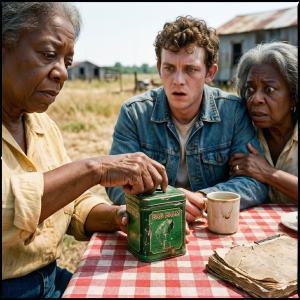
She set that little green tin down on the picnic table, and a man who hadn’t shown fear in thirty years went white as a sheet.
But I’m getting ahead of myself.
—
Norma Jean Hargrove had been a hardware store wife for forty-one years.
She knew the smell of sawdust and WD-40 the way other women knew their own perfume. She knew every vendor, every account, every handshake deal her husband Dale had ever made. She knew where the bodies were buried — figuratively speaking — because Dale told her everything.
Everything except that his brother Randy had been stealing it from under him for years.
Dale passed on a Tuesday in October, quietly, the way he did most things. Heart attack. Here one morning, gone by afternoon. The kind of loss that doesn’t announce itself, it just empties a room permanently.
Norma Jean was sixty-five years old, a widow, and suddenly very alone.
—
She started carrying the tin about a week after the funeral.
Dale’s Bag Balm. The little green square tin with the cow on the lid, battered at the corners, the label worn soft from years of his hands picking it up and setting it back down on his desk. He’d kept it there since before they were married. Hardware work is hard on hands, he always said.
She put it in her purse and just… kept it there.
It made her feel less untethered.
—
Randy moved fast. She’d give him that.
Within sixty days of Dale’s death, the paperwork started appearing. Ownership transfers. Signature pages. Everything neat and official-looking and absolutely wrong, because Norma Jean knew Dale’s signature the way she knew his voice, and that looping R and the way he crossed his E’s — that wasn’t Dale.
That was someone trying to be Dale.
She didn’t say a word.
She called a lawyer instead. Then an accountant. Then a second lawyer.
And then, very quietly, over the next eighteen months, Norma Jean Hargrove went to work.
—
Randy didn’t think much of her. Never had.
At the first family gathering after Dale’s death, he’d noticed the tin in her hand when she pulled out her phone. She’d been turning it over in her fingers the way she always did, a habit she hadn’t even noticed herself developing.
“What is that, some kind of good luck charm?” he’d said, loud enough for the table to hear. “Sentimental old-woman nonsense.”
His wife had laughed a little, nervous.
Norma Jean had just smiled and put it back in her purse.
She thought about that moment a lot over the following year. It kept her warm on the hard days, when the lawyers were slow and the accounts were complicated and she wondered if she was too old and too tired for what she was doing.
Sentimental old-woman nonsense.
She’d think of that, and then she’d get back to work.
—
The Fourth of July picnic was Randy’s idea, same as every year.
Hargrove Hardware had sponsored the town fireworks for going on twenty years. It was Randy’s favorite day — company shirts, company banner, Randy shaking hands and accepting credit for a business that had Dale’s fingerprints all over it. The whole town came. The mayor usually stopped by.
This year Norma Jean came too.
She wore a yellow blouse and white slacks and comfortable shoes, because she was sixty-seven years old and she was done being uncomfortable in any sense of the word. She brought potato salad. She said hello to people she hadn’t seen since Dale’s funeral and she let them hug her and she hugged them back.
And she carried her purse.
Randy saw her and his smile flickered — just for a half second — before he recovered.
“Norma Jean! Glad you could make it.” Big voice. Crowd-ready.
“I wouldn’t have missed it,” she said. “I have something for you.”
She set her purse on the picnic table. Reached inside past her phone, past her wallet.
She brought out the little green tin.
She could feel people watching. This was a small town. People always watched.
Randy’s jaw tightened. “What is this, another —”
“Just wait,” she said.
She set the tin down in front of him on the red-checked tablecloth, right there in the July sun with the whole town looking on and the smell of grilled hamburgers in the air.
And she clicked it open.
The color drained from his face so fast that his wife grabbed his arm to keep him from falling.
Because what was inside that tin wasn’t Bag Balm.
It hadn’t been for a long time.
—
It was a key.
Small, brass, the kind that fits a safe-deposit box. And under it, folded into a tight square, a single piece of paper with a handwritten list of dates and dollar amounts going back eleven years.
In Dale’s handwriting.
Not Randy’s forgery of Dale’s handwriting. Dale’s actual handwriting, with that looping R and the way he crossed his E’s, every letter exactly the way she knew it. The way you know your husband’s hands after forty-one years.
Dale had known.
That was the thing that had stopped Norma Jean cold when she found it, eight months after the funeral, when she finally emptied the last of the Bag Balm and found the key taped to the bottom of the tin and the list folded underneath it. She’d sat in Dale’s desk chair in the back of the hardware store for a long time, just holding it. Because Dale had known, and Dale hadn’t told her, and she’d had to make her peace with that before she could do a single other thing.
She figured he’d been protecting her. That was Dale. He carried things so other people wouldn’t have to.
She carried it for him now.
—
The safe-deposit box was at First Regional Bank over in Cartersville, twenty-two miles from town, which explained why Randy had never found it. Randy had searched the obvious places — she’d noticed things moved in Dale’s office, a drawer left a quarter-inch wrong, the filing cabinet in a slightly different spot. But Randy had never known about Dale’s account at First Regional, because Dale had opened it in 1987, before Randy was even involved in the business, and he’d kept it quiet the way he kept everything quiet.
What was in the box had taken her breath away.
Copies of everything. Going back more than a decade. Bank statements, invoices, inventory records with anomalies circled in Dale’s neat handwriting. Photographs of documents — Randy had apparently not realized that Dale’s reading glasses had a camera built into the frame, a gift from their son Travis that Dale had quietly put to very specific use. There was a yellow legal pad with twelve pages of notes in Dale’s hand, organized and dated and thorough in the way that only a man who had spent forty years running a business could make a set of notes thorough.
Dale had been building a case.
He just hadn’t lived to finish it.
Norma Jean finished it for him.
—
Her second lawyer — Karen Albright, out of the county seat, sixty-one years old herself and with eyes like a corrections officer — had looked at the contents of that safe-deposit box and then looked at Norma Jean for a long quiet moment.
“How long have you had this?” she asked.
“Eight months,” Norma Jean said.
“And you waited eight months to bring it to me.”
“I needed to understand all of it first. I needed to know what I had before I showed it to anyone. And I needed to find three more things Dale’s notes said were out there.”
Karen Albright had smiled then, just slightly, the way a woman smiles when she recognizes something of herself in someone else.
“Did you find them?”
“I did.”
—
The three things were a second set of inventory records Randy had filed with the county going back nine years — records that contradicted, precisely and damningly, the records he’d submitted to the IRS. An email chain, recovered by a forensic accountant Norma Jean had hired with the money from Dale’s modest life insurance payout, showing Randy and a supplier coordinating invoices for equipment that had never arrived. And a witness: Merle Stuckey, who had driven deliveries for Hargrove Hardware for seventeen years and had been laid off by Randy six weeks after Dale died and had been waiting, without quite knowing it, for someone to ask him the right questions.
Merle Stuckey was seventy-two years old and remembered everything.
The lawyers took it from there.
—
What was in the tin on that picnic table, under the key, was not the original list. The originals were in Karen Albright’s office, in a fireproof filing cabinet, copies held by two other parties whose names Norma Jean was not going to mention out loud.
What was in the tin was a single document.
A settlement agreement. Signed the previous Thursday. Every asset Randy had stripped from Hargrove Hardware over eleven years, valued to the dollar by two independent forensic accountants, plus interest, plus the legal fees Norma Jean had run up fighting the fraudulent transfer paperwork. A number that had made Randy’s own lawyer sit very still for a moment before he picked up his pen.
Randy had signed it because his own lawyer had told him plainly that if he didn’t, what came next would be a criminal referral, and the difference between a civil settlement and a fraud and forgery prosecution was a difference Randy needed to think very hard about before he got proud.
Randy had thought about it.
Randy had signed.
—
And so what Randy saw when Norma Jean clicked that tin open at the Fourth of July picnic, in front of the whole town, in front of the mayor, in front of his own wife and the banner that said HARGROVE HARDWARE — PROUDLY SERVING THIS COMMUNITY — was not some piece of evidence she was threatening him with. That was done. It was over.
What he saw was the key, resting on top of the folded settlement.
Just sitting there, small and brass and ordinary.
And he understood what she was telling him.
She had found it. She had understood it. She had used it. And she had won. And she hadn’t needed him to be afraid, hadn’t needed him to confess, hadn’t needed anything from him at all except his signature, which she’d already gotten in a lawyer’s office where he had no audience and no crowd-ready voice to hide behind.
She wasn’t showing him the tin to threaten him.
She was showing him the tin to let him know she was done carrying it.
—
She clicked it closed again and put it back in her purse.
“That’s all,” she said pleasantly.
Then she went and got herself a plate of potato salad — her own recipe, which was the best one there and everyone knew it — and she sat down with Dale’s cousin Bette and they talked about Bette’s grandchildren for the better part of an hour.
Randy left before the fireworks.
—
Norma Jean stayed for all of them.
She sat in a lawn chair with a blanket over her knees even though it was July, because she was sixty-seven and the nights still got cool and she no longer cared about looking like she needed a blanket. She watched the colors go up over the field the way she and Dale had watched them for years, the big blooming bursts of red and gold and that particular blue that always made Dale say it was his favorite color even though she knew his favorite color was green.
She held her purse in her lap.
At some point during the finale, when the sky was loud and bright and everyone around her was looking up, she reached in and took the tin out one more time. Held it the way she always did. Felt the worn corners, the soft label, the slight give of the battered lid.
Then she set it down gently under her lawn chair.
She watched the rest of the fireworks with both hands free.
—
Travis, her son, came and got her after. He folded up her chair and walked her to the car, and when they got there he noticed her hands were empty.
“Didn’t you have —”
“I left it,” she said.
He looked at her. He was forty-three years old and he had his father’s eyes and he understood without asking.
He held the car door open for her.
She got in.
—
The hardware store is doing fine, by the way. Better than fine. Travis runs it now, with Norma Jean’s blessing and a few of her conditions, and she comes in two mornings a week to look at the books, because she is sixty-seven years old and has discovered that she has a talent for this and she sees no reason to stop.
The store still sponsors the town fireworks every Fourth of July.
The banner still says HARGROVE HARDWARE.
That part, at least, Randy had gotten right.