She showed up to her ex-husband’s wedding as the caterer.
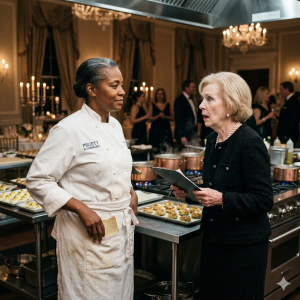
Not as a guest. Not as a memory someone whispered about across a champagne flute. As the woman running the kitchen, wearing a white chef’s coat with her name embroidered on the chest — and not a single person in that Savannah ballroom recognized her.
That part, Darlene Pruett had counted on.
—
Twelve years is a long time. Long enough for a woman to lose everything and rebuild it into something unrecognizable. Long enough for the people who wrote her off to forget they ever did it.
Darlene had built Pruett & Company Catering out of a church kitchen, a borrowed set of commercial pans, and one laminated recipe card she kept folded in her apron pocket wherever she went.
She couldn’t explain the card, not really, if anyone ever asked. It was her grandmother’s chicken and dumplings recipe, written in pencil on a yellow index card, laminated at a Kinko’s on a Tuesday when Darlene had exactly eleven dollars to her name.
She just knew that every time someone looked through her like glass — every time a vendor asked if her “boss” was available, every time a venue coordinator assumed she was the help and not the owner — her fingers would find that card.
Smooth. Still. Solid.
And then she’d smile, and get back to work.
—
The Henderson-Pruett wedding had come to her through a third-party event planner, the kind of high-cotton Savannah affair with monogrammed napkins and a string quartet and a guest list that read like a country club directory.
Her ex-husband Gary’s new fiancée, Bethany, was twenty-nine, a dental hygienist from Bluffton, and by all accounts a perfectly nice woman who had no idea her future mother-in-law had personally selected Pruett & Company from a portfolio without ever connecting the dots.
Darlene had connected them immediately.
She’d debated turning down the contract for about forty-five seconds.
Then she’d touched the recipe card in her pocket, thought about her grandmother’s voice — “Baby, you show up. That’s how you win” — and signed on the dotted line.
—
The evening started without a ripple.
Her team moved through the reception like water, silver trays catching candlelight, the oyster bar drawing long, happy lines of guests in their linen blazers and sundresses. Darlene stayed mostly in the kitchen, the way she always did during service — not hiding, just working. Watching. The way she’d learned to watch, back when watching was all she’d had the power to do.
She heard Gary’s laugh once, loud and carrying over the band, and she felt nothing except mild professional satisfaction that the crab cakes had gotten a visible reaction from the table near the dance floor.
She touched the recipe card once, just out of habit.
Then Linda Pruett walked into the kitchen.
—
Gary’s mother.
Linda, who wore Chanel to grocery stores and had once told a room full of people at the Savannah Golf Club that her son’s first wife had “good intentions but limited horizons.”
Linda, who had stood in this very venue twelve years ago — this same ballroom, at Gary and Darlene’s own wedding reception — and said what she said.
Linda, who clearly had not yet looked closely at the name on the contract.
She walked in with the posture of a woman who owned every room she entered, waving a clipboard at Darlene’s sous chef like she had questions about the passed hors d’oeuvres timing.
“I need to speak to whoever is in charge of this event,” Linda announced to no one in particular.
“That’s me,” Darlene said, from the stove.
Linda glanced at her. The polite, unseeing glance of a woman who has never truly looked at the help.
“I mean the owner of the company, dear.”
Darlene dried her hands on a dish towel. Slowly. Deliberately.
“Also me,” she said.
Something flickered across Linda’s face — a small confusion, the first crack in the plaster. She looked down at the clipboard in her hand, at the contract header she’d been using all evening to flag catering questions.
She read the company name.
She read it again.
Her face went the color of old milk.
“Pruett and —” she started.
“Company,” Darlene finished for her, her hand moving to her apron pocket, fingers finding the laminated edge of that little yellow card. Smooth. Still. Solid.
She smiled the way her grandmother had taught her to smile — not sharp, not triumphant. Just certain.
“You actually have met the owner, Linda,” she said, her voice as even as a kitchen counter. “About twelve years ago. In this very building.”
Linda’s mouth opened. Nothing came out.
“When you told me,” Darlene continued, calm as river water, “that I’d never amount to anything worth remembering.”
The kitchen went quiet enough to hear the string quartet in the ballroom playing something slow and sweet.
Linda Pruett stood there, holding that clipboard, her eyes doing the math that twelve years hadn’t prepared her to calculate.
And Darlene just waited.
—
What Darlene remembered about that night twelve years ago — the night of her own wedding reception in this same building — was the smell of gardenias. They’d been everywhere, in tall glass vases along the windows, tucked into the centerpieces, pinned to the lapels of the groomsmen. She’d loved gardenias. She’d thought they smelled like something permanent.
She’d been in the bridal suite touching up her lipstick when she overheard Linda in the hallway, talking to Gary’s aunt Carol in the low, carrying voice of a woman who never imagined she’d be overheard because she’d never truly considered that the people around her were real enough to hear things.
“She’s sweet,” Linda had said. “In the way that a stray cat is sweet. She tries. But Gary has ambitions, Carol. He’s going to outgrow her inside of five years, and then she’ll be back where she started, with nothing to show for it. That girl will never amount to anything worth remembering.”
Darlene had stood very still, lipstick in hand, and listened to the rest of it.
Then she’d walked back into her own wedding reception, danced every dance, cut the cake, kissed her husband, and smiled until her face ached.
She hadn’t told Gary what she’d heard. She’d told herself it didn’t matter, that Linda was Linda, that love was bigger than one woman’s opinion in a hallway.
She’d been right about some of that.
—
Linda found her voice somewhere in the long silence.
“Darlene.” It came out smaller than she’d probably intended. Not imperious. Not correcting. Just the name, dropped like something she’d picked up and wasn’t sure how to hold.
“Linda,” Darlene said back, equally plain.
Her sous chef, Marcus, had gone very still near the pass window, a ladle in his hand, doing a masterful impression of a man who was absolutely not listening to every single word.
“I didn’t — the planner handled the contract, I never —” Linda stopped. Started again. “I didn’t know it was you.”
“I know you didn’t,” Darlene said.
The simplicity of that seemed to land harder than anything pointed would have. Linda blinked.
“The food has been remarkable,” Linda said finally. She said it carefully, like she was testing the temperature of it, like she wasn’t sure if even a compliment was safe ground.
“Thank you,” Darlene said. “We’ve worked hard to get here.”
Another silence. The string quartet had shifted to something upbeat, a little Gershwin, and the muffled sound of it filtered under the kitchen door like light under a curtain.
Linda looked down at the clipboard. She seemed to be rearranging something internally, the way a person does when they’ve walked into a room and found the furniture completely different from what they remembered.
“I owe you an apology,” she said.
Darlene hadn’t expected that. She kept her face steady, but something in her chest shifted an inch.
“I said something ugly to Carol the night of your wedding,” Linda continued. Her voice had gone careful and a little stiff, the way people sound when they are genuinely unaccustomed to saying hard things and are trying anyway. “I don’t know if you heard it or if someone told you or if this is —” She gestured vaguely at the kitchen, at the whole improbable evening. “I don’t know what this is, exactly.”
“It’s a job,” Darlene said. “A very good one. One I’m proud of.”
“You should be.” And Linda said it without qualification, which was, Darlene thought, probably the most it was going to cost her to say anything she’d said all evening.
It wasn’t a speech. It wasn’t a reckoning from a movie, where the wrong person breaks down and says every true thing and earns their absolution. It was a sixty-two-year-old woman in a mother-of-the-groom dress, standing in a catering kitchen, saying the words she had.
Darlene looked at her for a moment. Then she nodded.
“I know,” she said. And she meant it in all the ways it could be meant — I know you owe me one, I know it cost you something to say it, I know it’s not enough and it doesn’t need to be, I know who I am now in a way I didn’t then. All of it, folded into two words.
Linda nodded back, once, like a period at the end of a sentence.
She looked at the clipboard. “I came in because someone had a question about the wedding cake service timeline,” she said, returning to the voice of a woman with logistics to manage.
Marcus materialized immediately with a printed schedule.
And that was that.
—
Linda left without looking back. The kitchen exhaled.
Marcus waited exactly four seconds before turning to Darlene with the expression of a man who had ten thousand questions and knew better than to ask a single one during active service.
“Cake goes out at nine forty-five,” Darlene said.
“Yes, chef,” he said, and went back to work.
—
Darlene didn’t see Gary until the very end of the night.
She hadn’t planned on seeing him at all. That wasn’t what she’d come for. She’d come because the contract was good and the venue was beautiful and her grandmother’s voice had told her to show up. She wasn’t there to haunt anyone. She wasn’t there to be a chapter in a story someone else was telling.
But as her team was breaking down the oyster station at close to eleven o’clock, Gary came through the service entrance looking for his mother’s forgotten pashmina, and he found Darlene instead.
He stopped.
She watched it happen — the confusion first, then the slow assembly of recognition, the way a face moves when it is putting together something it genuinely wasn’t prepared for.
“Darlene,” he said.
“Gary.” She was wiping down a prep table, unhurried. “Congratulations. Bethany seems lovely.”
He stared at her. He was forty-four now, a little heavier, still handsome in the way certain men stay handsome without trying. He looked at the kitchen around him, at her team in their white coats, at the Pruett & Company van visible through the propped-open back door.
“You catered my wedding,” he said. He didn’t sound angry. He sounded like a man trying to orient himself in a space he didn’t have a map for.
“You hired the best,” she said simply, and there was no meanness in it, just the plain truth of it, offered without apology.
Gary laughed. It was a short, bewildered sound, nothing like the loud, carrying laugh she’d heard earlier in the ballroom. This was smaller. More honest.
“Are you okay?” he asked. “I mean — are you —” He looked around again. “You did all this?”
“Built it from nothing,” she said. “Eight years running. We did the Governor’s mansion last spring.”
He shook his head slowly. Not in disbelief — she could see he believed it — but in the way a person shakes their head when they are absorbing information that requires a recalibration of something they thought they knew.
“I heard you left Savannah,” he said.
“I came back,” she said.
They stood there for a moment in the way of two people who shared a whole world once and now shared only a kitchen at the end of someone else’s party. It wasn’t comfortable exactly, but it wasn’t sharp either. It was just what it was — the ordinary, slightly melancholy thing that time does to people who once mattered to each other.
“Your grandmother’s chicken and dumplings,” Gary said suddenly, looking at the menu card still clipped to the station board. “You put it on the menu.”
Darlene glanced at the card. They’d offered it as a late-night comfort course — a Pruett & Company signature, small cups of it sent out around ten o’clock, and it had stopped people mid-conversation at a dozen events.
“I did,” she said.
“I had two cups,” he said, and something passed across his face that she recognized — the specific look of a person tasting a memory they hadn’t expected. “It was the best thing I’ve eaten in years.”
She thought about her grandmother then, and about the laminated card in her apron pocket, worn soft at the corners now from years of being held. She thought about the Tuesday at Kinko’s, and the eleven dollars, and the church kitchen, and every vendor who’d asked for her boss, and every venue coordinator who’d handed her a service entrance map like that was all she was.
She thought about Linda’s face going the color of old milk.
She thought about standing still in a bridal suite, lipstick in hand, listening through a hallway wall.
“Glad you liked it,” she said.
And she meant it. She genuinely, cleanly meant it, because she was standing in her own kitchen, at the end of her own successful event, in a white coat with her own name on it. Gary’s enjoyment of her grandmother’s recipe was not a consolation. It was just a nice thing. She was allowed to let it be a nice thing.
He found his mother’s pashmina on a chair near the door.
He paused on his way out. “Take care of yourself, Darlene.”
“I always have,” she said.
—
Her team finished breakdown at midnight. They loaded the vans in the warm Savannah dark, the river somewhere nearby doing what rivers do, unhurried and indifferent and always moving. Marcus locked the last case and handed her the final sign-off sheet, and she signed it leaning against the van with a pen she’d had for three years because she liked the way it wrote.
She stood there for a minute after the team drove off. Just stood in the parking lot of that ballroom with the gardenias long since wilted and the string quartet long since packed up and all the monogrammed napkins balled into linen bags waiting for the laundry service.
She put her hand in her apron pocket.
The card was there. Still laminated, still yellow, still folded exactly the way her grandmother had folded recipe cards — in thirds, like a letter, like something meant to travel.
She didn’t take it out. She just held it.
Her grandmother’s name had been Cora. Cora Bea Pruett. She’d run her own kitchen for forty years out of a house in Guyton, Georgia, and she’d never once had a business card or a van with a logo on the side or a contract with the Governor’s mansion, but she’d fed people until they felt held, and she’d believed, down in her marrow, that a woman who could do that had everything she needed.
“Baby, you show up,” Darlene said quietly, to the parking lot, to the river, to no one and everyone. “That’s how you win.”
She got in her car.
She drove home through Savannah with the windows down and the night air coming off the water, past the squares with their live oaks and their silence, past the houses with their lit windows and their ordinary life moving around inside them. Her phone showed three new inquiry emails and a five-star review that had posted during service, from a guest who’d written, I don’t know who the caterer was tonight but someone needs to tell them the chicken and dumplings changed my life a little.
Darlene laughed out loud at that, alone in her car, a real laugh, unguarded and full.
She pulled into her own driveway — her own house, bought with her own money, with a kitchen she’d designed herself, with herb pots on the back step and a magnetized strip above the stove that held her good knives.
She hung up her chef’s coat on the hook by the door.
She put the recipe card on the kitchen counter, the way she always did when she got home, so she could see it in the morning.
It was just a yellow index card. Pencil on paper, sealed in laminate, soft at the corners, containing a recipe for chicken and dumplings that had never failed her once.
It