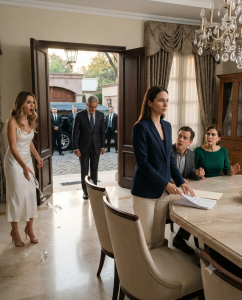
When Mercedes Alcázar threw the divorce papers across the marble table, she did it with the confidence of a woman who had never once in her life been forced to wonder whether she was safe.
The papers slid across the polished surface and stopped inches from Sofía’s hands.
“Sign, you ridiculous librarian,” Mercedes said, her voice carrying through the salon with practiced contempt. “And leave this family before I regret giving you anything.”
The insult landed exactly the way it was meant to. Publicly. Cleanly. With witnesses.
That was how the Alcázars liked to punish people.
Not with shouting first. With ceremony.
The salon was drenched in soft afternoon light, the kind that made every expensive object in the room glow. Crystal. Silver. Imported rugs. Paintings chosen more for price than meaning. The mansion in Lomas de Chapultepec had always felt less like a home and more like a polished declaration that the Alcázars belonged above everyone else.
And in that house, Sofía had spent three years being treated like a stain someone was too embarrassed to mention directly.
She had learned to recognize all the variations of contempt. The pause before introductions. The narrowed eyes over her modest dresses. The way the staff had initially been kind to her until they understood the family expected distance. The way Mercedes always found a reason to mention “breeding,” “background,” or “class” whenever guests were present. The way Leonardo smiled through it and later acted as if none of it had mattered.
Her crime, apparently, was simplicity.
She worked in a public library in Coyoacán. She wore little jewelry. She liked old books, quiet cafés, handwritten notes, and walking to work when she could. She had never cared to impress people who treated kindness like weakness.
To the Alcázars, that made her poor.
Worse, it made her incomprehensible.
And rich people who cannot categorize you quickly often become cruel.
Sofía looked down at the divorce packet. It was thick. Thorough. Every page had been designed to end more than a marriage. It was meant to establish a hierarchy one final time: Leonardo would remain exactly who he had always been in public—the brilliant heir, the polished executive, the man building an empire through vision and discipline. Sofía would leave with a settlement large enough to sound generous in headlines and small enough to be insulting in context.
Three and a half million dollars.
Mercedes had made sure to say it aloud.
“For someone like you,” Leonardo added without lifting his gaze from his phone, “that’s more than you ever imagined.”
Across from them, Valeria Iturbide crossed one leg over the other and smiled into her wineglass.
Valeria was one of those women who understood the power of appearing effortless. Her white dress had probably cost more than most people’s monthly rent. Her jewelry was subtle in the way only truly expensive jewelry can be. She sat in the salon like she belonged there, because in every way that mattered, the Alcázars had already made room for her.
She wasn’t supposed to be there. Not officially.
But no one had asked her to leave.
That told Sofía everything she needed to know about when this marriage had really ended.
“She’s not even crying,” Valeria said softly.
Mercedes laughed. “She’s not cold. She’s resentful. Women without a family name always think they’re the victim.”
The cruelty in the room was so casual it would have been unbearable if Sofía had still expected decency from them. But she didn’t. Not anymore.
There had been a time, early in the marriage, when she believed Leonardo’s indifference came from pressure. From exhaustion. From being raised in a family where affection was always transactional. She had mistaken emotional negligence for stress. She had defended him in conversations he never deserved to be protected in.
That had been her last act of innocence.
She lifted the first page and scanned the clauses. House. Vehicles. Corporate participation. Country property in Querétaro. Investment accounts. Joint assets carefully reclassified until almost nothing remained joint at all.
Leonardo had prepared this with the precision of a man who assumed she wouldn’t understand what he was taking.
“I want to confirm something,” Sofía said.
The room shifted slightly. They had expected tears. Silence. Maybe pleading.
Not composure.
“When I sign, Leonardo keeps everything,” she continued. “And I make no claim.”
“That’s right,” Leonardo said, finally looking up. “You understand your place at last.”
Her eyes held his.
“And you are certain it all belongs to you.”
Something in the question annoyed him.
“I built this,” he said. “I worked. You stood beside me.”
The family attorney, Héctor Villaseñor, adjusted the papers in front of him. He was a narrow man with watchful eyes and the permanent expression of someone who had spent years surviving other people’s secrets. He had been present for acquisitions, settlements, tax disputes, whispered scandals, and one very quiet paternity arrangement fifteen years earlier that had never reached a courtroom.
He knew what panic looked like.
This wasn’t panic.
Sofía took the pen.
For one brief second, Héctor felt a pressure in his chest he could not explain. He watched her posture, her hands, the total steadiness in her expression. It looked less like a woman losing a marriage than a woman walking through a door she had already unlocked in private.
She signed.
When Héctor saw the surname, his skin went cold.
Not Alcázar.
Duarte.
He stared at it long enough for Leonardo to look up in irritation.
“Counselor, file it.”
Héctor didn’t move.
“Mr. Alcázar,” he said carefully, “she signed Duarte.”
Leonardo frowned. “That was her last name before marriage. So what?”
Héctor looked at Sofía, then back at the page.
“What Duarte?” he asked.
Sofía placed the pen on the table with remarkable delicacy. Then the sound began outside.
A low vibration.
Mercedes frowned toward the windows. Valeria turned her head. Leonardo half rose from his seat. The chandelier trembled almost imperceptibly overhead as the sound deepened from distant engine noise into something coordinated and close.
Then the front gates opened.
From the salon windows, they watched a procession of armored SUVs enter the property in precise succession. No wasted movement. No confusion. No showy aggression. They spread through the drive with the efficiency of people who expected compliance because compliance had already been arranged.
Mercedes stood.
“What is this?”
Leonardo took a step forward. “Sofía. What did you do?”
The front doors opened before she answered.
An older man with silver hair entered the salon carrying no visible urgency and therefore commanding all of it. His suit was dark, perfectly fitted, and entirely forgettable in the deliberate way of men who never need their clothing to speak for them. He did not glance at the Alcázars. He crossed the room directly to Sofía and inclined his head with unmistakable respect.
“Good afternoon, President Duarte.”
The silence that followed was total.
Valeria’s wineglass slipped from her hand and shattered on the floor. No one reacted.
The man straightened. “The Áurea trust completed the transfer at eleven this morning. The board confirmed your appointment. All banking authorizations have been released. Every controlling participation is now under your authority. Your grandfather’s instructions were clear. Effective immediately, you assume full possession.”
He handed her a leather portfolio.
“Thank you, Arturo,” she said.
Leonardo gave a short laugh, but there was no humor in it.
“President of what? Sofía, what is this?”
She finally met his eyes.
There was no anger there.
No triumph either.
Only clarity.
“When I was a child,” she said, “my grandfather used to tell me that power begins to lose the moment it needs to shout. That’s why I never corrected any of you.”
Mercedes found her voice first. “I don’t care who you are. She signed the divorce. She has no claim on this family.”
Arturo turned toward her.
“Mrs. Alcázar, I would advise caution. Grupo Alcázar, this residence, the associated corporate debt, the aircraft, the Querétaro ranch, and Mr. Alcázar’s personal obligations are secured through entities owned by Mrs. Duarte.”
Leonardo went white.
“No.”
Sofía’s gaze did not leave him. “Yes. What should trouble you is not who I am. It’s that for three years, none of you ever asked why a woman you thought had nothing never once asked your family for anything.”
His phone rang.
He looked down at the screen. A bank.
Then another call. A board member. Then another. A private lender. A restricted number from New York. Another from Mexico City. The vibration on the table sounded suddenly frantic.
His world was learning the truth in real time.
He stared at Sofía as if seeing her for the first time.
The truth was, he never really had.
He had met her at a charity literacy event hosted through one of the group’s cultural foundations. She had spoken about access to education in neighborhoods where public funding had collapsed. Not dramatically. Not emotionally. She had simply known what she was talking about, and people listened. Leonardo had been intrigued because she was the first woman in months who did not seem impressed by him.
She had not asked for introductions. Not for favors. Not for invitations.
That made her irresistible.
In the beginning, he had admired her calm. Later, he resented it. Then he tried to dominate it.
He never managed.
Even in private, she never fought the way he expected. She didn’t escalate. She didn’t beg. She asked precise questions, listened carefully, and stored information he assumed had evaporated because she had not immediately used it against him.
That had been his biggest mistake.
Confusing quiet with emptiness.
Sofía stood from her chair.
“I didn’t sign to lose everything, Leonardo,” she said. “I signed to stop protecting you.”
She turned to leave.
Arturo moved with her, but before they reached the door, he paused beside the table and placed another file in front of Mercedes.
“Since we are all assembled,” he said, “there are additional documents the family should review.”
Mercedes did not touch them.
“What documents?”
“Transfer histories. Reclassified loans. Offshore movement between shell entities. Guarantees attached to debt instruments your son appears to have signed under assumptions that are no longer valid.”
Leonardo’s head snapped toward him. “What assumptions?”
Arturo’s tone did not change. “That the collateral would remain under Alcázar control.”
For the first time since the convoy arrived, fear entered the room fully formed.
Not embarrassment.
Not outrage.
Fear.
Valeria slowly set her glass stem on the side table, though the bowl had already broken away. “I don’t understand,” she said.
Sofía looked at her. “That depends on how much you knew.”
Valeria’s face tightened. “About what?”
“About the consulting firm that received the last internal payment.”
Leonardo turned toward Valeria so quickly that Mercedes flinched.
“What payment?”
Valeria opened her mouth, but no sound came out.
Héctor Villaseñor, who had remained silent through most of the exchange, lowered his eyes. He now understood why Sofía had chosen this exact day for the divorce. This was not merely social humiliation. It was sequencing. A legal and financial choreography timed to the second.
Divorce first.
Protection withdrawn second.
Exposure third.
And somewhere behind all of it lay a structure built years earlier by someone named Duarte.
Mercedes finally grabbed the file and flipped it open. She scanned the first pages and then the next. Her expression changed so quickly it was almost grotesque. “Leonardo,” she said, “what is this?”
He snatched the papers from her.
Line items. Dates. Entity names. Emergency credit extensions. Guarantees. Luxury purchases routed through corporate channels. Funds transferred to a boutique advisory company with one silent partner hidden behind layers of registration.
Valeria Iturbide.
His hand tightened around the pages.
“You said this was temporary,” he said.
Valeria’s eyes filled with panic. “I said I could help move things until the acquisition closed.”
“There was no acquisition.”
Her silence answered him.
Mercedes sat down very abruptly.
For years she had believed her son’s confidence meant competence. She had mistaken swagger for control, expensive dinners for leverage, charm for judgment. Now, as call after call continued flooding the room, she began to understand the possibility she hated most: the family had not been betrayed by outsiders first.
They had been betrayed from within.
Sofía stood near the doorway, watching all of it with a sadness so restrained it almost hurt to look at.
Not because she still loved Leonardo the way she once had.
That version of love had died slowly, in humiliations too small to justify individually and too relentless to survive together. It had died when he let Valeria linger too long at dinners. When he mocked her work in front of investors. When he once told her, after a dinner party, that intelligent women were more appealing when they spoke less. When he dismissed her questions about irregular transfers and laughed at her for reading financial statements “like novels.”
It had died the night she realized his care only existed when it cost him nothing.
But grief had remained.
Not for the marriage itself.
For what it proved.
Her grandfather had warned her before the wedding.
Not with commands. Never that.
He had simply asked, “Does he value what cannot increase his status?”
At the time, she believed the answer was yes.
Later, when she saw the first fractures, she said nothing to her family. Arturo knew enough to keep watch. The trust lawyers knew enough to prepare contingencies. Her grandfather, already ill by then, amended his instructions in ways Leonardo would only now begin to understand.
Because Sofía was not merely a wealthy woman who had concealed her background.
She was the designated successor to a holding structure older than Grupo Alcázar’s rise and far more patient. The Duarte family had not built a public empire with magazine covers and vanity events. They had built quiet leverage. Banks. Debt vehicles. land reserves. Acquisition capital. Strategic rescues of failing companies whose owners later forgot who had saved them.
Years ago, when Grupo Alcázar expanded too fast, the financing pipeline that kept it standing had come through layered instruments no one in the family bothered to examine beyond the names of intermediaries.
Those intermediaries led, eventually, to Duarte-controlled entities.
Leonardo had built plenty.
But not nearly as independently as he claimed.
And Sofía had known exactly when his ambition tipped into recklessness.
The first time she covered for him, it was out of loyalty.
The second time, out of hope.
The third time, she stopped calling it love and started calling it delay.
“I should have let the board see this last year,” she said quietly.
Leonardo looked up. “Then why didn’t you?”
Because despite everything, she had once wanted to save him.
Instead, she answered with the truth he deserved to hear.
“Because I wanted to know whether you would stop on your own.”
He laughed once, harshly. “You set me up.”
“No,” she said. “I watched you continue.”
The distinction hit harder because it was true.
Arturo checked his watch. “Madam President, we need to leave. The audit team is waiting.”
Leonardo stepped forward. “Audit?”
Arturo’s expression turned almost sympathetic. “The audit is not your largest concern.”
Mercedes looked up sharply. “Then what is?”
Arturo glanced at Sofía. She gave the smallest nod.
He spoke with formal precision. “There is an inheritance enforcement clause tied to the original Duarte-Alcázar agreements.”
The room went still again.
Mercedes’ face lost color. “That agreement was symbolic.”
“No,” Arturo said. “It was binding.”
Leonardo stared between them. “What agreement?”
And that was the final humiliation of all.
His family had built its identity on superiority while failing to teach its heir the origin of half its stability.
Arturo continued, “Two generations ago, when the Alcázar expansion nearly collapsed, the Duarte family provided the capital structure that prevented liquidation. The terms included financial oversight rights in the event of marital union between the families, especially if mismanagement, concealment, or betrayal jeopardized shared interests.”
Valeria gripped the back of a chair.
Mercedes whispered, “My husband said those protections would never be invoked.”
“He assumed no one would be foolish enough to trigger them,” Arturo replied.
Leonardo looked at Sofía as if the floor had vanished beneath him. “You married me because of a contract?”
The pain in his voice came too late to matter, but Sofía answered anyway.
“No,” she said. “I married you because I loved you. The contract is why your collapse won’t destroy innocent people with you.”
That hit him harder than the numbers.
Because it meant there had been a version of this story where he could have had both her love and her protection.
He lost both on his own.
He looked toward Valeria. “Get out.”
She didn’t move.
“Get out!” he shouted.
This time his voice echoed.
And in that echo, he heard it himself—the desperation, the unraveling, the sound of a man discovering too late that shouting was all he had left.
Valeria backed toward the hall, pale and trembling. Mercedes sank into the chair nearest the window, one hand over her mouth. Héctor quietly began gathering the papers he would now need for proceedings far more serious than divorce.
Sofía took one last look at the room.
The marble table. The broken glass. The unsigned arrogance still hanging in the air like perfume that had gone sour. The husband who had mistaken possession for strength. The mother who had weaponized lineage without understanding its real history. The woman who thought she was arriving for a victory and instead had walked into an audit.
Then Sofía spoke for the last time before leaving.
“My grandfather taught me something else,” she said. “The most dangerous people are not the loud ones. They’re the ones everyone underestimates while standing in their debt.”
She turned and walked out.
The convoy doors closed behind her. The city outside moved as usual—traffic, heat, vendors, sunlight on glass towers—as if entire dynasties did not collapse quietly every day behind private gates.
Nine days later, the emergency board session stripped Leonardo of operational control.
Within three months, the luxury aircraft was sold, the ranch was restructured under creditor supervision, and multiple internal investigations triggered lawsuits no amount of social influence could bury. Valeria’s firm dissolved under scrutiny. Mercedes stopped appearing at public events. Héctor, who had seen enough families destroy themselves to know when to leave, resigned before the worst filings became public.
Sofía did not return to the mansion.
She retained ownership where necessary, liquidated what should never have been protected, and preserved the segments of the business that employed people who had done nothing wrong. The public narrative was managed carefully. Mismanagement. Internal review. Leadership transition. Strategic restructuring.
The headlines never captured the truth.
The truth was smaller, sharper, and far more human.
A woman had been mocked for being ordinary by people who confused discretion with inferiority.
A husband had believed money made him untouchable because he never bothered to ask where the scaffolding beneath him came from.
And a family that worshipped surnames had forgotten the one name that mattered most until it was signed in ink directly in front of them.
In quieter moments afterward, Sofía still thought about the version of herself who had arrived at that mansion with hope. She did not miss the marriage, but she mourned the trust she had carried into it. That was the real cost. Not the public cruelty. Not the legal theater. Not even the betrayal with Valeria.
It was realizing that love had asked her to shrink in a place where respect was never going to be offered freely.
She returned to the library in Coyoacán two weeks after the board session.
The staff greeted her exactly as they always had. One coworker asked whether she still wanted the first edition repair catalog she had requested. A child near the reading corner fell asleep over a picture book. Outside, someone was selling coffee in paper cups. Inside, the silence felt honest.
Sofía stood among the shelves and let that ordinary peace settle around her.
Power, she knew now, was not the mansion. Not the convoy. Not the signatures, the leverage, or the fear in Leonardo’s face when the calls began.
Power was being able to leave a room that tried to define your worth—and never need permission to do it.
Still, one question stayed with her long after the filings, the transfers, and the headlines faded.
What was the bigger red flag?
That Leonardo betrayed her for status and appetite, or that for so long he truly believed she was too small to see him doing it?