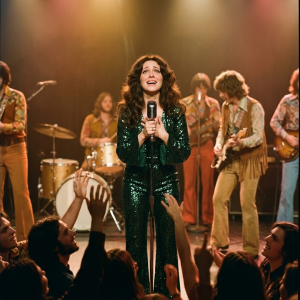
She smiled when they threw her out.
That’s the part nobody in Cedarville could ever quite explain.
Not a bitter smile. Not a fake one. Just — calm. Like she already knew something the rest of the room didn’t.
— 1997, and Nora Selby had been singing with the Cedarville Community Choir for six years. She knew every alto harmony by heart. She’d ironed her green rehearsal blouse that morning. She’d even brought a tin of her mother’s peppermint brownies for the break table.
She never got to put them down.
The new director — Patricia Hale, married just four months to Nora’s former fiancé, Russell — stopped the rehearsal mid-song. Turned to face the choir. And in front of sixty people Nora had known her entire life, Patricia said the words that would follow Nora out of that room and all the way out of Cedarville.
*”Some voices just aren’t polished enough for a performance of this caliber. Nora, I think you’d be more comfortable watching from the audience this year.”*
There were gasps. A few. Not enough.
Nora set her sheet music on top of the upright piano — slowly, neatly, like she was shelving a library book — and she walked out without a single word.
What nobody saw was what she slipped into her coat pocket on the way out the door.
A folded rehearsal program. The one they’d handed out at the start of the evening, with the choir roster printed inside — her name still on it, in black ink, third row from the bottom.
She’s had it ever since.
—
Twelve years passed.
Cedarville moved on, the way small towns do. Russell and Patricia bought a nice colonial on Birchwood Drive. The Rialto Theater — that gorgeous old 1940s gem on Main Street — fell into disrepair, boarded windows and all, the marquee letters picked off one by one by weather and neglect.
Nobody knew who bought it.
The sale was handled through a shell company. The renovation crew was brought in from out of state. For eight months, Cedarville watched the old Rialto get rebuilt from the inside out — new roof, restored plasterwork, a stage that could hold a full orchestra — and not a soul could get a straight answer about who was behind it.
Until the invitations arrived.
Cream-colored envelopes, hand-addressed, delivered to sixty people around Cedarville. *You are cordially invited to the Grand Reopening Gala of the Rialto Theater. Black tie. December 14th. Compliments of the Founder.*
No name. Just that.
People talked about those invitations for weeks. Who sent them? Why those sixty people specifically? Half of them had some connection to the old Choir. Half of them had been in that rehearsal room in 1997.
Patricia Hale-Selby — she’d kept the name, which still struck people as something — received her invitation on a Tuesday. She told her neighbor it was probably a real estate developer from Nashville or Atlanta wanting community goodwill.
She RSVP’d yes. Of course she did.
—
Tonight, the Rialto glittered.
Champagne. String lights threaded through the restored balcony rails. A string quartet warming up near the lobby bar. The smell of fresh paint underneath gardenia centerpieces, that particular mix that feels like possibility.
Nora was there early — though most guests wouldn’t have recognized her. Twelve years in Nashville, then Charlotte, then a very quiet corner of success that she’d never felt the need to announce back home. Her hair was up. She wore a deep navy dress, simple but fitted. And tucked into her small evening bag, folded into quarters the way it had been since 1997, was that old rehearsal program.
A few guests noticed her touching it through the evening. Once near the coat check. Once by the stage door. A small gesture — her hand pressing down on the bag, just for a second — like checking that something precious was still there.
Nobody knew what it was. Nobody thought to ask.
—
Mayor Denton gave his speech at nine o’clock, thanked the anonymous benefactor, called it a miracle for the town, got a little misty about it. The room applauded.
And then the curtain rose.
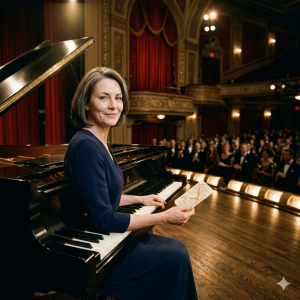
There, at the Rialto’s gleaming new grand piano — the centerpiece of the restored stage, a nine-foot Steinway that had cost more than most houses on Birchwood Drive — sat a woman in a navy dress, adjusting the microphone with a quiet smile.
The room went still.
In the front row, Patricia Hale-Selby had just found her seat. It was reserved. Gold plaque on the chair back, the way they do at galas for honored guests.
She leaned in to read it.
*Compliments of the Founder.*
The color left her face so fast that the woman beside her reached out to touch her arm.
Up on the stage, Nora’s hand dipped into her evening bag one last time.
Her fingers found the folded program.
She looked up — out past the footlights, past the rows of familiar Cedarville faces — and found the one she’d been waiting twelve years to find.
And she smiled.
That same smile.
—
She didn’t unfold the program. She didn’t hold it up, or make a show of it. She simply set it on the piano’s music ledge, in the place where sheet music goes, and smoothed it flat with two fingers.
Then she leaned into the microphone.
“I grew up in this building,” she said. “Saturday matinees. My mother used to bring me and my sister for the two-thirty show, and we’d split a bag of popcorn that was too salty and too good, and I’d stare up at that ceiling — ” she glanced up at the restored plasterwork, the painted medallions, the chandelier that now blazed clean and whole above them ” — and I’d think that this was the most beautiful place in the world.”
A few people in the audience nodded. The older ones who remembered.
“I left Cedarville in January of 1998. Some of you know why. Most of you were there.” She said it without heat, without theater. Just the plain fact of it. “I spent about two years being angry about that night. And then I spent about two more years being grateful for it.”
Someone in the third row shifted in their seat.
Nora’s eyes didn’t move from the middle distance. She wasn’t performing. She was just talking, the way you talk when you’ve been waiting a long time to say something and you’ve decided, finally, to say it simply.
“I went to Nashville because I had nowhere else to go. I waited tables at a place on Demonbreun Street and I played piano on Tuesday nights for tips. One Tuesday a record producer came in with his girlfriend and her birthday dinner ran long and I played for three hours instead of two and he left me his card under a ten-dollar bill.” She paused. “I still have that ten-dollar bill somewhere, too. I keep things.”
There was a little laughter. Warm laughter. The kind that comes out of people when they’re relieved to find that a story is going somewhere good.
“I made three albums. None of them set the world on fire, which is fine. I wrote songs for other people who did set the world on fire, which paid considerably better.” She smiled at that. “I built something I’m proud of. I built it quietly, because I didn’t see any reason to make noise about it. And then about four years ago, I drove through Cedarville on the way back from my sister’s place in Kingsport, and I passed the Rialto with its boards on the windows and its busted marquee, and I pulled over on Main Street and I sat in my car for about twenty minutes.”
She touched the edge of the program on the piano ledge.
“I thought about my mother bringing me here. I thought about that ceiling. And I thought — someone ought to fix this. Someone ought to give this back.”
She let that sit for a moment.
“So I did.”
The room didn’t erupt. It did something better than that — it exhaled, all at once, sixty people letting go of eight months of wondering, and in the silence that followed you could hear the chandelier crystals shifting in the heat of the room.
In the front row, Patricia Hale-Selby sat very still. Her hands were in her lap. She was looking at the stage the way you look at something you’ve been trying to prepare for and couldn’t.
Nora saw her. Of course she did. She’d known exactly where that chair was placed.
“I invited the sixty people who were in that rehearsal room in December of 1997,” Nora said, “because those are the sixty people who watched something happen and didn’t know what to do about it. And I want you to know — I’m not angry. I haven’t been angry in a long time.” She looked around the room slowly, taking it in section by section, the way a choir director surveys her singers. “But I wanted you to see it. I wanted you to be here for this. Because this is what it looks like when somebody gets back up.”
She reached down and picked up the folded program.
She held it for a moment — not for the room, just for herself, the way you hold something before you finally put it down.
Then she set it back on the ledge, opened the lid of the Steinway, and played the opening bars of the carol they’d been rehearsing the night she was asked to leave. “O Holy Night.” The one she’d known every note of for twenty-five years.
And then she sang it.
Nobody in that room had ever heard Nora Selby truly sing. Not like this. Not what she’d become. The voice that came out of her in the Rialto that night was something that a church basement rehearsal room could never have held anyway — something that needed exactly this much space, exactly this height of ceiling, exactly this kind of silence from an audience that had stopped breathing.
People cried. Several of them. The older woman beside Patricia reached out again — not out of worry this time, but just because that is what people do when something is too beautiful to hold alone.
Patricia cried too.
She wouldn’t have told you that beforehand. She would have told you she was beyond being moved by Nora Selby. But there she was, in the front row of a theater she hadn’t known belonged to the woman she’d humiliated, and the voice washing over her was not the voice she’d dismissed in 1997 — or maybe it was exactly that voice, and she’d simply been wrong, and she was only now, twelve years later, being allowed to understand that.
—
Nora played for forty minutes.
When she finished, she stood and took one small bow — not a performer’s bow, more of an acknowledgment, a nod — and she picked the old program up off the piano ledge.
She walked down the stage steps and through the crowd, which parted for her the way crowds do for someone who has just done something that has changed the air in a room.
She stopped in front of Patricia.
Patricia stood. Her husband Russell, somewhere in the fourth row, did not.
For a moment the two women just looked at each other. Nora was calm. Patricia’s chin was doing the thing chins do when someone is trying very hard not to cry any further and losing the fight.
“I’m sorry,” Patricia said. She said it quietly, the way you say things you mean. “I was awful to you. I was awful to you and I’ve known it for a long time and I didn’t —” She stopped. Started again. “I’m sorry, Nora.”
Nora nodded once. Not performing forgiveness. Not making a moment of it. Just receiving it, the way you receive something you’ve been owed for years and have long since stopped needing to survive.
“I know,” she said. And then, because she was Nora Selby and she had always known exactly where the line was: “This theater has a community arts program starting in January. Voice lessons for kids on Saturday mornings. It’s free.” She held Patricia’s gaze. “I thought you might want to know.”
Patricia blinked.
“There’s a signup sheet at the coat check,” Nora said.
And she moved on through the crowd, touching arms, accepting embraces, accepting glasses of champagne she mostly didn’t drink, and laughing with people she hadn’t seen in twelve years as though twelve years were nothing, as though she had always known it would end up exactly here.
—
The folded program sat on the piano ledge for the rest of the evening.
Nobody touched it. Some people walked up to the stage during the reception and looked at it from a few feet away, the way you look at a relic when you understand what it means. Just a piece of paper. The kind of thing you’d throw away without thinking. Her name in black ink, third row from the bottom, in a list of sixty people who had moved on.
Or not moved on, as the case might be.
Nora collected it on her way out, sometime after midnight. She slipped it back into her evening bag.
A woman near the door — Gail Muncie, who’d sung soprano beside Nora for four of those six years and who had been one of the gaspers in 1997, which had never quite stopped troubling her — caught Nora’s arm.
“Are you going to keep it?” she asked. Nodding at the bag.
Nora thought about it for a second.
“For a little while longer,” she said. “Then I think I’ll let it go.”
She buttoned her coat. Outside, Main Street was quiet and cold, and the Rialto’s new marquee threw a clean white light across the sidewalk that you could have read a letter by.
She stood in it for a moment before she got into her car.
That same smile.
Then she drove home.