By the time Darlene Harrow stood up at her sister’s retirement party, nearly everyone in Carter County had already chosen a version of the story.
In that version, Lila Harrow was the strong one.
She was polished, capable, composed under pressure. She had spent more than three decades working in public schools, first as a teacher, then as a principal, and over the years she had built a reputation that felt almost untouchable. She remembered birthdays, wrote sympathy cards, spoke at graduations without notes, and had the kind of calm authority people mistook for integrity. When their mother Ruth died after a hard fight with cancer, people said Lila had handled everything beautifully.
In that same version of the story, Darlene was the sad one.
Quiet. Dutiful. Harmless. The sister who kept books, balanced accounts, and never interrupted anyone. The one who still lived in the same modest house outside town, drove an aging sedan, and spoke so softly that people leaned in only when they absolutely had to. At family gatherings she cleared dishes while Lila led conversations. At church suppers she sat near the end of the table and listened. Most people liked Darlene. Very few noticed her.
Lila had always understood the power of being noticed.
What she never understood was the power of being underestimated.
Ruth Harrow’s ranch had been the spine of the family for forty years. Two hundred and forty acres outside Springer, Oklahoma. Pastures cut by fences Darlene’s father had strung by hand. A white farmhouse with green shutters and a porch swing weathered silver by wind. A long metal barn that smelled like hay, leather, and mineral feed. There were black cattle, a stock pond, mesquite along the back fence, and enough history pressed into the land to make selling it feel, to Ruth, almost like selling blood.
She had said that more than once while she was sick.
“This place is family,” she told both daughters one humid August evening when the pain had already started changing her face. “You don’t have to love every acre the same way I do, but you don’t carve it up and hand it to strangers. Promise me.”
Darlene promised immediately.
Lila hesitated, then smiled and said, “Of course, Mama.”
At the time, Darlene didn’t think anything of that pause. Looking back, she would remember it with a chill.
Ruth’s health worsened fast after Christmas. Hospice came in. Meals were left untouched. Some mornings she was lucid and sharp enough to ask after the calves. Other days she drifted in and out, too weak to finish a sentence. Through it all, Darlene handled practical things. Medications. Bills. Ranch invoices. Insurance mail. Lila handled what other people saw. Doctors. Visitors. The pastor. The lawyer, or so she claimed.
When Ruth died in March, grief moved through the family like weather—heavy, disorienting, and strangely public. People filled the funeral home, brought casseroles, hugged too hard, said the same soft things they always said.
At the visitation, Darlene stood near the casket in a dark dress with a small green ledger tucked under her arm. At the time, it looked like an ordinary notebook. Something a bookkeeper might carry without thinking.
It was not ordinary.
Three days after the funeral, Lila called Darlene and asked her to meet at the probate attorney’s office. Her voice was measured, almost kind. There was paperwork, she said. Some things Mama had updated. Nothing to worry about.
The phrase slid into Darlene’s memory later like a blade: nothing to worry about.
The new will was waiting on the attorney’s conference table when she arrived.
Darlene remembered the room in fragments: the hum of the vent, the silver pen on the legal pad, the framed certificate on the wall, Lila already seated with a box of tissues positioned strategically near her hand. The attorney looked uncomfortable before he spoke, which frightened Darlene more than bad news would have.
According to the document, Ruth had signed a revised will shortly before her death. Everything related to the ranch—land, livestock, mineral rights, equipment, house—passed solely to Lila. Darlene received a handful of sentimental items and a small cash amount.
Darlene read the first page twice. Then she flipped to the signature.
Her chest turned cold.
The signature looked wrong.
It was Ruth’s name, yes, but it had the dragged, shaky stiffness of something copied, not written naturally. More than that, the date made no sense. Ruth had been heavily medicated that day. Darlene knew because she had the prescription refill envelope in her purse from picking up the medication herself.
She looked at Lila, waiting for some explanation that might put the world back into place.
Lila pressed a tissue to the corners of her eyes and said softly, “Mama changed her mind at the end. She was worried about you handling a ranch. She wanted things simple.”
It was an astonishing sentence. Not just because it was cruel, but because it was so carefully built. It made Darlene sound weak while pretending to protect her.
The attorney added that the will appeared valid on its face. Two witnesses. Notarized. Properly signed.
Darlene said almost nothing in that office. She asked for a copy. She took it home. She sat at her kitchen table until dark with the document in front of her and the green ledger open beside it. On the first line of the first page, she wrote the date of the supposed signing.
Then she wrote where Ruth had really been.
Mercy Hospital. Palliative wing. Bed 214.
That was the beginning.
The ranch went under contract with alarming speed. Too alarming. Lila spoke of “necessary decisions” and “avoiding burdens.” She had the language ready before anyone even asked. Men from a Tulsa investment group began showing up at the property in clean boots, talking about access roads and parcel values. Darlene watched one of them step over the old water line her father had dug and felt something inside her settle.
Not break.
Settle.
She knew numbers. She knew records. She knew that lies made by people like Lila were rarely wild. They were neat. They wore makeup. They carried folders. But under the polish, there was always a seam if you were patient enough to follow it.
So Darlene did what she had done all her life when things felt unstable: she kept a ledger.
At first she only meant to organize questions. Dates. Times. Names. The kind of details grief scrambled. But as she checked one fact against another, questions turned into discrepancies. Discrepancies turned into patterns.
The signature date on the will was March 14.
Ruth’s hospital records showed she had been admitted to palliative care at 2:10 p.m. that day. Morphine was administered at 2:23. A second dose at 3:05. The will stated it had been signed at 3:30 in the presence of two witnesses and a notary.
Darlene requested the medication logs.
She requested the visitor sheet.
She requested the nursing notes.
No one stopped her because no one noticed what she was doing. That was one of the gifts Lila had unknowingly given her. Everyone assumed Darlene was still too crushed to fight. They mistook quiet for surrender.
At Easter, Darlene brought the green ledger to her niece’s house and jotted something down after Lila casually mentioned having “talked to Mama’s lawyer for weeks before the end.” That contradicted what the attorney had told Darlene privately—that he had only seen the revised will after Ruth’s death, delivered by Lila.
In June, Darlene went to the county courthouse. She paid for certified copies of probate filings and deed transfers. Sitting on a hard bench, she wrote down time stamps from the recorded sale. Lila had moved on the ranch with a speed that bordered on panic.
In July, she checked the witness names.
One was a retired school secretary named Bonnie Pritchard, a close friend of Lila’s. Darlene requested school district reimbursement records through a public records process. Bonnie had submitted mileage for a trip to Branson, Missouri, beginning two days before the will was supposedly signed and ending three days after.
The second witness was a maintenance supervisor from Lila’s school district. Darlene found photographs on his daughter’s social media from a softball tournament in Amarillo that same weekend, time-stamped and publicly posted. She printed them anyway and noted the dates.
The notary took longer.
Her name was Teresa Vann, a woman who ran a small insurance office near the square. Darlene didn’t confront her immediately. Instead, she learned that Teresa had notarized several documents for school employees over the years and that Lila knew her socially. Months later, after a courthouse clerk quietly resigned and rumors started to move through town, Teresa asked Darlene to meet her in the back room of the insurance office after closing.
She looked sick before she even spoke.
“I didn’t watch your mama sign that will,” she said.
Darlene didn’t answer.
Teresa wrung her hands and stared at the floor. “Lila said Ruth was too weak for visitors and that everything had already been signed. She brought me the signature page and asked me to complete the acknowledgment because the attorney’s office was closing and it had to be done that day. She said it was all proper. She said the witnesses had already signed.” Her voice shook. “I know that doesn’t excuse it.”
“No,” Darlene said quietly. “It doesn’t.”
Teresa eventually signed an affidavit.
The real break came from a mistake Lila would never have made if she had respected Darlene’s intelligence.
Ruth had kept an old rolltop desk in the farmhouse. After the sale, while sorting the last of her mother’s papers, Darlene found an email printout shoved beneath a pad of stationery. It was from Lila to the land broker handling the ranch deal. The message was terse, practical, and devastating.
Need this closed fast before my sister gets ideas. Mom signed what was necessary. Courthouse contact says we can move the title summary early.
Darlene read it three times before she allowed herself to react.
That sentence did two things at once: it showed premeditation, and it suggested someone at the courthouse had fed information or accelerated documents improperly. Darlene copied the email, placed the original in a plastic sleeve, and wrote two names in her ledger: the broker’s and the deputy clerk overseeing probate recordings.
By then she had stopped thinking in terms of family betrayal alone. What Lila had done was larger than greed. She had used Ruth’s dying days, a forged legal instrument, and apparently at least one cooperative official to strip land out of the family before anyone could object.
Darlene hired a lawyer at last.
Not one from town. Not one who might care about school board lunches or local reputations. She found an estate litigation attorney in Oklahoma City, a woman named Celeste Warren who listened without interrupting and understood the value of organized proof the second Darlene set the green ledger on her desk.
“You built me a case file,” Celeste said, turning pages carefully.
“I built what happened,” Darlene answered.
Celeste smiled grimly. “That too.”
Over the next few months, Celeste did what Darlene could not. She subpoenaed records. She took statements. She put legal pressure where quiet note-taking no longer reached. The broker, facing possible civil exposure, cooperated. The former deputy clerk retained counsel and then, through counsel, admitted to releasing internal title information before probate cleared. Teresa Vann’s affidavit was formalized. The witness timelines were corroborated. A handwriting expert compared known samples of Ruth’s signature with the will and found significant indicators of simulation.
Celeste advised Darlene to file immediately and let the matter unfold in court.
Darlene agreed.
But she wanted one more thing first.
She wanted the truth spoken where the lie had lived best: in public, in front of all the people who had let Lila hide inside respectability.
When Lila announced her retirement gala at the country club, Darlene understood at once what she would do.
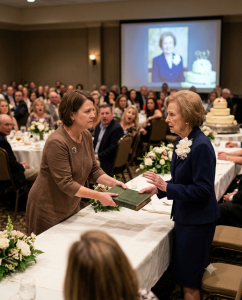
The night of the party, nearly two hundred people filled the ballroom. A slideshow rotated through images of Lila smiling with students, accepting plaques, hugging teachers, cutting ribbons. Her career was arranged on poster boards and projector screens like evidence for the defense.
Darlene arrived in a simple brown dress with Ruth’s silver brooch pinned at the collar and the green ledger tucked under her arm. Some people noticed the book and looked away quickly, as if recognizing it from previous glimpses they had never bothered to understand.
Speeches began. Lila was praised as selfless, steady, gracious. When she thanked “my dear sister for standing by me through a difficult year,” several guests applauded.
Then Darlene stood up.
The silence that followed was not immediate. It rippled outward in layers. A chair scraped. Someone coughed. A server froze with a tray in his hands. Darlene walked to the front and placed the ledger on the head table beside Lila’s dessert plate.
“This won’t take long,” she said.
Lila smiled tightly. “Darlene, maybe after—”
“The right time was before you buried Mama under a forged will,” Darlene said.
The room changed.
Darlene opened the ledger and began with facts. Ruth’s hospital timeline. The morphine doses. The witness absence. Teresa’s affidavit. The speed of the sale. She did not dramatize any of it. She did not need to. Every page was measured, dated, and attached to something real.
When she held up the school reimbursement record proving one witness had been in Branson, someone near the back gasped aloud.
When Dale Mercer, the ranch foreman, rose to say Ruth had been too weak to sign anything that week, the mood in the room tipped from discomfort to shock.
Then Darlene unfolded the broker email.
Lila moved toward her, panic flashing through her face for the first time all evening. “You have no right—”
“I have every right,” Darlene said, and read the email out loud.
By the time she finished, no one was clapping for Lila anymore.
The superintendent stared at the tablecloth. The pastor looked physically ill. One of Lila’s oldest friends quietly sat back down as if her knees could no longer hold her.
Lila tried denial first. Then outrage. Then tears. But the ledger was too complete, and worse for her, Celeste Warren had already chosen that exact hour to step into the ballroom with a process server and two county investigators.
The gossip afterward would say the timing was theatrical.
It was.
Celeste handed Lila a civil complaint seeking to void the forged will, unwind the land transfer, and recover damages. The investigators requested that Lila and the former deputy clerk remain available for questioning concerning potential forgery, false notarization, filing of fraudulent instruments, and related misconduct.
Lila’s retirement party ended without cake.
The legal fight took months, because truth often does. The Tulsa investment group tried to argue they were good-faith purchasers, but internal broker correspondence showed they had reason to question the speed and irregularities of the sale. Faced with deeper exposure, they agreed to rescind and settle. The court invalidated the forged will. Ruth’s prior will, the legitimate one, was reinstated: the ranch passed equally to both daughters.
Lila’s half did not stay hers for long.
The court found she had obtained it through fraud. Through the settlement and subsequent judgment, her interest was effectively stripped and applied toward restitution, fees, and damages. Criminal charges followed. Teresa avoided prosecution by cooperating fully, but she lost her notary commission and much of her standing in town. The former deputy clerk resigned and later pled to reduced charges tied to improper handling of records. Lila, who had once stood before auditoriums praising honesty to children, accepted a plea deal that kept her out of prison but left her with a felony record, probation, and public disgrace.
That should have felt like triumph.
For Darlene, it mostly felt like weather after a tornado—clearer air over a ruined arrangement of things.
She got the ranch back. Not every part of it, not exactly as it had been, but the land remained in the family. The cattle operation took work to stabilize. There were legal fees, repairs delayed during the sale fight, fences neglected, contracts to unwind. Dale stayed on. Darlene’s son began helping on weekends. A year later, there were calves in the north pasture again.
One evening, near sunset, Darlene sat on the porch swing with the green ledger on her lap.
She turned to the final page.
Not the evidence pages, not the affidavits, not the receipts. A blank page she had saved without knowing why. After a long time, she wrote a single sentence.
Mama was right about the land, but wrong about one thing. Blood does not always protect blood.
Then she closed the book.
People in town still talk about that retirement party. Some say Lila got what she deserved. Others say public humiliation was cruel, no matter what she did. A few insist family matters should have stayed private, though none of them can explain why privacy always seems to benefit the person who lied first.
As for Darlene, she never gives speeches about it.
If asked, she only says that numbers matter, dates matter, records matter, and silence is not the same thing as surrender.
Then she looks out over Ruth Harrow’s Oklahoma pasture, where evening light still settles on the grass like something that cannot be forged, and lets people decide for themselves what the biggest red flag was: the fake will, the rushed sale, the polished smile—or the fact that everyone found Lila easier to believe simply because Darlene was quiet.