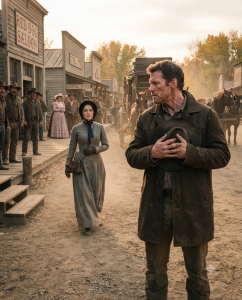
By Thursday afternoon, Cedar Hollow had the feel of a place waiting for a public hanging.
Nothing official had been called, no bell had rung, no lawman had posted a notice, but everyone in town sensed entertainment on the wind. Curtains shifted in parlor windows. Men leaned out of the saloon doors pretending to cool off. Women slowed outside the general store and adjusted shawls and baskets they did not need to adjust. A pair of boys climbed onto an empty wagon for a better view.
The stagecoach from the east had arrived.
And on that coach was the woman almost no one believed truly existed.
The blacksmith’s bride.
For eleven years, Cedar Hollow had spoken of Eli Brennan with the same ugly certainty people reserve for weather and funerals.
No woman would ever marry him.
They said it over coffee, over fence posts, in church yards, by the pump, under their breath and sometimes to his face. They said it after the fire, when the right side of his face was left ridged and pale, when one ear pulled strangely against the scar tissue, when the handsome black-haired boy who had once turned heads at harvest dances became the man children were warned not to stare at.
At first, Eli had fought the shame. He had tried looking people in the eye. He had tried speaking before others could whisper. He had even gone once to a church social two years after the fire, standing there in a clean shirt while conversations curled away from him like smoke.
After that, he had stopped trying.
The forge became his whole life.
By thirty-eight, Eli was the kind of man who could lift a wagon wheel alone, shoe a nervous horse without getting kicked, and judge iron by sound the way other men judged music. He worked before dawn and after dusk. Ranchers from miles away depended on him for plow blades, hinges, hardware, shoeing, custom repairs, and quick fixes no one else in the valley could manage. Cedar Hollow needed him the way a body needs its hands.
But need is not the same as kindness.
People paid him without warmth and thanked him without looking at him. Some left the coins on the bench rather than place them in his palm. When strangers asked who the blacksmith was, the townsfolk lowered their voices and made a story of his face before mentioning his name.
That was why, when word spread that Eli Brennan had answered an advertisement for a wife and had exchanged letters with a widow in Boston for nearly six months, no one believed it would end in marriage. Curiosity, maybe. Pity, perhaps. But marriage? Not once she saw him. Not once she stepped down and realized what waited at the curb.
So the town came to watch.
Eli had gone to meet the coach anyway, because even if humiliation was waiting, it was his to meet standing up.
He had scrubbed his face with cold well water until the left side went red and raw. He had combed his dark hair with more care than he had used in years. He wore his best coat, though the cuffs were shiny with age, and he held his hat so tightly in both hands he could feel the brim beginning to bend. He had considered, more than once that morning, not going at all. He could have left a wagon. He could have asked the driver to bring her to the house. He could have spared himself the sight of recognition turning to revulsion.
But he knew that kind of cowardice would stay with him longer than any insult.
So he waited.
When the stagecoach door opened, a hush moved through the crowd.
Margaret Sullivan appeared slowly, one gloved hand gripping the frame before she stepped down. She wore a gray travel dress practical enough to show she had no illusions about frontier life. Dust dulled the hem. Strands of chestnut hair had escaped beneath her bonnet. There was tiredness in the set of her shoulders, but not weakness. She was thirty-four, with a face that would not have made a painter famous and eyes that might have frightened a liar into confession.
She stood beside the coach and looked around once.
In that one sweep of observation, she understood more than most strangers would have in a week.
The gathered faces. The brittle smiles. The men pretending not to wait for something amusing. The distance between the crowd and the broad-shouldered man standing apart from everyone else.
Then came the muttering.
One of the saloon regulars, half drunk and eager for cruelty, said, “Wait till she sees the whole of him.”
A second man laughed.
Margaret never gave them the courtesy of a glance.
Instead, she looked at Eli Brennan.
He stood very still at the edge of the road, hat in hand, every line of his body braced. The left side of his face was strong and weathered, the jaw stubborn, the eyes guarded. The right side bore the fire’s history in pale, ridged skin that pulled from cheek to ear and down into the collar. It was a harsh sight, yes. But what struck Margaret first was not the injury.
It was the expectation in him.
He had prepared himself to be hurt.
She crossed the street.
Later, half the town would claim that was the moment Cedar Hollow shifted on its hinges. Not because a woman walked across a road, but because she did it without hesitation.
She stopped in front of him and looked directly at his face, all of it, steadily enough that Eli nearly forgot to breathe. He waited for pity. He waited for the flicker of disgust people always tried and failed to hide. He waited for the careful kindness that was often worse than either.
He found none of it.
Instead, she held out her hand.
“Mr. Brennan, I’m Margaret Sullivan. You wrote me an honest letter. I’ve come a long way trusting that honesty.”
For one embarrassing instant, Eli could not make sense of the words. Then he caught himself, shifted his hat awkwardly, and took her hand with the kind of care a man uses when he is afraid anything human and decent might vanish if he grips too tightly.
“Ma’am,” he said, the word scraping out of him. “Your trunk is there. I brought a wagon. The house is up the hill.”
She gave the smallest nod, as if that arrangement suited her perfectly.
“Then let’s go home,” she said. “And on the way, you can tell me what a blacksmith eats, because I intend to improve it.”
A few men at the saloon looked as though someone had slapped them.
Eli loaded her trunk in silence. Margaret climbed into the wagon. When he took the reins, his hands were less steady than they had ever been in a forge full of sparks.
The house stood on a rise behind the blacksmith shop, plain and weather-beaten but swept clean. Margaret saw the signs of effort everywhere. Fresh kindling stacked dry by the door. A washbasin filled with clean water. A table scrubbed hard enough to pale the wood. A single jar of late wildflowers, bent and half-wilted, standing in the middle like an apology dressed as welcome.
“It isn’t much,” Eli said.
Margaret touched the flowers gently.
“It’s more than I’ve had in years.”
That answer told him as much about her as any letter had.
Over the supper he had plainly worried over, Margaret learned the shape of his quiet. He asked practical questions first. Did she have enough blankets for the night? Was the ride tolerable? Did she prefer tea or coffee in the morning? Every kindness came out plain and unadorned, as though tenderness was something he did not trust himself to decorate.
In turn, Eli learned that Margaret had once lived in a narrow Boston street where wagon wheels rattled till midnight and privacy was thinner than boardinghouse walls. He learned she had been widowed after nursing a husband through a long sickness that left her with debts and no family eager to share them. He learned she had answered his advertisement not out of romance, but because his letters lacked the one thing she had come to despise most in men: performance. He had not promised easy happiness or false gentleness. He had written that he worked hard, lived simply, had scars that drew stares, and wanted a wife he would never lie to.
By candlelight, that honesty looked almost dangerous in its rarity.
They married on Sunday.
There was no grand celebration, only a traveling preacher, two reluctant witnesses, and a church full of people who came less to bless the union than to see whether it truly happened. Margaret wore the same gray dress. Eli stood beside her in a clean shirt with shoulders that looked fit to carry oxen and a face tense with disbelief. When it came time for vows, his voice trembled. Not one or two words. Every word.
Margaret took his hand before the preacher even pronounced them husband and wife.
The gesture traveled through Cedar Hollow faster than any sermon.
Marriage did not make the town kind, but it changed the terms of its cruelty. No longer could people pity the poor blacksmith who had no chance. Now they could test the woman foolish enough to choose him.
Margaret met that test the way she met most things: quietly, and without surrender.
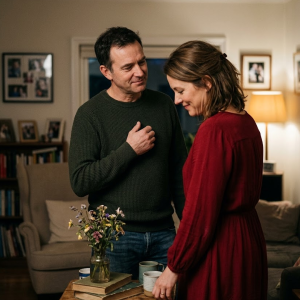
She hung curtains in the little house and scrubbed the floorboards until they shone. She baked bread that filled the rooms with warmth. She patched Eli’s work shirts with such neat, stubborn stitches that he kept touching the repairs as if they were foreign miracles. She learned the rhythm of the forge and the way his mood changed with the day’s labor. When a difficult job went badly, he grew quieter. When a customer praised the work without glancing up, the silence settled deeper.
At supper they did not speak much at first. Eli had spent too many years alone to know how to fill a room with ordinary talk. But Margaret noticed that he looked at her when he thought she was occupied. She noticed he left the larger potato on her plate. She noticed he chopped extra wood without being asked on windy evenings and rose in the night once to make certain the shutters were latched during rain.
Kindness, she knew, often speaks before comfort does.
The first person in Cedar Hollow to treat Eli without even a trace of caution was not an adult.
It was Sadie Mercer, seven years old, skinny as a fence rail, and possessed of that terrifying honesty only children and drunks carry without shame.
Sadie was the daughter of Hannah Mercer, the widow who kept the boardinghouse near the far end of town. Perhaps because life had given her little room for fantasy, Sadie preferred things she could watch happen with her own eyes. The forge fascinated her. She loved the roar when Eli opened the fire, the heavy clang that shook the floor, the sparks that burst upward like gold insects.
One day she wandered too close, and Margaret came hurrying over, only to stop short at the sight before her.
Eli had crouched down to Sadie’s height and was explaining the bellows. His large scarred hand guided the girl’s smaller one over the handle, careful as a teacher. Sadie listened with fierce concentration.
“Aren’t you scared?” another child hissed from outside.
Sadie looked back, insulted by the stupidity of the question.
“Of what?”
“Of him.”
She studied Eli’s face as if seeing a horse, a cupboard, or a weather vane.
“He makes tiny iron ponies,” she declared. “That’s not something monsters do.”
Eli went absolutely still.
Margaret did not mention it until evening, when they sat over soup while wind pressed at the windows.
“She wasn’t afraid of you,” she said.
He stared into the bowl. “No.”
“Children usually see what’s there. Adults see whatever story makes them feel safer.”
His mouth moved in something that almost became a smile and then retreated.
Cedar Hollow might have gone on in that uneasy peace a while longer if not for Tom Ackerley.
Tom owned more cattle than anyone in the valley and believed this fact made him a better class of human being. He was broad in the belly, loud in public, stingy in private, and famous for delaying payment to anyone who worked for him. Men endured him because he had money. Women avoided being alone with him because money was not his worst quality.
He came to the forge one raw afternoon in a fury over a repaired wagon part and began arguing before he was fully through the door.
“You’re overcharging,” he barked.
Eli, who had learned patience the hard way, wiped his hands and named the price again.
Tom’s voice rose. “I should’ve known better than to deal with a man branded by fire. My grandmother always said when flames touch a man’s face, they pull the evil out where everyone can see it.”
The words were ugly enough. But then his gaze slid toward Margaret, who had stepped outside at the noise.
“And you,” he said with a smirk, “Boston must have been hard on you if this is what you settled for.”
Eli’s expression closed like a door. He took one step forward, but Margaret was quicker.
She crossed the space between them with terrible calm.
“My husband has that face,” she said clearly, “because he ran back into a burning barn to save animals that belonged to other people while healthier men stood outside and watched. What you call a mark is courage burned into the skin.”
Tom laughed once, uncertain now.
Margaret did not stop.
“You will pay him what you owe, Mr. Ackerley, or you will announce to everyone on this street that the only time you feel brave is when you insult a man better than yourself.”
There are moments when a crowd changes sides not because it has grown moral, but because someone has named the truth too plainly to evade. This was one of them.
Every face on the street turned toward Tom.
Red climbed his neck. He reached for his wallet, slammed the money onto the bench, and left without meeting anyone’s eyes.
That night, after supper had gone cold between them, Eli said, “You didn’t have to do that.”
Margaret set down her fork.
“That is exactly why I did.”
He looked up slowly.
“I did not come to Montana to be tolerated,” she said. “And I will not watch people treat my husband like a burden they are generous enough to endure.”
He stared at her a long moment. Then, with visible care, he turned his hand under hers and laced their fingers together.
For Eli Brennan, that small motion carried more vulnerability than a speech.
Had the story ended there, Cedar Hollow might have remembered it as the season the blacksmith’s wife taught the town a lesson.
But meanness tied to pride rarely ends with embarrassment.
The next morning, before the sun was fully over the hills, pounding shook the Brennans’ door. Margaret rose at once, wrapping a shawl over her nightdress. When she opened the door, she found a local stable boy and Sadie Mercer, barefoot in the dirt, crying so hard she could barely form the words.
“It’s Mama,” Sadie sobbed. “She won’t wake up.”
Within minutes, Eli had harnessed the wagon.
The boardinghouse kitchen smelled of burnt porridge and panic. Hannah Mercer lay collapsed near the stove, skin burning with fever, lips dry, one hand still wrapped around a scorched dish towel as though she had tried to finish working after her strength failed. And standing near the table, behaving as though the inconvenience to his breakfast mattered more than the woman on the floor, was Tom Ackerley.
Margaret knelt beside Hannah and touched her forehead. The heat was alarming.
“She needs a doctor now.”
Tom gave a short, contemptuous laugh. “And who’s paying for that? She owes me already.”
Margaret looked up sharply. “For what?”
He tapped the folded paper on the table.
That was when she noticed it.
A document. Legal. Fresh ink. Hannah Mercer’s boardinghouse listed as collateral against a debt. Margaret reached for it, but Tom moved his hand first.
“She borrowed feed, supplies, cash in winter,” he said. “Couldn’t keep up. It happens.”
Hannah stirred faintly at that, enough for Margaret to see terror flicker behind the fever.
Eli had been standing near the door, filling the room simply by occupying it. Now he stepped forward.
“You’ll send for the doctor,” he said.
Tom sneered. “Make me.”
Eli did not raise his voice. That made the silence more dangerous.
“If she dies after working herself sick while you stand here counting what grief might buy you,” he said, “every man in this valley will know what kind of coward you are.”
Tom opened his mouth and then closed it again. Perhaps for the first time, he understood that humiliation before a street crowd was one thing. Being named a predator over a sick widow and her child was another. The stable boy was already staring. So was Mrs. Pike from across the way. People were gathering in the doorway.
Tom cursed and jerked his head at the boy.
“Go get the doctor.”
The boy ran.
Margaret and Eli carried Hannah upstairs. During the next hour, while they sponged her forehead and coaxed water between her lips, pieces of the truth began to form. Hannah had borrowed modestly in winter, yes, but not enough to forfeit the whole property. Tom had altered terms after her last payment fell behind. He had told her she could catch up by cooking for his hired men without charging extra. He had sent over sacks lighter than billed and marked them full price. He had threatened quiet eviction if she spoke against him before the debt was settled.
Worst of all, if Hannah died before naming the fraud, Sadie would have nothing.
By noon the doctor confirmed the widow had been driven into collapse by fever and exhaustion. She might survive, but only if she rested for weeks. Weeks she could not afford.
Margaret stood in the narrow upstairs hall, looking from the sickroom door to the stairwell below where Tom’s voice drifted up in oily fragments as he argued his rights to the property.
Something inside her hardened.
She went downstairs and took the paper from the table before he could stop her.
“You have no right,” he snapped.
“I have eyes,” she replied.
She read more slowly than he liked, and that made him reckless. By the time he realized it, he had admitted too much. The interest rate had changed after the original agreement. The fee columns did not match the amounts Hannah remembered. A witness signature belonged to a ranch hand in Tom’s employ, not a neutral party. Several dates overlapped impossibly with days Tom himself had been out of town buying stock.
Margaret looked up from the paper.
“This won’t hold if it reaches a judge.”
Tom’s expression shifted. “There isn’t a judge here.”
“No,” said Eli from the doorway. “But there’s a preacher who reads legal forms, a doctor who knows when a woman has been worked nearly to death, and a town full of men who don’t want anyone sniffing around their own accounts next.”
By then the room had filled. The doctor had stayed. Mrs. Pike had brought broth. Two ranch hands from neighboring spreads stood near the wall, their faces uneasy. Even the general store owner had edged inside. Tom saw what was happening a second too late. His power had depended on private fear. Public scrutiny made him smaller by the minute.
Hannah, pale but conscious now, called weakly from the stairs that she had never agreed to the revised terms.
Tom turned toward the sound.
Margaret saw the flash in his eyes before anyone else did. It was the look of a man who realizes he is losing control and would rather frighten everyone back into silence than surrender gracefully.
He took one hard step toward the stairs.
Eli was faster.
He caught Tom by the coatfront and shoved him back against the wall so hard the framed calendar rattled loose.
No fist. No wild brawl. Just one immovable man pinning another in place with the strength of ten years spent bending iron.
“You will not go near her again,” Eli said.
Tom blustered. Threatened. Claimed defamation. Claimed debt. Claimed insult. But the room had changed around him. The doctor demanded to inspect the paper. The store owner, sensing which way survival lay, muttered that some of the dates did seem wrong. One of the ranch hands quietly admitted he had been asked to sign as witness after the fact. Another said Tom had bragged, drunk, that he would have the boardinghouse by first snow.
That was all it took.
By evening, Tom Ackerley’s authority had cracked wide open.
He left Cedar Hollow two days later under the pretense of business, but not before signing a withdrawal of claim under pressure from half the town and the threat of formal charges in the county seat. He sold off part of his cattle that winter to cover other debts people suddenly felt brave enough to press. Within a year, he was gone from the valley for good.
Hannah Mercer recovered slowly. Margaret organized meals before anyone could object. Eli repaired broken shutters and a kitchen hinge without charging a cent. Sadie resumed her visits to the forge as though she had always belonged there, and when Eli forged her a proper iron pony with a curved neck and proud little legs, she declared it finer than anything sold in a city shop.
As for Cedar Hollow, shame did what sermons never had.
People did not become saints overnight. Some never changed in their hearts at all. But they began, at last, to speak Eli Brennan’s name with respect when respect was due. Men looked him in the eye when paying. Women stopped lowering their voices when Margaret passed. Children learned quickly from the example set before them, and the story of the scarred blacksmith shifted from warning to legend.
Not because his face changed.
Because the truth around it finally did.
Years later, newcomers would hear the tale in pieces. They would hear about the woman from Boston who stepped off a stagecoach and crossed a street as if cruelty had no claim on her. They would hear about the blacksmith who had once run into a fire for animals that were not his and later stood between a widow and the man trying to strip her home away. They would hear about a little girl who trusted iron ponies more than gossip. And they would hear, always with a kind of reluctant admiration, that Cedar Hollow had once mistaken scars for corruption and found out too late that character leaves marks of its own.
On spring evenings, if the weather was mild, Eli and Margaret sometimes sat outside their house on the rise. The forge would be cooling. The valley would glow bronze in the last light. They did not need many words. Margaret mended. Eli carved bits of wood or simply watched the road.
Once, long after Tom had vanished and the town had settled into its new memory, Margaret caught Eli studying the horizon with that old guarded expression.
“What is it?” she asked.
He hesitated, then told the truth, as he always had.
“Sometimes I still expect it to go back the way it was.”
She laid her hand over his scarred one.
“It won’t,” she said. “Not entirely. People can be cruel longer than they can be decent. But once they’ve seen who someone really is, they can never unsee it without lying to themselves.”
He considered that.
“And if they do lie?”
Margaret smiled faintly. “Then at least now they know they’re lying.”
Eli looked at her for a long moment, the evening light touching both the ruined side of his face and the part that had survived untouched. Age had deepened the lines around his eyes. Work had roughened his hands even more. But something once absent lived there now in plain sight.
Peace.
Not the loud kind. Not the easy kind. The earned kind.
The kind built slowly by truth, defended at cost, and held onto by two people who understood exactly what loneliness had asked of them before they found each other.
In the end, that was what Cedar Hollow had failed to understand from the start. The greatest red flag had never been the face that frightened them. It was the ease with which they chose someone to despise. And the question that lingered long after Tom Ackerley was gone and Eli Brennan had become a man even his enemies respected was one no one liked answering aloud:
How many decent people had they nearly destroyed before they learned the difference between being marked and being monstrous?