They said Wanda Delacroix was too old, too quiet, and too ordinary to be dangerous.
That was the first mistake.
The second was assuming that a woman who had spent thirty-one years carrying other people’s secrets from mailbox to mailbox would not know how to keep one of her own until the exact moment it could do the most damage.
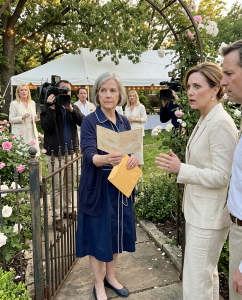
On the afternoon Wanda walked through the gate of the Hartwell-Brougham Annual Garden Party Fundraiser, nobody on that polished lawn saw a threat. They saw a woman in a navy dress with white piping, low church shoes, and a cardigan despite the warm Oklahoma air. They saw a manila envelope tucked under one arm and an old birthday card in her hand.
Most of them did not look twice.
But one woman did.
And the instant Celeste Hartwell-Brougham looked across the lawn and saw Wanda standing there, smiling faintly and holding that open card toward the camera, every drop of color drained from her face.
That reaction was what made people turn.
That reaction was what started the collapse.
Wanda had once known Celeste by another name.
Donna Pruett.
Forty years earlier they had shared a cramped dorm room at Northeastern State University, two broke girls trying to make adulthood out of hand-me-down clothes and grocery-store ramen. Back then Donna was quick, bright, funny in a way that made hard days feel survivable. She borrowed Wanda’s notes, Wanda’s shampoo, Wanda’s interview blazer, and sometimes Wanda’s certainty that things would work out in the end.
Wanda gave her trust the way young women often do when there is no room left for suspicion. They studied side by side, whispered late into the night, and traded details about their lives with the careless intimacy of people who think betrayal only happens in movies or newspaper stories.
Wanda told Donna things that later seemed impossible to have said aloud. Her mother’s maiden name. The street where she grew up. The nicknames her family used. Her first bank. Her little habits when choosing passwords and security answers. Small things. Harmless things. The sort of details nobody guards when they are twenty years old and believe loyalty is permanent.
After college they drifted, as people do.
A Christmas card one year. A phone call another. Then longer gaps. Then silence.
Wanda built a modest, steady life in Tulsa. She never became wealthy, but she became reliable, and there is a kind of dignity in that. She joined the United States Postal Service and stayed long enough to become part of the city’s unnoticed architecture. She sorted letters before dawn, memorized neighborhoods street by street, and learned to read lives through envelopes.
A lot of people think mail carriers just deliver paper.
They do not understand that paper records collapse the distance between what people say and what is true.
Wanda learned which homes were being refinanced, which sons wrote home from county jail, which daughters sent postcards from places they never intended to leave. She learned the names of widows, the barking patterns of dogs, the months when school debt notices started arriving, and the seasons when families pretended everything was normal until the certified letters began.
By the time Wanda reached her sixties, she had a bad knee, a dependable reputation, and the kind of retirement plan that was never going to make her rich but would keep her safe.
Or so she thought.
At sixty-three, she sat in an office to review her retirement account and was told there seemed to be a problem.
The young employee excused himself. Then another person came in. Then a manager.
The account had been accessed, redirected, and closed.
Not recently. Not by accident. Thoroughly.
The paperwork showed it had been handled under Wanda’s own identity credentials. The person responsible had answered every security question correctly, used the right personal identifiers, and moved the money in a way that was both deliberate and difficult to reverse.
Wanda sat still while they explained it because she had delivered enough bad news over the years to know that the first person who flinches in a room loses control of it.
She took notes.
She asked for copies.
She went home and locked the door.
At first there was the usual machinery of official concern. A fraud report. A complaint. An investigator. Calls she had to repeat herself on because different departments needed the story in different forms. Everyone was polite. Everyone was sorry. Nobody had anything useful to offer.
Then a name surfaced in Wanda’s mind with the clarity of a wound reopening.
Donna.
Who else knew enough to become Wanda on paper without forcing anything? Who else knew her answers before security questions had even become a modern ritual?
The investigators tried to trace Donna Pruett and found almost nothing. The identity seemed to vanish around 1991. Records went thin. Forwarding information turned stale. There was no obvious bridge to the present.
For a few days Wanda allowed herself to feel broken.
Then she got angry.
Not loud angry. Not dramatic angry.
Working angry.
She went to her kitchen table in Turley, brewed coffee, spread out every document she had been given, and looked at the mess until a shape began to emerge. If the authorities could not follow the line, she would. Not because she believed the system would suddenly become sharper, but because thirty-one years in the mail had trained her in one principle above all others:
Nothing disappears cleanly. It only gets buried under enough paper.
She started digging.
The first months were slow and humiliating. She filed Freedom of Information requests and got back pages so heavily redacted they looked like grief in black marker. She searched county deed transfers with eyes that ached by late afternoon. She called numbers that no longer belonged to the people she needed. She made lists of aliases, addresses, and possible timelines.
Some evenings she thought she was chasing a ghost.
Then an old thread would catch.
A forwarding order tied to a surname that looked unfamiliar until Wanda connected it to a relative. A marriage filing in another county. A property purchase under a middle name. A donation record from a local society listing “Celeste Hartwell-Brougham” beside a signature whose looping capital letters made something in Wanda’s chest tighten.
The name meant nothing to most people.
To Wanda, it felt like a mask held up to sunlight.
She kept building.
Her work history helped more than she had expected. People trusted Wanda because she had been part of their ordinary lives for decades. A former postal clerk remembered a reroute. A county employee slid a copy a little closer than policy probably allowed. A banker who used to wave when she delivered to his street told her where to look for old trust filings.
Nobody gave her a miracle.
They gave her fragments.
Wanda was the one who turned the fragments into a weapon.
During those two years, she also found the birthday card.
It was in a cardboard box under old church programs and expired appliance warranties, tucked between photographs and faded receipts from a life that had seemed too small to interest anybody. The envelope was soft at one corner from water damage. The postmark read June 1987.
Inside, Donna had written a simple message in blue ballpoint ink. Warm. Affectionate. Signed with her full name.
Donna Pruett.
Wanda read it once and sat down very slowly.
The card was not enough to prove every financial crime. It could not trace the money by itself. But it did something else. It stitched the vanished woman to the present one in a way no polished denial could survive. It was intimate evidence. Human evidence. The sort of thing a camera loved because it was impossible to explain away in a single sentence.
From then on, Wanda carried it in her cardigan pocket.
Her sister noticed. So did her neighbor Gloria. So did a woman from church who asked if Wanda was feeling alright. Wanda just smiled and said she was holding onto something for the right moment.
She did not say that some revenge is ruined by haste.
The right moment appeared in the society pages before it arrived in real life. The Hartwell-Brougham Annual Garden Party Fundraiser. Maple Ridge. Restored historic home. Benefit for the Tulsa Children’s Garden Society. Mayor attending. Local press invited.
Wanda read the announcement twice and clipped it out.
A public event. Good lighting. Important witnesses. A woman who had spent years manufacturing respectability now planning to display it on her own lawn.
Perfect.
On the day of the fundraiser, Wanda dressed with care. Navy dress. White piping. Sensible shoes. Clean cardigan. She packed the envelope with two years of records and tucked the birthday card into her pocket. On the drive over, she still had not fully decided which one she would lead with.
The envelope was the better legal strike.
The card was the better public one.
When she arrived, the lawn was already filling. Cream linen. floral centerpieces. Waiters circulating with trays of iced tea and sparkling water. A camera crew near the rose arbor collecting footage that would later be edited into ninety seconds of civic elegance.
No one stopped Wanda at the gate.
That, too, did not surprise her. People assume older women carrying papers belong somewhere official. She had watched that social reflex work like a master key for decades.
Then she saw Donna.
Celeste, as the city knew her now, stood with her husband, District Councilman Ray Brougham, greeting donors under the filtered light of the oak trees. She looked expensive in a way that had once seemed impossible for the girl from Muskogee. Cream linen dress, pearl earrings, controlled smile, perfect posture. The kind of woman magazines call gracious.
Wanda wondered, not for the first time, how many layers of theft and reinvention it had taken to build that image.
She crossed the lawn.
A woman in yellow saw her first, leaned toward Celeste, and pointed.
Celeste turned.
Everything that happened next unfolded in seconds but lived in Wanda’s memory as a string of individual frames: Donna’s smile collapsing. Her eyes fixing on Wanda’s face, then dropping to Wanda’s hands. The exact instant she recognized the birthday card. The way her shoulders locked. The way her husband looked at her, confused, when all color vanished from her skin.
Wanda slipped the envelope beneath her arm.
Then she raised the card with both hands so the writing faced outward.
The Channel 6 camera drifted in her direction, drawn by instinct before understanding.
“Good evening, Donna,” Wanda said.
The nearest guests went still.
Ray Brougham frowned. “Celeste?”
Wanda did not look at him. “No. Not Celeste. Not at first.”
Donna took one careful step toward her. “Wanda,” she said under her breath, “please.”
It was not an apology. It was a management voice. The voice of a woman trying to contain an event before it became real.
Wanda almost appreciated the nerve.
She opened the card wider and read aloud the line inside.
“To Wanda Delacroix, my truest friend—love always, Donna Pruett.”
The name hit the air like a dropped glass.
Ray looked at his wife. Really looked. “Donna?”
The whisper moved through the guests fast and ugly. Somebody near the arbor repeated the name. The reporter from Channel 6 started walking toward them with a microphone. Two donors edged closer without pretending not to listen.
Donna’s eyes flicked to the envelope under Wanda’s arm, and that was when Wanda knew she had won the first battle. Donna had understood what was in the file. She had understood that the card was only the public proof, not the full extent of Wanda’s work.
“Don’t touch that,” Donna snapped when Ray instinctively reached for the card.
The raw panic in her voice startled everyone nearby.
Ray pulled back. “What is going on?”
Wanda answered him before Donna could reshape the scene. “Ask your wife what name she used in Muskogee. Ask her how my retirement account was emptied using information only my college roommate would know.”
Ray’s face did something Wanda would later remember with complicated satisfaction. It hardened not into immediate belief, but into private terror. A politician’s husband recognized scandal before he recognized truth.
Donna lowered her voice. “We can discuss this somewhere else.”
“No,” Wanda said. “You discussed it somewhere else when you erased me on paper.”
The Channel 6 reporter was close enough now to hear every word.
Ray turned fully toward his wife. “Is your name Donna Pruett?”
Donna hesitated.
That hesitation was the death of Celeste Hartwell-Brougham as she had built her.
People who are innocent answer instantly.
Donna did not.
Instead she said, “Ray, let me explain.”
Wanda slid the manila envelope free and held it out—not to Donna, but to Ray.
“I spent two years finding what polite investigators couldn’t,” she said. “Property transfers, signatures, dates, filings, identity links. Enough to keep your family busy for a very long time.”
Donna lunged forward, not wildly, but fast enough to betray herself. Ray caught the envelope before she could snatch it.
“Wanda,” Donna said, and for the first time there was no polish left at all. “Please. We can fix this.”
Fix.
As if there were a repair for thirty years stolen under a different name.
Ray opened the envelope and looked at the top page. Then the next. His expression moved from confusion to disbelief to a colder understanding that made the skin around his mouth tighten.
“What is this?” he asked.
Donna did not answer.
He looked at the signature pages. He looked at the old name. He looked at his wife.
The reporter raised her microphone. “Councilman Brougham, is your wife being accused of identity fraud?”
That was the moment the crowd stopped being guests and became witnesses.
Donna tried one final pivot. She reached for Wanda’s elbow and whispered, “You don’t know everything.”
Wanda met her eyes. “I know enough.”
And then, because there are truths that deserve to be delivered cleanly, she said it so everyone nearest could hear:
“You took my future and used it to buy your own.”
The line landed harder than any legal document could.
Ray stepped away from his wife as if distance itself might save him. He flipped farther through the file, saw the account redirection details, saw timelines aligning with old name changes and new assets, saw enough to understand that even if every accusation had not yet been proven in court, the lie at the center of his marriage was real.
“Is any of this false?” he asked.
Donna looked around at the camera, the guests, the reporter, Wanda, the husband who no longer stood beside her, and finally at the birthday card still trembling in Wanda’s hand.
Her shoulders sagged.
“No,” she said.
It was barely above a whisper.
But microphones are built for moments exactly like that.
The rest unraveled quickly.
The reporter asked for comment. Ray refused and walked toward the house with the envelope. Two guests quietly left. One woman started crying from sheer secondhand shock. Donna tried to follow her husband, then stopped and turned back to Wanda with a face stripped of every social layer she had spent decades constructing.
“I was desperate,” she said.
Wanda considered that.
Maybe Donna had been desperate once. Maybe she had started with a lie she thought she could control. Maybe she had told herself she was borrowing time, borrowing identity, borrowing one life until she could build another.
But desperation might explain a decision.
It does not explain staying silent while the woman you betrayed ages into fear and uncertainty because of it.
It does not explain decades.
“It was my name,” Wanda said. “My money. My years.”
Donna’s mouth trembled, but Wanda no longer cared whether it was guilt or self-pity.
By Monday, the story was everywhere local. Questions about Celeste Hartwell-Brougham’s identity led to questions about finances, property, political disclosures, and charitable boards. The official investigations that had once drifted now moved with appetite. Banks returned calls. Attorneys sharpened interest. Ray Brougham retained counsel and issued a statement distancing himself from any personal wrongdoing. Within weeks, he filed for divorce.
The Children’s Garden Society asked Celeste to step down.
Then they announced she had resigned.
Then they removed her name from the website entirely.
The criminal side took longer, as these things do, but the paper trail Wanda had built proved exactly what she had hoped it would. Identity fraud. Financial theft. False statements attached to multiple records. Not every count landed at the highest level, and not every dollar was recoverable. The law is rarely as tidy as justice in the mind. But enough stuck.
Enough to end the fiction.
Enough to force Donna Pruett—Celeste Hartwell-Brougham no longer—to stand in public records under the name she had once tried to shed and answer for what she had done with the life she stole.
Months later, some funds were restored to Wanda through a combination of recovery actions and settlement orders. Not all. Time does not refund neatly. But Wanda’s future was no longer gone. Damaged, yes. Delayed, yes. Not erased.
People asked her afterward whether the confrontation at the party had been worth it.
She always paused before answering.
Not because she doubted herself, but because the truth was heavier than the question.
It had not made her feel triumphant in the simple way people imagine revenge feels. There had been no bright clean victory in it. She had not floated home lighter. She had gone back to Turley, taken off her shoes, set the birthday card on the table, and cried for the twenty-year-old girl who had once opened that card with trust in her hands.
What she felt was not joy.
It was restoration.
A line had been drawn back through the years. A lie had finally been made to stand in daylight.
She kept the card, though. Not because she needed the evidence anymore, but because it reminded her of the oldest truth in the whole story:
The most dangerous people are not always the loud ones. Sometimes they are the ones everyone overlooks. The ones who listen more than they speak. The ones who know the city, know the paper, know the patterns, and know exactly how long to wait.
Now and then, Wanda still wonders which moment mattered most. The theft itself. The years of silence. The look on Donna’s face when she saw the card. The instant Ray said her old name aloud. The whispered confession. The unraveling.
Or maybe it was much earlier than all of that.
Maybe the biggest red flag was never what Donna stole in the end, but what she learned so carefully in the beginning.
And maybe the hardest question is the one Wanda still cannot answer for herself:
If betrayal arrives wearing the face of the person you once trusted most, how early are you supposed to know the difference?