The monitors went dark at exactly 9:47 a.m., but the collapse had begun long before that.
By the time the screens in Studio B blinked to black, Carol Hensley had already spent a year arranging the truth with the precision of a woman who understood that facts, once properly shelved, become impossible to hide forever.
The host of Carolina Morning Live was still smiling when it happened. The “Woman of the Year” sash lay draped over her arm. Donna Reardon sat poised on the studio sofa in a cream blazer, radiant and composed, every inch the beloved bestselling author whose cookbook had charmed half the South. The audience had been clapping seconds earlier.
Then the monitors died.
The teleprompter went blank. The confidence screens darkened. A murmur moved through the room. The camera operators glanced up in confusion, waiting for instructions from a control room that had suddenly gone silent.
In that small pocket of disarray, one voice rose with remarkable calm.
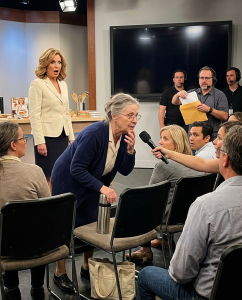
“Before you do that,” Carol Hensley said, leaning toward the host’s live microphone, “you might want to ask her what name is on the library card.”
The room froze around the sentence.
Donna’s smile didn’t fall. It locked in place, as though fear had reached up through her spine and turned her to glass.
Most people in the audience didn’t understand what had just happened. But people on the production team did, because several of them had already opened the sealed manila envelopes waiting for them backstage. They had seen copies of handwritten recipe cards, old letters, archived records, copyright filings, credit reports, and at the bottom of each packet, the same cream-colored library checkout card stamped with a single date:
September 12, 1987.
Borrower: Carol M. Hensley.
No one in the room knew that date mattered more than the title on Donna’s latest book or the sash in the host’s hand.
Except Carol.
And Donna.
Carol Hensley had never looked like someone destined for public confrontation. At sixty-one, recently retired from the Pack Square branch of the Buncombe County Library, she moved through the world quietly. She wore bifocals and practical shoes and always carried a thermos of black coffee. Her gray-streaked hair was usually pinned back without much thought. She had the steady, observant face of a woman who had spent decades helping other people find what they’d misplaced.
Friends described her as kind. Neighbors described her as reliable. Former coworkers described her as unflappable.
None of them would have called her dangerous.
But danger often hides inside patience.
The story between Carol and Donna had begun thirty years earlier at UNC Asheville. It was 1987, and they were first-year students in Governors Hall, both nineteen, both eager to invent themselves. Carol came from Weaverville, from a modest house where her mother kept stacks of handwritten recipe cards in a chipped ceramic box beside the stove. Food was how her family comforted, celebrated, apologized, and endured. Carol had grown up watching her mother turn ordinary ingredients into memory.
When she left for college, she brought those recipes with her.
Not because she planned to become a chef or a food writer, but because homesickness is easier to bear when you can smell your own history. On weekends, Carol would rig up dorm-room meals that somehow tasted real despite hot plates and bad equipment. She made biscuits in borrowed pans. She made soup from scratch. She wrote notes in the margins of her mother’s cards whenever she had to improvise.
Donna loved all of it.
She would sit cross-legged on the bed, knees tucked under her chin, and watch Carol cook as if it were a form of magic. She always laughed that she herself couldn’t boil water. She said she admired women who knew how to make something from nothing. She said Carol’s mother’s recipes felt like stories.
Carol believed her. Why wouldn’t she?
At nineteen, admiration feels like loyalty.
The friendship survived college for a while. Then adulthood, with its jobs and moves and marriages and debt and grief, stretched the space between them. They exchanged cards at Christmas for a few years. A few letters. Then less. Then almost nothing.
Carol became a librarian. Donna drifted through marketing, events, and local media circles, always reappearing in other people’s stories as someone charismatic, ambitious, and socially effortless.
Carol’s life was quieter. She married briefly, divorced, buried her mother, and went back to work. Years passed. Little administrative troubles crept into her life—credit issues, records mismatched under her name, a loan application she never submitted. Every time she fixed one problem, another appeared somewhere else. Not enough to destroy her, but enough to make her feel watched by bureaucracy itself.
She reported what she could. Nothing stuck.
Then came the afternoon in Brevard.
Carol was forty-three, wandering through a used bookstore on a rainy Saturday, when she pulled a worn copy of Joy of Cooking off a shelf and an old library checkout card slipped out from between the pages. She bent to pick it up, more amused than alarmed at first. Libraries had gone digital years earlier. Cards like that belonged to another era.
Then she saw the name.
Carol M. Hensley.
The date stamped across the card was September 12, 1987.
It unsettled her, but not enough. She tucked the card into the book and took it home. It sat in a drawer for years.
The true shock arrived in 2019, the year Donna Reardon published Sunday Table: Heirloom Recipes from the Heart of the South.
The cookbook was an instant hit. Reviewers praised its warmth, authenticity, and sense of tradition. Donna gave interviews about womanhood, memory, and the women who shaped her understanding of food. In every photo she looked luminous and confident, framed by flour-dusted counters and soft Southern light.
Carol bought the book because she recognized Donna’s face on the display table and felt a strange, reluctant curiosity.
She stood in the store and began turning pages.
By the time she finished the second chapter, she knew.
Not suspected. Knew.
The apple stack cake was her mother’s. The spoonbread. The green tomato chow-chow. The buttermilk pie. The blackberry cobbler with the same small sequencing error her mother always made when copying from memory. Recipe after recipe had been lifted, polished, and repackaged. The names had changed. The headnotes had changed. The soul of them had not.
Forty-seven recipes in all.
Carol didn’t cry in the store. She didn’t call anyone. She didn’t march into a lawyer’s office.
She went home, made coffee, opened a legal pad, and wrote one word across the top:
Archive.
That was the beginning of a year-long excavation.
Retirement had given Carol time. Librarianship had given her method. Grief had given her endurance.
She gathered original recipe cards in her mother’s handwriting. She found old family cookbooks with annotations. She tracked down a neglected copyright filing from 1989—something she and her mother had once attempted when a friend encouraged them to submit their recipes formally. It had gone nowhere, buried under illness and money worries.
She pulled old credit reports and saw patterns more clearly than she ever had before. Dates. Variations of her name. Addresses she never used. Overlapping timelines. She found a 1993 letter from Donna with a line that chilled her once she reread it in context: I always thought your mama’s recipes would make us famous someday.
The deeper Carol looked, the less it felt like a cookbook theft and the more it resembled a long theft of identity itself.
Then the checkout cards began appearing again.
One was tucked inside a copy of Donna’s cookbook at a bookstore in Asheville. Another was taped to a mirror in a hotel bathroom in Charlotte the morning after Donna gave a keynote speech. The most disturbing one arrived at Carol’s own front door before dawn in February, slipped under the threshold without a word.
Someone else knew what Donna had done.
Someone close enough to leave evidence where it would be found.
At first Carol feared it was a threat. Then she realized it was something else: pressure. Whoever it was didn’t want to expose Donna directly. They wanted Donna to feel exposed.
Carol had no idea why.
When she learned Donna would receive a “Woman of the Year” honor on Carolina Morning Live, she stopped waiting for answers. She requested a public audience ticket, then quietly confirmed which producers and network representatives would be in the building that morning. She prepared fourteen manila envelopes, each containing the same careful packet of evidence.
She arrived early. Delivered every envelope by hand. Took her seat in the third row.
Then came the blackout, the sentence, and the shockwave.
The host stared between Carol and Donna, suddenly aware that her cheerful final segment had become something far more dangerous. A producer opened his packet and went pale. The room no longer felt like a set. It felt like a courtroom where no one had prepared a defense.
“What library card?” the host asked, trying to keep her voice steady.
“The one from 1987,” Carol said, rising from her seat. “The one filed under my name. The same year my mother’s recipe cards disappeared from my dorm room. The same year my name started being useful to somebody else.”
Donna turned toward her slowly.
“Carol,” she said, and for a moment her voice contained the ghost of the nineteen-year-old girl she once was. “You were never supposed to keep that card.”
The audience let out a collective breath.
It wasn’t denial. It was something far more damning—familiarity, fear, and the casual assumption of a shared secret.
Carol’s expression barely changed. “I kept more than the card.”
Donna swallowed, and the poise began to fracture. “You don’t understand what happened after college.”
“No,” Carol replied. “I understand what happened to me.”
The exchange might have continued in circles if Donna hadn’t made one fatal mistake. She looked straight at Carol and asked, “Who’s been leaving them for you?”
Heads turned.
The question was too specific, too loaded. Innocent people didn’t ask who had been delivering evidence unless they already knew someone had it.
Before Carol could answer, a male voice broke across the studio from near the stage curtains.
“I am.”
A man stepped into view wearing an earpiece and a blazer, one hand clenched around another faded checkout card. He was in his fifties, pale with strain, recognizable to the staff immediately as Michael Voss, the senior segment producer who had booked Donna on the show three times and helped shape her on-air image.
Donna looked at him as if she’d stopped breathing.
Michael’s face held a fury so old it had clearly outlived shame.
“You don’t get to stand there and make her look crazy,” he said.
The host, now wholly abandoned by the script, whispered, “Michael… what is going on?”
He laughed once, harshly. “What’s going on? What’s going on is that thirty years ago Donna stole her roommate’s recipe box, started using her name on forms when it was convenient, and built half a life out of things that were never hers. And I know because I helped her bury it.”
The audience erupted into confused noise.
Donna stood. “You don’t know what you’re saying.”
“Yes, I do,” Michael snapped. “I know every word of it.”
Security appeared at the back of the studio, but no one moved. Not yet.
Michael took another step forward, eyes fixed on Donna. “You told me it was harmless at first. Just borrowing a credit history variation for an apartment. Just copying some recipe cards because nobody would care. Then later it was website registrations, test filings, old accounts, pieces of paperwork. You said it was all fixable.”
Carol felt the room tilt.
Michael saw it and turned toward her, his face softening for the first time. “I was twenty-four and stupid, and I was in love with her,” he said. “I worked in local promotions then. She knew I could get access to forms, records, and things people shouldn’t touch. She said it was temporary. She said you’d never be hurt.”
Donna’s voice sharpened. “Don’t you dare pretend you were manipulated. You enjoyed every bit of it.”
“Not after your mother died,” Michael said. “Not after the book.”
That changed something in the room. Until then, it had sounded like old fraud and old theft. The cookbook made it current. Public. Profitable.
Michael lifted the checkout card in his hand. “I found this when I was clearing storage after the network bought the old station archives. I recognized the name because yours kept showing up in weird paperwork years ago. Then Donna came on for the first cookbook segment, and I saw the recipes. I knew exactly what she’d done.”
He looked at Carol. “I was afraid to come to you. So I left the cards where you’d find them. I thought if you already knew, maybe you’d decide what to do.”
Carol stared at him, trying to reconcile the trembling man in front of her with the invisible ghost who had been nudging the truth toward daylight. Anger rose first. Then relief. Then the deeper fury of hearing what she had already suspected confirmed aloud.
Donna squared her shoulders, gathering fragments of control. “This is absurd. Recipes aren’t property. Families share them. Women pass them around. She’s turning memory into ownership because she’s bitter.”
Carol reached into her tote and removed a small stack of original cards bound with a faded rubber band. Even from several feet away, the blue handwriting was visible. She handed them to the host, who took them mechanically.
“Read the note at the bottom of the spoonbread card,” Carol said.
The host looked down and swallowed. “It says, ‘Donna asked for this again. Tell her not to skip the cream.’”
The room fell silent.
A tiny, domestic sentence. That was what broke the last of Donna’s version of reality. Not legal language. Not accusations. A note written by a woman long dead, casually recording that Donna had indeed been there, had indeed asked, had indeed learned these recipes from the Hensley kitchen and no other.
Donna’s face changed. The public smile disappeared entirely, and for an instant Carol saw the girl from 1987—not innocent, not warm, just hungry.
“You think I stole a life?” Donna said, voice shaking now with rage rather than fear. “You had no idea what your life looked like to anyone else. You had a mother who taught you things. A home people wanted to stay in. A name that meant safety. You don’t know what it was like to come from nothing and watch everyone trust you more when you sounded like her, cooked like her, borrowed from you.”
The confession hung in the studio, raw and ugly.
Carol answered quietly. “Coming from nothing is not permission.”
Donna laughed through tears she seemed startled to feel. “I made something of it. I made it matter.”
“No,” Carol said. “You made money from what mattered to someone else.”
At that point the network representatives stepped in. One asked Donna to remove her microphone. Another asked Michael to come with them. The host, visibly shaken, looked at the audience and then at the cameras still recording portions of the chaos. The segment had become unrecoverable, but the truth had gone too far to be folded back into silence.
What followed moved quickly. The show cut to an unscheduled break. Security escorted Donna and Michael off the set through separate exits. Carol remained where she was until a young producer approached her with tears in her eyes and asked whether she was all right.
Carol surprised herself by saying yes.
Not because she felt healed. Not because justice had neatly arrived in a television studio. But because the burden of private proof was no longer private.
Within days, the story broke beyond local television. The network suspended the segment and released a statement. Donna’s publisher announced an internal review. Food journalists began comparing recipes publicly. Former classmates surfaced with memories of Donna introducing dishes as “a friend’s family recipe” long before she claimed them as her own. Lawyers became involved. Civil claims followed. A state investigation reopened several fraud complaints tied to old identity records.
Michael Voss gave a formal statement and turned over documentation linking himself and Donna to earlier acts of identity misuse. His cooperation did not erase what he had done, but it transformed rumor into evidence. He lost his job. Donna lost more.
Within three months, Sunday Table was pulled from several major retailers. The publisher canceled future printings pending legal resolution and later agreed to a settlement with Carol that included a public acknowledgment, financial compensation, and the transfer of recipe rights connected to the disputed material. Donna was dropped from speaking events, awards lists, and televised appearances. Civil proceedings over identity-related damages stretched longer, but they no longer drifted in the realm of “unproven administrative errors.” They had names attached now.
Carol did something that surprised everyone who expected triumph to make her loud.
She stayed quiet.
Not hidden. Quiet.
She declined interviews beyond one brief written statement: My mother’s work belonged to the hands that made it, and the truth belonged to whoever was willing to carry it into the light.
Months later, a small independent press approached her about publishing a book of her mother’s recipes alongside the family stories behind them. At first Carol refused. Then she reconsidered, not because she wanted the spotlight but because she was tired of watching stolen things travel farther than the originals.
The book came out the following spring.
It did not explode onto bestseller lists. It did not become a national sensation. It found its readers slowly—through libraries, local shops, church groups, cooking circles, daughters buying copies for mothers and mothers buying copies for daughters. On the dedication page, Carol wrote simply: For my mother, who never mistook love for ownership, and never confused sharing with taking.
As for Donna, she issued one public apology through her attorney, though it read more like a statement crafted to contain damage than a true reckoning. There were rumors she had moved out of state. Some said she blamed Michael for everything. Some said she insisted Carol had ruined them both over “family recipes.” Carol stopped reading any mention of her.
The last time Carol saw Michael was in a lawyer’s office conference room. He looked older than he had on television, worn down by guilt and consequences. He tried to apologize. Carol listened. Then she said the only thing she felt sure of.
“You didn’t expose her for me,” she told him. “You exposed her because you finally got tired of carrying your part of it.”
He had no answer.
That, more than anything, helped Carol understand the shape of what had happened. Donna had not stolen her life because she admired it. She had stolen from it because she believed anything warm, rooted, or trusted could be taken apart and worn like a borrowed coat. Michael had helped because wanting someone can make cowards of people who mistake proximity for love.
Neither of them had understood what Carol eventually did: that the value of those recipes was never fame, never money, never branding. It was the life inside them. The mother who wrote notes in blue ink. The daughter who remembered them. The kitchen where memory was still an act of care rather than performance.
The television audience remembered the blackout. The line about the library card became the kind of local legend people repeat for years. But that wasn’t the moment Carol treasured most.
Her favorite moment came later, alone at her kitchen table on Kimberly Avenue. She opened a fresh copy of her own book, turned to the spoonbread recipe, and saw her mother’s note preserved on the page exactly as written:
Donna asked for this again. Tell her not to skip the cream.
Carol laughed then. Really laughed. Not because it was funny, exactly, but because the note had outlived the lie. A woman who never sought credit had left behind the sentence that unraveled a thief.
Sometimes justice arrives like thunder. Sometimes it arrives on old cardstock in a fading file system, then waits patiently for the right reader.
And if there was any aftershock left when the noise died down, it was this: plenty of people understood why Donna wanted what Carol had. A home. A mother’s wisdom. A name that felt safe. But wanting warmth is not the same as earning it, and envy can wear sincerity so convincingly that by the time the truth surfaces, the real question is no longer what was stolen.
It’s how many people saw the theft and called it success.